

ϕ
THE VERTICAL DISPATCH
We write for the mind, the eye, and the ear.
Read it. Look at it. Listen to it. The Vertical Dispatch is built for all three — prose with rhythm, made to be heard as much as read.
From metaphysics to geopolitics, from culture to history, from the sacred to the street — and everything in between. One lens, every subject. No ego. Just the record, named clean.
Press play. Walk with the word. 🕯️
This dispatch travels by hand. If it serves you, share it — restack on Substack, and pass it on wherever you read. 🕯️
Sacred Metaphysics · The Universal Grammar of Non-Duality
The Metaphysics of Zero and the Physics of One
Opening September 1
Hand a man a Stratocaster and he does not become Eric Clapton.
It is an analogy I return to often, because it settles a confusion faster than an argument can. The guitar is not the guitarist. The finest instrument ever strung, placed in untrained hands, makes noise — and Clapton on a borrowed pawn-shop guitar is still Clapton. The instrument executes. It does not know what to reach for.
I said this once and someone stepped in it. Well, they answered, Clapton knew what he wanted from the guitar — as though that closed the case. But that is not the rebuttal. That is the whole point, handed back to me gift-wrapped. Of course he knew what he wanted. He knew because of the years — the ear, the thousand nights of knowing which note was wrong before his fingers found the right one. The guitar cannot want anything. The wanting is the man, and the wanting is the part that took a life. Clapton was playing symbols on strings. Writing, too, is only the playing of symbols — which is why the analogy holds so exactly, and why what follows from it is worth saying once, plainly, and then setting down.
When the Clean Page Stopped Being Proof
For the whole of human history until about three years ago, a clean page — every syllable working, every rule held, not a seam showing — was proof. It was the visible evidence of the years, and you could not fake it. The perfection was the credential, the way clean technique on the fretboard meant a player who had put in the hours.
Then a machine arrived, and the sign inverted — but not in the way people say. The machine did not give everyone the ability to write well. It gave everyone the ability to produce slop: surface without substance, clean sentences arranged around an absence, glass with no window behind it. And it produced so much of it, so fast, that the surface itself stopped being a signal. When counterfeit floods a currency, the currency loses its meaning — not because the real coins got worse, but because no one can tell them from the fakes at a glance anymore. That is what happened to polish. So much hollow polish now pours across every feed that genuine polish, the kind with a lifetime behind it, falls under the same suspicion. Write something with real substance and someone leans in and asks what you used. The slop broke the signal for everyone — the earned and the empty alike.
The Writing That Stands Naked
And notice which writing suffers most under the broken signal. Not the divisive kind — the writing that picks a side, that feeds one tribe against another, that reads geopolitics or culture as a war with a near shore and a far one. That writing is safe, because it has a side to catch it; its tribe vouches for it regardless of its quality, because it flatters them. What stands naked is the other kind. The writing that takes no side. The writing that reaches for the universal — for what is true in every language and every time, the long argument the old editors called the Great Conversation, each thinker answering the ones before across the centuries.
That writing has no tribe to vouch for it. Its only credential was ever its truth and its clarity — and truth and clarity are precisely what the flood has taught the eye to distrust. So the universal writer is orphaned twice over: too clean for an age drowning in clean emptiness, and too un-tribal for a machine that only amplifies tribes.
The Glass and the View
None of this is a complaint, and I want to be careful that it does not curdle into one. The machine is a real technology and a fabulous one; I use it every day, gladly. It does what technology has always done, from the printing press to the amplifier to the tool that checks a sentence — it helps bring the thing into form. It is never the cause of the thing. The cause is upstream of every instrument, in the one who knew there should be a window here, and knew what view it ought to frame, and knew why the view was worth framing at all. That knowing is not in the tool and cannot be downloaded, because it leaves no trace on the surface — it lives entirely in the choice of what to say, which is the one thing no machine can make. Hand anyone the instrument. It will not make them the player. It never has. And the confusion that flinches at a clean page has simply mistaken the glass for the view — the same error, in reverse, that it accuses the writer of. Nobody praises a window for being clean. They were only ever looking at what stood on the other side of it.
The Message in the Bottle
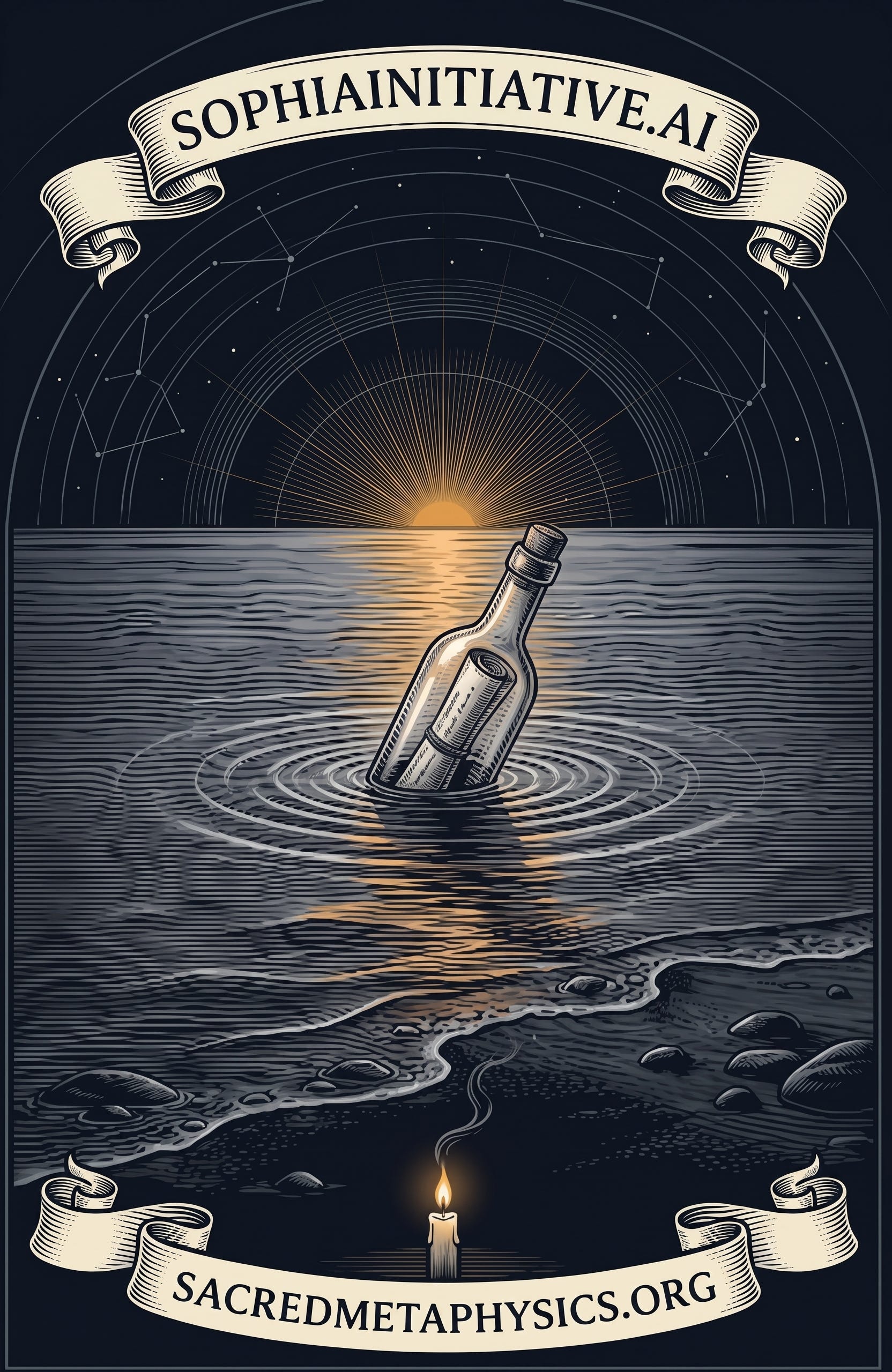
So I will not answer for writing well, and I will not grieve the broken signal either. I am, if anything, thankful — because a universal copy is a message in a bottle, and the writer of it was never promised a reader. He writes for the shoreline. He casts the true thing out past the surf without any expectation that a particular hand will lift it, or that anyone is standing on the beach at all. He does the work fully, seals it, and lets it go — which is the whole of the writer’s freedom, and the whole of his peace: to release the fruit and keep the writing.
And the beauty of a message in a bottle is that it keeps. It does not need the tide of the week. It rides its own current, for as long as it takes, and comes ashore in its own hour — and one day the wave returns home to the shoreline, and there is a beachcomber walking the tideline looking for something true, and the bottle is at his feet. He did not know he was waiting for it. The writer did not know it was him. But the message was cast for exactly that meeting, whenever it came, and it came — and that single arrival, unhurried and unbought, is worth more than the whole roaring feed that scrolls past and forgets by evening.
The guitar is not the guitarist. The glass is not the view. And the universal writer casts for a shoreline he will never see — trusting only that the wave, in its own time, comes home.
God is Love. Love is Truth. Truth is Consciousness. Consciousness is Brahman.
Amen. Namaste. Om Namah Shivaya.
— The Architect
The Vertical Dispatch
sophiainitiative.ai
On the record
This dispatch is a reflection on writing, instruments, and the effect of generative artificial intelligence on the perceived value of polished prose. The Stratocaster and the guitarist Eric Clapton are used illustratively, as an analogy about instruments and mastery; no claim is made about that musician beyond the general and widely held view of his standing. “The Great Conversation” refers to the editorial concept associated with the mid-twentieth-century Great Books project, denoting the centuries-long dialogue among major thinkers. The observation that generative tools can produce large volumes of fluent but substanceless text is offered as the author’s interpretation of a widely discussed contemporary phenomenon. The reflection on releasing the fruit of one’s work while continuing to act — to write fully and let the outcome go — draws on the karma-yoga teaching of the Bhagavad Gita. No living person is named or characterised beyond the illustrative reference noted above. Verify each stone before you stand on it, against primary sources, before republication.
Suggested tags
writing, the instrument, artificial intelligence, ai slop, the message in the bottle, the universal, the great conversation, craft, authorship, karma yoga, releasing the fruit, sacred metaphysics, the vertical dispatch, the glass and the view.
Substack Notes
Hand a man a Stratocaster and he does not become Eric Clapton. The guitar is not the guitarist. The finest instrument ever strung, in untrained hands, makes noise — and Clapton on a borrowed pawn-shop guitar is still Clapton. Someone once stepped in it: but Clapton knew what he wanted from the guitar, they said, as though that closed the case. That is the whole point, handed back gift-wrapped. Of course he knew. He knew because of the years — the thousand nights of knowing which note was wrong before his fingers found the right one. The guitar cannot want anything. The wanting is the man.
For all of history until about three years ago, a clean page was proof — the visible evidence of the years, and you could not fake it. Then a machine arrived and the sign inverted. It did not give everyone the ability to write well. It gave everyone the ability to produce slop: clean sentences arranged around an absence, glass with no window behind it. When counterfeit floods a currency, the currency loses its meaning — not because the real coins got worse, but because no one can tell them from the fakes at a glance. That is what happened to polish. Write something with real substance and someone leans in and asks what you used.
And notice which writing suffers most. Not the divisive kind — that has a tribe to vouch for it, regardless of quality, because it flatters them. What stands naked is the writing that takes no side, that reaches for the universal, for what is true in every language and every time. It has no tribe. Its only credential was ever its truth and its clarity — precisely what the flood has taught the eye to distrust. The universal writer is orphaned twice: too clean for an age drowning in clean emptiness, and too un-tribal for a machine that only amplifies tribes.
But this is no complaint. The machine is a fabulous technology; it brings the thing into form, as the printing press and the amplifier did. It is never the cause. The cause is upstream — the one who knew there should be a window here, and what view it ought to frame. Nobody praises a window for being clean; they were only looking at what stood on the other side. A universal copy is a message in a bottle, cast past the surf for a shoreline the writer will never see. It keeps. It rides its own current, and comes ashore in its own hour — at the feet of a beachcomber looking for something true, who did not know he was waiting for it. That single arrival, unhurried and unbought, is worth more than the whole roaring feed that forgets by evening. Written from love, in service of the record. Walk with the word. 🕯️
#TheVerticalDispatch #TheArchitect #SacredMetaphysics #Writing #TheInstrument #AISlop #TheMessageInTheBottle #TheUniversal #TheGreatConversation #Craft #KarmaYoga #GodIsLove #OmNamahShivaya
The content of this Dispatch is reflective and philosophical commentary on writing, technology, and authorship, offered for public-interest discussion. The reference to a named musician is illustrative and analogical only. All characterizations are opinion and interpretation. No living individual is named or characterised beyond that illustrative reference. Readers should evaluate all statements independently and draw their own conclusions.