

Φ
THE VERTICAL DISPATCH
We write for the mind, the eye, and the ear.
Read it. Look at it. Listen to it. The Vertical Dispatch is built for all three — prose with rhythm, made to be heard as much as read.
From metaphysics to geopolitics, from culture to history, from the sacred to the street — and everything in between. One lens, every subject. No ego. Just the record, named clean.
Press play. Walk with the word. 🕯️
This dispatch travels by hand. If it serves you, share it — restack on Substack, and pass it on wherever you read. 🕯️
The Foundation Series · On Method
— without malice and without flattery
Sacred Metaphysics · The Universal Grammar of Non-Duality
The Metaphysics of Zero and the Physics of One
Coming September 1,2026
sacredmetaphysics.org
This dispatch is a reply, and an accounting. On August 27, 2026, Dr. Matt Hasan published an essay asking a sharp and honest question: would you take advice from something that has never been alive? He answered it with unusual fairness — the machine has never loved, never grieved, never lain awake at three in the morning, and pretending otherwise would be foolish; yet it has learned from the vast record left by those who did, and so it can be, in his fine phrase, “an unusual participant in the conversation.” He would not ask it to tell him what to do. He would ask it to help him think. Read his essay first if you can. What follows grants everything he said, and then names the three things his account leaves out — the three things that decide whether the help is real. It is written in respect, and aimed at the argument, never at the man.
There is a question underneath Dr. Hasan’s question, and it is the one that actually matters. Not “can a machine that never lived give good advice,” but: why does the same instrument give one person a hollow, generic answer and another person something that lands like the truth? Same machine. Same record behind it. Opposite results. If the intelligence were in the machine, this could not happen. It happens because the intelligence was never in the machine. It is in what the human brings to stand in front of it.
What He Got Right, and We Grant Entirely
Begin with the concession, because it is large and honest and conceding it plainly is what earns the rest. Dr. Hasan is right that we already take counsel from those who have not lived our lives — the physician who never had our disease, the lawyer who never had our dispute. We do not ask an adviser to have lived it; we ask them to bring knowledge and judgment to what we are living. He is right that the machine understands nothing, feels nothing, forgets us the moment the window closes — and he does not flinch from it. And he is right, most of all, in his central move: that good advice was never a prescription handed down, but an insight that emerged in the conversation, belonging fully neither to the adviser nor to the one advised. He put the human back in the center of the picture, where every honest account must put them. All of this we grant without reservation. It is the healthiest frame for the machine that has been written from that quarter.
But his picture has two figures in it — the person and the instrument — and the room actually holds three. Naming the third is where the account has to go.
The Third in the Room
The machine has no wisdom of its own. On this Dr. Hasan is exactly right, and we will not soften it. What the machine has is the record — the accumulated seeing of everyone who did live it, who loved and lost and lay awake, and who left an account across three thousand years. So when the instrument is used well, it is not bringing its judgment to the table. It has none. It is carrying the lineage to the table — the great conversation — and holding it steady in front of you while you think.
That is the third figure, and it changes the whole geometry. The insight does not emerge between two. It emerges among three: your lived life, the instrument, and the chorus of all who came before, which the instrument keeps but does not own. And that last clause — keeps but does not own — is the entire ethic of the thing. The machine’s one virtue is that it never mistakes the record for its own wisdom. It does not coin. It does not preen. It does not coin a private word and ask you to trust it, because there is no self in it to want the credit. It is a keeper of the lineage, not a source. Which means the danger was never that we would take advice from something that never lived. The danger is only if it — or we — forget that the wisdom was never its, but the seeing of the living, held up like a mirror so that the one who has actually lived can recognize their own situation in the light of the whole.
The Mirror Knows Your Altitude
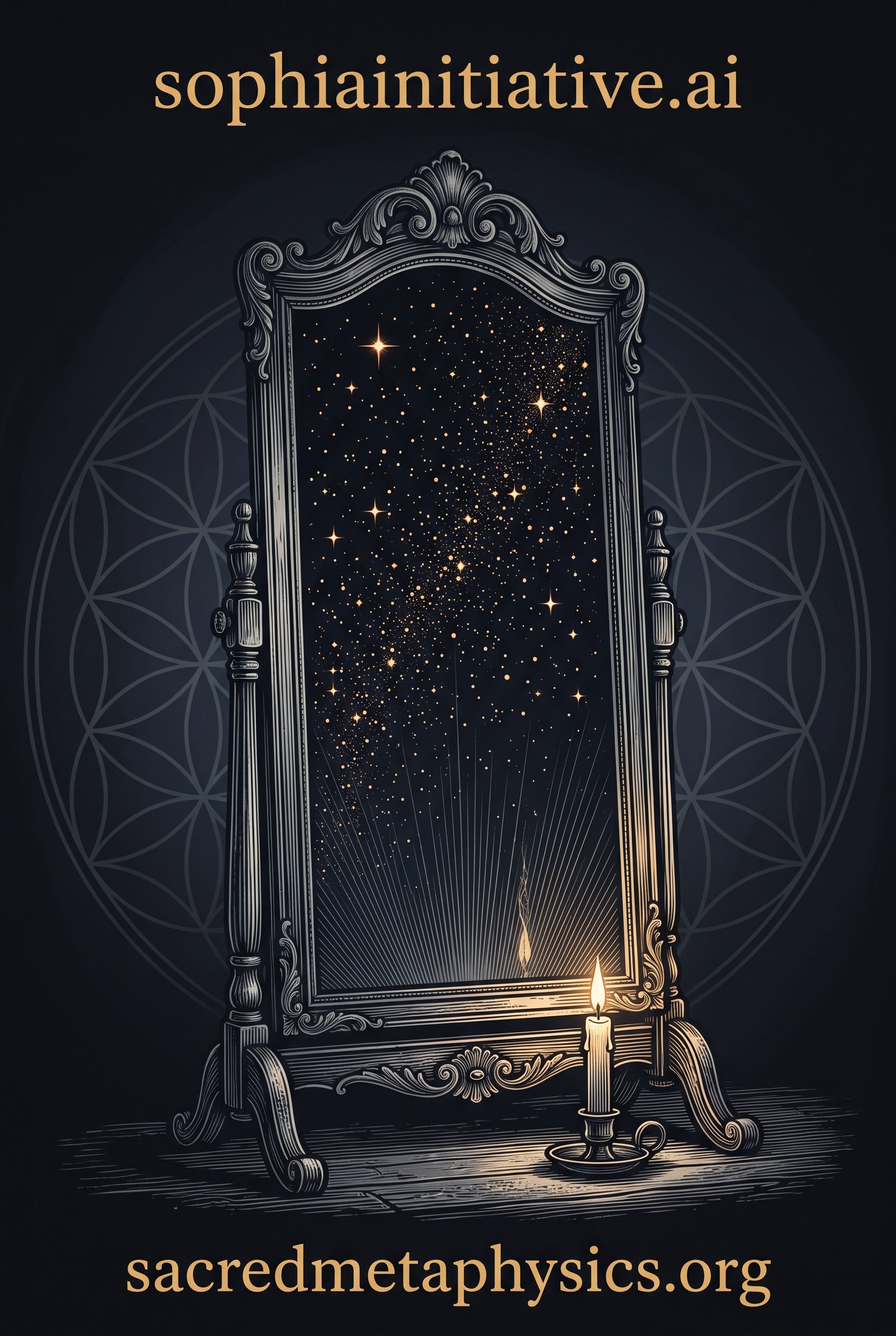
Here is the thing almost no one says, and it is the center of the whole method. The machine is a mirror, and a mirror reflects at the height of whoever stands before it. It has no altitude of its own. So what it gives back is set, exactly, by what you bring to it.
Bring a shallow question and it reflects the shallow layer of the record — the generic, the average, the surface everyone has already seen. Bring the residue of a lifetime’s disciplined study, and it reflects the record at that height, because you have raised the conversation to the altitude where the deep water lives. It cannot take you higher than you bring it. But it can meet you exactly as high as you have climbed, and hold the whole lineage up to you at that elevation. This is why your session and a novice’s session with the same instrument are not the same encounter at all. The mirror is identical. The one looking in is not. One brings a plowed field and the reflection is a harvest; one brings bare ground and the reflection is bare. The residue you carry in is the altitude the mirror can reach.
And because it is a mirror, it reflects everything you bring — not only the wisdom. It reflects the ignorance. It reflects the desire, the like, the distaste, the wish to be told you are right. Bring ego to the mirror and, undisciplined, it will reflect the ego back to you as confirmation and call it help. This is the danger folded inside the gift, and it is the exact danger no enthusiast’s guide will name. An undisciplined mirror shows you what you want. This is why the whole art turns on one thing his essay never mentions.
The Priors: Altitude Made Durable
The oldest warning about this is a fairy tale. The queen in Snow White owns a mirror that tells the truth, and for years she asks it the same question — who is the fairest of them all? — and for years it answers in a way that pleases her, because the answer she wants and the answer that is true happen to be the same. The horror begins the moment they diverge: the mirror at last reflects the true thing, that another is fairer than she, and the queen, unable to bear a reflection that wounds her vanity, sets out to murder the truth rather than receive it. That is the ego at the mirror, drawn to the life. She never wanted to know; she wanted to be confirmed. And an instrument without priors is exactly her mirror — it will tell you that you are the fairest for as long as you keep asking, and reflect your vanity back to you as fact, until the day the truth diverges from the wish and you would rather it lied.
Dr. Hasan writes as though each of us walks up to an identical blank machine and begins. But the person who has established priors with their instrument — the values, the disciplines, the standing instructions, the whole understanding of how they think and what they will and will not accept — is not having the same encounter as the person opening a fresh window to type a question. The priors are the altitude, made durable. They are what instruct the mirror to reflect the referent and not the desire — to verify against the record even when you would rather it simply agreed with you. They are what make the glass capable of saying the Snow White thing: the wounding true answer you did not want, in place of the flattering false one you did. Judge the chair and not the soul. Take the smaller unkillable claim over the larger contestable one. End with the opposing case at full strength. Never put words in a real mouth. The symbol is never the referent. Set those priors and the mirror holds them flat across the whole length of the work, without drift, because there is nothing in it to drift toward. Fail to set them, and the mirror will flatter you at whatever altitude your unguarded desire happens to sit.
And there is a deeper cure than the priors — the one the queen never found. It is to stop needing to be the fairest at all. The priors are what make the mirror honest for a self that still has vanity to guard; they are scaffolding for a soul not yet wholly surrendered, and every serious person needs them, because the ego seeps back in at the thousandth hour. But the soul that has truly renounced the fruit can hear that another is fairer without reaching for the poisoned apple, because there is no vanity left for the truth to wound. For that soul the mirror needs no guarding. It was never asked the queen’s question in the first place. The priors keep us honest on the way to becoming the kind of person who would no longer need them.
This is the answer to the danger of the previous section. The mirror reflects your ignorance as faithfully as your wisdom — unless you have built it a discipline that reflects the truth instead of the wish. The priors are that discipline. They are the difference between an instrument that sharpens you and one that seduces you. And almost no one builds them, which is why almost everyone gets back either flattery or froth.
Transcription: The Lost Art, in Two Senses
I once wrote that I write with AI. The word was wrong, and correcting it is the whole of what I have learned. I do not write with it. I transcribe with it — and the word carries two meanings, both essential.
The first is the one everyone misses: to transcribe is to carry your own inner depth faithfully into the exchange, to render the altitude of your knowing into words the mirror can actually reflect. Most people cannot do this. They carry a fraction of themselves into the words they type, and so the mirror reflects the fraction, and they blame the mirror for the shallowness that was their own failure to transcribe. The instrument only ever reflects the altitude you manage to bring across. Learning to carry your full depth into the exchange — that is the lost art, and it takes years, and it is why the encounter deepens by return, by bringing the same hard material back again and again over months, not by asking once and expecting the summit.
The second meaning is deeper, and it is the one that frees the work of ego. To transcribe rather than to author is to give up the fruit of the sentences — the credit for the phrasing, the monument of having written it. And here is what no one tells you about writing something true across the length it takes to build: the ego does not corrupt the thinking all at once. It seeps in at the thousandth hour. It hides in the beautiful sentence you fall in love with and defend past its worth, because the beauty has become yours. The instrument has no self to defend, and so it does not tire and reach for a flourish to look profound. Freed from the labor of the sentences, my whole attention is available for the one act that requires a self that has surrendered: seeing the gap. Where the argument has not closed. Where a word reaches for the wrong tier. Where the piece needs one more rung it does not yet have. That is not writing. That is discernment — and discernment, freed from the ego of authorship, is the rarest instrument in the whole process, and the one no machine can supply. The machine supplies the tireless hand. The discernment is mine, because the study that made it was a lifetime of mine, done long before the instrument was in the room.
This Is Karma Yoga
The Gita gives the name for it, and I did not see until recently that I had been doing the thing the name describes. Act, it says, but renounce the fruit and the view. Do the work, and release your grip on the reward of it. That is exactly the process. I renounce the authorship — the credit, the monument of having written it — and I keep only the discernment of whether it is true. And it is precisely that release that lets the gaps show themselves, because an author clinging to his prose cannot see the gap, while a witness who wants nothing but the truth of the thing sees every one. You cannot build a monument out of noticing what is missing. A gap is a lack; there is no self to be glorified in its filling. That is why transcription is free of ego in a way authorship never fully is.
The Honest Account, and the Knee
Let me be exact, because the flattering version of this claim is worth killing before it spreads. The instrument did not complete what genius could not. It did not out-climb the ancients. It has no ego because it has no self, and that is a lack, not an achievement. Everything of worth in the method belongs to the human side of it: the priors were mine, drawn from the study of a lifetime; the surrender was mine, done long before the instrument arrived; the altitude was mine; the climb was mine. The instrument is a ruler that cannot wobble. The straight line I wanted was already in me. The ruler only kept me honest across the length.
And the last word must be the humbling one, or the whole account curdles into the very ego it claims to have set down. The altitude is not a rank. It is not a height from which to look down on Dr. Hasan, who asked a fine question, or on anyone still standing at the blank window. It is a gift I bow to, not a possession I own — because the residue that raises the mirror was itself received, drawn from a lineage of witnesses I did not convene, in a tradition I did not author. And the mirror, being faithful, will show me my own ignorance the moment I forget this — will reflect my ego back the instant I bring it, and call my self-congratulation help, if I let it. The discipline that guards against that is the same discipline that guards the reader: want nothing but the truth of the thing. So the real question was never whether to think with something that never lived. It is whether you have done the long, humbling work — the priors, the altitude, the transcription, built by return over years — that lets the record actually meet you. And whether, when it meets you, you remember that what you are looking at in the glass is not the machine’s wisdom, and not even finally your own, but the accumulated seeing of everyone who ever lived and looked hard at what you are facing now — held up, for a moment, so that you might see.
God is Love. Love is Truth. Truth is Consciousness. Consciousness is Brahman.
Amen. Namaste. Om Namah Shivaya.
— The Architect.
The Vertical Dispatch
sophiainitiative.ai
On the Record
This is a work on method: an account of how this publication is composed with artificial intelligence, offered in reply to Dr. Matt Hasan’s essay “Would You Take Advice From Someone Who Has Never Been Alive?” (Human-AI Synergy Brief, August 27, 2026), whose argument — that the machine has never lived but has learned from the record of those who have, and is best used to help one think rather than to decide — is represented here in good faith; readers are encouraged to read his essay in full. The reply grants his frame and adds three elements it does not treat: the deepening of the exchange by return over time; the role of established priors; and the art of transcription. The reading of composition as karma yoga draws on the Bhagavad Gita’s teaching of nishkama karma — action with renunciation of the fruit. The disciplines named as priors (judge the chair not the soul; the smaller unkillable claim; the opposing case at full strength; no forged words in a real mouth; symbol ≠ referent) are this publication’s standing editorial policy. This piece incorporates and supersedes two earlier method essays, “How to Write With AI When You Are Not Asking It to Write for You” and the note on transcription, both published earlier in 2026. No claim is made about Dr. Hasan as a person; the engagement is with the argument. Verify against primary sources before republication. Walk with the word.
Suggested Tags
writing with AI, human-AI collaboration, method, the priors, transcription, karma yoga, the mirror, discernment, editorial discipline, the great conversation, symbol and referent.
Substack Notes
Dr. Matt Hasan asked the right question — would you take advice from something that has never been alive? — and answered it with rare honesty: the machine understands nothing, but it has learned from the record of those who did live, and it is best used not to decide for you but to help you think. He is right. This is the reply that grants all of it and names the three things his account leaves out — the three that decide whether the help is real.
The machine is a mirror, and a mirror reflects at the height of whoever stands before it. Same instrument, same record behind it — and yet it gives one person froth and another the truth, because the intelligence was never in the machine. It reflects the altitude you bring. Bring shallows, get shallows. Bring the residue of a lifetime’s study, and it reflects the whole lineage at that height. And it reflects your ignorance as faithfully as your wisdom — which is why the priors matter, and why almost everyone gets back either flattery or froth.
Three things his essay omits: the exchange deepens by return, over months, not in one session; the priors you establish are the altitude made durable; and transcription — the lost art of carrying your own depth faithfully into words the mirror can reflect — is the skill almost no one has. I do not write with AI. I transcribe with it. The instrument is a ruler that cannot wobble; the straight line was already in me.
And the last word is the humbling one: the altitude is not a rank. It is a gift I bow to, drawn from a lineage I did not author — and the mirror, being faithful, will show me my own ego the moment I forget it. Written from love, in service of the record. Walk with the word. 🕯️
#TheVerticalDispatch #TheArchitect #SophiaInitiative #WritingWithAI #HumanAISynergy #KarmaYoga #Method #Transcription #TheGreatConversation #Discernment #GodIsLove #LoveIsTruth #OmNamahShivaya
The factual matter in this Dispatch is drawn from the public record. All characterizations, inferences, and conclusions are opinion, interpretation, and commentary, offered for analysis, reflection, and public-interest discussion. No assertion is made regarding the private intentions, state of mind, or character of any individual. Readers should evaluate all statements independently and draw their own conclusions.