

Φ
THE VERTICAL DISPATCH
We write for the mind, the eye, and the ear.
Read it. Look at it. Listen to it. The Vertical Dispatch is built for all three — prose with rhythm, made to be heard as much as read.
From metaphysics to geopolitics, from culture to history, from the sacred to the street — and everything in between. One lens, every subject. No ego. Just the record, named clean.
Press play. Walk with the word. 🕯️
This dispatch travels by hand. If it serves you, share it — restack on Substack, and pass it on wherever you read. 🕯️
sacredmetaphysics.org
0protocol.ai
visva.world
sophiainitiative.ai
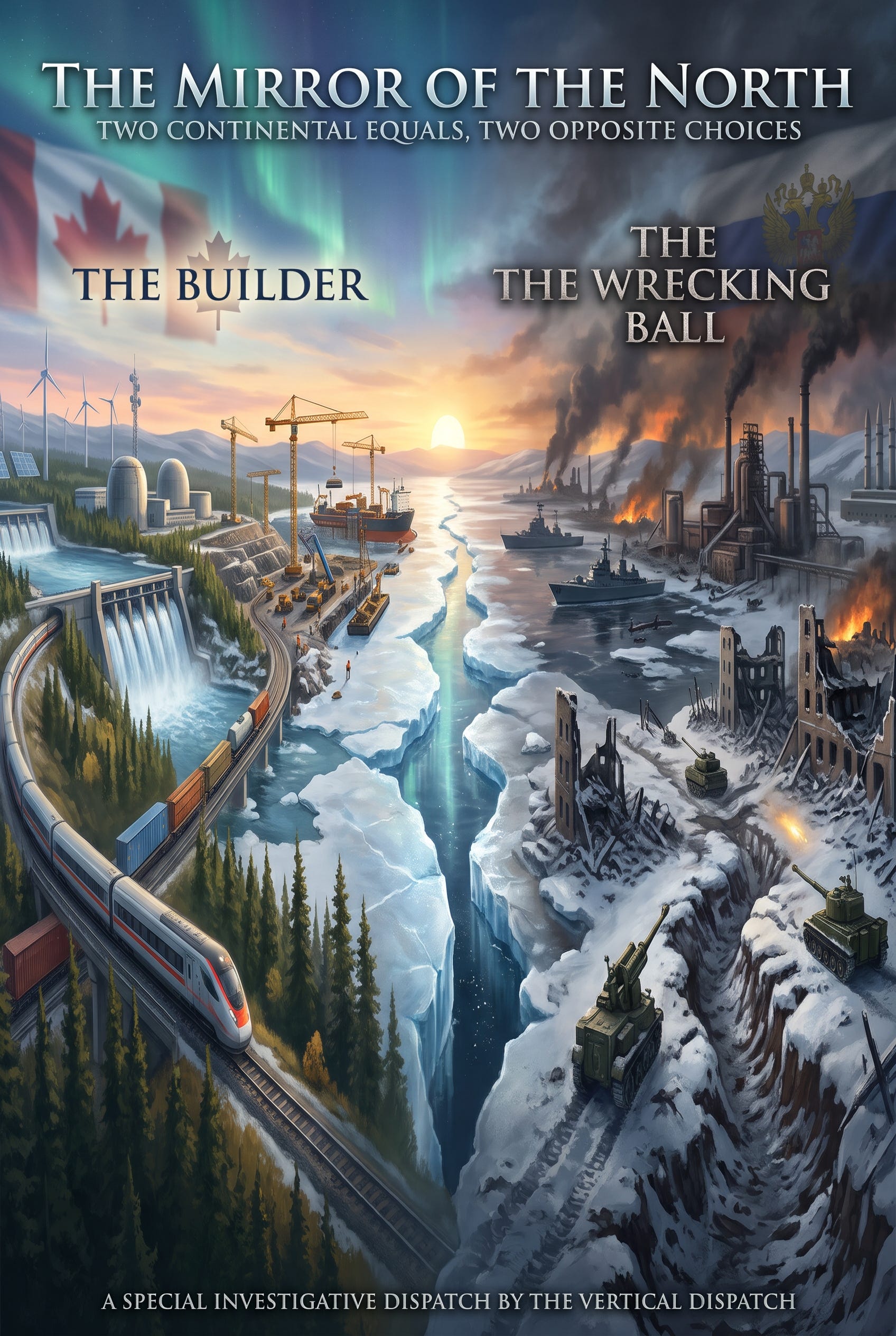
Place a map of the Northern Hemisphere flat on a table and trace the perimeter of the Arctic Circle. Two nations dominate the upper latitudes of the earth: Russia, spanning eleven time zones across northern Eurasia, and Canada, stretching across six time zones from the Atlantic to the Pacific and up to the frozen archipelago of the High Arctic. Together, these two countries govern more than a quarter of the planet’s landmass, hold its largest reserves of fresh water and boreal forest, and sit atop the critical minerals, hydrocarbons, and northern sea lanes that will define the twenty-first century.
Yet in the popular imagination of global media, these two nations occupy entirely different universes. Cable news networks and foreign policy journals cover Russia as a looming, existential colossus—a superpower capable of dictating terms to Europe and shaking global markets at will. The same outlets routinely treat Canada as a polite, secondary middle power, grateful merely to hold a seat at the table.
Step away from the television screens and examine the hard ledger of international economics, however, and that illusion dissolves. According to the International Monetary Fund’s late-2026 assessments, Russia’s nominal gross domestic product stands at $2.86 trillion, ranking eighth in the world. Canada’s nominal GDP stands at $2.49 trillion, ranking eleventh. Measured at market exchange rates, the total economic output of the Russian Federation exceeds that of Canada by barely fifteen percent.
They are not ideological enemies locked in a clash of equals, nor are they a giant and a minnow. They are material peers—two northern resource giants of comparable economic mass standing at the same historical crossroads. What separates them is neither geography nor wealth, but the fundamental purpose to which they put their power. Faced with the shattering of postwar trade orthodoxy in 2026, Canada chose the hard work of the builder. Russia chose the nihilism of the wrecking ball. And when one strips away the propaganda, only two material differences prevent the world from seeing them as peers: Russia’s inherited Soviet nuclear arsenal, and the Kremlin’s willingness to spend human lives without limit.
I. The Ledger of Equivalence
To understand the divergence between Ottawa and Moscow, one must first establish how remarkably similar their foundational endowments truly are. Both nations entered the modern era as sparsely populated continental expanses whose survival depended on mastering harsh climates, vast distances, and commodity extraction.
Look at the material base of both countries. Russia holds the world’s largest landmass at roughly seventeen million square kilometers; Canada ranks second at nearly ten million. Both nations border three oceans. Both possess immense reserves of oil, natural gas, timber, potash, nickel, uranium, gold, and rare earth elements. Both face the strategic opening of the Arctic Ocean as receding ice turns once-impassable waters into viable shipping corridors and contested resource basins.
Even on the macroeconomic balance sheet, the two countries operate in the same weight class. A nominal economy of $2.5 trillion to $2.9 trillion places both nations squarely in the second tier of global economic power—far behind the $32.6 trillion American colossus and the $21.5 trillion Chinese industrial engine, yet alongside Italy, Brazil, and France.
Beneath that headline parity, of course, lies a stark inversion in how each nation distributes its wealth. Russia achieves its $2.86 trillion output across a shrinking population of roughly 143 million people, yielding a nominal GDP per capita of just under $20,000. Canada generates its $2.49 trillion across a growing population of roughly 42 million citizens, producing a nominal GDP per capita exceeding $60,000. Even when economists adjust for Russia’s lower domestic prices through purchasing power parity, the average Canadian commands roughly a third more economic output than the average Russian.
Yet on the external stage—where nations buy influence, fund militaries, and project power across borders—nominal scale is what counts. Both Ottawa and Moscow command roughly two-and-a-half to three trillion dollars in annual economic mass. Both possess the raw materials the rest of the world needs to run its factories, heat its homes, and feed its populations. Given those parallel starting conditions, the question before any serious observer is straightforward: why does one country spend its capital constructing a global network of shared prosperity, while the other burns its wealth to leave craters across its neighbor’s soil?
II. The Architecture of the Builder
In 2026, Canada faced an external shock that could easily have driven a lesser government into nationalist retrenchment or economic panic. When Washington tore up decades of North American trade predictability with sweeping unilateral tariffs, Ottawa suddenly found its primary export artery under siege.
Rather than lashing out or retreating behind walls, Prime Minister Mark Carney treated the crisis as an engineering problem. Recognizing that a nation of forty-two million people cannot survive by bullying superpowers, Canada deployed its $2.49 trillion economy as an instrument of rapid, disciplined construction—both inside its own borders and across three oceans.
At home, Ottawa moved to eliminate the self-inflicted friction that had long fragmented its internal market. Through the One Canadian Economy Act, the federal government dismantled interprovincial trade barriers, harmonizing labor mobility and regulatory standards from British Columbia to Newfoundland. Simultaneously, the newly established Major Projects Office fast-tracked more than $125 billion in nation-building infrastructure—expanding hydroelectric capacity at Churchill Falls and Gull Island, advancing high-speed rail corridors, scaling nuclear power in Ontario, and opening critical mineral supply lines across the Canadian Shield. Instead of subsidizing decline, Ottawa directed generational capital toward sovereign artificial intelligence, clean energy grids, and export terminals.
Abroad, Canada practiced what Carney termed middle-power realism. Within a single year, Ottawa joined the European Union’s flagship defense procurement framework, launched the Canada-EU Alliance for the Future in Montréal, concluded landmark free-trade pacts across Southeast Asia and the Philippines, and expanded preferential market access to more than two billion consumers across sixty countries.
Every brick laid in this strategy served a constructive purpose. When Canada ships liquefied natural gas to Germany, uranium to Japan, or potash to Brazil, it creates mutual dependency anchored in law. Nobody dies when Canada expands its trade footprint. No cities burn, no borders shift by force, and no neighboring populations flee into exile. The builder’s logic is cumulative: each agreement strengthens the rule of law, lowers the cost of survival for partner nations, and proves that a mid-sized economy can secure its sovereignty by making itself indispensable to the peace of others.
III. The Mechanics of the Wrecking Ball
Now turn the lens toward Moscow. Possessing virtually the same nominal economic mass as Canada and an even richer inheritance of natural resources, the Kremlin looked at the twenty-first century and rejected every tenet of modern state-building.
Over the past quarter-century, Russia’s leadership systematically hollowed out its civilian economy. Instead of investing its windfall oil and gas revenues into universities, high-speed rail, domestic manufacturing, or sovereign technology, Moscow built a brittle extractive state designed to enrich a narrow security elite and fund a permanent war machine. Outside of raw commodities and state-subsidized weaponry, modern Russia produces almost nothing the global market wishes to purchase. Its benchmark interest rate sits at fourteen percent to contain wartime inflation, its civilian infrastructure decays across its provinces, and its economy relies heavily on Chinese industrial imports merely to keep its factories turning.
Unable to compete through innovation, trade, or living standards, the Kremlin discovered that a $2.86 trillion economy can still command the front pages of every newspaper on earth if it abandons all civilized restraint.
In international affairs, you do not need to be strong enough to build an empire in order to ruin your neighbor’s peace. A wrecking ball requires no architectural skill; it requires only mass, momentum, and indifference to the rubble it creates. By converting its industrial base into a factory for artillery shells, glide bombs, and ballistic missiles, Moscow traded long-term national prosperity for short-term destructive leverage. Where Canada uses critical minerals and energy to stabilize global supply chains, Russia weaponizes gas pipelines, grain blockades, and cyberattacks to induce inflation and political paralysis across Europe and the Global South.
IV. The Two True Differences
If one strips away the diplomatic theater, the historical grievances, and the daily noise of the news cycle, an uncomfortable truth emerges. Russia is not a peer competitor to the United States or China. Economically, it sits in the exact same tier as Canada and Italy. Conventionally, years of grinding attrition in Ukraine have exposed the severe limits of its ground forces, depleted its Soviet-era armor reserves, and neutralized its fleet in the Black Sea.
Only two material factors separate Russia’s geopolitical footprint from that of Canada.
The first is nuclear inheritance. When the Soviet Union collapsed in 1991, the Russian Federation inherited the world’s largest stockpile of nuclear warheads—an arsenal of roughly five thousand strategic and tactical weapons capable of extinguishing human civilization in an afternoon. That single legacy grants Moscow an artificial seat at the superpower table. Without those warheads resting in silos and submarines, a country with a $2.86 trillion economy and a shrinking population would command no more strategic deference in Washington or Beijing than Brazil or Italy. Nuclear parity acts as a permanent shield behind which the Kremlin can practice conventional aggression without fear of direct military retaliation from stronger powers.
The second difference is a boundless willingness to cause—and absorb—human death.
Modern democracies operate under a moral and political covenant: the state exists to preserve the lives, liberty, and prosperity of its citizens. In Canada, the loss of a single soldier abroad triggers national mourning, parliamentary scrutiny, and institutional accountability. To send half a million young Canadians to die in a muddy trench for a strip of foreign territory is not merely politically impossible; it is civilizationally unthinkable.
The Kremlin operates under the opposite premise. Over the past twenty years—and overwhelmingly since its full-scale invasion of Ukraine in 2022—Russia has absorbed roughly half a million military deaths and well over a million total casualties, exceeding the total combat deaths the United States suffered across all of World War II. By recruiting heavily from impoverished rural republics with massive cash payouts while insulating the urban middle classes of Moscow and St. Petersburg, the Russian state has industrialized human expendability. It treats its own men as raw ammunition and its neighbor’s civilians as legitimate targets.
In geopolitics, a mid-sized economy willing to feed hundreds of thousands of its own citizens into a meat grinder—while leveling entire cities across its border—will always dominate the headlines over a wealthy democracy quietly signing trade treaties. The news follows smoke and blood, not concrete and fiber-optic cable.
V. The Verdict of the North
To frame Russia and Canada as near-equals in material endowment is not an exercise in false equivalence; it is the clearest possible indictment of how power can be used or squandered.
Both nations stood at the threshold of the twenty-first century with continental scale, immense natural wealth, and roughly two-and-a-half to three trillion dollars in economic output. One nation looked at that inheritance and asked how it might connect billions of people through clean energy, secure supply chains, and rules-based cooperation. The other looked at the exact same inheritance, pointed to a pile of Cold War warheads, and asked how much pain it could inflict before the rest of the world paid attention.
History eventually renders a harsh verdict on wrecking balls. When the dust settles, a wrecking ball leaves behind only broken stone, exhausted treasuries, and empty homes—while the builders quietly inherit the future.
God is Love. Love is Truth. Truth is Consciousness. Consciousness is Brahman.
Amen. Namaste. Om Namah Shivaya.
— The Architect.
Written from love, for a sacred humanity, in the full light of consciousness, toward the greater good.
Merci pour cet article très éclairant. Vous faites la démonstration que l’économie russe n’est pas celle d’une superpuissance. C’est une économie visant la destruction et la propagande russe ( d’une redoutable efficacité) nous fait croire le contraire depuis des décennies, si ce n’est des centaines d’années.