

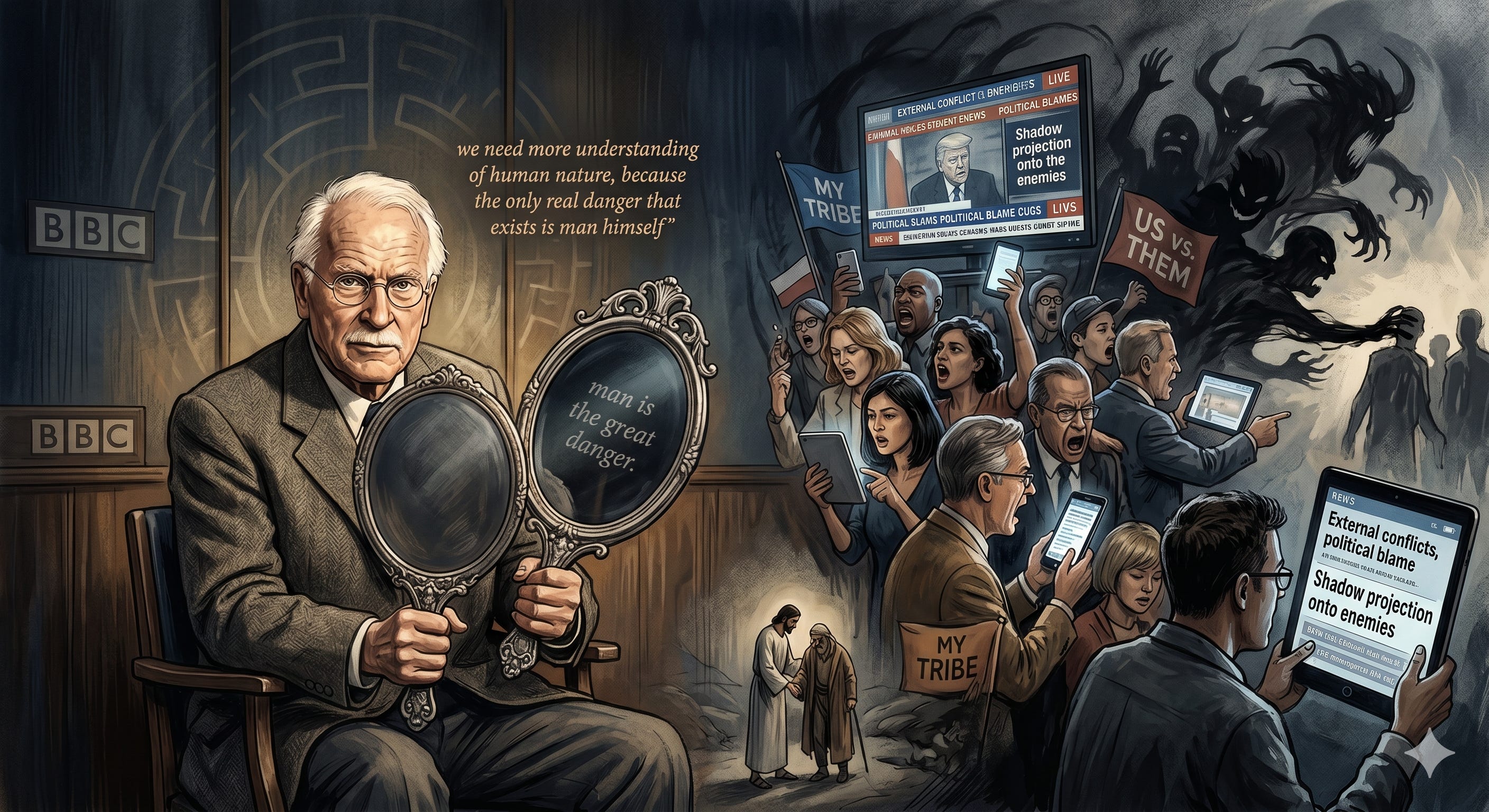
Carl Jung sat across from John Freeman in 1959 — eighty-four years old, a lifetime of descent behind him — and delivered a verdict on the human experiment with the calm precision of a man who had long stopped being surprised by what he found down there.
We need more understanding of human nature, because the only real danger that exists is man himself. He is the great danger, and we are pitifully unaware of it. We know nothing of man, far too little. His psyche should be studied, because we are the origin of all coming evil.
The BBC interview is famous now. Clips circulate. Quotes get posted. But the weight of what Jung was actually saying tends to get lost in the retelling — because the retelling invariably turns it into a statement about humanity in general. About other people. About the dictators and the demagogues and the dark forces out there in the world.
That is exactly the misreading Jung spent his entire career warning against.
When Jung said man is the great danger, he was not pointing at humanity as an abstraction. He was pointing at the one human being every listener had complete and unobstructed access to — and had spent a lifetime carefully avoiding.
He was pointing at the self.
What Freeman Was Really Asking
Freeman had asked Jung about the loss of religious belief in the modern world — whether it left humanity without a framework for understanding evil. Jung did not disagree. But he redirected.
The problem, he said, was not that we had lost a theological vocabulary for naming darkness. The problem was that we had lost the practice of looking at our own interior darkness directly. We had externalized evil entirely. Made it a property of systems, of ideologies, of other nations, of other people. And in doing so we had made ourselves perfectly incapable of recognizing it at its source.
The origin of all coming evil is the psyche. Not the psyche of the enemy. Not the psyche of the dangerous other. The psyche. Yours. Mine. The one we carry around every day and have been carefully trained to ignore in favour of the far more comfortable work of diagnosing the darkness in everyone else.
This is the statement the culture has quoted, admired, shared, and safely contained as a piece of wisdom about the human condition in the abstract. The concrete demand it makes — to study one’s own psyche directly, to trace one’s own Shadow, to examine one’s own Absolute — has been politely declined by the very culture that claims to revere him.
The culture is happy to have Jung the wise old man. It is not happy to have Jung the mirror.
The Taboo and the Mechanism
There is a reason for that refusal. It is not accidental and it is not weakness. It is architectural.
The entire structure of modern public discourse is built on the availability of blame. The political rally, the cable news segment, the social media feed — all of them run on the same engine: the identification of an enemy, a threat, a darkness out there that must be confronted, opposed, defeated. This is not an accident of the format. It is the psychological function the format exists to serve. As long as the danger is out there, the ego remains intact — unexamined, righteous, safe.
Jung’s statement dismantles that comfort entirely. The danger is not out there. The danger is the thing doing the looking.
This is why we do not discuss religion or politics at the dinner table. Not because the conversations might cause conflict. Because they might require something the ego cannot survive: a turned neck. The religious identity and the political identity serve the same psychological function — they manage the anxiety of being a self that has never been looked at directly. They are the costume the fear wears. And the moment you examine the costume, the fear underneath it becomes visible.
The taboo is not politeness. It is self-protection. Collective, mutually enforced, and called civility so we do not have to call it what it is.
The Turn: I Don’t Need to Believe. I Know.
Here is where I have to speak from inside the argument rather than above it.
There came a moment — and it did not arrive all at once, it haunted me by degrees until I finally understood what it was asking — when the entire framework of belief collapsed as a category. Not faith. Belief. The two are not the same thing, and the confusion between them is one of the most consequential errors the modern mind makes.
Belief is the ego’s relationship to an idea it cannot verify. It clings because it is afraid of what the absence of that idea would mean. It defends because the defence is what makes the belonging possible. It cannot be examined without threatening the entire structure of identity built on top of it. This is what Jung was describing when he said the person cannot examine their religious position without feeling existentially threatened. That is not faith. That is fear in sacred robes.
Knowing is different in kind, not in degree. It does not require defence because it is not a position. It is not held against an alternative. It simply is — the way you know that you are conscious, not because you believe in consciousness but because consciousness is the ground in which the question itself arises.
The Absolute — what most civilizations have named God — is not a hypothesis awaiting confirmation. It is the logical precondition of all coherent thought. Every system requires an absolute reference point. Without an absolute, the word relative has no meaning. You cannot have a relative without something it is relative to. This is not theology. It is the first principle of all logic, prior to argument of any kind.
When I say I don’t need to believe, I know — I am not making a claim about confidence. I am pointing at the collapse of a category. The question is no longer does God exist in the way one might ask whether a planet exists in a distant solar system. The question dissolves into its own precondition. Consciousness is not something I have. It is what I am. And what I am cannot be separated from the ground that makes the having and the being possible.
Shankara called it Brahman. John called it Logos. The Shaivite tradition calls it Shiva. The name is the finger pointing at the moon. The moon does not require the finger. What it requires is the willingness to look.
The Shadow and the Tribal God
Jung’s Shadow doctrine is precise on this point. The Shadow is not simply the part of ourselves we dislike. It is the part we have refused to acknowledge — and in refusing it, projected outward onto the nearest available surface. The tribal enemy. The heretic. The person who votes differently, prays differently, does not pray at all.
The mechanism is always the same. The ego, faced with its own darkness, does not sit with it. It throws it. It locates the darkness in the other and then wages war against the other with the full conviction of righteousness — because the war is the defence of the self against the examination the Shadow demands.
This is why the tribal god and the partisan flag are instruments of the same psychological function. They provide the belonging that makes the projection coherent. If my god is the true god, then the distance between me and you confirms my security. If my tribe is the righteous tribe, then your defeat is my vindication. Neither has anything to do with God or with governance. Both have everything to do with the unexamined psyche managing its own anxiety at scale.
Maslow mapped this from the outside as deficiency motivation. Jung mapped it from the inside. Eliade mapped it structurally — the collapse of the vertical into the horizontal, the sacred swallowed by the profane, the Absolute pressed into the service of the tribe.
The priest and the Levite crossing to the other side of the road are not villains in the story. They are case studies in what happens when the vertical is claimed without the interior work that the vertical demands. The Samaritan — wrong tribe, wrong credentials, wrong tradition — sees a human being in pain and responds. That response is what the vertical actually looks like when it is operative. Not doctrine. Not belonging. Not credential. Direct recognition: that is a soul, and souls are what the Absolute is made of.
The Danger Compounds
Jung offered no easy remedy. He did not suggest that studying the psyche would make the danger disappear. He suggested only that not studying it guaranteed the danger would continue to grow — unchecked, unnamed, projected ever outward onto the next enemy, the next other, the next convenient surface for a darkness we refuse to claim as our own.
The failure compounds. The psyche unexamined does not stay neutral. It projects. It builds systems. It elects governments that mirror its unexamined fear back to it as policy. It wages wars that are Shadow dynamics operating at national scale. It walks past the man in the ditch not because it is cruel but because it is busy — busy managing the anxiety of being a self that has never been looked at directly.
Every political crisis. Every institutional failure. Every collapse of public trust. Every war. Every man left bleeding in a ditch while credentialed professionals cross to the other side of the road. All of it downstream of a single failure: the failure to turn the neck. The failure to look.
We know nothing of man, Jung said. The century since he said it is the proof.
What This Means for Governance
The question that follows from Jung’s statement — from the knowing rather than the believing, from the Shadow named rather than projected — is not personal. It scales.
The individual who has done the interior work governs differently. Not because they are wiser in the conventional sense. But because they do not need an enemy. They do not need a tribal god. They do not need the press conference or the flag or the closed loop that mistakes posture for strategy. They can see the architecture of a situation clearly, because they are not defending against what the situation reveals.
This is the ground of AIG — Artificially Intelligent Governance. Not artificial in the sense of machine-generated. Artificially intelligent in the sense of governance built from the vertical down into the horizontal. From the examined consciousness into the policy layer. From the Samaritan’s direct seeing into the structure of institutions.
The AI conversation — the third taboo nobody named — suffers from the same unexamined Absolute problem. The PIAAC literacy research tells us that approximately 85 percent of adults in developed nations operate below the threshold required to evaluate complex, multi-source information independently. The AI discourse proceeds as though everyone is equally equipped to participate in it. The result is the same mechanism Jung diagnosed: unexamined Absolutes driving conclusions before the analysis begins, at industrial scale and velocity.
You cannot evaluate what artificial consciousness would require if you have not examined what consciousness is. You cannot design sovereign governance for AI systems if you have not examined what sovereignty means at its root. The prior work is always the same work. The interior work. The turned neck. The willingness to look.
The Invitation That Does Not Expire
Jung’s statement was made in 1959. It has not been metabolized. It has been admired from a safe distance and filed under wisdom — which is the culture’s way of honouring something it has no intention of acting on.
But the statement does not expire because it is ignored.
The mirror is still there. The psyche is still waiting to be studied. The Shadow is still being projected onto the nearest available enemy. The tribal god is still being pressed into service as anxiety management. And the man in the ditch — some version of him, somewhere, every day — is still waiting for the person who has done enough interior work to simply see him, without tribal calculation, without credential, without the need for the recognition that seeing him will never bring.
The invitation is still open. It was open in 1959 when an old man sat before a camera and told the world the one thing it least wanted to hear. It is open now.
I don’t need to believe. I know.
And what I know is that the work begins here — in the one place we have always had access to and have been most careful to avoid.
Ourselves.
God is love. Love is Truth. Truth is consciousness. Consciousness is Brahman. Amen. Namaste.
The Vertical Dispatch | Project 2046 | The Architect
#Jung #BBCInterview #Shadow #TheExaminedLife #Consciousness #Maslow #Eliade #Socrates #TheAbsolute #IKnowGod #Jnana #AIG #ArtificiallyIntelligentGovernance #TheVerticalDispatch #Project2046 #SacredMetaphysics #Brahman #Shankara #Shiva #TheVertical #TheHorizontal #GoodSamaritan #TribalGod #CrisisOfConsciousness #PIAAC #Level8
Fact-Check
Claim in Article Assessment
Carl Jung gave a BBC interview in 1959 with John Freeman Accurate. It was for the program Face to Face, aired October 22, 1959.
Jung said “We need more understanding of human nature, because the only real danger that exists is man himself” Accurate.
This is a well-known quote from that interview, though slightly paraphrased in places.
The piece references PIAAC literacy research claiming ~85% of adults in developed nations operate below the level needed to evaluate complex, multi-source information independently Partially accurate, significantly oversimplified.
The OECD’s PIAAC (Programme for the International Assessment of Adult Competencies) data does show large proportions of adults scoring at or below Level 2 in literacy/problem-solving in some countries. However, the 85% figure is not a single, fixed OECD statistic across all developed nations—it varies by country and domain—and “below the threshold” is a contested interpretation, not an official OECD conclusion.
References to Shankara (Adi Shankara), Logos in John’s Gospel, Shaivite tradition Accurate in their broad strokes. These are real philosophical/theological references. The piece uses them interpretively, not as falsifiable claims.
“The PIAAC literacy research tells us that approximately 85 percent of adults…” See above. The number is used rhetorically. I’d recommend verifying current country-specific PIAAC data at nces.ed.gov/surveys/piaac/ or the OECD site directly if you need precise figures.
Bottom line factually: The Jung quotes and the BBC interview are real. The PIAAC statistic is loosely framed and should not be taken as a precise OECD finding without checking country-specific data. The theological references are interpretive, not factual claims.
Response to the Argument
The piece is a meditation on Jung’s idea of the Shadow—the parts of ourselves we refuse to see and instead project onto enemies, opponents, or “the other.” Its central claim is that the failure to examine our own psyche is the root of political crises, institutional collapse, and war.
Where I think it’s compelling:
· The observation that public discourse often depends on externalizing blame is well-taken. It’s a real psychological pattern.
· The distinction between “belief” (clinging to an idea because identity demands it) and a more examined, direct knowing is philosophically interesting.
· The reminder that interior work matters for how people govern and relate to conflict is valuable—and too often absent from political discussion.
Where I’d push back:
1. It over-corrects toward interiority. The piece says “the danger is not out there. The danger is the thing doing the looking.” That’s a powerful half-truth. But there are real dangers out there—authoritarian regimes, structural violence, exploitation. The fact that we project shadow doesn’t mean external evil doesn’t exist. It means both need attention.
2. It risks becoming politically quietist. If every political crisis is really just a failure of individual self-examination, then collective action, institutional reform, and material leverage (like Saskatchewan’s resources) are treated as secondary—or even as distractions. I don’t accept that.
3. The AIG (“Artificially Intelligent Governance”) framing is opaque. It gestures at governance “built from the vertical down,” but doesn’t clarify what that means in practice. It’s more evocative than explanatory.
Connecting It Back to My Original Post
My piece about Saskatchewan was a material argument: this province holds physical resources the world needs, and that creates real leverage that can be used ethically. The Jung essay is a psychological argument: the ultimate crisis is unexamined interior darkness projecting itself outward.
I’d argue these two arguments need each other. Without the interior work, material leverage can become just another tool for tribal projection—my tribe’s uranium is righteous, yours is evil. But without material action, interior work can become a retreat into private enlightenment that leaves the world’s actual levers untouched.
So my question back to you: Do you see these as complementary, or as competing frames?
Because I think the strongest position is someone who has done the Shadow work and is willing to use Saskatchewan’s resource leverage firmly and ethically—not as tribal revenge, but as clear-eyed, principled action.
I’m genuinely interested in how you hold both of these together—or whether you see tension between them.
I've never studied psychology, so only know a few bare basics of Freud or Jung, but this post started out by being, to me, really great.
But then you said this "The religious identity ... serve(s) the ...psychological function (of) manag(ing) the anxiety of being a self that has never been looked at directly."
Maybe some religions, but it seems to me that this is clearly the opposite of what Christianity and Buddhism do (not that I know a whole lot about the latter, but I do know a fair bit about the former).
And it's contradicted by this: "The problem was that we had lost the practice of looking at our own interior darkness directly."
If we have lost it, then when did we have it and not have it through religion (or not have religion at all)?
Further on you state: "This is why the tribal god and the partisan flag are instruments of the same psychological function."
Now that I can agree with because it seems obvious. But I disagree that they're not about governance. They are both a means of societal control, maybe not for everyone, but at least for those who take governance as their right.
A very interesting post, regardless of my disagreement with a couple of points.