

THE FOURTH POLE · FOUNDATION DOCUMENT
Glennford Ellison Roberts · The Architect
Project Keystone · Level 5 Executive Brief
Title: Subtitle: Why the Study of Power Must Begin with the Study of Consciousness· · ·
Sacred Metaphysics & Consciousness
History of the Absolute & Eternal
The Level 5 Executive Brief
Why the Proper Study of Power Must Begin with the Study of Consciousness
A note on this brief. This is the first published material from The Fourth Pole, forthcoming Fall 2026 — the new book by Glennford Ellison Roberts that brings the study of consciousness to the material world at the highest level: the reading of power, alliance, and the order now forming as the American century closes. The Fourth Pole rests on a foundation most geopolitics ignores — and this brief delivers that foundation, at executive altitude, so the reader can judge the book on solid ground. It is not the full work; the full work is Sacred Metaphysics & Consciousness: History of the Absolute and Eternal. This is the brief a serious, intelligent, and properly skeptical reader needs in order to understand that what follows is rigorous study and not fiction, mysticism for its own sake, or belief asked to stand in for argument. It asks the reader to accept nothing on faith. It asks only that the reader follow the argument and judge it on its own ground. Where the brief states documented fact, it says so. Where it crosses into interpretation, it says so. The line between the two is held throughout, because the entire credibility of the work depends on holding it.
1. The Diagnosis
Krishnamurti spent a lifetime returning to a single sentence: the problem is a problem of consciousness. Whatever the crisis — political, economic, environmental, civilizational — he insisted that at its root it is not a problem of systems, resources, or technique, but of the consciousness from which those systems are built and run. A crisis produced by a given level of consciousness cannot be solved by the same level of consciousness that produced it.
This brief takes that diagnosis seriously and applies it to the study of power. The shelf of serious books on geopolitics is long and, in its own terms, rigorous. It measures armies, economies, territory, demography, institutions, and the rational pursuit of interest. It is very good at the outward and the countable. But it has left one dimension of its subject almost entirely unexamined — and it is the dimension that governs all the others. It has not studied the level of consciousness from which a leader perceives the world, nor the developmental altitude from which a whole people is governed. Where the field has looked inward at all, it has studied only the surface contents of the mind: the biases, the personality, the cognitive distortions of the individual leader. It has never given its due to the depth — to the level itself.
The wager of this work is simple. No study of mankind that omits consciousness can call itself proper. If the problem is a problem of consciousness, then a geopolitics that refuses to study consciousness cannot diagnose its own subject. The proper study of mankind is man; and man, at the root, is consciousness. It is time the study of power was conducted at the root.

2. The Necessary Ground
Here the brief must be precise, because everything downstream depends on it. The work does not argue that God exists. On the question of God — the named, formed, personal God of the traditions — the honest position of a proper study is that the matter is genuinely open. Call it undetermined. A rigorous mind does not assert it as proven, and this work does not. The reader who is an atheist, an agnostic, or a believer can proceed from here on equal footing, because the argument does not turn on the answer to that question.
But something is not open, and that is the heart of the matter. Something must necessarily exist, and its necessity is not a matter of faith — it is a matter of logic. For the relative to exist, there must be that against which it is relative. For the temporal to exist — for there to be change, sequence, before and after — there must be a ground in which the change occurs and which is not itself merely another changing thing. For the subjective and the objective to be distinguishable at all, there must be a frame in which the distinction holds. In short: for anything whatsoever to have meaning, an absolute and eternal ground must exist in some form, because meaning is precisely the relation of the particular to something that does not itself dissolve into the flux.
This is not theology. It is the oldest move in disciplined philosophy, from Plato through the idealist tradition: the recognition that the measurable, relative, temporal surface of things cannot ground itself, and therefore points necessarily to a ground it cannot contain. One may be entirely agnostic about God and still hold the Absolute as necessary — indeed one must, on pain of surrendering the very possibility of meaning. The reader is not asked to believe in anything. The reader is asked to notice that without an eternal ground, nothing — including this sentence — means anything at all.
That necessary ground is what this work studies. The traditions gave it many names. The brief will use several. None of the names is the thing; each is a symbol pointing at the ground that the symbols require in order to point at all.
3. The Oldest Study — The Vedas
Caitanyam ātmā
Consciousness is the Self. — Shiva Sutra 1.1
Consciousness has been studied with rigor for far longer than the modern world tends to remember. The contemplative traditions of India produced, over millennia, the most detailed and sustained empirical investigation of consciousness in the human record — empirical in the strict sense that it proceeded by disciplined first-person observation, replicated across generations of trained practitioners, refined and corrected like any other body of careful inquiry. The opening verse of the Shiva Sutras states the conclusion that the whole tradition exists to point at: consciousness is the Self. Not a property of the self; the ground of it. Not something the mind has; what the mind, and everything else, arises within.
This is named here not to ask the reader to adopt a religion — the work asks nothing of the kind — but to establish a fact the modern study of power has forgotten: the interior is not soft, and its study is not new. It is the oldest serious inquiry there is. To treat consciousness as too unserious for hard analysis is to be ignorant of four thousand years of analysis. The wisdom traditions are not superstition standing where knowledge should be. They are the longest-running research program in the history of the species, and their central finding — that beneath the changing contents of mind there is an unchanging ground that is the condition of awareness itself — is precisely the necessary ground that Section 2 established on independent logical grounds. Two instruments, arriving from two directions, at one address.

4. The Modern Study — Jung and the Shadow
If the Vedas are the ancient door into the study of consciousness, Carl Jung is the modern one. He was the first in the modern West to map the human interior with rigor and without flinching, and the first to insist that the study had to begin not in the light but in the dark. The foundational concept is the shadow: the disowned material, the refused inheritance, the part of the self that cannot be faced and is therefore pushed below awareness, where it does not dissolve but persists — and governs. What a person, or a nation, will not face does not disappear. It returns, in Jung’s formulation, as fate: enacted upon the world precisely because it was refused as choice.
This is the key that unlocks the whole inquiry, and it explains the very gap this brief began by naming. There is a reason the study of power has kept the door to consciousness locked, and it is the same reason a person keeps a door locked within himself. Behind it is the shadow. A discipline that will not examine the shadow of nations cannot study their consciousness, because consciousness studied honestly begins with what consciousness refuses. The conviction that the inner life of nations is too soft for serious analysis is itself a defense — the mechanism by which the serious mind avoids the one room it cannot enter without being changed.
Jung also gave the modern world the precise statement of what the study, pursued to its end, produces. Asked near the end of his life whether he believed in God, he paused, corrected the verb, and said: I don’t believe — I know. The correction is the whole movement of this work in miniature — from inherited belief to direct knowledge, from the secondhand symbol to the firsthand encounter. The work does not ask the reader to believe things about consciousness. It asks the reader to learn to see it. And seeing, as all honest self-knowledge does, begins by turning toward the shadow before it can lift toward the light.
5. Why the Modern World Lost the Vertical — Wolfgang Smith
If consciousness has been studied so long and so well, why does the modern world treat it as unserious? The answer lies in a specific and datable turn in the history of Western thought, and the most rigorous contemporary account of it comes from Wolfgang Smith — a mathematician and physicist before he was a philosopher, which is precisely why his account carries weight where a purely religious one would not.
Smith’s central diagnosis is the Cartesian bifurcation: the splitting of reality, following Descartes, into measurable extended matter on one side and unextended mind on the other, with the consequence that serious knowledge came to mean knowledge of the measurable alone. The vertical dimension of reality — the dimension of quality, of meaning, of the ground from which the measurable arises — was not refuted. It was amputated, defined out of the domain of the real. Science became, in consequence, magnificent and short: extraordinarily powerful within the horizontal plane of the measurable, and structurally unable to reach the vertical ground that the measurable depends on. It can tell us, with breathtaking precision, how things behave. It cannot, in principle, tell us what they are or what they are for, because those are vertical questions and the method was built to exclude them.
Smith stands at the end of a long line — Plato, Plotinus, Aquinas, Leibniz, the idealists — that refused at every stage to surrender the ground to the surface. His contribution is to make that refusal in the vocabulary of modern physics itself, demonstrating that the measurable surface cannot account for itself and points necessarily to a ground it cannot contain. This is the same necessary ground of Section 2 and the same unchanging ground of Section 3, now reached from the direction of physical science. The call that follows from Smith is exact: the vertical is real, its amputation was an error, and a proper study of anything — including power — must restore it.
Universal Dynamics — The Framework Beneath Both
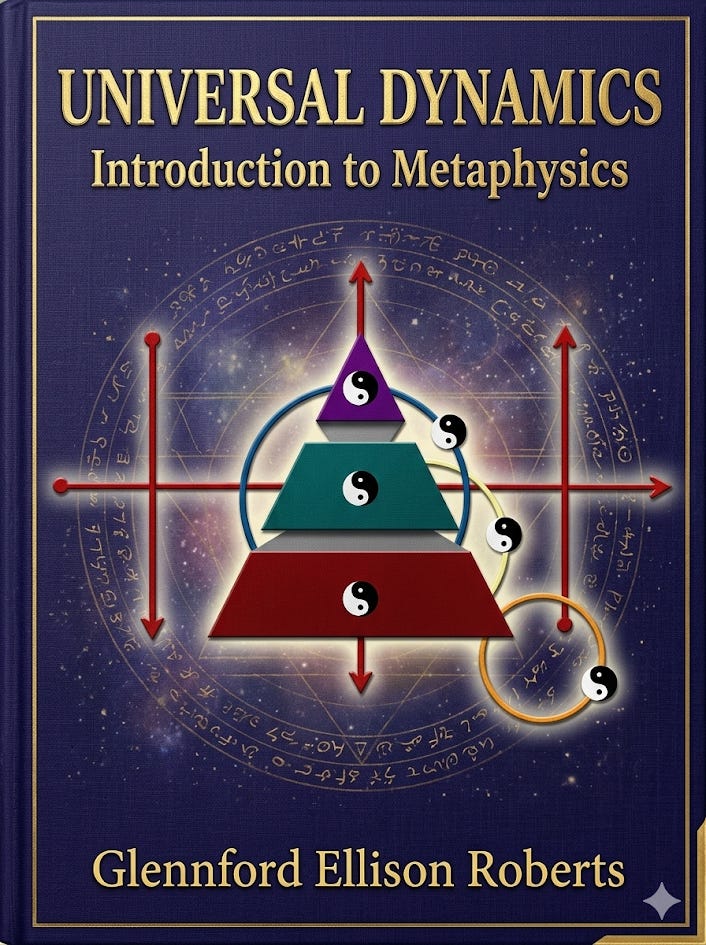
Before we descend from the vertical Smith calls us to restore, to the horizontal that Drucker raised to a science, the reader should be given the single framework that holds them both — the framework from which this entire study proceeds. It is called Universal Dynamics, and it was first set down by the author in 1995, decades before the developmental science that would later, in its own vocabulary, confirm it.
Universal Dynamics names three irreducible registers present in everything that exists. There is the conceptual — the ground, the source, the unmanifest principle from which a thing arises; call it X. There is the physical — the manifest, expressed, measurable form the thing takes in the world; call it Z. And between them there is the functional — the living bridge, the translation, the conscious medium through which the ground becomes the form; call it Y. Every concept, every being, every institution, every cosmos holds all three at once: the ground it comes from, the form it takes, and the bridge that joins them. The vertical that Wolfgang Smith calls us to restore is the axis from X to Z — the descent of the ground into the manifest. The horizontal that Peter Drucker mapped with such rigour is the plane of Z alone — the measurable surface, studied brilliantly and in isolation from the axis that gives it meaning. The two are not rivals. They are one structure, seen from two directions. Smith names the vertical axis; Drucker measures the horizontal plane; and Universal Dynamics is the cross where they meet — the eternal descending through the temporal, joined at the living centre, the non-dual held whole at every level of the ascent. This is the lens through which everything that follows is read.
6. The Horizontal at Its Peak — Peter Drucker
To see both the power and the limit of the horizontal in one figure, consider Peter Drucker, who did for the study of organized human life what the Cartesian turn did for nature: he made it a science. Before Drucker, management was not a discipline; it was what executives did by instinct. Drucker named it, structured it, and gave it its first principles. His enduring instrument, Management by Objectives, encodes the essential horizontal move: make the implicit explicit, declare the aim in writing, and measure performance against the declaration. An organization that cannot state its vision, mission, values, and objectives does not truly hold them; the writing-down is the having. This is rigorous, real, and indispensable, and nothing in this work diminishes it.
But Drucker is also the proof of exactly where the horizontal stops. He made management a science, and the science is short in precisely Smith’s sense. It measures the countable surface of organizational life with great skill and reaches a ceiling it cannot pass, because the questions that matter most at the top — what is genuinely worth doing, from what level of consciousness a leader perceives, what a person or institution is ultimately for — are vertical questions, and the horizontal science has no instrument for them. Drucker took the horizontal as far as it can go. That is his greatness, and it is also the demonstration that the horizontal, by itself, runs out exactly where the most important questions begin.
7. The Vertical Restored — Rigorously
The decisive development of recent decades is that the vertical can now be restored not as religion but as rigorous, contemporary, defensible study. Three bodies of work make this possible, and together they form the map at the center of the larger project.
First, Elliott Jaques provided the bridge. Working entirely within organizational science, Jaques measured the cognitive complexity of human roles by their time-span — the length of the longest task a person can hold and complete. This is a genuine, measurable, vertical dimension: it ranks minds by the depth of time they can hold in view, and it does so with the empirical rigor the modern mind demands. Jaques measured, in effect, the shadow that the vertical casts onto the horizontal plane of work. He did not name the full vertical, but he proved that altitude of mind is real and measurable, and he built the bridge from the horizontal science of management toward it.
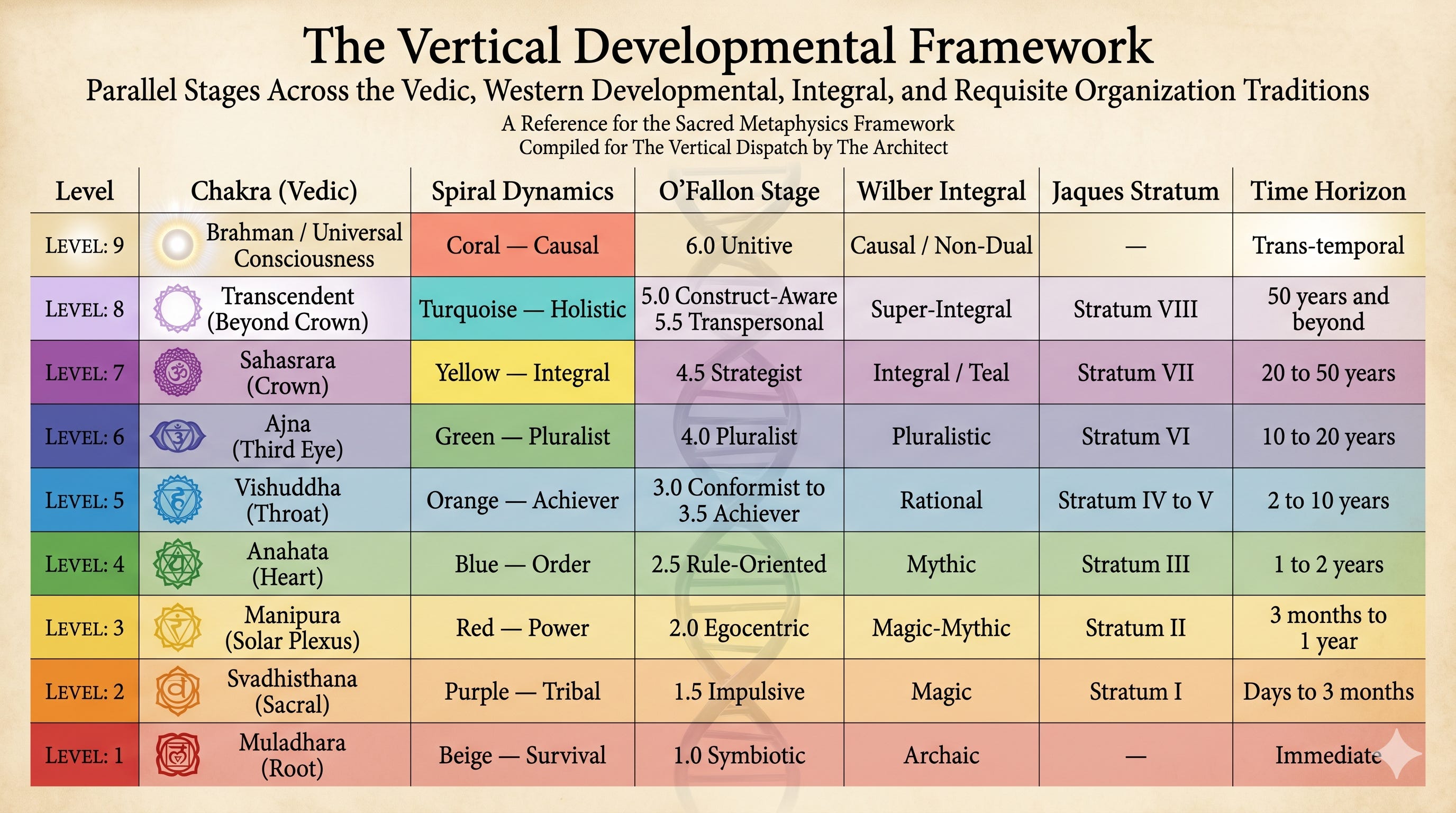
Second, the developmental tradition supplied the path. The work of Clare Graves, developed as Spiral Dynamics by Beck and Cowan; the integral synthesis of Ken Wilber; and above all the rigorous contemporary research of Terri O’Fallon’s Stages model — these map the stages through which consciousness actually develops, from egocentric through rational and pluralistic toward the integrative and beyond. This is not speculation; it is research, with instruments, data, and predictive power. Its central finding is directly relevant to the study of power: each stage can perceive and build only what its altitude permits, and the great challenges of the present require a stage of consciousness now emerging but not yet widespread.
Third, the contemplative map — the chakra system and the broader architecture of the perennial traditions — supplies the full ascent, and the developmental science has, remarkably, climbed back to confirm it. The highest stages the contemporary researchers can identify converge on exactly what the oldest traditions named: a non-dual ground in which the separation of observer and observed dissolves. The newest science arrives where the most ancient sages already stood. The summit is, in the traditions’ own terms, older than the Vedas — beginningless, the timeless ground that every map, ancient or modern, is finally pointing at. The cross-tradition chart that anchors the larger work sets these systems side by side — Jaques, the developmental stages, the integral levels, the chakras — and shows them converging, layer by layer, on one architecture. The convergence is the strongest available evidence that the vertical is not the invention of any one tradition but the structure of reality itself, mapped by many instruments arriving at one result.
8. The Deep Record — A Proper Study Includes the Past
One further dimension must be named, because a proper study of man cannot stop at the present. Man has a past far deeper than geopolitics ever reckons with, and that deep past is part of the proper study. Here the brief is careful to distinguish the documented from the interpretive, because the larger work makes a strong claim and its credibility depends on the distinction being explicit.
The documented part is this. The precession of the equinoxes is a real astronomical phenomenon — the slow wobble of the Earth’s axis completing one full circle approximately every twenty-six thousand years, advancing roughly one degree every seventy-two years. This is measurable, confirmed, and known to every astronomer. It is the great clock that many ancient cultures observed and recorded with striking precision. Likewise documented is that the human story includes a near-extinction: genetic and archaeological evidence points to a severe bottleneck in the deep past — associated by many researchers with the Toba supereruption roughly seventy-four thousand years ago — through which the species passed reduced to a small remnant before expanding again. The estimates of that remnant vary widely and are genuinely debated; the brief does not pin a single figure to it. What is not in serious dispute is that humanity, at some point in the deep past, passed through a narrow gate and began again.
The interpretive part — and the brief names it plainly as interpretation, the thesis the larger work argues rather than a fact it asserts — is that the deep record reads as the story of a new beginning, and that the quality of consciousness available to humanity has a history that tracks, in broad strokes, against the great clock. This is the domain the work calls astrotheology: not astrology, which makes claims about celestial influence on individual lives, but the study of the relationship between cosmic cycles and the development of consciousness at the civilizational scale. The reader is not asked to accept this thesis to accept the rest of the work. It is offered as a framework to be tested against the evidence, in the same spirit Marcus Aurelius meant when he wrote of considering the stars and their relationships rather than casting a horoscope. What the brief establishes here is narrower and firmer: that a proper study of man includes the deep past, that the past contains a documented new beginning, and that the larger work takes that record seriously and reads it as part of the study of consciousness — rigorously, with the line between fact and interpretation held throughout.
9. The Landing — Why This Matters for the Board
Return now to where the brief began: the study of power. Everything above is the foundation, and with it in place the central claim of the larger work can be stated and understood as the disciplined conclusion it is, rather than dismissed as mysticism.
The crises of the present age — the closing of one world order and the unsteady forming of another, the fall of an old guarantor and the emergence of a new and distributed alliance of democratic middle powers — are not, at the root, problems of economy or armament. They are, as Krishnamurti diagnosed, problems of consciousness: of the level from which the world is being led. The old order was built and run from a level of consciousness that has reached the limit of what it can address; what is now emerging — visible in the leaders and coalitions building the successor architecture — reflects a higher developmental altitude that can hold the complexity the moment requires. Read against the developmental map, the political surface becomes legible as the expression of a consciousness shift. This is what it means to study power at the root.
And so the brief closes by stating clearly what it was written to establish. The larger work it points toward — Sacred Metaphysics & Consciousness: History of the Absolute & Eternal — is not voodoo, not fiction, and not belief dressed as knowledge. It rests on documented astronomy and archaeology, on four thousand years of contemplative inquiry, on the rigorous modern study of consciousness from Jung through contemporary developmental science, on the logical necessity of an eternal ground, and on the honest restoration of a vertical dimension that a specific and datable error amputated from modern thought. It leaves the question of God genuinely open. It holds the necessity of the Absolute as the precondition of meaning. It distinguishes at every step the documented from the interpretive. The reader who follows the argument is not asked to believe. The reader is asked only to see — and to grant that the proper study of mankind is man, that man at the root is consciousness, and that the study of consciousness, conducted rigorously, is the missing foundation of any true reading of power.
The proper study of mankind is man. Man, at the root, is consciousness. And the study of consciousness — ancient and modern, contemplative and scientific, vertical and rigorous — is the foundation on which the reading of the coming order is built. This brief is the door. The larger work is the house. The reader who has followed the argument is prepared to enter either.
Sources and standing. This brief draws on the Shiva Sutras of Vasugupta and the Mahavakyas of the principal Upanishads; the analytical psychology of C.G. Jung, including the documented 1959 BBC Face to Face interview (“I don’t believe — I know”); Wolfgang Smith on the Cartesian bifurcation and vertical causation in modern physics; Peter Drucker on management as a discipline and Management by Objectives; Elliott Jaques’ stratified-systems theory and its applied continuation through Ronald Capelle (Optimizing Organization Design, 2013) and Michael Brush (Structure That Works, 2026); Terri O’Fallon’s developmental Stages model; Ken Wilber’s Integral Theory; Spiral Dynamics (Beck and Cowan, from the work of Clare Graves); the documented astronomy of the precession of the equinoxes; the archaeological and genetic record of the deep human past, including the contested Toba bottleneck; Alexander Pope, An Essay on Man (1733); Aldous Huxley, Proper Studies (1927); and the public record of the June 2000 Human Genome announcement. The standing editorial standard applies throughout: assessments are advanced from the documented record only, without malice and without flattery, with the line between documented fact and interpretation held explicitly at every step.
God is Love. Love is Truth. Truth is Consciousness. Consciousness is Brahman.
The vertical is sacred.
Amen. Namaste. Om Namah Shivaya.
#TheFourthPole #SacredMetaphysics #Consciousness #Geopolitics #Canada #Carney #MarkCarney #CdnPoli #CanadianPolitics #DemocraticAlliance #MiddlePowers #WorldOrder #AfterAmerica #VariableGeometry #FourthPole #Geopolitics2026 #TheVerticalDispatch #TheArchitect #Project2046 #AIG #StudyOfConsciousness #TheVertical #Krishnamurti #Jung #Shadow #NonDual #Advaita #DevelopmentalStages #IntegralTheory #SpiralDynamics #Stage45 #ProperStudy #ConsciousGovernance #GlennfordEllisonRoberts #SophiaInitiative #SingleEye #Matthew622
Wow, there’s power in your work. I will keep reading.