


Twenty-three days into the most ambitious military operation the United States has launched since the 2003 invasion of Iraq, the strategic picture clarifies into a single, uncomfortable question that Western planners have consistently failed to ask before committing to force: What does it actually mean to defeat Iran?
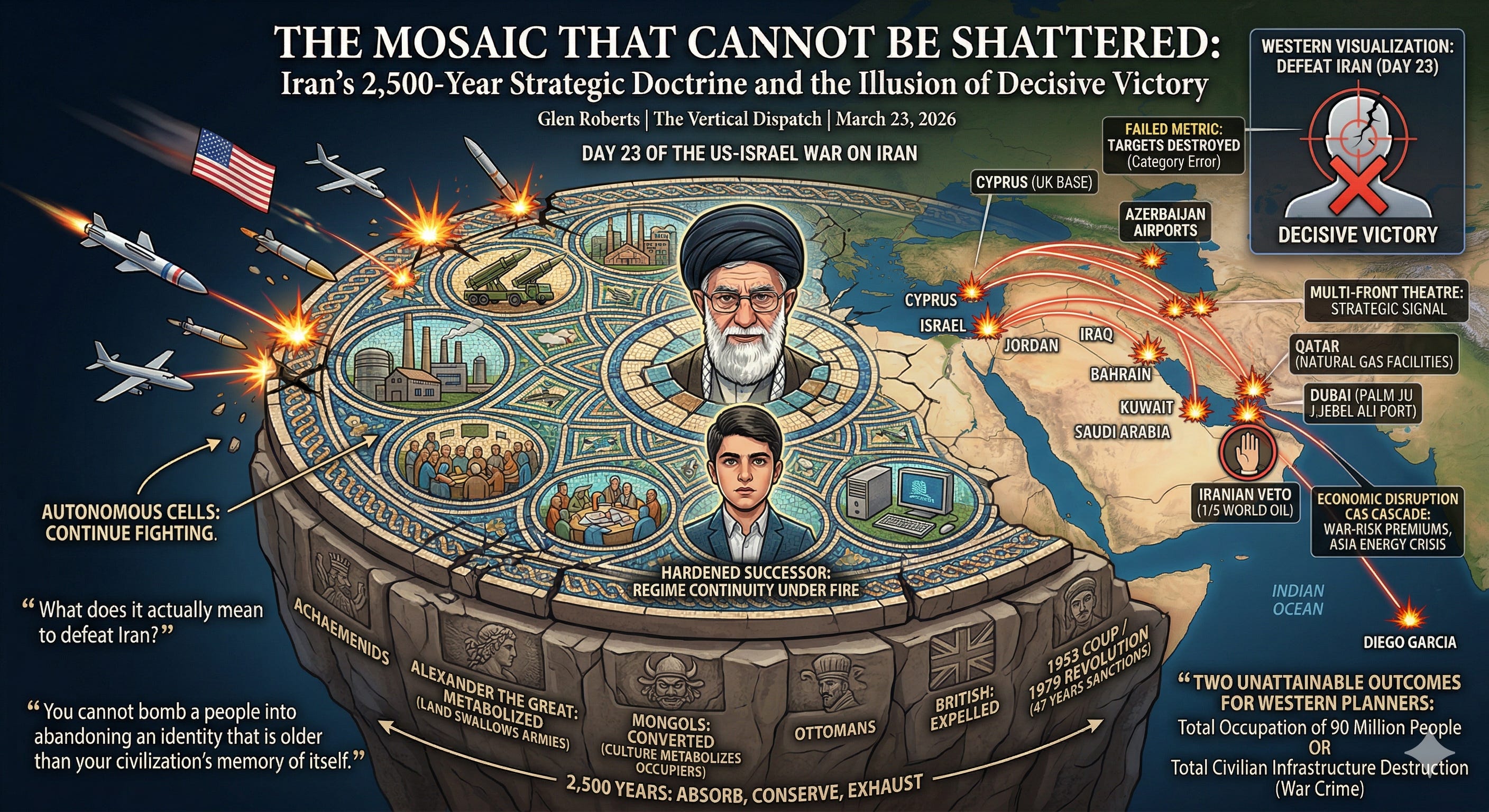
The theatre is now staggering in its breadth. Iranian strikes have reached Israel, the UAE, Qatar, Kuwait, Bahrain, Saudi Arabia, Azerbaijan, Cyprus, Jordan, Iraq, Diego Garcia in the Indian Ocean, and French and Italian NATO installations across the region. The Strait of Hormuz — through which roughly a fifth of the world’s traded oil passes — has been effectively placed under Iranian veto. Trump has threatened to obliterate Iran’s power plants within 48 hours. Iran has threatened to close Hormuz completely in response. A new supreme leader, Mojtaba Khamenei, has been installed and pledged to continue the fight.
This is not chaos. This is doctrine.
Iran does not fight to win the first battle. It fights to survive every battle until its enemy exhausts the will to continue.
◆ THE MOSAIC DEFENSE ◆
Iranian military strategists have spent decades building what analysts call the Mosaic Defense — a doctrine constructed around one foundational premise: that in any conventional confrontation with the United States or Israel, Iran will absorb catastrophic early losses. Senior commanders will be killed. Communications networks will be severed. Key installations will be destroyed. The doctrine does not treat these losses as defeat. It treats them as the opening conditions of the real war.
The Mosaic Defense is built for decapitation. It is designed to function after the head has been removed. Each cell, each proxy network, each regional node operates with sufficient autonomy to continue fighting without central coordination. The mosaic cannot be shattered by eliminating any single tile — including the supreme leader himself.
This is why the killing of Ali Khamenei, far from ending the war, has produced a hardened successor, a unified IRGC command, and intensified strikes across twelve countries. The West planned for regime collapse. Iran planned for regime continuity under fire. The doctrine held.
The economic dimension of the doctrine is equally precise. Low-cost Iranian drones and missiles force adversaries to expend interceptors that cost orders of magnitude more to replace. The UAE has absorbed over 800 projectiles. Israeli air defenses have been running continuously for three weeks. Every interception widens the cost asymmetry. Time, in this calculus, works for Iran.
◆ THE PATTERN IS 2,500 YEARS OLD ◆
It would be a strategic error to treat the Mosaic Defense as an innovation of the Islamic Republic. The doctrine is ancient. It is Persian civilizational memory formalized into military architecture.
Persia defeated Babylon not through overwhelming force but through the patient accumulation of strategic depth. Alexander the Great conquered Persia’s armies and found he could not conquer Persia — the civilization absorbed him, hellenized his successors, and outlasted his empire by centuries. The Mongols, history’s most fearsome military force, swept through Persia with catastrophic violence. Within two generations the Mongol rulers of Persia had converted to Islam, spoken Persian at court, and become patrons of Persian culture. The conquerors were metabolized.
The Ottomans pressed against Persia’s western frontier for centuries and never extinguished it. The British managed Iranian resources for decades and were ultimately expelled. The United States engineered the 1953 coup, installed the Shah, and was answered in 1979 with a revolution that has now persisted for 47 years under the most comprehensive sanctions regime ever imposed on a modern state.
The pattern is not stubbornness. It is not irrationality. It is a civilizational strategy refined across twenty-five centuries: absorb, conserve, exhaust. The land swallows armies. The culture metabolizes occupiers. The long timeline defeats the short campaign.
You cannot bomb a people into abandoning an identity that is older than your civilization’s memory of itself.
◆ THE MULTI-FRONT THEATRE AS STRATEGIC SIGNAL ◆
The breadth of the current Iranian response — reaching from the Indian Ocean to the Mediterranean, from the Caucasus to the Gulf — is itself a strategic communication. It is not evidence that Iran is winning the conventional military exchange. It is evidence that Iran is executing the doctrine precisely as designed.
Iranian drones struck a luxury hotel on Dubai’s Palm Jumeirah and ignited fires at Jebel Ali Port, one of the region’s most critical commercial hubs. Qatar suspended most of its natural gas production after Iranian strikes hit its energy facilities. Azerbaijan’s airports have been targeted. A UK base in Cyprus was struck, prompting Britain to authorize American use of its regional air bases and dispatch Royal Navy assets. French and German military personnel have been casualties. A US F-35 made an emergency landing after being hit by Iranian anti-aircraft fire.
Each of these actions imposes costs that compound beyond the immediate military exchange. Energy markets are disrupted. Insurance and war-risk premiums are rising across the entire Gulf. Regional governments that had no quarrel with Washington are now absorbing Iranian ordnance on their territory. The political geography of the Middle East is being reorganized in real time — and not in a direction favorable to long-term American strategic positioning.
Iran’s military doctrine has always understood that the decisive battlefield is not the kinetic exchange but the political will of the adversary. Every week the war continues without decisive Iranian collapse strengthens Iran’s core strategic message to the Global South: we fought the full weight of American and Israeli military power and we did not break.
◆ WHAT DECISIVE VICTORY WOULD REQUIRE ◆
Western planners and their media echo chambers continue to measure progress in the language of targets destroyed, missiles intercepted, and Iranian military assets degraded. This metric is a category error.
To truly defeat Iran — not merely to punish it, not merely to degrade its current military capacity, but to end its strategic resistance — would require one of two outcomes. The first is the physical occupation and pacification of a nation of 90 million people with a terrain that defeated every prior conqueror. The second is the complete destruction of Iranian civilian infrastructure at a scale that would constitute one of the largest war crimes in recorded history, producing a humanitarian catastrophe that would collapse international support for the operation within days.
Neither outcome is available. What is available is an extended air campaign that degrades Iranian military assets while Iran’s doctrine absorbs the damage, disperses its capabilities, and continues to impose costs across twelve theatres. The longer the campaign continues without the decisive collapse that was promised, the more the strategic narrative shifts in Iran’s favor.
Trump’s 48-hour ultimatum over the Strait of Hormuz is itself an indicator of this dynamic. Ultimatums are issued when coercion has not yet produced compliance. Day 23, and the Strait remains under Iranian leverage.
◆ THE LONG GAME AND THE CIVILIZATIONAL CLOCK ◆
History does not record the names of the empires that believed they had finally broken Persia. It records Persia.
The Achaemenid Empire, the Parthians, the Sassanids, the Safavids — each arose from the ashes of conquest, reconstituted the Persian civilizational project, and outlasted the powers that had believed themselves victorious. The Islamic Republic is the current instantiation of a civilizational continuity that has been running for two and a half millennia. It has structural deficits, internal contradictions, and a population that has expressed profound dissatisfaction with its government. None of these facts make it defeatable by air campaign.
The Mosaic Defense doctrine did not emerge from ideological commitment alone. It emerged from civilizational memory — the encoded knowledge of a people who have survived every form of external assault and who understand at a bone-deep level that time is the ultimate strategic asset. Three weeks of American air power against 2,500 years of Persian endurance is not a close contest on the timeline that ultimately matters.
The question for Western strategists, and for the governments now absorbing Iranian ordnance on their territory, is not whether Iran can be hurt. It is already being hurt. The question is what political and strategic outcome is available after the hurting stops — and whether any of the current parties has a credible answer to that question.
They do not. And Iran knows they do not. That knowledge is the foundation of the doctrine, the inheritance of the civilization, and the reason the mosaic holds.
Glen Roberts is a metaphysician, author, and independent researcher. He is the author of Sacred Metaphysics Volume 1 and the architect of Project 2046.
#MosaicDefense #IranStrategy #MiddleEastConflict #Geopolitics #AsymmetricWarfare #DecentralizedResilience #PersianCivilization #2500YearsEndurance #USIsraelWar #StraitOfHormuz #HormuzLeverage #EnergySecurity #GlobalEconomy #HormuzVeto #DubaiStrikes #JebelAliPort #QatarNaturalGas #DiegoGarcia #NATO #MojtabaKhamenei #RegimeContinuity #IRGC #MilitaryDoctrine #StrategicMemory #CultureMetabolizesOccupiers #IdentityCannotBeBombed #CostAsymmetry #PoliticalWillWarfare #DecisiveVictoryIllusion #CivilizationalClock #ShortGamevsLongTimeline #HistoryRecordsPersia #AchaemenidLegacy #ParthianDefense #SassanidResilience #SafavidDepth #AbsorbConserveExhaust #LandSwallowsArmies #ConquerorsMetabolized #LongTimelineContest #VerticalDispatch◆