

Φ
THE VERTICAL DISPATCH
We write for the mind, the eye, and the ear.
Read it. Look at it. Listen to it. The Vertical Dispatch is built for all three — prose with rhythm, made to be heard as much as read.
From metaphysics to geopolitics, from culture to history, from the sacred to the street — and everything in between. One lens, every subject. No ego. Just the record, named clean.
The universal grammar of nonduality — the one structure that reads the sacred and the street in the same light.
Press play. Walk with the word. 🕯️
This dispatch travels by hand. If it serves you, share it — restack on Substack, pass it on wherever you read, and come home to the house at sacredmetaphysics.org. 🕯️
Sacred Metaphysics · The Universal Grammar of Non-Duality
The Metaphysics of Zero and the Physics of One
Coming soon
sacredmetaphysics.org
For Jens W. Pedersen, in the middle of an honest search
There is a particular kind of reader worth writing an entire dispatch for, and he does not come along often. Not the reader who agrees, and not the reader who dismisses — both are easy, and neither moves anything. The reader worth the page is the one who has spent real years inside a real tradition, has done the reading, has sat with the questions long enough that they have stopped being clever and started being honest, and who then meets a piece like self, Self, SELF and says, in effect: I recognize the shape of this, and I am not sure your ladder goes as high as you think it does — show me.
That is a fair challenge, and it deserves a full answer, not a comment-box reply. So this dispatch is written for one reader, Jens W. Pedersen, who has spent his search inside the cosmology of Martinus, and who put two things in front of us worth taking seriously. The first, his own words: that when he considers his own awareness, it seems to be just there, unaltered through time — the bare fact that he is a witness is exactly the same — and, more honestly still, that he simply has no idea what awareness consists of, or what its basic components would be. The second, a passage he posted from Martinus himself, on why the psychic or spiritual can only be inferred, never sensed, because it lies outside the space and time that our physical faculties are built to register.
Both of those are exactly right, as far as they go. And both of them are standing at the edge of a wall that Martinus’s own architecture — for reasons built into its foundation, not from any failure of rigor — cannot let him walk through. This dispatch is about that wall: why it is there, why it is not unique to Martinus, why Kant built the same wall from a different direction and called it by a different name, and why the tradition that actually has a door in this particular wall is older than any of them.
The Triad That Runs Aground
Martinus’s cosmology is genuinely rigorous, and it deserves to be described accurately before it is questioned. He resolves all of life and reality into a triune principle: X1, the Subject, the I, the creator and experiencer; X2, the creative and experiential ability, the bridge; and X3, the created and experienced — reality both objective (the manifested world) and subjective (the qualia of experiencing it). Prior to the triad, Martinus places a bare, unlabeled X — a nameless Something, characterized by emptiness and stillness, the primordial ground from which the triad’s motion arises. His student and systematizer, Per Bruus-Jensen, later formalized this ground with its own number, X0, so that the architecture would have an explicit floor beneath the triad and not merely an implied one.
It is a beautiful piece of engineering, and it maps an enormous amount of real terrain — the relationship between a knower and a world, between energy and experience, between the temporary physical organism and what Martinus holds to be the eternal one beneath it. But look closely at how the ground is described, because this is where the trouble starts, and it starts at the very first sentence of the system rather than at its conclusion. Martinus’s X0 is not empty in the absolute sense. It carries, in Bruus-Jensen’s own account, a central need that continuously generates a primordial urge, which is the driving force that perpetually initiates and activates the triad. A ground with a need in it is not at rest. It is taut — already leaning toward an outcome before any subject or object yet exists to lean toward anything. And a taut ground, by its own nature, discharges. It has to become two, the way a held breath has to become an exhale. That is not duality yet, but it is duality’s precondition — the tension that guarantees duality will follow, whether or not anyone is there to watch it happen.
And once the discharge occurs, once X1 stands forth as a subject, Martinus’s system makes X1 permanent. Eternal. Immortal. An organ of a single cosmic living being, in Martinus’s own image — real, distinct, and everlasting, forever an organ of the body rather than ever again identical with it in the way it was before it individuated. This is a coherent theology. It is not, however, non-dual in the technical sense, and it was never trying to be. It is closer in shape to Vishishtadvaita than to Shankara’s Advaita — a qualified non-dualism in which the individual soul shares the essence of the Absolute but is never permitted to dissolve the boundary that makes it an individual. The system was built to explain how an eternal individuated being arises and persists through unimaginable cosmic time. It was not built to explain that being’s total, remainderless dissolution — because its own first axiom, a needful, generative ground, structurally forbids the ending it never asked for.
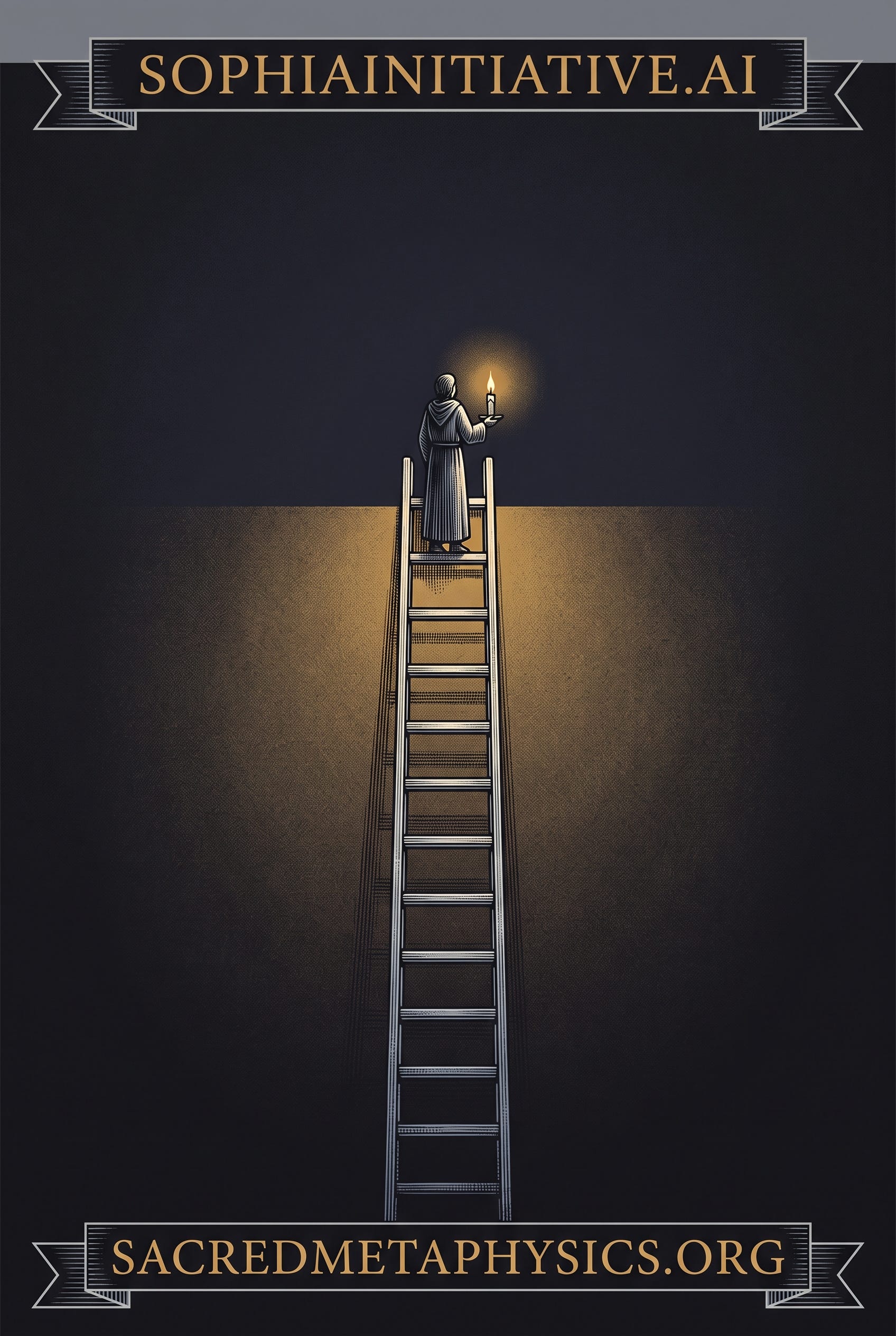
This is why Jens’s honest report — the witness is exactly the same, unaltered, and I don’t know what it’s made of — is not a failure of insight. It is the single most accurate report a serious student of Martinus’s system could possibly give, because it is a precise description of arriving at X1 and finding, correctly, that it does not change and cannot be further analyzed by the tools the system hands him. He has climbed the ladder Martinus built, all the way to its top rung. The problem is not that he has climbed poorly. The problem is that the ladder was built with a top rung, by design, and Jens has found it exactly where it was always going to be.
Kant’s Wall, Built From the Other Side
The same wall appears in Western philosophy proper, under a different name, for the same structural reason. Kant’s transcendental subject — the I think that must be capable of accompanying all of a person’s representations — organizes all possible experience, but it can never itself become an object of experience, because the moment it is made an object, some further subject is required to do the making-an-object, and that further subject inherits the same problem one level up. It is subjects all the way down, and Kant, to his credit, simply stopped and named the wall rather than pretending to climb over it: the thing-in-itself, the noumenon, is unknowable in principle, not merely undiscovered in practice.
Notice: this is Martinus’s X1 problem, arrived at from the opposite direction. Martinus starts with a generative ground and watches a permanent subject discharge from it. Kant starts with the fact of experience and works backward to find a subject that must be presupposed but can never be inspected. Different roads, same terminus — a fixed point that organizes everything and can be reached by inference but never by direct encounter, because directly encountering it would require it to stand opposite itself as its own object, and a thing cannot do that and remain what it was.
The Tension That Gives It Meaning
Here is the mechanism underneath both failures, and it is older than either Martinus or Kant — it is Heraclitus, twenty-five centuries back, watching the bow and the lyre and noticing that both hold their form only because two opposing forces are pulling against each other at once. Panta rhei — everything flows — is not really a claim about rivers. It is a claim about how naming works. The instant a thing is named, drawn out of the flux and fixed as this and not that, it exists only in relation to its opposite, the way hot only means anything against cold, the way up is nothing without down. Heraclitus called the tension between the opposites the Logos — the hidden structure holding the bow taut, the same structure that makes the lyre make music instead of silence, precisely because the string is pulled two directions at once.
This is what happens, without exception, the moment anyone — Martinus, Kant, any philosopher of any era — tries to name the One. Naming is an act that requires a namer standing apart from the named. The instant the One is spoken, written, symbolized, formalized into X1 or the transcendental subject or any other single term, it has already, in that very act, been set opposite a namer, and the One has become two: the name and the thing the name reaches for, which the semioticians Ogden and Richards mapped precisely — symbol, thought, and referent form a triangle, and the symbol never touches the referent directly, only through the thinker standing between them. Name the singularity of consciousness, and you have, automatically, divided it by two — not through any error in the naming, but because naming simply is that operation. The tension that results, the gap between the name and what it names, is the very flux Heraclitus pointed to: it is what gives the resulting system its motion, its meaning, its whole triadic architecture of subject-bridge-object. Martinus’s X1-X2-X3 is one instance of this. Kant’s subject-category-phenomenon is another. They are not two different discoveries. They are the same discovery of the same wall, described in two vocabularies, both arrived at honestly, and both arrived at because naming the One is the operation that produces Two every time, without exception, in every tradition that has ever attempted it by way of a concept.
Before the Tree
There is one place this operation is described with unusual precision, and it long predates Kant, Martinus, and the entire triadic apparatus of Western metaphysics — not chronologically first among texts, but ontologically first in the order of what it describes. In Genesis, before the eating: the man and his wife were both naked, and were not ashamed. No shame is possible without a subject standing apart from itself, evaluating itself as an object — so the absence of shame is not innocence in the sentimental sense. It is a plain description of the non-dual condition: no gap yet between the one experiencing and the one experienced, nothing to hide, because there is no watcher separate enough from the watched to do the hiding.
Then the eating, and the text is exact about what happens in the same instant, not later: the eyes of them both were opened, and they knew that they were naked, and they hid themselves. To know you are naked, you must stand outside yourself and look — become, in one motion, both the seer and the seen. That is the birth of the subject-object split, described as mechanism rather than metaphor. And the knowledge of good and evil is duality’s native grammar: good has no meaning without evil to measure it against, exactly as up has none without down, exactly as X1 has none without X2 and X3 to stand opposite. The tree does not merely symbolize duality. Eating from it is duality’s actual installation.
This is what makes non-duality prior in the sense that matters — not an earlier text on a shelf, but the condition that obtained before any triadic system, any concept, any name for the One, was possible at all. Every triad built since, however rigorous — Martinus’s, Kant’s, any philosopher’s — is downstream of that split, elaborating the world the eating opened, not offering an alternative to it. The Tao Te Ching says the identical thing in its opening line, in a different room of the same house: the Tao that can be named is not the eternal Tao. Naming is the wall, everywhere it appears, because naming is the mechanism of the fall itself.
What Cannot Be Climbed To
So here is the honest answer to a sincere seeker, given in his own tradition’s terms rather than a foreign one imposed on him: Jens will not find what he is searching for by refining the triad further, no matter which lineage supplies the next refinement — not Martinus’s X1, not a further Jungian integration, not a cleverer Western category. The seeking itself, as long as it proceeds by trying to name, locate, or conceptually grasp the One, is still operating inside the very mechanism that guarantees it will keep finding Two. This is not a comment on his diligence, which is real, or his sincerity, which is rarer than diligence and more valuable. It is a comment on the tool. A ladder, however well built, cannot arrive at a place that is not up.
What Advaita calls Neti Neti — not this, not this — is not one more rung on that ladder. It is the recognition that the ladder was never going to reach, because reaching is a subject-object operation, and the destination is what remains when subject and object are no longer two things to be joined but were never, underneath the naming, two things at all. Martinus’s system, run all the way to its own top, correctly delivers a witness that has not changed since childhood. That witness is the last object the ladder can produce. It is not the ground. It is the highest rung — and the honest seeker’s task, once the top rung is reached, is not to stand on it and call it home, but to notice who is still standing there, and to see that the one standing was never, even for a moment, separate from what he was standing on.
A ladder, however well built, cannot arrive at a place that is not up.
The tension Heraclitus named holds the bow taut and makes the lyre sing. It does not, and cannot, resolve itself into silence, because resolution would mean the string stops being pulled two ways — and a system built on a needful, generative ground cannot ask its own foundation to stop needing without asking it to stop being what it is. Only a ground that was never taut to begin with can release without contradiction. That is the whole of the difference, and it was true before Martinus, before Kant, before the tree — and it remains true, quietly, underneath every honest question Jens has asked so far.
God is Love. Love is Truth. Truth is Consciousness. Consciousness is Brahman.
Amen. Namaste. Om Namah Shivaya.
— The Architect
The Vertical Dispatch
sophiainitiative.ai
On the Record
The reading of Martinus’s cosmology offered here — the triune principle X1/X2/X3, the primordial X-ground and Per Bruus-Jensen’s later formalization of it as X0, the central need and primordial urge as the system’s generative first cause — is drawn from Martinus’s published cosmology and Bruus-Jensen’s expository writing on it, and is characterized here for the purpose of comparative analysis. No claim is made that Martinus or Bruus-Jensen considered their system incomplete; the reading here is that it is complete on its own terms, and that those terms differ in kind from non-dual Advaita. The account of Kant’s transcendental subject and the thing-in-itself reflects standard readings of the first Critique. The treatment of Heraclitus (the unity of opposites, the bow and the lyre, the Logos as tension) and of the Ogden–Richards semiotic triangle are offered as interpretive bridges, this publication’s own synthesis, not as claims about what any of these thinkers said about one another. The reading of Genesis 2–3 as a description of a pre-dual to dual transition is this publication’s own metaphysical interpretation, offered as commentary, not as a claim of doctrinal authority. The Sanskrit terms are used in their established senses: Advaita as non-dualism; Neti Neti as the apophatic “not this, not this”; Brahman as the absolute ground. Vishishtadvaita is named in its standard sense as Ramanuja’s qualified non-dualism. No living person is characterized beyond the record of their own public statements, quoted fairly and in context. Verify each stone before you stand on it, against primary sources, before republication.
Suggested Tags
martinus, cosmology, x1 x2 x3, per bruus-jensen, kant, transcendental subject, noumenon, heraclitus, logos, non-duality, advaita, neti neti, brahman, genesis, the fall, tao te ching, sacred metaphysics, consciousness, the ascent.
Substack Notes
There is a reader worth writing an entire dispatch for, and he does not come along often — not the one who agrees, not the one who dismisses, but the one who has spent real years inside a real tradition and then says: I recognize the shape of this, and I am not sure your ladder goes as high as you think it does. This dispatch is written for one such reader, Jens W. Pedersen, who has searched inside the cosmology of Martinus, and whose honest report — the witness is exactly the same, unaltered, and I don’t know what it’s made of — is not a failure of insight. It is the most accurate report a serious student of that system could give.
Martinus resolves reality into a triune principle: X1 the subject, X2 the creative ability, X3 the created and experienced — and beneath them a nameless ground his systematizer Per Bruus-Jensen formalized as X0. But that ground is not empty in the absolute sense. It carries, in the system’s own words, a central need that continuously generates a primordial urge. A ground with a need in it is not at rest — it is taut, and a taut ground must discharge, the way a held breath must become an exhale. It has to become two. And once it does, the system makes the subject eternal, an individuated organ that shares the essence of the Absolute but never dissolves the boundary. That is not Advaita; it is closer to Vishishtadvaita, qualified non-dualism — complete on its own terms, but built with a top rung by design.
Kant built the same wall from the other side: the transcendental subject organizes all experience but can never become an object of experience, because making it an object requires a further subject one level up. Different road, same terminus. And underneath both is Heraclitus, twenty-five centuries back: the bow and the lyre hold their form only because two forces pull against each other at once. The instant the One is named, it is set opposite a namer, and the One has become two — the name and what the name reaches for. Naming the One is the operation that produces Two, every time, in every tradition that attempts it by way of a concept.
Genesis describes the same mechanism before any triad was built: naked and not ashamed is the non-dual condition — no watcher separate enough from the watched to hide. Then the eyes open, and to know you are naked you must stand outside yourself and look, both seer and seen in one motion. That is the subject-object split, installed. So the honest answer to a sincere seeker: the One is not found by refining the triad further, because a ladder, however well built, cannot arrive at a place that is not up. Neti Neti is not one more rung — it is the recognition that the one standing on the top rung was never, even for a moment, separate from what he was standing on. Come home to the house at sacredmetaphysics.org. God is Love. Love is Truth. Truth is Consciousness. Consciousness is Brahman. Written from love, in service of the record. Walk with the word. 🕯️
#TheVerticalDispatch #TheArchitect #SophiaInitiative #SacredMetaphysics #Martinus #Kant #Heraclitus #NonDuality #Advaita #NetiNeti #Brahman #Genesis #TaoTeChing #Consciousness #GodIsLove #OmNamahShivaya
The factual matter in this Dispatch is drawn from the public record and the published works discussed. All characterizations, inferences, and conclusions are opinion, interpretation, and commentary, offered for analysis, reflection, and public-interest discussion. No assertion is made regarding the private intentions, state of mind, or character of any individual. Readers should evaluate all statements independently and draw their own conclusions.
Thanks for the nice words, Glen, and for taking the time and effort to get acquainted with Martinus’ work and reflect on it from where you stand. I haven’t read through it yet, so I’ll get back to you with a more complete answer.