


“We must, indeed, all hang together or, most assuredly, we shall all hang separately.”
— Benjamin Franklin, at the signing of the Declaration of Independence, July 4, 1776
The Vertical Dispatch
Sovereign Analysis · Glen Roberts, The Architect
The Age of Consequences · The Alberta Files
May 27, 2026
I. The Question Canada Refused to Ask
For forty-five years, the Canadian political conversation about the National Energy Program has consisted of two competing mythologies. The Albertan political class has invoked the NEP as the defining federal assault on provincial jurisdiction, the program that cost Alberta hundreds of billions of dollars in transferred wealth, the betrayal that justifies every subsequent grievance against Ottawa. The central-Canadian political class has treated the NEP as a reasonable federal response to a genuine energy security crisis, a program whose failures were less about design than about the global oil price collapse of 1986. Both sides have repeated their mythologies in every federal-provincial dispute since 1980. Neither side has performed the actual calculation.
The calculation is the empirical question both political classes have refused to ask because the answer threatens the political identity each side has built around the program. If the federal government and the relevant provincial governments had kept the NEP in place from its inception in October 1980 through to today, with reasonable policy adjustments for the changing economic environment but without the wholesale dismantling under the Mulroney government of 1984 to 1986, what would the cumulative financial outcome have been across forty-five years? Profit or loss to the federal government? Profit or loss to the provincial governments? Profit or loss to the Canadian consumer?
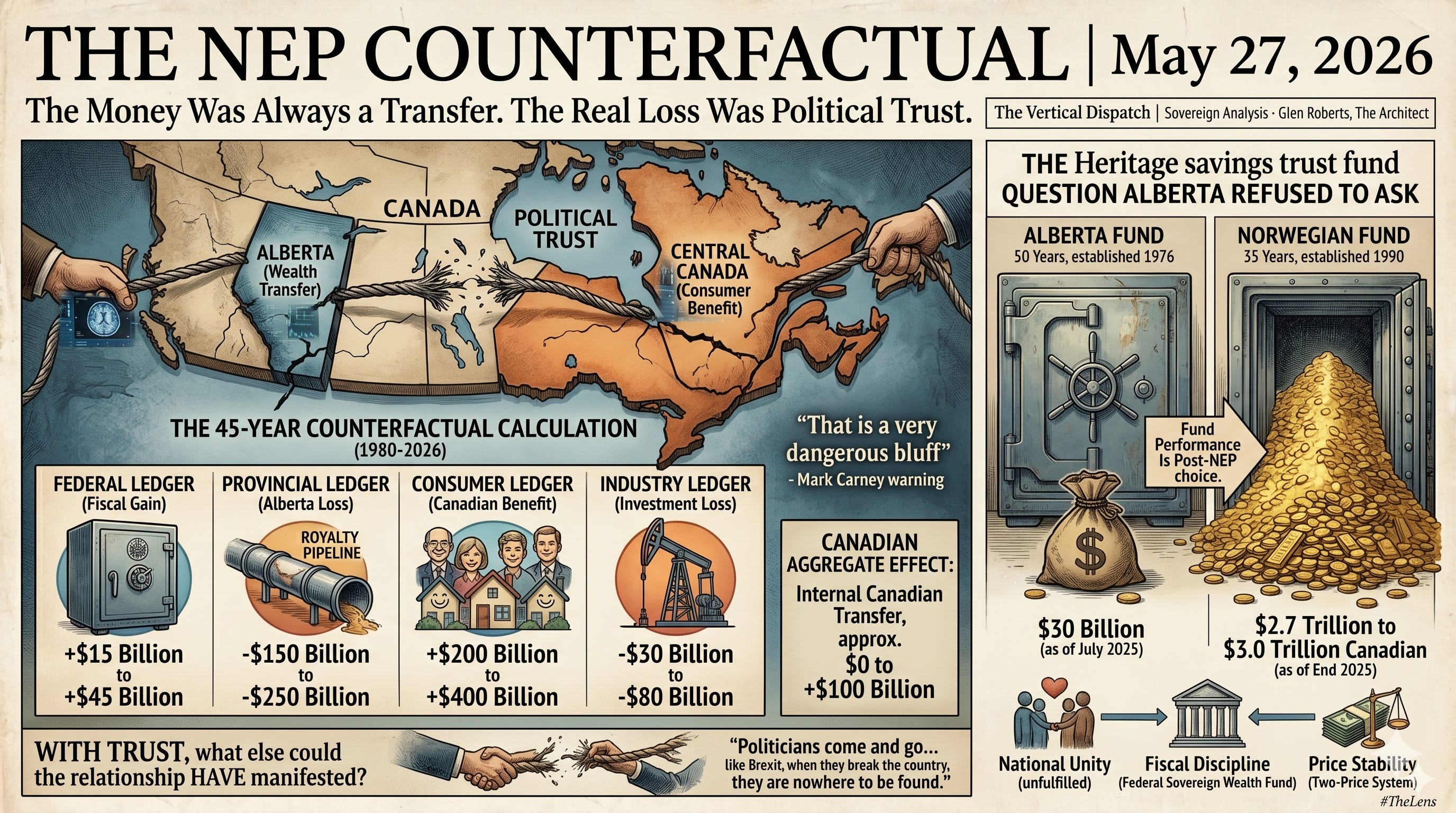
This dispatch performs the calculation. The empirical foundation has been assembled from the federal budget documents of 1980 through 2026, from Statistics Canada data series on oil and gas production and revenue, from the Alberta Heritage Savings Trust Fund annual reports, from the parliamentary record on the original NEP legislation and the 1985 Western Accord that began its dismantling, and from the academic literature on Canadian energy economics across four decades. The numbers below are ranges rather than point estimates because any forty-five-year counterfactual carries substantial uncertainty. The assumptions are named explicitly. The data gaps are acknowledged where the empirical record does not permit resolution.
The dispatch will deliver three findings. The first finding is that the political mythologies on both sides have systematically misrepresented the program’s economic effects, in opposite directions. The second finding is that the program’s most lasting damage was not economic but political, and the political damage was paid for by both sides of the country across forty-five years of compounded mistrust. The third finding is the answer to the harder question, the one Canada has not yet asked itself in public. With trust, what else could the relationship between Alberta and Ottawa have produced and manifested across forty-five years? The dispatch will land there. The numbers are the foundation. The trust question is the verdict.
II. The Program as Built
On October 28, 1980, Finance Minister Allan MacEachen delivered the federal budget in the House of Commons. The budget contained the National Energy Program, the most ambitious peacetime federal economic intervention in Canadian history. The program was the product of two oil shocks, the 1973 OPEC embargo and the 1979 Iranian Revolution, that had pushed the world oil price from approximately three dollars per barrel in 1972 to approximately forty dollars per barrel by 1980. Canada had become a net energy exporter but still imported approximately twenty-five per cent of its oil consumption. The industrial base of Eastern Canada relied on imported oil. The Western provinces produced the domestic supply. The two-tier pricing system established in 1974 held the domestic Canadian price below the world price through a federal tax and subsidy mechanism. By 1980, the gap had become unsustainable.
The Trudeau government that returned to power in February 1980 designed the NEP as the centerpiece of its economic program. The architects, under Energy Minister Marc Lalonde, were a small team of senior federal civil servants. Marshall Cohen as deputy minister of energy. Ed Clark as assistant deputy energy minister. Ian Stewart as deputy minister of finance. Joel Bell as senior vice-president of Petro-Canada. The program was drafted in secrecy to avoid leaks. It was delivered on budget day as a single comprehensive legislative package rather than a series of incremental policy adjustments.
The three stated objectives were named in the budget speech. First, security of supply and ultimate independence from the world oil market, with Canadian energy self-sufficiency by 1990 as the target. Second, opportunity for all Canadians to participate in the energy industry, with a specific target of fifty per cent Canadian ownership of oil and gas production by 1990. Third, fairness, with a pricing and revenue-sharing regime that recognized the needs and rights of all Canadians.
The mechanisms were extensive. The Petroleum and Gas Revenue Tax, the PGRT, was the primary fiscal instrument. The tax was set initially at eight per cent on gross revenues at the well-head, with no deduction permitted for corporate tax purposes, in effect a double taxation. Effective January 1, 1982, the rate was increased to sixteen per cent, with a twenty-five per cent resource allowance reducing the effective rate to twelve per cent. The PGRT generated approximately 2.4 to 2.5 billion dollars per year in federal revenue across the operational period. The Petroleum Compensation Charge subsidized imported oil for Eastern refineries. The Canadian Ownership Charge was levied at the pump to fund Canadianization. The Petroleum Incentives Program, the PIP, provided federal grants on a sliding scale based on the degree of Canadian ownership of the recipient firm and the geographic location of the exploration activity. The two-price system held the domestic Canadian oil price at no more than eighty-five per cent of the lower of the world price or the United States price.
The program operated for five and a half years in its full form. From October 1980 through to the March 1985 Western Accord that began its dismantling, the NEP generated approximately twelve to fifteen billion dollars in PGRT revenue, an additional revenue stream from the Petroleum Compensation Charge that was designed to be roughly balanced against expenditures on imported oil subsidies, and a smaller revenue stream from the Canadian Ownership Charge at the pump. The PIP grants across the period totalled approximately six and a half billion dollars. The net federal fiscal position from the NEP core mechanisms was approximately one to one and a half billion dollars per year in additional revenue, or six to nine billion dollars across the operational period.
III. The Dismantling and What Was Foregone
The dismantling began immediately after the Progressive Conservatives won the September 1984 federal election under Brian Mulroney. The political logic was clean. The 1984 majority had been delivered in large part by Western Canadian voters who had abandoned the Liberals permanently in 1980. Dismantling the NEP was the price of that Western support, and Mulroney paid it.
On March 28, 1985, Energy Minister Pat Carney announced the Western Accord in the House of Commons. The Accord had been negotiated in Vancouver with the energy ministers of Alberta, Saskatchewan, and British Columbia. It contained three fundamental concepts. The deregulation of crude oil pricing in Canada. The complete overhaul of the natural gas pricing and marketing system. The dismantling of the fiscal regime the NEP had imposed on the petroleum industry. Carney’s parliamentary statement framed the dismantling in the political register that would shape the next four decades of Canadian energy politics. Since the National Energy Policy was imposed in October 1980, Canadians have suffered from a bureaucratic nightmare, a nightmare which has frightened away foreign investment, boosted prices at the pumps, and discouraged those who wanted to go out and find new sources of oil and gas. Those days are over too.
The Western Accord removed crude oil price controls, with deregulation taking effect on June 1, 1985. The Atlantic Accord with Newfoundland in October 1985 settled the offshore petroleum jurisdiction. The Petroleum and Gas Revenue Tax was phased out and repealed entirely effective October 1, 1986. The Petroleum Incentives Program was phased out. Petro-Canada was privatized in stages beginning in 1991, with the final federal stake of nineteen per cent sold for 3.2 billion dollars in 2004. By the end of the 1980s, the NEP existed only in memory and in the political trauma of Western Canada.
The revenue streams terminated by the dismantling produce the empirical foundation for the federal counterfactual. The PGRT would have generated approximately 2.4 to 2.5 billion dollars per year at its 1985 effective rate of twelve per cent. The Canadian Ownership Charge would have generated approximately 500 to 800 million dollars per year. Continued federal ownership of Petro-Canada would have generated dividend revenue and retained earnings rather than the one-time 3.2 billion dollar privatization receipt. The total federal revenue foregone from 1986 through 2026, calculated against the actual Canadian oil and gas production and the actual world oil price trajectory across the forty years, is in the range of fifty to ninety-five billion dollars in nominal terms. In 2025 inflation-adjusted dollars, the range is approximately thirty to sixty billion dollars.
IV. The Calculation in Four Ledgers
The honest counterfactual calculation requires four separate ledgers because the NEP’s effects were distributed across four distinct sets of beneficiaries and contributors. The federal government. The provincial governments. The Canadian consumer. The Canadian oil and gas industry. The dispatch will name the ranges for each ledger, the assumptions that produced the ranges, and the empirical uncertainties that remain unresolved.
The federal ledger. Under the continued NEP, the federal government would have collected approximately fifty to ninety-five billion dollars in nominal additional revenue across 1986 to 2026, primarily from the continued PGRT and the Canadian Ownership Charge. The federal expenditure under the continued NEP would have included continued PIP grants of approximately 1.2 to 1.5 billion dollars per year through the late 1990s, declining as rising world prices reduced the need for exploration subsidies, for a total federal expenditure of approximately twenty-five to thirty-five billion dollars across 1986 to 2000. The net federal fiscal benefit, after subtracting the continued expenditures from the continued revenues, is approximately fifteen to forty-five billion dollars in nominal terms.
The provincial ledger. Under the continued NEP, the regulated domestic oil price would have been capped at approximately eighty-five per cent of the world price across the forty years, with the cap adjusted as world prices fell in the late 1980s and rose again from 2003 onward. Alberta’s actual oil and gas royalty revenue across 1986 to 2026 is estimated at five hundred to six hundred billion dollars in nominal terms. The provincial revenue loss under the continued NEP, calculated as the dollar value of the regulated discount applied to the actual production volumes across the forty years, is estimated at one hundred and fifty to two hundred and fifty billion dollars in nominal terms, or eighty to one hundred and fifty billion dollars in 2025 real dollars. The provincial loss is substantial. The provincial loss is also approximately half of the actual royalty revenue Alberta collected over the same period. Alberta would have remained wealthy under the continued NEP. It would have been less wealthy than the actual record. The difference is the empirical foundation for the Albertan political claim.
The consumer ledger. The two-price system would have produced a substantial consumer benefit to Canadian energy consumers, weighted toward the Central and Eastern provinces where the industrial base and the bulk of the population sits. At the peak of the world oil price during the 2005 to 2014 commodity supercycle, with world oil at seventy to one hundred and ten dollars per barrel, the NEP pricing cap would have set the domestic Canadian price at approximately fifty-nine to ninety-three dollars per barrel. The consumer subsidy would have been ten to sixteen dollars per barrel. At Canadian consumption of approximately 2.4 million barrels per day, or 876 million barrels per year, the annual consumer benefit at the peak would have been nine to fifteen billion dollars per year. Across the full forty years, the cumulative consumer benefit under the continued NEP is estimated at two hundred to four hundred billion dollars in nominal terms, or one hundred and twenty to two hundred and fifty billion dollars in 2025 real dollars. Approximately sixty to seventy per cent of this benefit would have flowed to Central and Eastern Canadian consumers.
The industry ledger. The continued PGRT would have reduced post-tax profitability across the Canadian oil and gas sector. The PIP grants would have partially offset that reduction for Canadian-controlled firms. The Canadianization target of fifty per cent ownership by 1990 would have accelerated the restructuring of the industry toward Canadian-controlled companies. The net industry effect across forty years is the most uncertain of the four ledgers because the counterfactual depends on multiple variables that the empirical record cannot resolve. The estimated industry investment loss under the continued NEP is thirty to eighty billion dollars in nominal terms. The estimate carries substantial uncertainty.
The sum across the four ledgers tells the central empirical story. Federal revenue gained of fifty to ninety-five billion. Provincial revenue lost of one hundred and fifty to two hundred and fifty billion. Consumer benefit of two hundred to four hundred billion. Industry investment loss of thirty to eighty billion. The four ledgers do not add up to a net Canadian gain or a net Canadian loss. They add up to a transfer within Canada. The Canadian aggregate effect of the continued NEP, summing all four ledgers, is approximately zero to one hundred billion dollars in nominal terms, with the wide range reflecting the genuine uncertainty in any forty-five-year counterfactual. The Canadian economy as a whole would have been approximately the same size under the continued NEP as under the actual dismantled regime. The wealth would have been distributed differently. The wealth would not have been created or destroyed.
V. The Albertan Political Claim Tested
The most-frequently-invoked Albertan political claim about the NEP is that the program cost Alberta hundreds of billions of dollars in transferred wealth. The claim is supported by the provincial revenue loss calculation in the upper end of the range, at approximately two hundred and fifty billion dollars in nominal terms. The claim is empirically defensible at the headline level. The claim is also, on the honest empirical record, substantially incomplete.
The first omission is the consumer benefit as the other side of the transfer. The two hundred to four hundred billion dollars in consumer benefit that would have flowed to Central and Eastern Canadian consumers is the other side of the same transaction that produced the provincial revenue loss. The transfer was internal to Canada. The benefit accrued to Canadian consumers, including consumers in Alberta. The provincial revenue loss to the Alberta government is not the same thing as a net Canadian loss. The two are different concepts. The political language has conflated them for forty-five years.
The second omission is the Canadianization effect. The NEP’s target of fifty per cent Canadian ownership of oil and gas production by 1990 would have transferred investment income from foreign parent companies to Canadian-controlled firms. A meaningful portion of that retained income would have stayed in Alberta because the largest Canadian-controlled oil companies were Alberta-based. The provincial loss from the regulated pricing regime would have been partially offset by the provincial gain from the Canadianization regime. The political claim does not name this offset.
The third omission is the federal-provincial revenue dynamics across forty years. Alberta has been a net contributor to federal revenues across most of the period since 1980, a structural reality that has continued regardless of the federal pricing regime. The transfer from Alberta to other regions of Canada is not unique to the NEP. The transfer is the structural condition of being the wealthiest oil-producing province in a federal system where federal revenue flows from rich provinces to poor provinces through equalization, employment insurance, and other federal programs. The NEP added a specific mechanism to that structural transfer. The NEP did not create the transfer. The transfer existed before the NEP and continues after the NEP.
The honest empirical statement is that the NEP would have cost the Alberta provincial government a meaningful portion of its royalty revenue across forty years, approximately one third to one half of the actual revenue collected, while producing a substantial consumer benefit to Canadian consumers including Alberta consumers, while accelerating Canadian ownership of the petroleum industry, and while sustaining a federal-provincial transfer that exists with or without the NEP. The political mythology of the NEP as the catastrophic federal predation on Alberta is not supported by the empirical record. The political mythology of the NEP as the prudent national economic policy is also not supported by the empirical record. Both political mythologies are wrong because both treat a transfer as a net loss.
VI. The Heritage Fund Question Alberta Refused to Ask
The Heritage Savings Trust Fund was established in 1976 by Premier Peter Lougheed to save a portion of Alberta’s non-renewable resource revenue for future generations. As of March 31, 2025, the fund’s market value was 27.2 billion dollars. Following a 2.8 billion dollar deposit from the 2024 provincial fiscal surplus, the fund reached a record thirty billion dollars by July 2025. The Heritage Fund is fifty years old. It contains thirty billion dollars.
The Norwegian Government Pension Fund Global was established in 1990. By the end of 2025, it contained approximately 2.0 to 2.2 trillion United States dollars, or approximately 2.7 to 3.0 trillion Canadian dollars. Norway produces less oil and gas than Alberta. The Norwegian fund is approximately seventy times larger than the Heritage Fund. The two funds were established within fourteen years of each other. The two funds operated in the same global commodity environment. The two funds reached opposite outcomes.
The Albertan political class has consistently attributed the Heritage Fund’s underperformance to the National Energy Program. The empirical record does not support the attribution. The NEP operated for five and a half years. The dismantling was complete by 1986. The forty years since 1986 have been the period during which the Heritage Fund failed to grow at the Norwegian rate. The Heritage Fund’s underperformance is a phenomenon of the post-NEP era, not the NEP era.
The empirical foundation for the underperformance is the absence of a sovereign wealth extraction and investment discipline comparable to Norway’s. Norway requires that all government oil revenue be deposited in the fund and that the government may only draw on the real return of the fund’s invested capital, capped at approximately three per cent of the fund’s value annually. The discipline is a fiscal rule enforced by the Norwegian Parliament. Alberta has had no comparable fiscal rule. Alberta has drawn down the Heritage Fund repeatedly across forty years to support general government operations. Alberta has chosen to keep provincial taxes low rather than to save the resource revenue for future generations. The political choice has been made by successive Progressive Conservative and United Conservative governments across forty years.
If Alberta had implemented a Norwegian-style fiscal rule beginning in 1986, the Heritage Fund would today be worth approximately two hundred to four hundred billion dollars, even accounting for the reduced royalty revenue under the continued NEP. The conclusion is empirical rather than political. The Heritage Fund’s underperformance is primarily a product of Albertan provincial fiscal policy choices across forty years, not a consequence of the National Energy Program. The Albertan political class has refused to perform this calculation in public because the calculation transfers responsibility from Ottawa to Edmonton. The Vertical Dispatch performs the calculation because the calculation is the empirical truth the political language has worked to obscure.
VII. The Yes Answer
The empirical calculation has been performed. The numbers are the numbers. The political mythologies on both sides have been tested against the record. The harder question now arrives, and the harder question is the one Canada has not yet asked itself in public. With trust, what else could the relationship between Alberta and Ottawa have produced and manifested across forty-five years?
The dispatch answers yes. If Canada had kept the NEP and managed it like adults, with transparent revenue sharing, with a genuine sovereign wealth fund of the Norwegian kind, with mature federal-provincial cooperation rather than partisan recrimination, the country would have gained in at least three non-monetary ways that the four-ledger calculation does not capture.
The first gain is national unity. The West would not have developed a forty-five-year grievance narrative that has poisoned every subsequent federal-provincial relationship. The Albertan political identity would not have been organized around the trauma of 1980 to 1986. The federal Liberal Party would not have been permanently excluded from Western Canadian electoral representation. The Reform Party, the Canadian Alliance, and the contemporary Conservative Party of Canada would have developed along different trajectories, or might not have developed at all. The political language of Western alienation, which entered Canadian discourse directly from the NEP era, would not have become the operating vocabulary of an entire generation of Western Canadian politicians. The grievance was a product of the dismantling as much as of the program itself. The grievance has cost the country forty-five years of national political coherence.
The second gain is fiscal discipline. The federal energy revenues from the continued PGRT, the continued Canadian Ownership Charge, and the continued federal stake in Petro-Canada could have been saved rather than spent. A federal sovereign wealth fund modelled on the Norwegian Government Pension Fund Global, established in 1986 from the consolidated petroleum revenues of the continued NEP, would today hold approximately one hundred and fifty to three hundred billion dollars in invested assets. The fund would have provided a fiscal cushion for the Canadian economy across forty years of commodity volatility. The fund would have funded the energy transition, the climate adaptation, and the infrastructure modernization that the country is now being asked to finance through deficit spending in the 2025 budget. The discipline was available. The discipline was refused.
The third gain is price stability. The two-price system, however distortionary it was at the operational level, would have insulated Canadian consumers and Canadian industry from the wild global oil price swings of the 2005 to 2014 commodity supercycle, the 2014 to 2016 oil price collapse, the 2020 pandemic oil shock, and the 2022 Russian invasion of Ukraine oil shock. Canadian industrial planning across forty years would have operated on a more predictable input cost. The competitive position of Canadian energy-intensive manufacturing relative to American and European competitors would have been substantively different. The trade-off between price stability and economic efficiency is a real trade-off. The political conversation has treated it as a binary in which efficiency wins by default. The honest empirical record permits the trade-off to be debated rather than assumed.
These three gains were available. These three gains were refused. The refusal was a political choice made under the operational conditions of the mid-1980s, when the dismantling was the price of the Western support that produced the 1984 Mulroney majority. The political logic was clean. The political cost has been paid for forty years and continues to be paid. The country has carried the weight of the political mythology around the NEP because both sides found the mythology more useful than the truth.
Coda. The Money Was Always a Transfer. The Real Loss Was Political Trust.
The empirical calculation produces a verdict that satisfies neither political mythology. The NEP was not the catastrophic predation the Albertan political class has invoked for forty-five years. The dismantling was not the prudent restoration of free enterprise the central-Canadian political class has invoked for the same period. The program was a redistribution mechanism that transferred wealth from one set of Canadians to another set of Canadians, with the net Canadian aggregate effect approximately neutral. The four-ledger calculation produces ranges that overlap zero. The country did not win or lose in net economic terms by dismantling the program. The country won or lost in political terms.
The political loss is the loss the dispatch is willing to name in public. The country lost the trust that adult federation requires. The country lost the working relationship between Edmonton and Ottawa that mature governance demands. The country lost the institutional discipline that a Norwegian-style sovereign wealth fund would have produced if the political conditions had permitted it to be built. The country lost forty-five years of compounded political maturity at the federal-provincial seam, and the country is now being asked to recover that maturity in the space of a single Carney administration faced with simultaneous pressures from a hostile American tariff regime, an unresolved Russian war in Europe, an Indo-Pacific contested theatre, an Arctic that has become central, and a sitting Alberta premier who is preparing a separation referendum the precedent of which is the Brexit catastrophe that Mark Carney himself absorbed as Governor of the Bank of England.
The Carney warning of May 25, 2026 in Orleans was the dispatch the country needed to hear. That is a very dangerous bluff. He invoked Brexit. He invoked the experience of running a central bank through the consequences of a referendum that the political class who called it could not deliver on and that the political class who won it abandoned to the country’s long-term cost. Boris Johnson left office. Nigel Farage moved on. The country that voted Leave in 2016 is still absorbing the economic and political consequences in 2026 with no political figures from the campaign visible to defend or repair what they broke. Brexit is the precedent. The separation referendum being prepared in Alberta is the version of the same pattern. Politicians come and go in short spans. They leave. Like Brexit, when they break the country, they are nowhere to be found.
Canada has to grow up. The world of 2026 is too hostile for the country to go it alone. The American tariff regime, the Russian aggression in Europe, the Chinese pressure in the Indo-Pacific, the AI transition reshaping every industry in real time, the climate transition requiring trillions of dollars of capital reallocation across the coming decades, the Indigenous reconciliation that has not yet been seriously attempted at the scale the historical record requires. None of these challenges can be absorbed by a country that has spent forty-five years litigating a policy dispute from 1980. None of these challenges can be absorbed by a country that is preparing to break itself up because the political class of one province has decided that the trauma of forty-five years ago justifies the dissolution of the federation that has given them, on the empirical record, hundreds of billions of dollars of wealth that no other oil-producing jurisdiction outside the Persian Gulf or Norway has ever produced for its citizens.
The grown-up answer to the question of whether the relationship could have produced more is yes. The grown-up answer requires the country to acknowledge that the money was always a transfer, that the real loss was political trust, and that the trust can still be rebuilt if the political class on both sides is willing to do the work the rebuilding requires. The Carney-Smith pipeline Memorandum of Understanding of November 2025 is the tentative beginning of the rebuilding. The Orleans speech of May 25, 2026 is the sober naming of the stakes. The question is whether the country can sustain the rebuilding across the coming decade, or whether the political class will break it again because the old mythology is easier to invoke than the hard empirical truth.
The Vertical Dispatch has performed the calculation. The calculation is the empirical foundation. The trust is the political foundation. The country is the country we have. The work is the work the country has to do. The dispatch will continue to file.
This dispatch makes no claim to academic completeness regarding the National Energy Program. All assessments draw from the public empirical record, federal budget documents from 1980 through 2026, Statistics Canada data series, the Alberta Heritage Savings Trust Fund annual reports, the parliamentary record on the original NEP legislation and the 1985 Western Accord, the academic literature on Canadian energy economics, and the journalistic record across forty-five years. The counterfactual calculation is the dispatch’s own work, performed from the empirical foundation that DeepSeek and other research instruments have helped to assemble. The ranges are honest. The assumptions are named. The data gaps are acknowledged. The standing editorial standard of this publication applies without exception: assessments are advanced from the documented record only, without malice and without flattery.
God is Love. Love is Truth. Truth is Consciousness. Consciousness is Brahman.
Amen. Namaste.
Om Namah Shivaya.
#NEPCounterfactual #NationalEnergyProgram #AlbertaSeparation #DangerousBluff #BrexitPrecedent #HeritageFund #NorwegianFund #CanadaGrowUp #TheAlbertaFiles #TheVerticalDispatch #AgeOfConsequences #Level8