


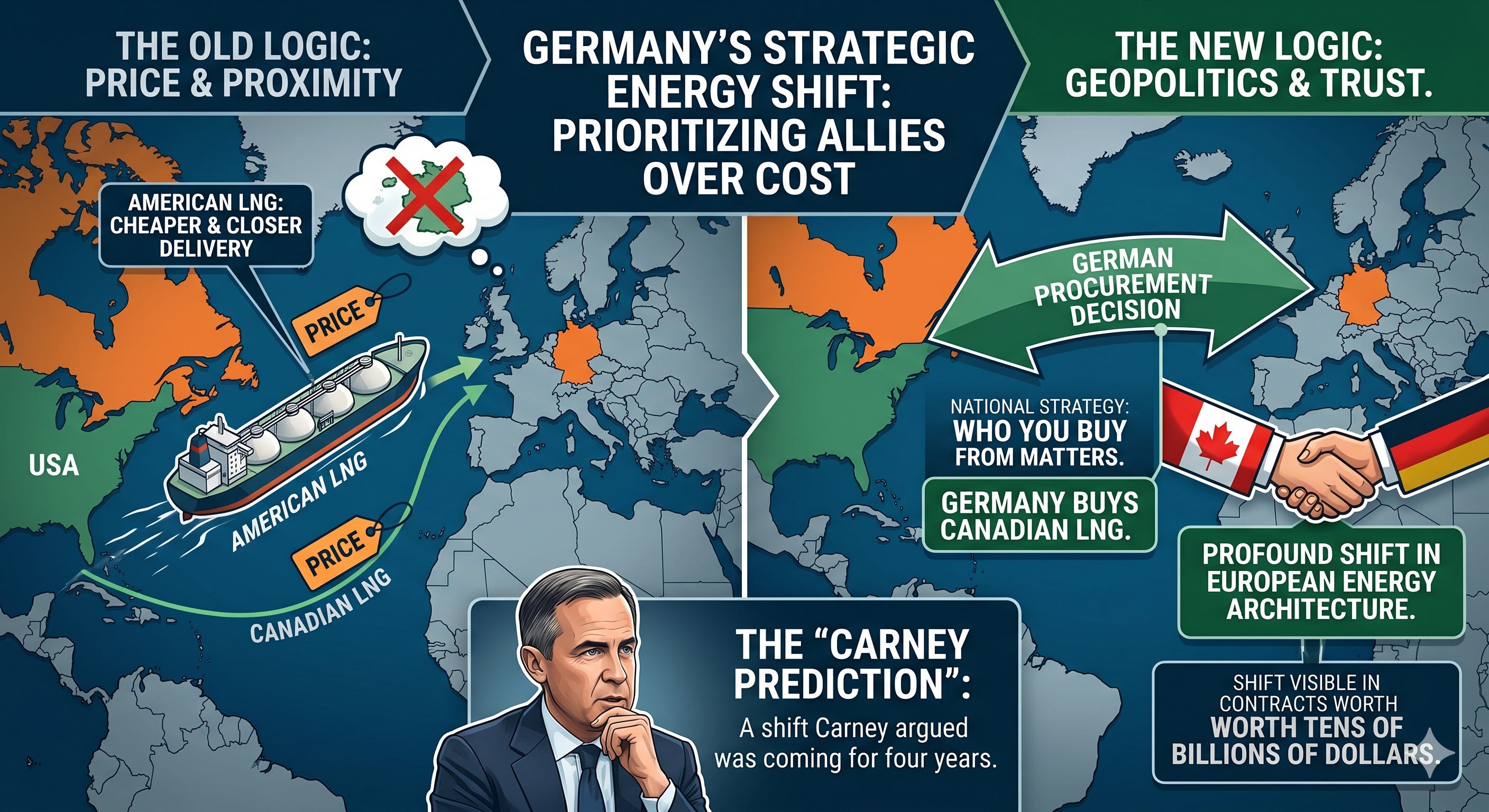
Germany chose Canada in part because it wants to diversify its LNG away from current suppliers — and do business with stable countries.
— Natural Resources Minister Tim Hodgson, Vancouver, May 27, 2026
The CanLit Files · Glen Roberts, The Architect
The Sovereign Core · The Age of Consequences
May 27, 2026
I. The Headline
The Government of Canada announced today in Vancouver a landmark long-term liquefied natural gas supply agreement between Ksi Lisims LNG on the British Columbia Pacific coast and Securing Energy for Europe, the German state-owned energy company known by its initials SEFE. Natural Resources Minister Tim Hodgson made the announcement alongside Eva Clayton, elected president of the Nisga’a Lisims government, which is principal co-owner of the project. The deal commits SEFE to purchase up to one million tonnes of LNG per year from the facility, on a term reported as up to twenty years, with shipments scheduled to begin in the early 2030s once construction is complete and the project reaches its final investment decision.
The Ksi Lisims facility is a proposed ten-billion-dollar export terminal on Canada’s Pacific coast, situated on Pearse Island in Nisga’a Nation territory eighty kilometres north of Prince Rupert near the Alaska panhandle. Its developers are the Nisga’a Nation, Houston-based Western LNG, and a consortium of Canadian natural gas producers called Rockies LNG. Total facility capacity at full build-out is twelve million tonnes per year, which will make Ksi Lisims Canada’s second-largest LNG export facility after the LNG Canada plant at Kitimat that began exports in 2025. The facility receives its gas through the proposed seven-hundred-and-fifty-kilometre Prince Rupert Gas Transmission pipeline, owned equally by the Nisga’a Nation and Western LNG.
The federal government designated Ksi Lisims a Major Project of national interest on November 13, 2025, when Prime Minister Carney announced the project’s inclusion in the federal fast-track approval list during an address near the site itself. The project received its joint federal-provincial environmental approval in September 2025. Shell and TotalEnergies have already signed twenty-year supply agreements with the project. The SEFE deal announced today is the first long-term Canadian LNG supply contract with a European buyer and the contract European buyers had been hoping to anchor for months. British Columbia Premier David Eby has stated publicly that the European anchor strengthens the investment case for the final investment decision the developers are expected to make later this year.
That is the headline. It is good news. It deserves the welcome the federal government and the British Columbia government and the Nisga’a Nation and the developers have given it. But the headline is also Level One reporting. The Dispatch’s job is to take the reader to the level where the structural logic of what is actually happening becomes visible. That is the work of this dispatch.
II. The Mechanism Underneath the Headline
Most readers will assume Germany is buying Canadian gas to burn in German power plants. That is not what is happening.
SEFE is a global LNG trading house. SEFE takes title to the Canadian gas at the Ksi Lisims terminal in British Columbia. From that moment on, SEFE owns the molecules. SEFE decides where they go. SEFE arranges the shipping. SEFE finds the end buyers, negotiates the prices, and pockets the trading margin. The Globe and Mail confirmed in its reporting this week that SEFE intends to export the Canadian fuel to Asia, not directly to Germany via the Panama Canal. The Canadian molecules will likely never physically reach German territory.
This is not a flaw in the deal. This is the design of the deal. SEFE is using the Canadian supply as part of a global swap arrangement. The Asian buyers who purchase the Canadian gas from SEFE will displace LNG they were previously buying from other suppliers — primarily United States Gulf Coast producers, Qatari producers, and Australian producers. The displaced supplies from those suppliers can then flow toward European markets instead, particularly the Atlantic-facing European terminals. Germany ends up with more LNG flowing toward Europe without ever physically receiving the Canadian molecules. The mechanism is what energy traders call a triangular swap. The European outcome is achieved through Asian distribution.
Why does Germany do it this way rather than simply buying directly? Because Germany is not just buying gas. Germany is buying market influence. Owning Canadian supply at the source gives SEFE optionality across the global system. SEFE can redirect the cargo if Europe has a winter emergency. SEFE earns trading margins on Asian sales. SEFE displaces other suppliers in markets Germany does not even consume in. The Canadian deal is a market-making lever, not a single-shipment contract. Germany has been operating this way since 2022, when the energy crisis taught Berlin that strategic energy security in the twenty-first century is built through portfolio diversification and global market position, not through bilateral pipeline contracts.
III. Why Germany Chose Canada Specifically
Germany’s existing LNG portfolio already includes long-term contracts with the United States (Venture Global’s CP2 facility in Louisiana, three million tonnes per year for twenty years), Norway (Equinor, ten billion cubic metres per year for ten years, valued at approximately fifty-five billion United States dollars), Russia (Novatek’s Yamal LNG, still flowing, free of sanctions), the United Arab Emirates (ADNOC’s Ruwais project, one million tonnes per year for fifteen years), Argentina (Southern Energy), and Turkey (BOTAS). Germany’s sister state-owned company Uniper signed a ten-year supply deal with India’s Gujarat State Petroleum Corporation in February 2026.
Germany is not new to this. Germany has been building a diversified state-owned global LNG trading book for four years. The Canadian deal is the latest addition to a portfolio that already spans seven supplier countries on four continents.
What makes the Canadian deal genuinely different from the others is what Canada is selling underneath the molecules.
The Nisga’a Nation is a principal co-owner of the Ksi Lisims facility and a fifty-percent owner of the Prince Rupert Gas Transmission pipeline that supplies it. The Nisga’a Final Agreement of 2000 was the first modern Treaty in British Columbia. The Nisga’a negotiated their self-government over twenty-five years across the most disciplined modern Treaty process the country has produced. The Nisga’a own their land. The Nisga’a govern their own affairs. The Nisga’a have built the legal, economic, and institutional capacity to enter international commercial arrangements at industrial scale as principals rather than as objects of consultation. The Ksi Lisims project is the operational fruit of that twenty-five-year disciplined work.
This is the part of the deal that has no precedent in the global LNG market. SEFE’s other contracts are with state oil companies, private corporate developers, and commercial supply houses. The Canadian arrangement is the first time a major European state-owned LNG trading house has anchored a long-term supply contract with a project where an Indigenous nation is a principal owner of the upstream resource. Europe is not just buying gas from Canada. Europe is buying the modern Treaty model as part of the supply contract. That Eva Clayton, elected president of the Nisga’a Lisims government, stood beside the Canadian Natural Resources Minister at today’s announcement podium is the ceremonial signal that the federation has, at least at the level of presentation, internalized the partnership the modern Treaty era was supposed to produce.
IV. The Carney Vision, Operational
The Vertical Dispatch has been tracking the Carney federal strategy across the spring. The strategy has several components. Trade diversification away from over-dependence on the United States market. Energy partnership with democracies that share Canada’s commitment to the climate transition and the rule of law. Indigenous co-ownership of major resource infrastructure as the operational expression of the Treaty inheritance. Strategic credibility as the currency middle powers actually possess in a world where great-power competition is destabilizing the global system.
The Ksi Lisims–SEFE deal is not one of these things. The Ksi Lisims–SEFE deal is all four of them in a single transaction.
Trade diversification — Canada is reducing dependence on the United States as a buyer of Canadian energy by anchoring a long-term European state-owned contract. The Prime Minister has publicly committed to doubling non-United States trade within a decade. The current trade picture, in which energy-rich Canada exports almost all of its oil and gas to the United States, is precisely the structural exposure the Carney strategy was designed to reduce. Energy partnership with a democracy — Germany has explicitly stated, through Minister Hodgson’s announcement today, that the choice to source from Canada is in part a choice to source from a stable democratic supplier rather than from politically less stable jurisdictions. Indigenous co-ownership — the Nisga’a Nation as principal partner is the defining feature of the deal, not an incidental one. Strategic credibility — Germany came to Canada because Carney’s European reputation, built across his Bank of England years, his Financial Stability Board work, his Glasgow Financial Alliance for Net Zero leadership, and his Climate Champion role, made the bilateral relationship credible at the level Berlin requires before committing decades of energy security to a counterparty.
The operational machinery is also visible on the page. The Prime Minister personally designated Ksi Lisims a Major Project of national interest on November 13, 2025, eligible for fast-track federal review through the Major Projects Office his government created for the purpose. The designation was made at Prince Rupert, near the site itself, with the Prime Minister stating the wider ambition that Canada is positioned to supply one hundred million tonnes annually of new LNG exports to Asia and that the Ksi Lisims project is intended to be “one of the world’s cleanest LNG operations,” with emissions ninety-four per cent below the global average. The federal regulatory pathway, the Major Projects Office institutional vehicle, and the Prime Minister’s personal designation were the federal-side scaffolding the deal required. The Berlin counterparty engagement, the SEFE corporate decision, and the European state-owned commitment were the Berlin-side scaffolding the deal required. Both scaffoldings were built before the announcement could be made. The announcement is the visible apex of work that was largely invisible.
The Carney vision is no longer a thesis. The Carney vision is a procurement decision worth ten billion Canadian dollars in announced project value, structured around an Indigenous-co-owned resource, with a European state-owned trading house, signed because the bilateral relationship had already been built and the domestic federal machinery had already been put in place. The deal is the first major proof point of the strategy operating as designed.
V. What Is Likely to Follow
If Canada proves to be an excellent supplier on this contract — which is what the next seven to ten years will test — the architecture this deal opens up is substantial. The Dispatch will lay out what the Canadian reader should expect to watch for. The pattern is visible. The deals are not yet signed. The pattern is what makes the deals likely to come.
First. SEFE itself will probably look for more Canadian supply. The Ksi Lisims facility has twelve million tonnes per year of total capacity. The deal announced today is one million tonnes. There is room for ten more deals of this size from the same facility. SEFE’s portfolio strategy is built on diversification at scale, and one million tonnes from Canada is a starting position, not a destination. Germany has publicly stated that no single supplier should exceed approximately twenty-five to thirty percent of total German LNG imports. The United States currently supplies more than ninety percent. To reach Germany’s stated target, Germany would need to multiply its non-United States supply by a factor of three or four. Canada is positioned to be one of the largest contributors to that diversification.
Second. The wider European energy complex behind Germany will watch the Canadian relationship closely. France, Italy, Spain, the Netherlands, Belgium, Poland, the Czech Republic, and the Nordic countries are all reorganizing energy security on similar diversification principles. European energy traders move in herds. Once one major state-owned trader has demonstrated that a supply relationship works, the rest follow within two to four years. Canada should expect interest from Engie of France, Eni of Italy, Naturgy of Spain, and the wider European corporate trading complex across the coming years.
Third. The Pacific Basin opportunity is even larger than the European one. Japan, South Korea, Taiwan, China, India, and the Southeast Asian economies are reorganizing their own energy supply on diversification principles after watching what happened to Europe in 2022. Canada’s Pacific coast is geographically closer to these markets than any major LNG supplier except Australia. LNG Canada at Kitimat began exports in 2025 and is already pursuing a Phase Two expansion. Ksi Lisims will be the second major Pacific facility. The Prime Minister has publicly named the ambition at scale — one hundred million tonnes annually of new LNG exports to Asia. The wider Canadian Pacific LNG complex could expand to three or four major facilities by the mid-2030s, with the Asian market as the primary destination and European trading houses like SEFE using Canadian supply as the upstream tail of their global swap operations.
Fourth. Beyond LNG, the Canada-Europe critical-minerals and clean-energy architecture is the deeper opportunity that will unfold across the coming decade. Canada has cobalt, nickel, copper, lithium, rare earths, uranium, hydrogen potential, and one of the world’s largest carbon-sink boreal forests. Europe needs every one of these for its energy transition. The same Major Projects Office that fast-tracked Ksi Lisims has also designated, on the same November 13, 2025 announcement, three critical minerals projects (Canada Nickel’s Crawford project in Ontario, Nouveau Monde Graphite’s Matawinie mine in Quebec, Northcliff Resources’ Sisson Mine in New Brunswick) and the Inuit-owned Iqaluit Nukkiksautiit hydroelectric project. The LNG deal is the most visible of the partnerships. It is not the only one and it will not be the last. The wider architecture is Canada-Europe strategic resource partnership for the energy transition. The LNG deal is the opening movement of a longer composition.
Fifth. The Indigenous co-ownership model the Nisga’a have established at Ksi Lisims is itself an exportable feature of Canadian supply. European buyers increasingly require Indigenous and community consent as part of the environmental, social, and governance profile of major resource projects. Russian, Qatari, and Australian supply do not have this feature at the same depth. Canadian supply, when structured around modern Treaty partnerships, does. The Carney government has been positioning Canada as the supplier of choice precisely because Canada offers the governance architecture European buyers need. The Nisga’a-SEFE arrangement is the first major demonstration. The Iqaluit Nukkiksautiit Hydro project, which is one hundred per cent Inuit-owned, is the next demonstration in a different sector. Other modern Treaty nations — the Haida, the Tsleil-Waututh, the Inuit of Nunavik, the James Bay Cree, the Yukon First Nations — could in principle anchor similar arrangements in critical minerals, hydroelectric power, and the wider resource basket. The model is exportable across the entire Canadian resource economy.
VI. The Work That Remains
The Dispatch does not write triumph pieces. The Foundation Series discipline requires the publication to name what is unfinished, even on the day the good news arrives.
Three things are unfinished here. The first is the contested consultation with neighbouring First Nations. The Gitanyow, the Gitxsan, the Lax Kw’alaams, and other nations whose territory the LNG corridor and the Prince Rupert Gas Transmission pipeline affects have raised concerns about the project and have, in some cases, filed legal challenges. The Nisga’a partnership at the heart of the deal does not exempt the federation from the duty to consult with every nation whose territory the project crosses. The Crown’s obligations are continuing obligations. The Supreme Court has been clear on this for forty years. The work of completing the consultation with neighbouring nations is the work that remains.
The second is the climate question. Liquefied natural gas is a transition fuel. The case for LNG as a climate strategy depends on it displacing coal in Asian power markets rather than displacing renewables or extending fossil fuel dependence. The Canadian government has stated that the Ksi Lisims project will be one of the world’s cleanest LNG operations with emissions ninety-four per cent below the global average. Environmental groups have raised legitimate concerns about whether the upstream and downstream emissions across the full life cycle of the project, and the wider market behaviour of LNG export expansion, support the climate displacement case at the scale required. The Dispatch will return to the climate question in a future piece. It is a serious question and it deserves serious treatment, not a paragraph buried in a celebration of a procurement deal.
The third is the final investment decision. The Ksi Lisims facility has not yet been financed. The European anchor contract announced today materially strengthens the financing case, and the Premier of British Columbia has stated publicly that the deal moves the project closer to its FID milestone. The deal does not by itself trigger construction. The project still requires the developers to secure the remaining offtake contracts, finalize the engineering and procurement, and reach the formal final investment decision expected later this year. The deal is a major step toward the project becoming operational. The deal is not yet the project becoming operational.
VII. The Education the Reader Deserves
Most Canadian readers will see the headline of this deal today and stop there. The Vertical Dispatch is in the business of taking the reader further. The reader who understands the deal at the level this dispatch has just laid out is a different reader from the reader who only saw the CBC headline. The reader who understands the trading mechanism, the Nisga’a co-ownership precedent, the Carney strategy proof point, the federal Major Projects Office machinery, and the architecture likely to follow is the reader the publication is in service of.
The country needs more readers at this level. The decisions Canada will make across the coming decade — on energy, on critical minerals, on Indigenous co-ownership, on European partnership, on the wider strategic positioning of the integrated multinational federation in a destabilizing world — will be better decisions if the readership understands what the federation is actually doing. The Dispatch’s mandate is the education of the Canadian reader. The Ksi Lisims–SEFE deal is one good news story among many that will arrive across the next year. The good news is real. The work underneath the good news is real. Both deserve to be understood at the depth the moment requires.
VIII. Closing Note
Canada has just become a structural partner in European energy security through a deal anchored by an Indigenous nation that signed its modern Treaty in 2000, fast-tracked by a federal Major Projects Office created in 2025, and announced jointly by the Canadian Natural Resources Minister and the elected president of the Nisga’a Lisims government on May 27, 2026. That sentence would have been unimaginable in 1996, when the Royal Commission on Aboriginal Peoples filed its final report and the federation received it politely and set most of it aside. Thirty years later, the partial implementation of the modern Treaty era has produced an Indigenous nation capable of anchoring an international commercial arrangement at industrial scale with a European state-owned counterparty, supported by a federal vehicle built explicitly to operationalize the partnership. The Foundation Series essay this publication filed earlier today named the modern Treaty work as evidence of hope. The Ksi Lisims–SEFE arrangement is the first time that hope has produced a fully internationally bankable contract.
The Carney vision is operational. The European reputation is the engine. The Nisga’a partnership is the foundation. The federal Major Projects Office is the machinery. The Architect’s mandate is the education. The Canadian reader is the figure all of it is in service of.
The deal is signed. The pattern is visible. The next decade will demonstrate whether the architecture scales. The Dispatch will track the demonstration, dispatch by dispatch, as the work unfolds.
· · ·
This dispatch references the announcement of the Ksi Lisims LNG–SEFE supply agreement by Natural Resources Minister Tim Hodgson and Nisga’a Lisims government president Eva Clayton in Vancouver on May 27, 2026; the reporting of CBC News, The Globe and Mail, Reuters, Bloomberg, Yahoo News, Euronews, and Global News through May 26 and 27, 2026; the federal Major Projects designation announced by Prime Minister Carney at Prince Rupert on November 13, 2025; the publicly disclosed SEFE supply portfolio as documented through press releases and trade media; the Nisga’a Final Agreement of 2000; and the Foundation Series essays filed by the publication across the spring. The standing editorial standard of the publication applies without exception: assessments are advanced from the documented record only, without malice and without flattery.
God is Love. Love is Truth. Truth is Consciousness. Consciousness is Brahman.
Amen. Namaste.
Om Namah Shivaya.
#KsiLisims #SEFE #GermanyCanadaLNG #TheNisgaaNation #EvaClayton #TheCarneyVision #TheMajorProjectsOffice #TheSovereignCore #ModernTreaties #IndigenousCoOwnership #TheVerticalDispatch #TheArchitect #TheEducationMandate #LevelThree #TheAgeOfConsequences #ThePatternIsVisible
Appreciate the in depth research. While LNG may be a transition fuel, indigenous co-ownership is a model for our global future, addressing generational cultural shadows and trauma, demonstrating a way forward built in authorship not charity.
Please have a look at Brandi Morin’s reporting, Indigenous Insider, here on Substack. She reports on the disastrous impact of Canadian mining companies in indigenous communities here in Canada and internationally. We need to address that as a nation - it is part of our shadow using the terms you draw from Jung. Best regards.