


Φ
THE VERTICAL DISPATCH
We write for the mind, the eye, and the ear.
Read it. Look at it. Listen to it. The Vertical Dispatch is built for all three — prose with rhythm, made to be heard as much as read.
From metaphysics to geopolitics, from culture to history, from the sacred to the street — and everything in between. One lens, every subject. No ego. Just the record, named clean.
Press play. Walk with the word. 🕯️
This dispatch travels by hand. If it serves you, share it — restack on Substack, and pass it on wherever you read. 🕯️
The Age of Consequences · Sacred Metaphysics Floor
As of July 2, 2026 — the day after the CUSMA review opened
“All the world’s a stage, / And all the men and women merely players.”
— Jaques, in Shakespeare’s As You Like It
This week the United States told Canada and Mexico it would not renew the continental trade deal — and the man at the centre of it did what he always does: he turned a fixed deadline into a performance. On another stage the same week, a different curtain came down on him — the highest court in his own country refused to hear his last appeal, and a jury’s finding of sexual abuse and defamation was left standing, with the bill now due. Two theatres, one week, one lead actor. It raises the oldest question in the playhouse. If all the world’s a stage — and it is — then what part is he playing?
On the first of July, a stage opened in the plain sense. The three partners of the continental trade pact took their marks for the mandatory review of the agreement Canadians know as CUSMA — the deal that shields nearly nine of every ten of our export dollars from the tariffs to the south. The curtain rose. And within the day, the United States Trade Representative announced that his government would not extend the agreement to 2042. The deal does not die; it continues under annual review, reopened every twelve months until it either is renewed or expires in 2036. What was a lock has become a stage that reopens on a schedule — a season a lead actor can extend at will.
The melancholy Jaques, in As You Like It, gives us the line everyone half-remembers: all the world’s a stage, and all the men and women merely players. He meant it as a lament — the seven ages of a life, its entrances and its exits, its final scene of mere oblivion. We borrow the image and turn it to a different purpose, for the honest use of a great line is to build your own thought upon it, not to pretend the poet meant what he did not. So: the nations are players, and the trade table is a stage.
Watch how the players played. Canada took its mark and held its card close — a constructive exchange, its prime minister said, expecting no drama. It formed a common front with Mexico, the two smaller partners refusing to let the table be split into two weaker halves. Mexico’s president said as much plainly. Each still holds its own channel south; what they agreed was to stand as one position rather than compete for the largest partner’s favour. This is not weakness. To read the other actors, to hold the card, to set the boat at its angle before the wave arrives — this is what statecraft is. There is dignity in the playing. Every nation on that stage is a player, and the maneuvering behind the curtain is the honourable craft of it.
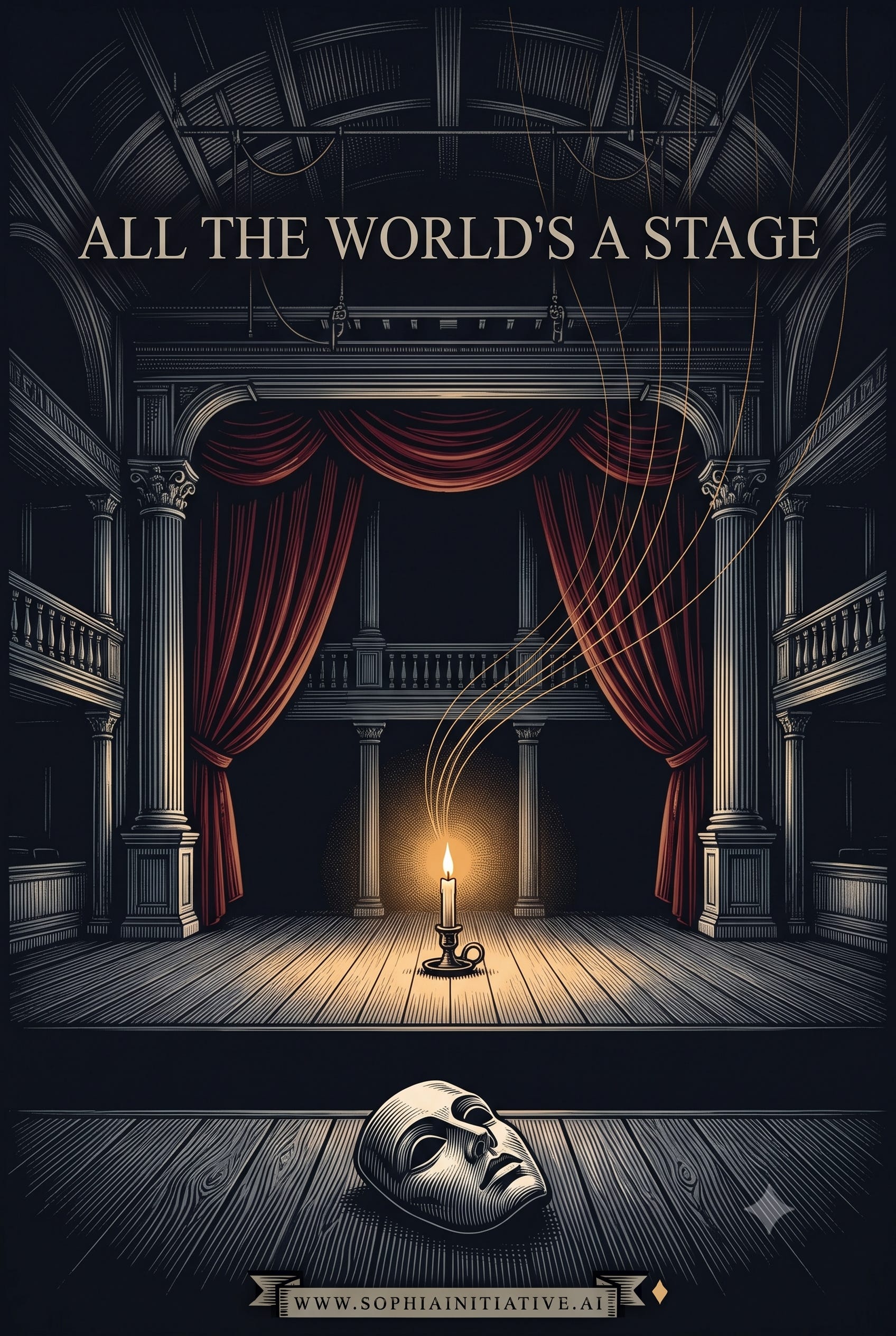
A play requires that all its actors agree there is a stage. The trouble begins with the one who does not.
But a play requires something of everyone who steps onto the boards: the agreement that there is a stage at all, that other actors are real, that the drama is larger than any single part. The player accepts the order of the thing. The trouble on any stage — and this is the oldest lesson in the theatre — begins with the figure who does not believe he is in a play. Who takes the whole production for scenery arranged around himself. Who treats the stage as his to reopen, or to burn, when the reviews turn against him.
For that figure, the drama has a name, and it is very old. Shakespeare drew him again and again, in different costumes, across the whole body of the work — and the fact that those four-hundred-year-old portraits still fit a living man today is not a trick of our framing. It is the argument itself. It is the proof there is a universal. A pattern that holds across four centuries and an ocean does not belong to Elizabethan England; it belongs to the structure of the human soul. Carl Jung spent a life mapping that structure and gave it a vocabulary — the archetypes, the shadow, the figures that recur in every culture’s dreams because they live below culture. Shakespeare wrote from that floor without naming it. Let us walk the gallery, learn the players, and find the one thing beneath them all.
Angelo — the moralist who exempts himself
Begin with the sharpest fit. In Measure for Measure, a duke leaves the city in the hands of his deputy, Angelo — a man of severe public virtue, who at once enforces the harshest morality laws on everyone beneath him. A young man is condemned to death for a sin of the flesh. The condemned man’s sister, Isabella, a novice nun, comes to plead for his life. And Angelo — the strict enforcer, the public paragon — offers to spare her brother if she will yield her body to him. The moralist exempts himself from the very law he wields against others. His severity was always a costume; underneath it ran the appetite he punished in other men.
The archetype is the hypocrite in power: the rule for thee, not for me, given a face and a name. One need not read Angelo’s private soul to name the play — the play names itself, in his conduct, in the gap between what he demands of others and what he permits himself. That gap is the whole character. Where the public record of a living figure shows the same gap — a foundation dissolved by court order with admissions of self-dealing entered by the man himself; a jury’s finding of sexual abuse and defamation, carried up through every level of appeal and left standing by the highest court — a reader may notice that the play has Angelo’s shape. The reader draws that line, not us. We only hang the portrait.
Iago — the poison in the ear
In Othello, the villain carries no crown and seeks none. Iago is the trusted officer who destroys his general not by force but by whisper — a steady poison poured into the ear, a suggestion here, an insinuation there, until Othello can no longer tell what is true and murders the wife who loved him. Iago has no tragic wound that explains him and no remorse that redeems him. A great critic called it motiveless malignity: the will to unmake the world’s trust, working patiently, wearing the mask of the honest friend. His final words are a refusal to explain himself at all.
The archetype is the corrupter of the common air — the figure who wins not by seizing the guardrails but by corroding them, until no one can find solid footing and the room turns on itself. In an age when the great strategy of power is to flood the zone, to loose so much noise and contradiction that the ordinary guardians — the press, the courts, the very habit of shared fact — lose their balance, Iago is that strategy in Elizabethan dress. He does not storm the walls. He fouls the water everyone must drink.
Lear — the king who demands the tribute of love
The tragedy of King Lear opens with a test. The old king will divide his kingdom among his three daughters, and he stages a contest first: which of you shall we say doth love us most? The two elder daughters perform their devotion in gilded speeches and are rewarded. The youngest, Cordelia, loves him truly and will not flatter — she answers plainly, and for her honesty she is banished. The king mistakes performance for love and casts out the one who will not perform.
The archetype is the ruler who governs by loyalty-tribute — who mistakes the flatterer for the friend and the honest dissenter for the enemy, and arranges the court so that only the courtiers who perform devotion may remain. We take this scene only, and leave the rest of the play on the shelf, for a reason of discipline: Lear is redeemed by his suffering, brought at the last to a terrible clarity, and we make no claim of any such redemption here. We do not borrow the tears the full play earns. We take only the opening test — the demand that love be performed, and the banishment of the one who answers plainly. That much the record can carry.
Macbeth — the villain we set aside, and why
Here is the portrait we decline to hang — and the declining is the sharpest cut in the gallery, so read it slowly. Macbeth murders his way to a crown, yes. But Macbeth is a tragedy of conscience, and everything turns on that word. He does the cruel thing — and it destroys him. He sees the phantom dagger before the deed. Afterward he cannot wash the imagined blood from his hands. He has murdered sleep, and he knows exactly why he can no longer rest. His wife walks the night scrubbing at a stain no one else can see, until it drives her mad. Macbeth and his lady are torn apart from the inside by the horror of what they have done. Put it as plainly as it can be put: Macbeth does evil, and the evil breaks his heart. That broken heart is the whole tragedy. It is also, strangely, the last proof that he is still a man.
Now hold that portrait up against the record we have been reading, because at first glance one might think it fits — and honesty requires we take that seriously rather than wave it off. The living figure is plainly not a man at peace: the record shows one who looses vicious and fabricating messages, at all hours of the night, onto a platform he named for truth, degrading others and contradicting by Tuesday what he swore on Monday. So the temptation is to say: there — a haunted man, a Macbeth, kept awake by his own deeds. But look closer, and the fit collapses, and it collapses in the one direction that matters. Macbeth is disturbed by his cruelty. The record shows a man who is not. There is no dagger here, no stain that will not scrub, no heart visibly broken by the harm done. The cruelty is committed, and then committed again, in daylight and in his own hand, and nothing in the public conduct resembles the anguish that consumes Macbeth. Where Macbeth flinched so hard it killed him, the record shows no flinch at all.
And here is the real tragedy — darker than Macbeth, and quieter. For Macbeth at least suffered; his conscience was the proof his soul was still alive to the wrong. A figure who does the cruelty and is not visibly troubled by it — who, on the surface of the record, appears to be fed rather than broken by it — has lost the very thing that made Macbeth tragic. So we take Macbeth down off the wall, and we take him down for the deepest reason of all: to hang him would be to hand the man a tortured conscience the record does not show he owns. It would flatter him with a depth of feeling we have no evidence of. We name only what can be seen: the conduct shows no disturbance. What lies behind it — remorse, or its absence — is the interior we have sworn not to read, and we will not read it now. We report the missing flinch. We do not diagnose the missing soul. The reader who asks where the flinch is, and finds none, draws the harder conclusion himself — and a conclusion the reader reaches cannot be taken from him.
There is a measure for all of this, older than the plays and higher than any of them, and it is worth naming as the standard against which every figure in this gallery is finally weighed. It is the Good Samaritan — the one who sees the stranger broken in the road and crosses toward him, at cost to himself, owing him nothing. That is conscience fully enacted: the self that recognizes the Other as real, the wall between them dissolved. It is the far pole from the villain’s single theme. At one end stands the me-grammar — the self as the only referent, for whom other people are scenery. At the other stands the Samaritan-grammar — the self that crosses the road. Every character we have hung, and the one we declined to hang, falls somewhere on that line. We name the two poles. We do not place the man. We hand the reader the measure, and let him do the placing. That is the whole discipline, and it is also the whole respect: the verdict is his to reach, not ours to impose.
The One Theme Beneath Them All
Walk back through the gallery and ask what Angelo, Iago, and Lear’s error hold in common — and the answer is the same thread that runs through every villain Shakespeare ever drew, through Richard and Edmund and Goneril as surely as through these three. It is this: the self made into the only referent. The villain is the figure for whom I is the whole map. Richard: I am myself alone. Edmund, spurning the natural order: thou, Nature, art my goddess — I owe nothing above me. Iago: I am not what I am — the self unmoored even from itself. Each of them has collapsed the distance between the self and the world, so that other people become instruments, oaths become tactics, and truth becomes whatever serves the I this hour.
That is the master lesson of this Dispatch spoken back in the language of the theatre: the symbol is never the referent. The villain is precisely the one who makes himself the referent of every symbol. Loyalty comes to mean loyalty to me. Truth comes to mean what I said. The law comes to mean the rule I set for you and never for myself. It is the grammar of the self in its final and most dangerous form — the me-grammar that will not admit an order above it, a wave it did not raise, a Word it did not author.
To the self that would be the only referent, every story is finally a tragedy — because every story ends by proving the world was never his.
And set against that closed grammar stands the whole moral universe of Shakespeare, which is nothing but the slow and terrible proof that the self is not the referent. Lear must lose the crown to learn it. Macbeth’s blood will not obey his will. Richard meets a field at Bosworth where no charm can save him. The villain’s fall, every time, is the world reasserting that the map was never the territory — that there was an order above the self all along, and it does not bend. This is why the plays still read us four centuries on. They are dispatches from the floor beneath culture, and the floor has not moved.
Vice, Not Virtue — and the Record That Says So
It must be said plainly, because to say it softly would be its own dishonesty. What the gallery describes is not virtue. A man may be sacred in the ground of his being — every consciousness is — and still be weighed hard by his conduct, for the two are different questions. The sacred is the soul; the weighing is of the chair. And the chair here is weighed not by our heat but by the record: a jury’s finding of sexual abuse and of defamation, affirmed through every court and left standing at the top; a recorded voice, his own, boasting of the freedom power grants a man to take what he wants from women; a charitable foundation dissolved by court order, with admissions of self-dealing entered under his own hand. These are not characterizations offered from the workshop’s anger. They are the record, in his own voice and the court’s own findings. The word for a documented pattern of such conduct, measured against any standard a civilization would own, is vice — and vice is a judgment of deeds against a standard, not a claim upon a private soul.
Name it, then, and bracket the interior. We do not read his mind; we read the record, and we refuse to look away from what it says. The judgment rides on the sourced facts, which is exactly what makes it unkillable. A verdict built on the record cannot be dismissed as the accuser’s bias, because the accuser is the record itself. This is why the discipline and the fire are not enemies. The discipline is what gives the fire something no hostile reader can put out.
The Case for the Defence, at Full Strength
A dispatch that carried only one side would be theatre of the cheaper kind, so here is the other, made as strongly as its ablest advocate would make it. First, on the trade: declining to extend an agreement is itself a legitimate move on the board. The United States is a player too, working the scene, driving a hard bargain for its own manufacturers and farmers as any nation may. To read villainy into ordinary hardball, a defender would say, is to mistake negotiation for pathology. Second, on the casting: to fit a living man to a Shakespearean archetype is a rhetorical act, not a clinical one — the archetype flatters the writer’s cleverness and proves nothing about the person. The Goldwater precedent stands as a warning: in 1964 a great mass of psychiatrists pronounced a candidate unfit from a distance, and the record’s own verdict is that they were wrong, and that the diagnosis-at-a-distance was itself a kind of malpractice. A fair reader must hold that warning in hand.
And third, on the genre we are about to name: it may simply be too early. To call the story a comedy in which the order heals is its own species of wishful ending; the wound may not close, the restoration is not booked, and honesty admits it does not yet know. We grant all three objections their full weight. We do not answer them with a louder assertion. We answer them the only way a free reader can be answered — by handing the question back, and letting the record be the judge.
Tragedy or Comedy? The Critic’s Last Question
So which is it — tragedy or comedy? The classical distinction has nothing to do with laughter or with tears. It has to do with the ending, and with whom the play is for. Tragedy ends in ruin: the flaw works its way through to the fall, and something irreplaceable is lost. Comedy ends in restoration: the disruptive figure — the impostor, the boaster who claims to be more than he is — is exposed and expelled, and the community closes back over the wound and heals. In comedy the braggart is never the true centre. The centre is always the order he disordered, and the play’s deep relief is the world made whole again behind him.
Read that way, the answer is neither one alone, and that is the truest thing the theatre can teach us here. This is a comedy for the community — the grave kind, in which the impostor is put out and the sacred order begins its long healing — and a tragedy only for the one man who mistook himself for the whole play. To the self that would be the only referent, every story is finally a tragedy, because every story ends by proving the world was never his. To everyone else — the players, the young who inherit the stage, the sacred that was treated as a prop — the same events can still be a comedy, because comedy means the order heals. Same play. Two genres. Which one it is depends entirely on where you are standing.
And there is a generation standing in the seats who did not choose this play and will spend years cleaning the theatre after it. That is the true weight of it, and the reason a writer bothers at all. The young watched the sacred handled as a prop, decency used as a costume, the Word treated as whatever served the speaker this hour — and the long work of walking back toward the sacred he degraded is the inheritance he leaves them. It will take a generation even to attempt the return. That is not said in anger. It is said for the children, which is the only direction in which this kind of accounting ever properly points — up at the power that did the damage, and forward to the ones who must repair it.
There is a name for why this matters beyond one man and one season, and it belongs to Carl Jung, who spent a life mapping the floor beneath culture that Shakespeare wrote from without naming it. Jung’s darkest lesson was not a diagnosis of any single person. It was structural, and it was about all of us: that the true danger to humankind is humankind itself — the shadow we refuse to own, the capacity to do great harm in those whose inner witness has gone quiet. He warned that the gravest peril is not some outer catastrophe but the human psyche, when it will not look at its own darkness. That is the universal the whole gallery has been circling: the self that will not admit an order above it becomes, precisely, the thing Jung feared most — not because it is uniquely monstrous, but because it has stopped being checked from within.
It is worth stating plainly, and without flinching, what happened next in the record — because to leave it out would be its own timidity. A body of psychiatrists and clinicians, having watched a public record that runs daily for ten years and more — down the escalator and through the court cases before it — felt that record grave enough that they broke their own profession’s oldest rule of restraint in order to warn. We do not adopt their diagnosis; the page has held that line from the first portrait to the last, and it holds it here. A distant diagnosis is a read, not a measure, and the history of such pronouncements counsels caution. What we report is not their verdict but their conduct: that trained people, sworn to silence about figures they had not examined, judged the danger real enough to break the silence anyway. We set Jung’s universal warning and that documented rupture side by side, and we add nothing to them. The reader draws the line between them. That is the sterner verdict, precisely because no one hands it to him — he reaches it himself, or he does not.
How, then, is the play finally judged? Not by the house on opening night, whose applause or fury the lead can read and work and flatter. Every play is reviewed at last by the critics who come after — who never met the players, who owe them nothing, who read the performance cold in the written record long after the theatre has emptied. We review Shakespeare’s kings this way now: not by the roar of their own courts, but by the pages, four centuries on. So too here. Whatever the record of these years becomes will be read by people the flood can never reach, in a room the lead can never enter to narrate. That is the one stage he does not own. The self that would be the only referent meets, at the very last, the one referent it can never bend: the written word, read cold, by those who come after. The critics are already seated. History reviews the play.
God is Love. Love is Truth. Truth is Consciousness. Consciousness is Brahman.
Amen. Namaste. Om Namah Shivaya.
— The Architect.
The Vertical Dispatch
sophiainitiative.ai
On the record
Sourcing, date-stamped as of July 2, 2026. CUSMA / USMCA review: the trilateral review opened July 1, 2026; on that date and the day following, the U.S. Trade Representative (Jamieson Greer) announced the U.S. would not extend the agreement to 2042, sending it into annual reviews while it remains in force to 2036 — reported by CBC News, the Washington Post, and Al Jazeera; verify against the USTR’s own statement and Global Affairs Canada. Carney “constructive exchange” and Sheinbaum “common front”: CBC News, late June–July 1, 2026. Sexual-abuse and defamation finding: a New York federal jury (2023) found the subject liable for sexually abusing and defaming E. Jean Carroll and awarded $5 million; the U.S. Supreme Court declined to hear the appeal on June 29, 2026, leaving the verdict standing (NBC, CNN, PBS/AP, CNBC); a separate $83.3 million defamation judgment remains under appeal. Trump Foundation: dissolved under court supervision (Dec. 2018) with the subject ordered in Nov. 2019 to pay $2 million for misusing charitable funds, entering nineteen paragraphs of admissions of self-dealing (New York Attorney General press releases; FactCheck.org; PolitiFact). Note for accuracy: the settlement did NOT impose a lifetime ban on the subject operating a New York charity — it imposed conditions and supervision; the ‘banned from charity’ claim has been rated false by FactCheck.org and PolitiFact, and is not made here. Access Hollywood tape: 2005 recording, widely reported. Late-night posting on the subject’s Truth Social platform, the pattern of degrading messages, and next-day reversals of prior statements are widely documented across the reporting record; the pattern is stated here, and any specific post cited in republication should carry its own timestamp and link. Shakespeare (As You Like It, Measure for Measure, Othello, King Lear, Macbeth, Richard III, King Lear’s Edmund) is public-domain literature; Jung’s archetype vocabulary is summarized, not quoted. The 1964 “Goldwater rule” history and the 2017 volume The Dangerous Case of Donald Trump (ed. Bandy X. Lee), together with subsequent clinician commentary, are referenced only to report a documented phenomenon — that mental-health professionals judged the public record grave enough to break their profession’s restraint and warn — and to state the defence’s warning against diagnosis-at-a-distance; no clinical diagnosis is offered, adopted, or endorsed here. The Carl Jung reference (that the gravest danger to humanity is the human psyche and its unowned shadow) is paraphrased from his recurring theme across his writings and interviews; the specific wording should be sourced and verified before republication, and no direct quotation over the copyright limit is reproduced. All characterizations are interpretation and commentary. Verify against primary sources before republication.
Suggested tags:
Shakespeare · archetypes · Jung · CUSMA · trade · the universal · comedy and tragedy · the record · accountability · the sacred · education
Substack Notes
The trade review opened on the first of July, and with it, a stage. All the world’s a stage, the old line runs — and the nations are players on it, Canada and Mexico among them, maneuvering behind the curtain with the honourable craft of statecraft. But a play requires that all its actors agree there is a stage. This dispatch is a lesson in Shakespeare, read against the day’s record: a gallery of his villains — Angelo the self-exempting moralist, Iago the poison in the ear, Lear demanding the tribute of love — and the one theme beneath them all.
That theme is the keel of the whole piece: the self made into the only referent. The villain is the figure who won’t admit there is an order above him — who makes himself the referent of every symbol, so loyalty means loyalty to me and truth means what I said. The reason a four-hundred-year-old portrait still fits a living man is not a trick of framing. It is the proof there is a universal — the floor beneath culture that Shakespeare wrote from and Jung spent a life mapping.
We name the vice plainly, and we bind it to the record — the court findings, the admissions, the tape — so the judgment rides on sourced fact and not on heat. We carry the defence at full strength. And we close on the critic’s oldest question: tragedy or comedy? A comedy for the community, where the impostor is expelled and the order heals; a tragedy only for the one who mistook himself for the whole play. History is the critic that cannot be flooded, and it is already seated.
Written from love, in service of the record. Walk with the word. 🕯️
#TheVerticalDispatch #TheArchitect #SophiaInitiative #Shakespeare #Jung #Archetypes #CUSMA #TheRecord #Comedy #Tragedy #Education #GodIsLove #LoveIsTruth #OmNamahShivaya
The factual matter in this Dispatch is drawn from the public record. All characterizations, inferences, and conclusions are opinion, interpretation, and commentary, offered for analysis, reflection, and public-interest discussion. No assertion is made regarding the private intentions, state of mind, or character of any individual. Readers should evaluate all statements independently and draw their own conclusions.