


Φ
THE VERTICAL DISPATCH
We write for the mind, the eye, and the ear.
Read it. Look at it. Listen to it. The Vertical Dispatch is built for all three — prose with rhythm, made to be heard as much as read.
From metaphysics to geopolitics, from culture to history, from the sacred to the street — and everything in between. One lens, every subject. No ego. Just the record, named clean.
Press play. Walk with the word. 🕯️
This dispatch travels by hand. If it serves you, share it — restack on Substack, and pass it on wherever you read. 🕯️
The Age of Consequences · Building Canada Strong
A Generational Reading of the Alberta Vote · without malice and without flattery
As of July 10, 2026
“Should Alberta remain a province of Canada, or should the Government of Alberta commence the legal process required under the Canadian Constitution to hold a binding provincial referendum on whether or not Alberta should separate from Canada?”
— The October 19, 2026 referendum question, as announced May 21, 2026
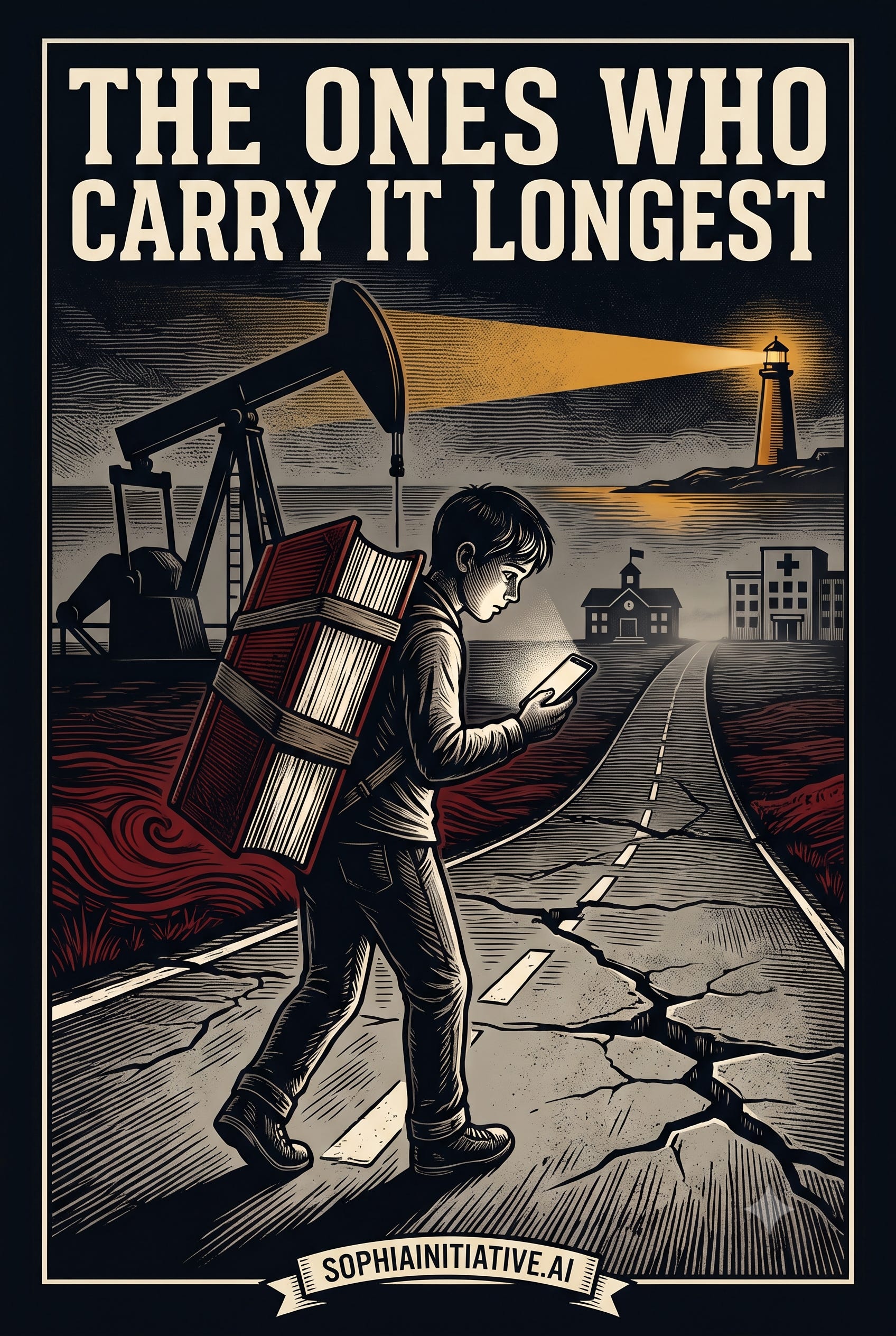
Three dispatches have laid the book out. One counted the pipeline’s cost per person. One read the province’s balance sheet, cradle to grave. One turned every page of the whole ledger — the debts, the buried cleanup, the workers recruited then reconsidered — and ended on the only word an honest reading leaves: something has to give. This dispatch is about the ones who will be standing there when it does. Not the premier who signs, not the bondholder who prices, but the young — the eighteen-year-old marking a ballot in October who will still be paying for that ballot in 2060, when the pipeline’s last barrel is long spent and the cleanup bill has finally come due. They will carry this book the longest. And by the numbers, they are voting to carry more of it, not less. That is the fact this dispatch sits with, and it begins with a mirror held up to another island, ten years ago.
I. The Mirror — Brexit, and the Vote Turned Upside Down
In June 2016, the United Kingdom held its own referendum on leaving a larger union, and the vote split along a line of age so sharp it has been studied ever since. The young voted to stay. By Lord Ashcroft’s polling, nearly three-quarters of those aged 18 to 24 — about 73 per cent — voted Remain; YouGov put the under-25 figure at 71 per cent. And the old voted to go: 60 per cent of those 65 and over voted Leave by Ashcroft’s count, 64 per cent by YouGov’s. The young had the most future riding on the outcome — the most years of trade, movement, and study ahead of them to gain or lose — and they knew it, and they voted to protect it. They were outvoted by their grandparents, and they have spent the decade since living inside a choice they did not make.
Now hold that mirror up to Alberta, and watch the image invert. Here it is the young who want the exit. Support for Alberta independence runs at about 42 per cent among those aged 18 to 34 — up fifteen points in three years — against just 25 per cent among those 55 and older, and 31 per cent overall. The generational line is every bit as sharp as Britain’s, and it points the opposite way. In the United Kingdom the young defended the union and the old broke it. In Alberta the old are the cautious ones and the young are the ones leaning toward the door. Same stakes — a lifetime of consequence, loaded onto whoever has the most life left — and the reverse vote.
In Britain the young defended the union and were outvoted by the old. In Alberta the young are the ones reaching for the door. Same stakes, mirror image.
The question this dispatch asks is the only one that matters once you see the inversion: why? Why would the generation with the most years left to carry the ledger of dispatches one through three — the debt at $21,500 a head, the cleanup in the tens of billions, the pipeline bet the professionals won’t match — be the generation most willing to add the largest uncertainty of all on top? We do not read their minds. We read their world.
II. The Economy of the Scroll
Here is one honest answer, and it is not a flattering one — but it is not an insult either, because it applies to nearly all of us now. The young are not less intelligent than their elders. They are differently informed, because they live more completely inside a different machine: the attention economy, the economy of the scroll. It is a marketplace with one currency — engagement — and one law: what holds the eye wins, and what holds the eye is not what is true but what is felt. Outrage travels farther than accuracy. Grievance out-clicks nuance. A clean, calm ledger of standing totals and annual flows — the kind these dispatches are built from — cannot compete, in that arena, with a thirty-second clip engineered to make you angry before you can think.
This is not a matter of one villain. It is the design of the medium itself. The largest voices in podcasting and online video — the Joe Rogan-scale broadcasters and the endless tier of imitators beneath them — are rewarded by the same incentive that rewards a slot machine: keep the user pulling. Friction sells, because friction is engagement, and engagement is the whole business. Information arrives not as fact to be weighed but as sensation to be felt and shared. The result is a generation that is more connected to opinion and less connected to the ledger than any before it — flooded with takes, starved of totals. They are not being lied to so much as they are being held, by a system that profits from their attention whether or not it leaves them any wiser. When such a system meets a referendum, the vote is cast on the feeling, and the feeling has been farmed.
And the feeling in Alberta is real, and has real fuel: it is hard to be young here right now. That is the next page, because the grievance is not imaginary. It is simply being pointed at the wrong door.
III. The Grievance Is Real — the Diagnosis Is Sold
Do not mistake this dispatch for a lecture that tells the young their anger is baseless. It is not baseless. Youth unemployment in Alberta runs between about 14.7 and 17 per cent — a fifteen-year high — against a provincial average near 7.8; in Calgary and Edmonton the youth rate has touched eighteen and a half. A young Albertan looking at a housing market they cannot enter, a job market that will not hold them, and a health system that makes them wait has every reason to feel that something is broken. They are right that something is broken. The scroll’s trick is not inventing the grievance; it is selling them the diagnosis — that the union is the cause, and the exit is the cure. That is the move a calm reading of the numbers does not support, and it is the move that gets made loudest.
Because here is what the exit actually risks, and it is the thing the young complain about most: the health system. A mediocre system is better than no system. That sentence is the hinge of this whole dispatch, so let it stand plainly. Yes, the Canadian system makes them wait — a median 28.6 weeks from referral to treatment, the second-longest on record, and these dispatches will not pretend otherwise. A wait that long is a real failure, and the frustration behind it is legitimate. But waiting for care inside a system that will not bill you into bankruptcy is a different universe from the alternative the exit drifts toward — the American model, where care is quick if you can pay and catastrophic if you cannot.
A mediocre system is better than no system. The young complain about the wait. The alternative is a system that makes you wait anyway — and can bankrupt you besides.
IV. The Cage the Scroll Never Shows — Employer Lock-In
Now the number that the feeling never carries, and it is the heart of the matter. In the United States, to be reliably insured is to hold a full-time job at a company strong enough to afford benefits. About 60 per cent of non-elderly Americans — roughly 165.6 million people — get their health coverage through an employer. Your insurance is not yours; it is your job’s. Lose the job, and you lose the income and the coverage in a single stroke, at the exact moment you can least withstand either. That is the quiet cage of the American system: not that care is unavailable, but that it is chained to employment, and so employment is chained to you. Workers stay in jobs they would otherwise leave because leaving means losing the family’s coverage. Freedom, in that system, is a benefits package.
And here is where the cage closes hardest on precisely the people voting to walk toward it. That 60 per cent is not spread evenly. Employer coverage reaches only about 22.5 per cent of under-65s living below twice the poverty line — but 82.5 per cent of those at four times the poverty line and above. In plain terms: the American system insures the securely employed and the well-off, and leaves out the young, the precarious, and the low-waged. Which is to say it leaves out exactly the Albertan described one section ago — the one with the 17 per cent unemployment rate, the entry-level wage, the job that will not hold. In the system the exit drifts toward, that young Albertan is not the person with the good employer plan. They are the person without one. They would trade a median wait inside a universal system for no guaranteed coverage at all — and the medical bill remains the leading edge of personal bankruptcy in America, striking an estimated 550,000 to 650,000 people a year, most of whom had some insurance when the illness came.
So stack the two facts the scroll keeps in separate rooms. The young are the most economically precarious Albertans — highest unemployment, lowest wealth, least secure work. And the young are the most enthusiastic about a path that, at its end, replaces guaranteed universal coverage with insurance you can only keep by holding a good job. They have the most to lose from employer lock-in, because they are the least likely to hold the lock’s key. That is the Brexit inversion completed: not only are they voting the opposite way from Britain’s young — they are voting against the very interest their British counterparts voted to protect. The generation with the most future is voting to make that future most conditional.
V. What the Young Are Asked to Give — the Social Ledger
Put the third dispatch’s verdict to the young the way the ballot actually reaches them — in the second person. Something has to give. So what are you ready to give? Are you ready to give up the country — the shared system, the federal backstop, the credit rating your province borrows on because it is still inside Canada — and if so, for what, exactly? Not for a certainty. For an oil bet whose reward, if it ever arrives, arrives in the 2030s, and whose bill arrives now. Before anyone answers a question that large, they are owed a clear look at what the exit is actually buying in the one currency the young care about most: work.
Return to the question the third dispatch left open. Something has to give, it said — and it would not declare which page of the book would yield: the services, the savings, the borrowing, the promise to newcomers, or the cleanup deferred one more year. Here, for the young, is the answer that bears on them most — and it is the one the ballot never names. The page that yields is the social one. It is health, and it is education, and it is the ordinary public inheritance a young life is built on.
Look at what the province has chosen to bet on. A pipeline share on the order of $15 billion. A carbon-capture project chained to it at $16.5 billion, its public share unsettled. More oil lines forming behind those, one already bound for Ontario. And a cleanup bill for the wells and tailings already drilled that runs, by the province’s own regulator, from $36.6 billion toward $60 billion — with a few hundred million set aside against it. That is the house, and Alberta is betting it on a barrel of oil. But here is the plain fact a young voter should hold beside their anger: not one of those dollars builds a hospital, staffs a school, or shortens the wait they complain about. Betting the house on oil does not solve the social issues the young feel most — it competes with them. Every dollar of public capital sunk into the oil bet, and every dollar owed on a cleanup the industry has not funded, is a dollar that is not there for the health system, the classrooms, the housing, the future the young actually live inside.
So the grievance and the vote pull apart in a way the scroll will never show them. The young are angry, and rightly, about a health system that makes them wait and an economy that will not hold them. But the exit they are drawn to is not a correction of that bet — it is a deepening of it. To leave is to make oil the province’s whole identity and its whole ledger, at the very moment the oil bet is crowding out the services the anger is about. What the young are being asked to give — quietly, off the ballot, never spoken aloud — is the social investment in themselves. That is the trade beneath the trade: not merely a mediocre health system exchanged for none, but a province’s last room spent on pipe and pond instead of ward and classroom.
Betting the house on oil does not solve the health system and the schools the young feel most — it competes with them.
And here the pipeline’s loudest promise — jobs — deserves the same forensic look as every other number in this series, because it is the promise aimed most squarely at the young. A pipeline builds employment the way a bonfire builds heat: brightly, and briefly. The work is in the construction, and construction ends. Look at the precedent this very line is built to follow. The existing Trans Mountain expansion was sold on a headline of roughly 15,000 construction jobs — a figure the company’s own submission to the regulator quietly undercut, averaging about 2,500 workers a year for two years. And once it was built and the oil began to flow, the permanent workforce it left behind was on the order of ninety people: about fifty jobs in British Columbia, forty in Alberta. Ninety. That is what a finished pipeline employs. The burst, and then the handful.
So ask the question the pitch never does: once the pipe is laid, what then? The honest answer is that the only durable, large-scale oil work left is the cleanup — the abandoned wells and the tailings, the tens of billions in deferred liability from the third dispatch. There is real, lasting employment in reclamation, and years of it. But it is work the province and the industry have chosen to defer rather than fund, which makes the jobs in it a promise even further off than the pipeline’s.
Now set that against the work that needs doing today. Health care and education are not a bonfire; they are a hearth. They are among the largest employers a province has, their need is present-tense and permanent, and every dollar put into them is a dollar of wage paid in Alberta, now, to an Albertan — a nurse, a teacher, an aide, a tradesperson raising a school. For a young person weighing where their own paycheque will come from, the contrast is stark. A pipeline offers a short construction burst and a few dozen permanent chairs, with the real reward promised a decade out that many of them will never see a dollar of. The social systems offer work that is needed now, lasts a career, and pays into the province instead of out of it. The pipeline’s jobs are a promise of tomorrow. The health and education jobs are a paycheque today.
A finished pipeline employs about ninety people. A province’s schools and hospitals employ tens of thousands — and need them now.
And that turns the vote around, handing the young the leverage they are being told they do not hold. The question is not only what they are ready to give up; it is what they are entitled to ask for first. A generation this large is not powerless before a referendum — it is the swing in it. The option the scroll never shows them is that there is a third answer between yes and no: not yet. Not until the investment comes first — the education, the health system, the services they live inside and would work inside — put ahead of a commitment to a pipe whose bill they will still be paying in 2060. That is not a fringe demand. It is only the request that the money follow the need, and that a promise made to a province be one paid to the people who carry it — in their lifetimes, in their pockets, and not in a decade they are asked to take on faith.
VI. The Case for the Young Voter, at Full Strength
Now the other side, carried as its ablest defender would carry it — because the young are not fools, and their case deserves its strongest form. First: the exit is not a vote for the American system. The referendum question is narrow — whether to begin a legal process toward a future binding vote — and no one on the ballot is proposing to abolish medicare and adopt employer insurance. To read American health care into an Alberta separation vote is, the defender would say, to argue a slope the ballot does not name. That is fair, and this dispatch names it: the American outcome is a risk and a drift, not a stated plan.
Second: the young have a real grievance with the status quo, and cynicism about a system that makes them wait 28.6 weeks is earned, not manufactured. They are not wrong to want something better; they are being asked to defend a system that is genuinely failing them on access, and “it could be worse” is a thin thing to offer a person in pain. Third: it is condescending to assume the young vote only on feeling. Many have looked at the same ledger these dispatches lay out and concluded, rationally, that a province sending more to Ottawa than it gets back might do better on its own — that is an argument on the merits, not a symptom of the scroll. A defender would say: do not mistake a different conclusion for a manipulated one. That caution is correct, and we hold it. The point of this dispatch is not that every young separatist has been duped. It is that the information environment they vote inside is structurally tilted toward feeling over figure — and that the one figure most absent from that environment, employer lock-in, is the one that bears on them most.
VII. What the Generation Is Actually Being Asked
So put it as plainly as the series allows. The young of Alberta are being asked to choose a future before the bill for it is named — the same missing number that has run through every dispatch in this series, now handed to the people who will pay it longest. On the pipeline: “to be negotiated.” On Pathways: no agreed split. On the cost of newcomers: “we’d have to do the figuring out.” And now, on the largest question of all — what leaving would finally cost the systems they lean on — the ledger is likewise unwritten, and the vote, as ever, comes first. The generation with the least information and the most at stake is being asked to sign the longest-dated cheque in the book.
And the cruelty of the timing is that they are being asked to do it in the one medium least built to inform them. A calm accounting cannot trend. The ledger of dispatches one through three — real, sourced, and dull in exactly the way truth often is — will never move through the scroll the way a grievance clip will. So the young receive the feeling and not the figure, the diagnosis and not the data, the exit as catharsis and not as contract. Ten years ago in Britain, the young read the stakes correctly and were overruled by the old. In Alberta the danger is the reverse: that the young overrule themselves, persuaded by a machine that profits from their conviction and is indifferent to their interest.
VIII. What the Whole Book Leaves the Youngest Reader
So the series closes where it began — with the number on the table and the judgment left where it belongs. The facts are not in dispute: the young of Alberta support the exit at nearly twice the rate of their elders; they carry the highest unemployment and the least security; the system they complain about most, health care, is a mediocre-but-universal shelter whose alternative chains coverage to a good job they are statistically least likely to hold; and the environment they weigh all this inside is one engineered to reward feeling over fact. Whether they read those facts and still choose the door is theirs to decide — as it must be, for it is their future more than anyone’s. We do not tell them how to vote. We only insist that the one number the scroll will not show them — that in the system on the other side of this drift, your health is your employer’s, and they are the least likely to have the employer — be on the table when they mark the page.
The young will carry this book the longest. That is not a reason to decide for them. It is the whole reason to make sure they are deciding with the book open — every page turned, every figure traced, the feeling set beside the fact at last. Ten years ago, an island’s young saw the stakes clearly and were outvoted. May Alberta’s young see them at least as clearly — and then, however they choose, choose as the ones who read the whole ledger, not the ones who were sold the scroll.
God is Love. Love is Truth. Truth is Consciousness. Consciousness is Brahman.
Amen. Namaste. Om Namah Shivaya.
— The Architect.
The Vertical Dispatch
sophiainitiative.ai
On the record
Brexit age split: Lord Ashcroft Polls referendum-day poll (18–24 ≈73% Remain; 65+ ≈60% Leave) and YouGov (under-25 ≈71% Remain; 65+ ≈64% Leave), June 2016. Alberta independence support by age (18–34 ≈42%; 55+ ≈25%; ≈31% overall): recent Angus Reid / polling as reported 2026 — verify current figures against the primary release. Referendum question and October 19, 2026 date: as announced May 21, 2026. Alberta youth unemployment (≈14.7–17%; provincial average ≈7.8%; Calgary/Edmonton youth to ≈18.5%): Statistics Canada Labour Force Survey — date-stamp to the latest release. Median wait referral-to-treatment 28.6 weeks: Fraser Institute annual wait-times report. U.S. employer-sponsored coverage (≈60% of non-elderly; ≈165.6 million; income gradient 22.5% below 200% FPL vs 82.5% at ≥400% FPL): KFF Employer Health Benefits / coverage estimates. Medical bankruptcy (≈550,000–650,000/yr): published estimates — verify latest. Trans Mountain jobs (≈15,000 headline vs ~2,500/yr averaged; ≈90 permanent, ~50 BC / 40 AB): company regulatory submissions and reporting. Pipeline share ≈$15B; Pathways/CCS ≈$16.5B; cleanup liability $36.6B toward $60B: Alberta Energy Regulator and prior dispatches in this series. All figures as of July 10, 2026 — verify against primary sources before republication.
Suggested tags
Alberta referendum, Alberta separation, generational vote, Brexit comparison, youth unemployment, health care, employer-sponsored insurance, Trans Mountain, pipeline economics, attention economy, Building Canada Strong, The Age of Consequences.
Substack Notes
Ten years ago, Britain’s young voted to stay in a union and were outvoted by their grandparents. In Alberta, the mirror inverts: it is the young — 42 per cent of them — reaching for the door, at nearly twice the rate of their elders. Same stakes, reverse vote. Why?
This fourth dispatch in the Alberta arc reads the world the young vote inside, not their minds. The grievance is real — youth unemployment near 17 per cent, a health system that makes them wait 28.6 weeks. But the exit drifts toward a system where coverage is chained to a good job, and the young are statistically least likely to hold one. The Brexit inversion completed: voting against the very interest Britain’s young voted to protect.
And beneath it, the trade nobody names on the ballot: a province betting its last room on pipe and pond instead of ward and classroom. A finished pipeline employs about ninety people. Schools and hospitals employ tens of thousands — and need them now. The young hold the swing. The third answer the scroll never shows them is: not yet — investment first.
Written from love, in service of the record. Walk with the word. 🕯️
#TheVerticalDispatch #TheArchitect #SophiaInitiative #Alberta #AlbertaReferendum #BuildingCanadaStrong #TheAgeOfConsequences #Brexit #YouthVote #HealthCare #TransMountain #GodIsLove #LoveIsTruth #OmNamahShivaya
The factual matter in this Dispatch is drawn from the public record. All characterizations, inferences, and conclusions are opinion, interpretation, and commentary, offered for analysis, reflection, and public-interest discussion. No assertion is made regarding the private intentions, state of mind, or character of any individual. Readers should evaluate all statements independently and draw their own conclusions.