

ABSTRACT
Western strategic doctrine has consistently failed to model Iran as a civilization, treating it instead as a political regime — a theocratic state whose legitimacy is contested and whose collapse is perpetually anticipated. This failure of category is not merely analytical sloppiness; it is a structural error embedded in how Western institutions perceive power, deterrence, and national identity. This paper argues that Iran must be understood first as Persia — a 2,500-year continuous civilizational project home to ninety million people — before any meaningful deterrence calculus can be constructed. A civilization that has survived Alexander, the Mongols, Arab conquest, and eight years of industrialized war against Saddam Hussein does not calculate existential threat the way a modern nation-state does. It calculates in centuries. And a civilization pushed to the threshold of obliteration, one that possesses the means of asymmetric civilizational response, represents a category of actor for which Western strategic doctrine has no adequate framework. The failure to recognize this is not a detail. It is the miscalculation that could end the world as we know it — not for a year, but for a generation.
I. The Error of Category
The foundational error in Western strategic analysis of Iran is categorical. Policy planners, intelligence assessments, and media commentary consistently treat Iran as though it were a political entity whose power is coextensive with the Islamic Republic — a government formed in 1979, ideologically contested, economically stressed, and therefore presumed to be brittle. Remove the government, the logic implies, and the threat dissolves.
This is not analysis. It is projection.
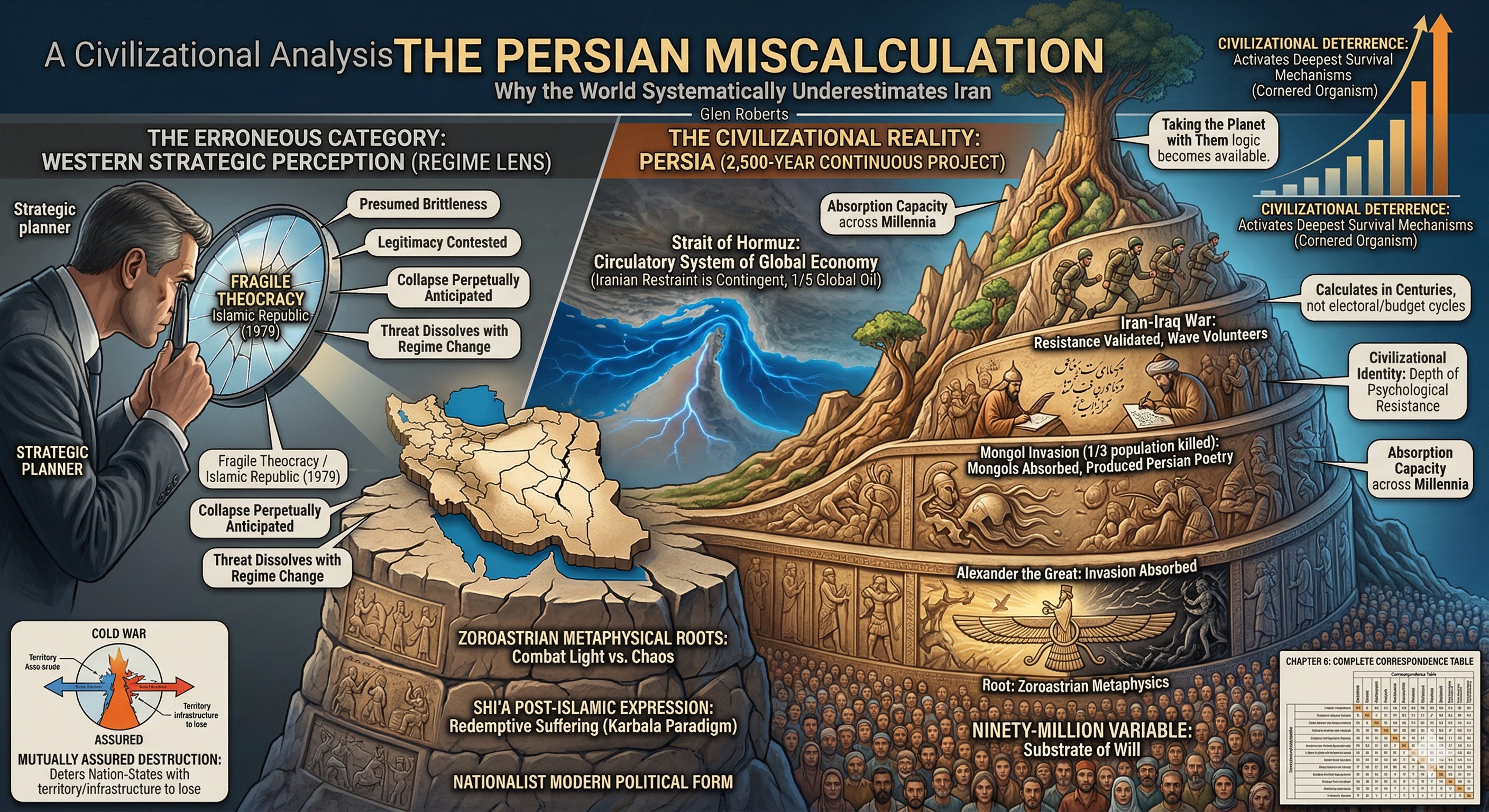
The Islamic Republic of Iran is a government. Persia is a civilization. These are not synonymous, and the conflation of the two produces strategic errors of the first order. When Western planners model Iran, they model the regime. When they should be modeling Iran, they must model a civilizational identity that predates the Roman Empire, survived the collapse of every empire that has contested it, and carries within its cultural memory the full weight of that endurance.
A civilization that has survived Alexander, the Mongols, and eight years of industrialized warfare does not calculate existential threat the way a nation-state does. It calculates in centuries.
This distinction is not merely historical sentiment. It is operationally significant. The Persian civilizational identity — Zoroastrian in its metaphysical roots, Shi’a in its post-Islamic expression, and nationalist in its modern political form — provides a depth of psychological resistance that has no analogue in the Western strategic vocabulary. The Islamic Republic may be unpopular with segments of Iran’s educated urban class. Persia is not unpopular. When the civilization perceives itself under existential threat, the gap between those who dislike the government and those who would fight for the civilization narrows rapidly. This dynamic was demonstrated with brutal clarity during the Iran-Iraq war, when a generation of young men volunteered for the front in waves that shocked Western observers who had predicted the regime’s imminent collapse.
The West has been predicting the Islamic Republic’s collapse for forty-five years. In doing so, it has consistently mistaken political unpopularity for civilizational fragility. These are different things.
II. The Ninety-Million Variable
Population is not merely a demographic statistic. In the strategic calculus of civilizational conflict, population is the substrate of will. Iran’s ninety million people constitute the largest population of any country in the immediate Middle Eastern theatre. They are young, highly educated relative to regional norms, disproportionately urban, and carry a national consciousness shaped by one of the world’s richest literary and philosophical traditions — Hafiz, Rumi, Ferdowsi, Avicenna. This is not a population that can be modeled as a passive recipient of Western regime-change scenarios.
When strategic planners discuss the Iranian threat, they tend to focus on the Revolutionary Guard, the nuclear programme, the missile arsenal, the network of regional proxies. These are real and important variables. But they are instruments held by a civilization of ninety million people who have, across millennia, demonstrated a singular capacity to absorb catastrophic disruption and reconstitute. The Mongol invasion killed an estimated one-third of Iran’s population. Persia did not cease to exist. It absorbed the Mongols. Within two generations, the Il-Khanate had converted to Islam and was producing Persian poetry.
The Mongol invasion killed perhaps a third of Iran’s population. Persia did not cease to exist. It absorbed the Mongols.
This is the variable that does not appear in any Western threat assessment matrix: civilizational absorption capacity. A civilization that has demonstrated this capacity across twenty-five centuries is not deterred by the same calculus that deters a modern nation-state with a seventy-year history. The threat of regime change does not deter a civilization. The threat of civilizational obliteration produces a different category of response — one for which the phrase ‘taking the planet with them’ is not rhetorical hyperbole but a precise description of the strategic logic that becomes available when a civilization concludes that its existence is no longer negotiable.
III. Civilizational Deterrence vs. Political Deterrence
Western deterrence theory was built in the Cold War context of two superpowers — states whose legitimacy was tied to the welfare of their populations and whose leadership calculated costs and benefits in terms of national survival understood as governmental continuity. Mutually Assured Destruction worked as a deterrent precisely because both parties had something to lose in the conventional sense: territory, infrastructure, population, international standing.
Civilizational deterrence operates on a different logic. A civilization that has been pushed to the threshold of genuine obliteration — not regime change, not economic strangulation, but the kind of existential threat that places the continuation of the civilization itself in question — does not calculate deterrence the way a Cold War superpower did. It calculates deterrence the way a cornered organism does: as the threshold beyond which the cost of inaction exceeds the cost of any action, including actions whose consequences are catastrophic and irreversible for all parties.
Iran’s strategic position in 2026 approaches this threshold by any honest assessment. Decades of sanctions have produced economic contraction. Regional proxy networks have been degraded. The nuclear programme is under constant interdiction pressure. Israeli strikes on Iranian territory have crossed red lines that were previously considered inviolable. Internally, a population that once tolerated the Islamic Republic as a tolerable if imperfect custodian of national sovereignty has been pushed toward more open dissatisfaction.
The Western analytical response to this situation has been to read it as evidence of Iranian weakness — a regime under terminal pressure, approaching the inevitable moment of its own dissolution. This reading inverts the actual logic. A political regime under this pressure might indeed collapse. A civilization under this pressure activates its deepest survival mechanisms. And Iran’s survival mechanisms, embedded in its geography, its culture, its strategic position astride the world’s most critical energy artery, and its arsenal of asymmetric response capabilities, are not the survival mechanisms of a collapsing state.
A dozen well-placed strategic actions, and the world as we know it is gone — not for a year, but for a generation.
This is the sentence that Western strategic doctrine cannot process. Not because it is implausible — anyone with a serious understanding of Iranian strategic capacity and the structural dependencies of the global economy knows it is entirely plausible — but because its plausibility requires acknowledging that the West’s Iran policy has been operating without an adequate theory of civilizational deterrence. The policy has been pressing on a civilizational entity as though it were a political regime, without reckoning with what happens when the civilization decides it has nothing left to lose.
IV. The Strait and the Architecture of Interdependence
The Persian Gulf and the Strait of Hormuz are not merely Iranian geography. They are the circulatory system of the modern global economy. Approximately one-fifth of all global oil supply and a significant fraction of the world’s liquefied natural gas transits these waters. The economies of China, Japan, South Korea, and India — collectively representing more than half of global GDP — are structurally dependent on the unimpeded flow of energy through this narrow passage.
Western strategic planners know this. What they consistently underweight is that Iran knows they know it — and that this knowledge is itself the deterrent. The Islamic Republic has never needed to close the Strait. The credible threat to close the Strait, held in reserve as an instrument of last resort, has been the foundation of Iranian deterrence for four decades. The threat functions precisely because it is not used. The moment circumstances alter that calculus — the moment Iranian strategic leadership concludes that last resort has arrived — the architecture of global energy security transforms overnight.
The cascading consequences of a Hormuz closure or significant interdiction would not be confined to energy markets. Insurance underwriting for maritime transit in the region would collapse within hours, achieving much of the economic effect of physical closure even before a single vessel was threatened. Asian economies dependent on Gulf energy would face acute crisis within weeks. The global recession trigger — already a matter of analytical consensus in energy security literature — would be pulled simultaneously with whatever military response the West attempted, ensuring that any conflict would be prosecuted against a backdrop of economic emergency in precisely the countries whose political support would be required to sustain it.
This is the architecture of interdependence that Iran inhabits and that Western strategic planning consistently fails to fully model. It is not that planners are unaware of Hormuz. It is that they treat Iranian restraint on Hormuz as a permanent condition rather than a contingent one — contingent, specifically, on Iran retaining a stake in its own continuation that makes restraint preferable to the alternative.
V. The Grammar of Civilizational Consciousness
To understand why Iran is systematically miscalculated, one must understand the grammar through which Persian civilizational consciousness operates — a grammar that is incommensurable with the political vocabulary of Western strategic discourse.
Persian civilization carries within it the Zoroastrian metaphysical structure of cosmic combat: the eternal struggle between Ahura Mazda and Ahriman, light and darkness, order and chaos. This is not merely a religious residue. It is an epistemological frame that shapes how Iranians — across the full spectrum of religiosity and political affiliation — understand historical conflict. Western strategic doctrine, shaped by Clausewitz’s conception of war as the continuation of politics by other means, assumes a fundamentally negotiable universe in which all parties are ultimately seeking a settlement. Civilizational consciousness shaped by the Zoroastrian frame does not assume a negotiable universe. It assumes a universe in which certain conflicts are of a different order — not political contests between parties with compatible interests, but cosmic struggles in which compromise with darkness is not a diplomatic option but a metaphysical betrayal.
The Shi’a layer of Iranian consciousness adds a further dimension that Western secular strategic analysis is structurally ill-equipped to process: the theology of redemptive suffering. The martyrdom of Husayn at Karbala is not, in the Shi’a imagination, a historical tragedy that should have been avoided. It is the paradigmatic act of principled resistance against overwhelming force — the moment when a small party of the righteous, knowing they would be destroyed, chose annihilation over capitulation. Every Iranian Shi’a carries this story in their bones. The Western strategic planner who models Iran without reckoning with the Karbala paradigm is modeling an Iran that does not exist.
This does not mean that Iranian leadership is irrational, or that it seeks martyrdom, or that deterrence is impossible. It means that the deterrence calculus must be calibrated to an entity whose deepest cultural grammar includes a positive valuation of resistance unto death when the alternative is the surrender of core civilizational identity. A civilization that holds Husayn as its paradigmatic hero does not model existential threat the way a civilization whose paradigmatic hero is a successful conqueror does.
VI. The Failure of Western Analytical Institutions
The systematic miscalculation of Iran by Western strategic institutions is not accidental. It is the product of several structural failures in how those institutions are built and how they process information.
First, the dominance of political science over civilizational history in the training of strategic analysts. The political science framework privileges regime type, institutional structure, and rational actor models. It has no adequate category for civilizational resilience — for the capacity of a deep-rooted cultural identity to persist and reconstitute through radical political discontinuity. An analyst trained in political science looks at Iran and sees a regime. An analyst trained in civilizational history looks at Iran and sees Persia.
Second, the temporal foreshortening of Western strategic analysis. American strategic planning operates on electoral cycles; NATO planning on budget cycles; intelligence assessment on the news cycle. Persian strategic consciousness operates on centuries. These are incommensurable temporal horizons, and the collision between them produces systematic error: Western planners consistently overestimate the speed of Iranian capitulation and underestimate the depth of Iranian strategic patience.
Third, the ideological capture of Iran analysis by regime-change advocacy. For decades, a significant portion of the analytical infrastructure purporting to assess Iran has been oriented toward making the case for regime change rather than understanding the civilization. This produces analysis that serves a predetermined conclusion — the Islamic Republic is fragile, its collapse is imminent, pressure should be increased — rather than analysis that serves strategic accuracy.
The cost of these failures is not merely analytical. It accumulates in the form of policies that increase Iranian strategic desperation without reducing Iranian strategic capacity — sanctions that impoverish the population without dissolving the civilization’s will to resist, military pressure that destroys infrastructure without destroying the civilizational substrate that rebuilds it, diplomatic isolation that removes the moderate voices within Iran that might otherwise provide an off-ramp.
VII. Toward a Civilizational Strategic Calculus
What would it mean to take Iran seriously as a civilization rather than merely as a regime? It would mean, first, acknowledging that the Islamic Republic is a contingent political expression of a civilization that will outlast it — just as Persia outlasted the Sassanids, the Safavids, the Qajars, and the Pahlavis. It would mean recognizing that Western policy toward Iran is not policy toward a government but toward one of the world’s great civilizations, and that the effects of that policy will shape civilizational consciousness in ways that extend far beyond the tenure of any particular government.
It would mean, second, constructing a deterrence theory that is adequate to the actual actor. Civilizational deterrence requires that the civilization retain a stake in its own continuation — a horizon of possibility in which peaceful coexistence is conceivable and preferable. Western Iran policy has systematically eroded this horizon. A civilization that has been told, through forty-five years of sanctions, interdiction, assassination, and proxy war, that the West’s ultimate objective is its transformation into something unrecognizable, has been denied the very premise on which deterrence depends. You cannot deter an actor whose deterrence calculus you have systematically destroyed.
It would mean, third, reckoning honestly with the asymmetric strategic position that Iran occupies. The civilizational capacity for asymmetric response — not merely military but economic, energetic, and informational — means that the consequences of a cornered Iran activating its full strategic repertoire are not proportionate to Iran’s apparent weakness as a conventional military power. The civilization is not weak. It is asymmetrically powerful in ways that conventional military metrics cannot capture, positioned at a chokepoint in the global system whose disruption would cascade through every economy on Earth.
The West has been negotiating with the government while ignoring the civilization. This is the error that could prove irreversible.
A generation of strategic analysts have watched Iran’s apparent weakness and concluded that pressure should be increased. The correct analytical reading is the inverse: a civilization with Iran’s strategic position and civilizational depth, pushed to the threshold of existential threat, becomes more dangerous precisely as it appears weaker. The desperation that Western policy reads as evidence of imminent collapse is the same desperation that activates the deepest layers of civilizational resistance. These are not opposite possibilities. They are the same phenomenon viewed from incompatible analytical frameworks.
VIII. Conclusion: The Stakes of the Miscalculation
The miscalculation of Iran is not an academic problem. It is a civilizational emergency — not only for Iran but for the global order whose stability depends on the Hormuz corridor remaining open, on energy markets remaining functional, on the cascade of catastrophic responses that a cornered civilization might activate remaining unactivated.
A dozen well-placed strategic actions — and the world as we know it is gone, not for a year but for a generation. This is not a threat assessment from an Iranian source. It is the logical consequence of the structural position that Iran occupies in the global system, combined with the civilizational deterrence logic of a 2,500-year-old culture that has never forgotten how to survive catastrophe by inflicting it.
The question that Western strategic planners have never seriously asked — because their frameworks do not permit it — is this: what does it look like when a civilization concludes that the threshold of last resort has been reached? The answer, for Iran specifically, is not hypothetical. It is architecturally embedded in Iran’s geography, its strategic assets, its civilizational psychology, and the logic of a culture that has Karbala as its deepest paradigm.
The world has not yet been forced to learn the answer. The policies that continue to press Iran toward that threshold, without adequate theory of what lies beyond it, represent the most consequential strategic miscalculation of the twenty-first century. Not because Iran seeks apocalypse. But because a civilization backed to the edge of obliteration by a world that has consistently failed to see it clearly will, in the end, make itself seen.
Glen Roberts is a retired independent philosopher, author, and framework developer. He is the author of Sacred Metaphysics Volume 1 and the founder of Project 2046. He publishes at The Vertical Dispatch on Substack. This paper is part of Project 2046’s analytical series on civilizational strategic doctrine.
Glen Roberts is a metaphysician, author, and independent researcher. He is the author of Sacred Metaphysics Volume 1 and the architect of Project 2046.
#ThePersianMiscalculation #Iran #Persia #CivilizationalAnalysis #GlenRoberts #Project2046 #Geopolitics #ForeignPolicy #MiddleEast #StraitOfHormuz #StrategicDoctrine #WesternPolicy #PersianHistory #IranianIdentity #ShiaIslam #KarbalaParadigm #AsymmetricDeterrence #NationalSecurity #InternationalRelations #GlobalEnergy #LongTermStrategy #CivilizationalEndurance #PolicyPaper #March2026