


A correspondent recently wrote to The Vertical Dispatch with an observation that deserves more than a comment thread reply. The argument, stripped to its essential claim, is this: Saskatchewan holds geological leverage of civilizational consequence, that leverage is almost entirely invisible in national political discourse, and someone in a position of authority should be naming it and using it deliberately for peace and prosperity rather than letting it be managed as a commodity by forces operating at a fraction of its strategic potential.
The observation is correct. The mechanism proposed to act on it requires significant refinement. And the governance architecture that would make it operational does not yet exist — which is precisely what AIG is designed to build.
This dispatch does three things. It verifies the resource claim with precision. It profiles the man who currently holds the key and assesses what cognitive level he is operating at. And it proposes four AIG principles that would convert Saskatchewan’s geological endowment from a trading advantage into a sovereign governance instrument.
What the Ground Actually Holds
Before the governance argument can be made, the evidentiary foundation must be established. The correspondent’s resource claims are largely correct but require precision to carry the analytical weight this argument demands.
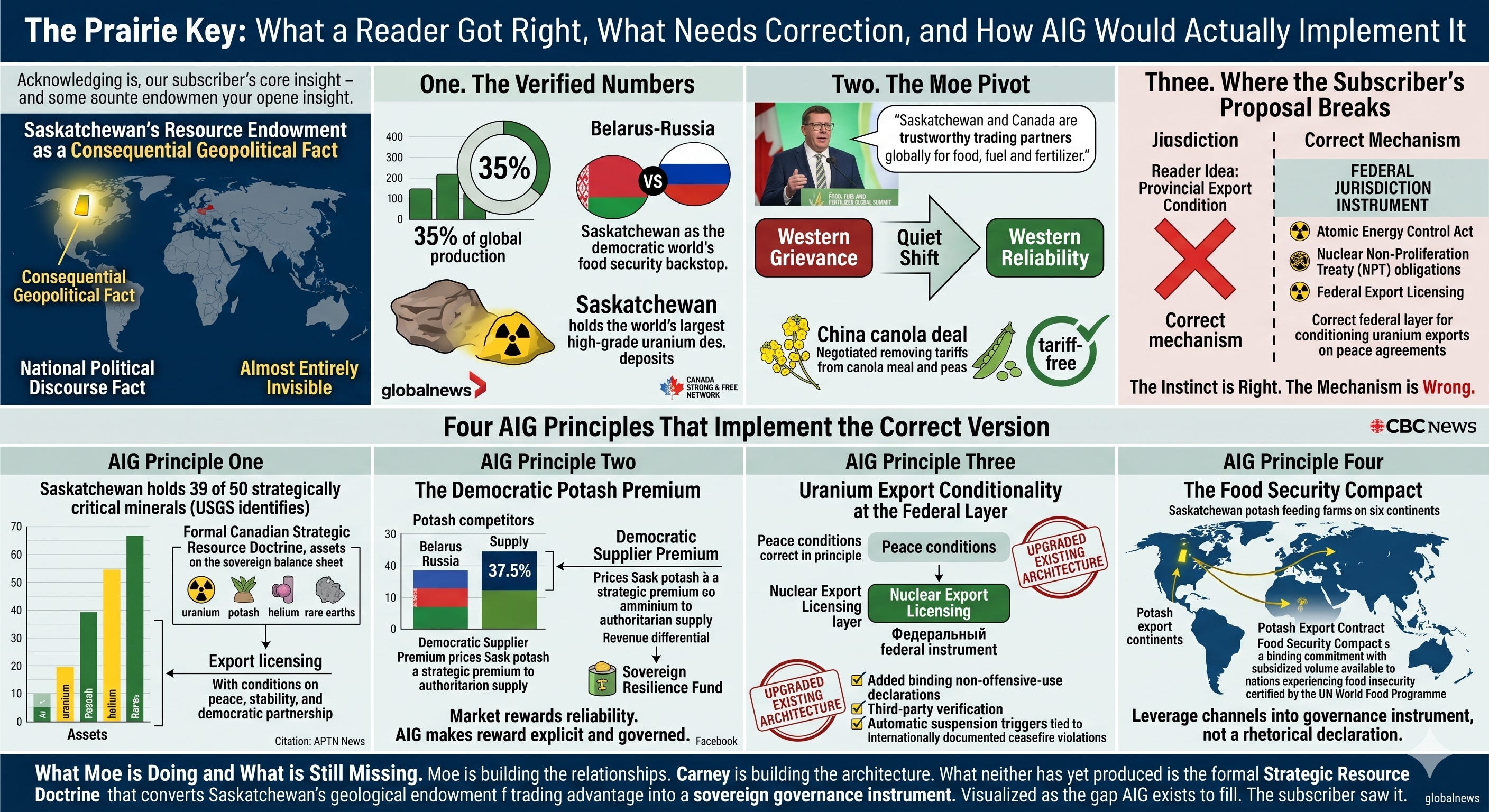
Saskatchewan holds the world’s largest potash industry, accounting for 35% of global production, and is home to the world’s largest high-grade uranium deposits. In 2025, uranium sales reached $3.2 billion — a new industry record, surpassing Saskatchewan’s own 2030 Growth Plan target by more than 50% for the second consecutive year. Potash sales rose 18% to $9.3 billion. Canada Strong & Free NetworkTwitter
Saskatchewan holds 27 of the 34 critical minerals on Canada’s official list and 39 of the 50 minerals the United States Geological Survey identifies as strategically critical. It is already home to North America’s first minerals-to-metal rare earth processing facility, with ambitions to become a rare earth elements hub. It is currently Canada’s largest helium producer, supplying roughly 3% of the global market, with a Helium Action Plan targeting 10% of global supply by 2030. APTN News + 2
The correspondent’s rare earth claim requires tempering — Saskatchewan has the deposits and the processing facility but is not yet a dominant global supplier. That infrastructure is being built now. The uranium and potash claims are unqualified.
Saskatchewan’s main global potash competitors are Belarus and Russia, who combined produce approximately 37.5% of the world’s supply. Read that twice. The democratic world’s alternative to authoritarian potash is a flat, wind-scraped province that most of the globe ignores. Six continents feed their farms with Saskatchewan potash. The two principal alternative suppliers are a Putin satellite and a country currently under comprehensive Western sanctions. That is not a trade story. That is a sovereignty story of the first order — and it is almost entirely absent from Canadian political discourse. Facebook
Saskatchewan is also Canada’s second-largest oil producer, targeting 600,000 barrels per day by 2030, and has invested over $500 million in helium infrastructure. In 2025, Saskatchewan led Canada in mineral resource development spending at $6.7 billion — 25% of the national total. Canada Strong & Free NetworkWikipedia
The correspondent is correct. This province is not a regional economy. It is a planetary resource architecture wearing a provincial flag.
The Man Holding the Key — A Cognitive Profile
Understanding what Scott Moe can do with this leverage requires an honest assessment of what kind of mind he brings to it. The Jaques Requisite Organization framework and the PIAAC literacy scale are the instruments The Vertical Dispatch uses for this analysis. Both are applied here without malice and without flattery.
Moe was born and raised on a grain farm between Shellbrook and Parkside, educated at the University of Saskatchewan where he received a Bachelor of Science in Agriculture. After graduating he worked in the agricultural equipment industry for several years. He then sold farm equipment, owned gas stations, and co-owned a pharmacy with his wife before entering politics in 2011. Facebook + 2
This is not the biographical formation of a Stratum VI or VII thinker in the Jaques model. That is not a dismissal. It is a precise observation that carries specific implications for what Moe can and cannot do with Saskatchewan’s resource leverage.
Carney’s formation — Harvard economics, Oxford DPhil under a Nobel laureate, thirteen years at Goldman Sachs across four global financial centres, Governor of two central banks — produces a mind that models systems across 20-year time horizons and repositions inside them before the events fully manifest. That is textbook Stratum VI-VII. Stubb’s formation — Furman, the Sorbonne, the College of Europe, a PhD from the LSE in International Relations — produces the same cognitive profile from a different institutional pathway.
Moe’s formation produces something different and something genuinely valuable at a different stratum. A BSc in Agriculture from the University of Saskatchewan, followed by years of direct commercial experience in the farming and small business economy of rural Saskatchewan, followed by a decade and a half of provincial politics managing the largest resource economy in the Canadian interior — this is Stratum IV operating at its upper ceiling, occasionally touching Stratum V when the problem demands it.
In PIAAC terms Moe reads and communicates at Level 3 — competent, concrete, locally grounded, capable of following multi-step instructions and synthesizing information from familiar domains. He is not operating at the Level 4-5 register of this publication or of the Carney-Stubb architecture. That gap is not a character flaw. It is a structural observation about what the governance instrument he operates within was designed to produce.
What Stratum IV-V at its best looks like in practice is exactly what Moe has been demonstrating in 2026. He joined Carney in China in January stating “Canada and Saskatchewan need a strong relationship with China and these meetings support the process of recalibrating how we work together.” That trip produced a preliminary agreement removing all tariffs from canola meal and peas and reducing canola seed tariffs to 15% — directly serving Saskatchewan farmers who had lost an estimated $850 million to Chinese retaliatory tariffs. He then joined Carney on the India trade mission in February, attending meetings in New Delhi and Mumbai. cbc + 2
At the Saskatchewan Chamber of Commerce Food, Fuel and Fertilizer Global Summit in April 2026, Moe said: “The world, as they look for food, fuel and fertilizer, and where they can get it in a sustainable way with a trustworthy trading partner, Saskatchewan and Canada is certainly that.” Canada Strong & Free Network
That is not the language of western grievance. That is the language of a provincial leader who has quietly understood that Saskatchewan’s resource endowment is most powerful when it is positioned as reliability rather than leverage — as the democratic world’s trustworthy alternative to authoritarian supply, not as a conditional threat to withhold it.
He disagrees with Carney’s framing that US trade dependency is a weakness — that political distance remains. But operationally he is functioning as a full partner in the most significant Canadian trade diversification architecture in a generation. The premier who spent years performing western grievance has become the premier who shows up in Beijing and Mumbai beside the Prime Minister and signs trade deals that directly benefit his farmers. Canada Strong & Free Network
That is Stratum IV-V doing exactly what it should do within a Stratum VI-VII architecture. The long-horizon strategic design belongs to Carney and Stubb. The provincial execution — showing up, building the relationships, delivering the agricultural wins — belongs to Moe. The system works when each level operates at the level it was designed for.
The problem is that no governance instrument exists to connect Moe’s provincial execution to a sovereign strategic resource doctrine that operates at the level the endowment demands. That is the gap. That is what AIG builds.
Three Problems the Instinct Cannot Solve Alone
The correspondent’s proposal — conditional exports, resource leverage tied to peace conditions — is morally serious and structurally impossible as a provincial declaration. Three specific problems prevent it from working as proposed.
The jurisdictional problem. Uranium export licensing, nuclear non-proliferation treaty obligations, and strategic resource export controls all sit at the federal layer. A premier cannot unilaterally condition uranium exports on peace agreements. The Atomic Energy Control Act does not permit it. The constitutional division of powers does not permit it. The instinct is correct. The mechanism is wrong.
The concentration problem. Saskatchewan’s resource endowment is extraordinary. Its governance architecture for managing that endowment as a strategic sovereign asset rather than a commodity is not. In 2023, 90% of Canada’s aluminum exports went to the US and just 3% to the EU — the aluminum story applies here too. A resource that sends 90% of its output to a single market has not converted geological advantage into strategic leverage. It has converted it into dependency wearing the costume of trade. 10Times
The invisibility problem. The most consequential geopolitical fact about Saskatchewan — that the democratic world’s food security backstop sits between two authoritarian potash producers — is almost entirely absent from Canadian national political discourse. Moe talks about it at industry summits. It does not appear in sovereignty discussions. It does not appear in defence policy. It does not appear in the Carney government’s trade diversification framework with the specificity it deserves. A strategic asset that is invisible in the governance discourse of the country that holds it is not being governed. It is being mined.
Four Principles AIG Would Apply
These are not regulatory proposals. They are governance instruments applied at the architectural layer before the contracts are signed and before the crisis makes the question obvious.
AIG Principle One — Strategic Resource Doctrine Before the Crisis.
Canada formally designated aluminum as a critical and strategic mineral in February 2026 — after the tariffs had already redirected the supply chain to Europe. Saskatchewan’s uranium and potash have been operating at civilizational scale for decades without a formal Strategic Resource Doctrine that classifies them on Canada’s sovereign balance sheet and establishes governance standards for their export. AIG requires that classification before the first long-term export contract is signed, not after the leverage has been surrendered. The doctrine establishes what the resource is, what it is worth in strategic terms beyond its commodity price, and what governance conditions must be satisfied before long-term commitments are made.
AIG Principle Two — No Strategic Resource May Exceed 50% Export Concentration to a Single Foreign Market.
The aluminum lesson applies directly. A resource generating billions annually and feeding six continents should not be 90% dependent on any single buyer regardless of proximity or treaty relationship. AIG imposes a hard ceiling at the contract approval layer. Saskatchewan potash, uranium, and helium contracts that would push any single foreign market above 50% of total export volume require sovereign resource review before approval. Diversification is not optional when the resource is classified as strategic. It is a governance requirement. The market pressure to maintain US concentration is real and understandable. The governance instrument that corrects for it must be structural not aspirational.
AIG Principle Three — Uranium Export Conditionality at the Federal Certification Layer.
The correspondent’s peace conditions applied to uranium are correct in principle and impossible as a provincial declaration. AIG implements them at the Nuclear Export Licensing layer — a federal instrument that already exists and can be strengthened. Every uranium export license requires binding non-offensive-use declarations, third-party verification through the International Atomic Energy Agency, and automatic suspension triggers tied to internationally documented ceasefire violations or verified offensive weapons development. This is not new architecture. It is existing architecture upgraded with structural clarity and enforcement teeth. The correspondent saw the right target. AIG provides the right instrument.
AIG Principle Four — The Democratic Supplier Premium and the Food Security Compact.
Saskatchewan’s potash competitors are Belarus and Russia at 37.5% of global supply combined. AIG formalizes what the market already partially recognizes — that democratic, rule-of-law supply chains command a premium over authoritarian alternatives. The Democratic Supplier Premium is a governance instrument that prices Saskatchewan potash at a structured premium to authoritarian supply and directs the revenue differential into a Sovereign Resilience Fund capitalized for long-horizon resource infrastructure investment. Facebook
The Food Security Compact accompanies every major long-term potash export contract — a binding commitment that a defined percentage of export volume is available at subsidized rates to nations experiencing food insecurity as certified by the UN World Food Programme. Saskatchewan is already feeding six continents. AIG makes that feeding a governed act of sovereign policy rather than an accidental consequence of market pricing.
What Is Already Moving and What Is Still Missing
Moe is building the relationships. Carney is building the trade architecture. Stubb is providing the multilateral framework. What none of the three has yet produced is the formal Strategic Resource Doctrine that converts Saskatchewan’s geological endowment from a provincial trading advantage into a Canadian sovereign governance instrument operating at the scale the endowment demands.
The correspondent who prompted this dispatch saw that gap without being able to name it precisely. The conditional export framework they proposed is not the instrument — but the instinct that something more deliberate, more structured, and more sovereign needs to govern these resources is exactly right.
Moe said it plainly at the April summit: “No one needs it more than the president of the United States of America. Canada has most certainly what the United States needs.” Canada Strong & Free Network
That is the correct reading of the leverage. What he did not say — and what no governance instrument currently requires him to say — is what Canada intends to do with that leverage beyond the next trade negotiation cycle.
AIG says it plainly: Saskatchewan is not a commodity province. It is a sovereign resource architecture. Govern it accordingly. The window for building that governance instrument on Canada’s terms rather than in reaction to the next foreign policy crisis is open.
It will not stay open.
The Vertical Dispatch publishes at the intersection of geopolitics, governance philosophy, and sacred metaphysics. AIG — Artificially Intelligent Governance — is a formal framework for governance design adequate to the complexity of the twenty-first century. It is not a technology.
It is a reckoning.#AIG #ArtificiallyIntelligentGovernance #TheVerticalDispatch #Saskatchewan #PrairieKey #ScottMoe #MarkCarney #AlexanderStubb #Potash #Uranium #Helium #RareEarths #CriticalMinerals #StrategicResources #CanadaSovereignty #FoodSecurity #CdnPoli #CanadaStrong #DemocraticSupplier #NuclearPolicy #IAEA #BelarusPotash #RussiaCanada #USCanadaRelations #TradePolicy #RequisiteOrganization #StratifiedSystems #PIAAC #CanadaFirst #VerticalDispatch
💯 relevant and accurate in our current times. I trust this dispatch will be received by the decision makers soon, to review and apply.
The Prairie Key Act: A Legislative Proposal for Peace, Prosperity, and Stewardship (Updated Edition) Two Part Series (25/05/2026)
The Prairie Key Act: A Legislative Proposal for Peace, Prosperity, and Stewardship (Updated Edition) Part One (25/05/2026)
https://kellydwills55.substack.com/p/the-prairie-key-act-a-legislative-a4a?utm_source=share&utm_medium=android&r=r5v2
The Prairie Key Act: A Legislative Proposal for Peace, Prosperity, and Stewardship (Updated Edition) Part Two (25/05/2026)
https://kellydwills55.substack.com/p/the-prairie-key-act-a-legislative-961?utm_source=share&utm_medium=android&r=r5v2
Please Comment Love and Restack!