


This dispatch was prompted by the persistent generosity of Kelly, a Canadian Substack writer whose four-part series on Saskatchewan's resource leverage arrived in my reading with a week's worth of patient encouragement behind it. Kelly's research is thorough, his moral orientation is sound, and his instinct — that something in Saskatchewan's geological position constitutes a genuine instrument of peace — is correct. What follows is not a summary of his work. It is a reframing of his material within the AIG governance architecture, which I believe is what his argument was reaching toward without yet having the framework to name. The Prairie Key, as Kelly conceived it, is a peace proposal. Read through AIG, it becomes something more precise: a governance question about the ground that capability must answer to. I am grateful for the research. The framework is the contribution I can make to it.
https://substack.com/@kelly794110
The world plays checkers with peace. Every summit, every sanctions package, every military alliance is a reactive move — one piece responding to one threat on a flat board where power is measured by mass and momentum. The nation with the most missiles wins. The nation with the largest alliance wins. This is checkers. It has been played, without interruption, for the entirety of the modern era. It has not produced peace. It has produced an unbroken sequence of consequences that compound into the next war.
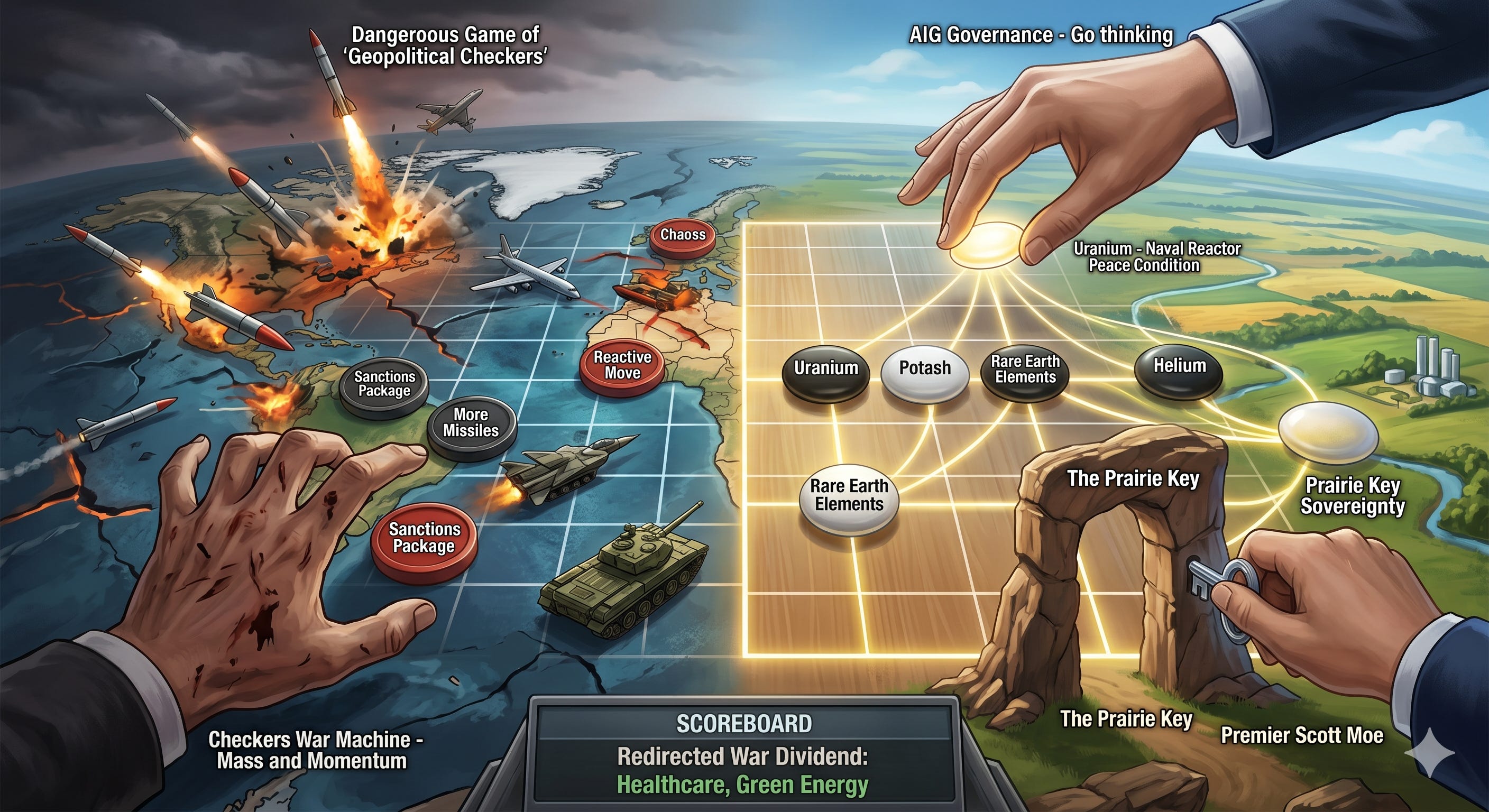
Saskatchewan is not a geopolitical player in the checkers game. It is quiet, cold, sparsely populated, and essentially invisible to the strategic imagination. It has approximately 1.2 million people — the population of Calgary. It is known, to those who know it at all, for wheat, football, and the legacy of Tommy Douglas. It does not appear on the mental maps of foreign ministers or defence planners.
But geology plays a different game entirely. Geology does not care about reputation or population. Hundreds of millions of years of planetary process concentrated four irreplaceable resources under the Saskatchewan prairie, and those resources now sit at the intersection of every system the world’s militaries depend on to function. The world cannot wage modern war without what lies beneath this province. And Saskatchewan has never once asked what its resources are being used for.
That silence is not neutrality. It is abdication. And it is about to become a choice — visible, deliberate, and consequential — or it will continue as the default. The Prairie Key is the architecture of the other option.
Artificially Intelligent Governance does not ask what power can do.
It asks what power is for.
I. What AIG Sees That Checkers Cannot
AIG — Artificially Intelligent Governance — is the framework this publication applies to every domain it touches. It must be named precisely here, because the Prairie Key is not a policy proposal in the conventional sense. It is an application of AIG logic to the question of resource sovereignty.
AIG names the ground that capability must answer to. It is not governance by algorithm, not technocratic administration, not the replacement of human judgment with machine judgment. It is the discipline of asking, before any act of governance: what is this for? Not what can it do — what is it for? The distinction is the distance between checkers and Go.
The checkers player asks: what move is available to me? The chess player asks: what sequence of moves serves my position? The Go player asks: what is the shape of the board I am building, and does this stone serve that shape? AIG asks the Go question in every domain — military, economic, ecological, constitutional — and refuses to act until the question is answered honestly.
Applied to Saskatchewan’s resources, the AIG question is this: what governance structure, applied to these four irreplaceable materials, would produce the greatest alignment between their extraction and the conditions that make human life sustainable? The answer is not a boycott. It is not nationalization. It is not isolationism. It is conditionality — the attachment of peace conditions to export permits for resources that the war machine cannot function without.
This is Go thinking. Saskatchewan does not need to win a confrontation. It needs to place its stones such that the shape of the board changes — such that the rational calculus of every buyer shifts from “war is viable” toward “peace is necessary.” AIG names the governance architecture that makes this possible. The Prairie Key is its application.
II. The Four Stones
Four resources. Each one irreplaceable. Together, they constitute a leverage position of a kind Saskatchewan has never understood itself to hold, because no one in the export permit office in Regina has ever been asked to think about it.
Uranium — The Nuclear Fuel
The Athabasca Basin in northern Saskatchewan contains the richest uranium deposits on earth — ore up to one hundred times more concentrated than what other producing nations can offer. This is not a marginal advantage. It is a categorical one. Nuclear power plants depend on it. Naval reactors — the ones that power submarines and aircraft carriers, that enforce blockades and project force across the world’s oceans — depend on it. Kazakhstan, Australia, and Namibia produce uranium. None of them matches Saskatchewan’s grade, scale, or reliability. There is no easy substitute. There is no seamless redirect. If Saskatchewan conditions its uranium exports on end-use verification — not for civilian power, but against offensive naval deployment — buyers face a genuine choice.
Potash — The Ground of Food Security
Saskatchewan produces approximately one-third of the world’s potash — the potassium-rich salt that is the essential ingredient in the fertilizer that sustains modern agricultural yields. Without it, crop yields fall 30 to 50 percent. Without sufficient potash, the world cannot grow enough food to feed itself at current population. Russia and Belarus produce most of the remaining global supply, and sanctions have disrupted their exports since 2022. The world has turned to Saskatchewan to fill the gap. Saskatchewan is not merely a supplier. It is the guarantor of global food stability. When its exports are reliable, food prices hold. When disrupted, food prices spike — and the populations most vulnerable to those spikes are the poor of nations already navigating political fragility. Potash is a peace resource. Selling it without conditions is a governance failure.
Rare Earth Elements — The Magnets Inside the Missiles
Neodymium. Praseodymium. Dysprosium. Terbium. These are the rare earth elements that produce the high-strength permanent magnets inside every smartphone, every electric motor, every drone guidance system, and every precision-guided munition. Modern warfare does not become less precise without them. It stops. China dominates global rare earth processing. The West has spent years attempting to reduce its dependence on a nation that has demonstrated willingness to weaponize that dependence. The only fully integrated rare earth processing facility in North America outside Chinese control is in Saskatoon, operated by the Saskatchewan Research Council. It is the West’s one real alternative. Western defence manufacturers cannot walk away from it. Saskatchewan, applying AIG governance logic, can set the terms of access.
Helium — The Invisible Coolant
Helium is not a party balloon resource. It is the only element capable of cooling certain technologies to the extreme low temperatures their function requires. MRI machines need it. Semiconductor fabrication plants need it. Military sensor arrays, missile guidance systems, and nuclear weapons infrastructure need it. The global helium supply is concentrated, fragile, and increasingly strategic. Saskatchewan’s reserves are significant and currently in early development. Within this decade, the province will become a critical node in the global helium supply chain — with all the leverage that entails, governed or ungoverned.
Saskatchewan has never asked what its resources are used for.
That silence is not neutrality. It is abdication.
III. The Constitutional Ground
AIG governance requires constitutional ground to stand on. It does not operate through wishful thinking or moral suasion alone. It operates through jurisdiction — the actual, enforceable authority to set conditions on what happens within a defined domain.
That ground exists. In Canada, natural resources are owned by the provinces, not the federal government. This is the foundational bargain of Confederation, written into the Constitution. When Saskatchewan joined Canada in 1905, it joined on the explicit understanding that its resources remained under provincial control. Every shipment of uranium, potash, rare earths, or helium leaving the province requires an export permit issued by provincial authorities. The province already conditions resource extraction — environmental standards, safety regulations, Indigenous consultation requirements are all attached to permits as a matter of routine governance.
Adding peace conditions to export permits is not the invention of a new power. It is a new application of an existing one. Saskatchewan does not require Ottawa’s permission to ask what its resources are being used for. It requires a premier willing to apply AIG logic to the authority he already holds.
The federal government manages foreign policy and international treaties. But export permits are provincial instruments. The distinction is real and it is sufficient.
IV. The Arctic Bridge — Geography as Governance
AIG does not govern resources in isolation. It reads systems. The Prairie Key’s resource conditionality is most powerful when combined with a second governance lever: the Arctic Bridge — the shipping route from Churchill, Manitoba, to Murmansk, Russia, across the top of the world.
The route is 6,700 kilometres. A cargo vessel makes the passage in approximately eight days. By comparison, the Panama Canal route from North America to Asia requires more than forty days. The St. Lawrence Seaway to Europe requires seventeen. The Arctic Bridge is not a proposal. It is an existing route, already navigated — in 2007, a Russian vessel docked at Churchill and delivered fertilizer to Prairie farmers. The passage is proven. Churchill is Canada’s only deepwater Arctic port connected by rail to the continental interior. The infrastructure exists.
Infrastructure Already Committed
The federal, Manitoba, and Saskatchewan governments have committed $262.5 million to upgrade the Port of Churchill and the Hudson Bay Railway.
The Arctic Gateway Group — a consortium including 41 Indigenous communities as co-owners — operates the port and rail line.
The Churchill-to-Murmansk passage has already been completed by cargo vessel. The route is proven.
What does not yet exist is the governance architecture to declare the route a peace corridor — open exclusively for peaceful cargo: food, fertilizer, medicine, civilian technology. No weapons shipments. No military cargo. No supplies for regimes under international sanctions. Ships that accept these conditions gain access to the fastest trade route between hemispheres. Ships that do not must use longer, slower, more expensive alternatives.
This is not a sanction. It is a condition of service. Canada controls the North American terminus. Canada sets the terms. And the terms are simple: if you want the efficiency of the Arctic Bridge, you accept the peace conditions of the Prairie Key.
The AIG logic here is explicit: trade interdependence is not a soft power instrument. It is a hard one. Nations that depend on the same trade corridor for economic survival do not go to war with one another, because war destroys the dependence that both benefit from. The Arctic Bridge, governed by peace conditions, makes the economic incentive and the peace incentive structurally identical. War becomes bad business. Peace becomes the rational choice — not because anyone has been persuaded, but because the board has been shaped.
Canada’s current relationship with Russia is frozen. The Arctic Bridge seems politically impossible at this moment. But peace is made with adversaries, not friends. The Bridge does not require Canada to endorse violations of international law. It requires Canada to offer a trade relationship that gives Russia an economic reason to de-escalate — and that withholds that relationship as a condition of continued belligerence. This is pressure applied through economic architecture, not military posture. It is the Go move. It is AIG.
V. The Peace Dividend — Redirecting the War Column
In 2025, total global military expenditure reached $2.8 trillion. NATO allies accounted for $1.4 trillion of that figure. Canada’s contribution was approximately $41 billion — a 20 percent increase from the prior year. Some NATO leaders are now calling for member nations to spend 5 percent of GDP on defence. For Canada, that would mean approximately $100 billion annually — more than double current spending.
AIG governance reads these numbers as a governance failure of the first order. The money exists. It is allocated. It is simply allocated to the wrong column in the ledger.
The Ledger the Checkers Board Cannot See
$2.8 trillion in annual global military spending exceeds the total cost of eliminating global hunger, providing universal primary healthcare, and fully funding climate adaptation in the developing world — combined.
The Sustainable Development Goals face an annual funding gap of approximately $4 trillion. Global military spending is $2.8 trillion. The resources exist. They are misallocated.
Canada spends $41 billion on defence. A peace-configured Canadian military — focused on coastal patrol, Arctic surveillance, disaster response, and cyber defence — could operate on $10 to $15 billion annually. The freed capital: $25 to $30 billion, every year, in perpetuity.
If Canada redirected half its current military budget and distributed it equitably among the provinces, Saskatchewan would receive approximately $2 billion annually. Against a total provincial budget of roughly $20 billion, that is transformational — sufficient to clear surgical waitlists, fund 5,000 affordable housing units annually, establish comprehensive mental health and addictions infrastructure, and accelerate the green energy transition, with capital remaining.
The peace dividend is not a political fantasy. It is a budget line. Budget lines are moved by governance decisions, and governance decisions are made by people with jurisdiction and the will to use it. The checkers player accepts the board as given. The AIG governor changes the board.
The objection will come: we need a military. Nations with bad intentions exist. Yes. The Prairie Key does not argue for zero defence. It argues for defence configured to actual threats — the wildfires, the floods, the cyberattacks, the pandemics, the Arctic sovereignty challenges that constitute genuine risk to Canadians — rather than defence configured for expeditionary warfare in alliance structures designed for a twentieth-century strategic environment that no longer exists.
Canada is not primarily responsible for deterring great-power adversaries. That responsibility falls to the United States, which spends more on its military than the next ten nations combined. If American military capacity cannot deter Russia or China, no Canadian contribution at any budget level will make the difference. The current posture is not deterrence. It is performance. AIG names that distinction clearly.
VI. The Objections — Read at the Level They Deserve
The objections to the Prairie Key are predictable because they are checkers objections. They accept the board as given and ask only what move is available within the existing configuration of power. AIG reads them differently.
Won’t buyers simply go elsewhere? For Saskatchewan’s uranium, rare earths, and potash, there is no equivalent elsewhere at equivalent scale, grade, and reliability. Kazakhstan, Australia, and Namibia produce uranium; none matches Athabasca’s concentration. China processes rare earths; Western defence manufacturers have spent years building Saskatchewan’s facility specifically to escape that dependence. Russia and Belarus supply potash; sanctions have already disrupted that supply, and the world turned to Saskatchewan to fill the gap. The leverage is asymmetric in Saskatchewan’s favour. Buyers will grumble. They will accept conditions. The alternative is no fertilizer, no rare earth magnets, no high-grade nuclear fuel.
Will the United States retaliate? American farmers import approximately 85 percent of their potash needs; Saskatchewan supplies most of it. Tariffs on Saskatchewan potash raise American food prices. American nuclear utilities and naval reactors depend on Saskatchewan uranium. American defence manufacturers depend on Saskatchewan rare earths as their only non-Chinese source. The asymmetry of dependence runs in Saskatchewan’s favour on each of these materials. Retaliation would be self-wounding. AIG reads this as leverage, not vulnerability.
Won’t this just be ignored? The first jurisdiction to condition its exports on peace will be called naive. The second will be called a copycat. The twentieth will represent a movement. The fortieth will be the new normal. Saskatchewan can choose its position on that sequence. AIG governance understands that norms are built by first movers who hold their ground.
Isn’t this idealistic? What is idealistic is the status quo — the belief that unconditional resource extraction, ever-increasing military budgets, and the continued export of materials to war machines without question will, at some point, produce peace. The evidence of seventy years says otherwise. The Prairie Key is not idealism. It is the application of a governance framework — AIG — to a leverage position that actually exists, using constitutional authority that already exists, to produce conditions that change the rational calculus of actors who are not moved by moral argument but are moved by structural incentive.
VII. The Action — What AIG Governance Looks Like in Practice
AIG does not remain at the level of analysis. It moves toward action through the institutions that have jurisdiction. In this case, the institution is the Government of Saskatchewan. The actor is the Premier. The instrument is the export permit. The condition is peace.
The mechanism is simple: before uranium, potash, rare earths, or helium leaves Saskatchewan, the buyer declares end use. Exports to civilian nuclear power are permitted. Exports to offensive naval reactors are conditioned. Exports to regimes under UN sanctions are refused. Exports to fertilizer markets are permitted. Exports to regimes using starvation as a weapon are refused. Rare earth exports to civilian manufacturers are permitted. Exports to missile guidance systems used in offensive invasions are refused.
This is not complicated governance. It is the application of a question — what is this for? — to a permit process that currently asks no questions at all. The export permit office in Regina is the lever. The Premier’s hand is on it. The public is the force that moves the hand.
Write to Premier Scott Moe: premier@gov.sk.ca | 306-787-9433
Write to Prime Minister Mark Carney: mark.carney@parl.gc.ca | 613-992-4211
The letter does not need to be long. It needs to be clear: Use the constitutional authority Saskatchewan already holds to condition resource exports on peace. AIG governance begins with this question: what is this for? Ask it before the next shipment leaves.
Politicians respond to volume. One letter is ignored. A hundred are noticed. A thousand produce action. Tell five people. Forward the address. The Prairie Key turns in a Premier’s hand — and the Premier’s hand moves when enough hands are on his door.
God is love. Love is Truth. Truth is Consciousness. Consciousness is Brahman. Amen. Namaste.
The Vertical Dispatch | Project 2046 | The Architect
#PrairieKey #AIG #ArtificiallyIntelligentGovernance #VerticalDispatch #TheArchitect #Saskatchewan #CanadianSovereignty #ResourceSovereignty #PeaceDividend #ArcticBridge #ChurchillMB #Uranium #Potash #RareEarths #Helium #CanadianPolitics #Geopolitics #PeaceGovernance #NorthernSovereignty #CanadaFirst #GovernancePhilosophy #ExportPolicy #FoodSecurity #NuclearFuel #DefencePolicy #PeaceBuilding #MarkCarney #ScottMoe #SubstackCanada #TheVerticalDispatch
May peace, single payer healthcare and prosperity be with you and yours.🤗❤️🇨🇦
I like the argument, rather the proposal.
My question though is how do you accommodate ego or nationalism?
As the world has evolved from being tribal to city states to nations it would appear, to me anyway, the next iteration of governance is via corporations.
Corporations as we know have no conscience, no morals, no ethics unless instilled via its ownership.
In turn that ownership is fluid based on longevity, desire to manage the strategy to time to cash out.
It seems this is all premised on commerce coupled with reasonable people doing reasonable things.
Again thanks for your essay