


Φ
THE VERTICAL DISPATCH
We write for the mind, the eye, and the ear.
Read it. Look at it. Listen to it. The Vertical Dispatch is built for all three — prose with rhythm, made to be heard as much as read.
From metaphysics to geopolitics, from culture to history, from the sacred to the street — and everything in between. One lens, every subject. No ego. Just the record, named clean.
Press play. Walk with the word. 🕯️
This dispatch travels by hand. If it serves you, share it — restack on Substack, and pass it on wherever you read. 🕯️
The Age of Consequences · Canadian Geopolitical Analysis
As of June 25, 2026
Part One of Two
“Nothing can be changed until it is faced.”
— James Baldwin
The House Nobody Would Touch
There is a house in Ottawa that the Prime Minister of Canada is not permitted to live in. It is his by right and by office, and it is a ruin. Twenty-four Sussex Drive — the official residence of the head of government of a G7 nation — has stood empty since 2015, stripped in the end of asbestos, mould, and the rodents that had moved in where prime ministers used to be. A 2008 Auditor General’s report called the repairs urgent and put them at roughly ten million dollars. By 2021 the National Capital Commission listed the building “critical” and the bill at some thirty-seven million. The number rose every year, for the simplest reason: nobody fixed it.
Let the record be honest at the outset, because the honesty is what makes the rest unkillable. This was not one party’s failure. Stephen Harper lived in the house for a decade and approved nothing beyond the necessary. Justin Trudeau, on taking office in 2015, chose not to move into the home he had grown up in, and then declined for nine years to repair it. When two former prime ministers, of opposite stripes, offered to raise the restoration money privately, the idea died. The cowardice, in plain terms, was bipartisan. The trap was the whole political class’s making.
And the trap had a shape worth naming. No leader would spend the money because the moment he did, the opposition of the day would rise and say: look at him, lavishing millions on his own mansion while you cannot pay your rent. Angus Reid found that sixty-four percent of Canadians believed recent governments let the house rot precisely out of fear of that backlash. So the house was left to fall, not because the money was absent — the same years saw $1.7 billion spent refurbishing Parliament Hill — and not because the law forbade a fix, but because fixing it earned no votes and cost political skin.
The obstacle was never the law. Parliament writes the law. The obstacle was that ending the embarrassment paid less than keeping it.
The Excuse That Is Really the Confession
It is sometimes said, by way of explanation, that the Prime Minister cannot simply move back into Twenty-four Sussex because it would have to be renovated first. This is offered as a difficulty. It is in fact the confession. Parliament itself has run for years out of temporary quarters while Centre Block is rebuilt — the Commons decamped to West Block, the work proceeds across a decade, and at no point did anyone pretend the institution could not function in the meantime. The will was there for Parliament. It was never there for the Prime Minister’s house.
A government that can house the legislature in a converted train-shed annex for ten years can house a Prime Minister in suitable quarters while his residence is restored. That is a logistics problem, and competent governments solve logistics problems when they wish to. The residence rotted not because the repair was impossible to stage, but because no one would carry the political weight of staging it — and the opposition stood ready, at every turn, to make that weight heavier.
The Cold Step
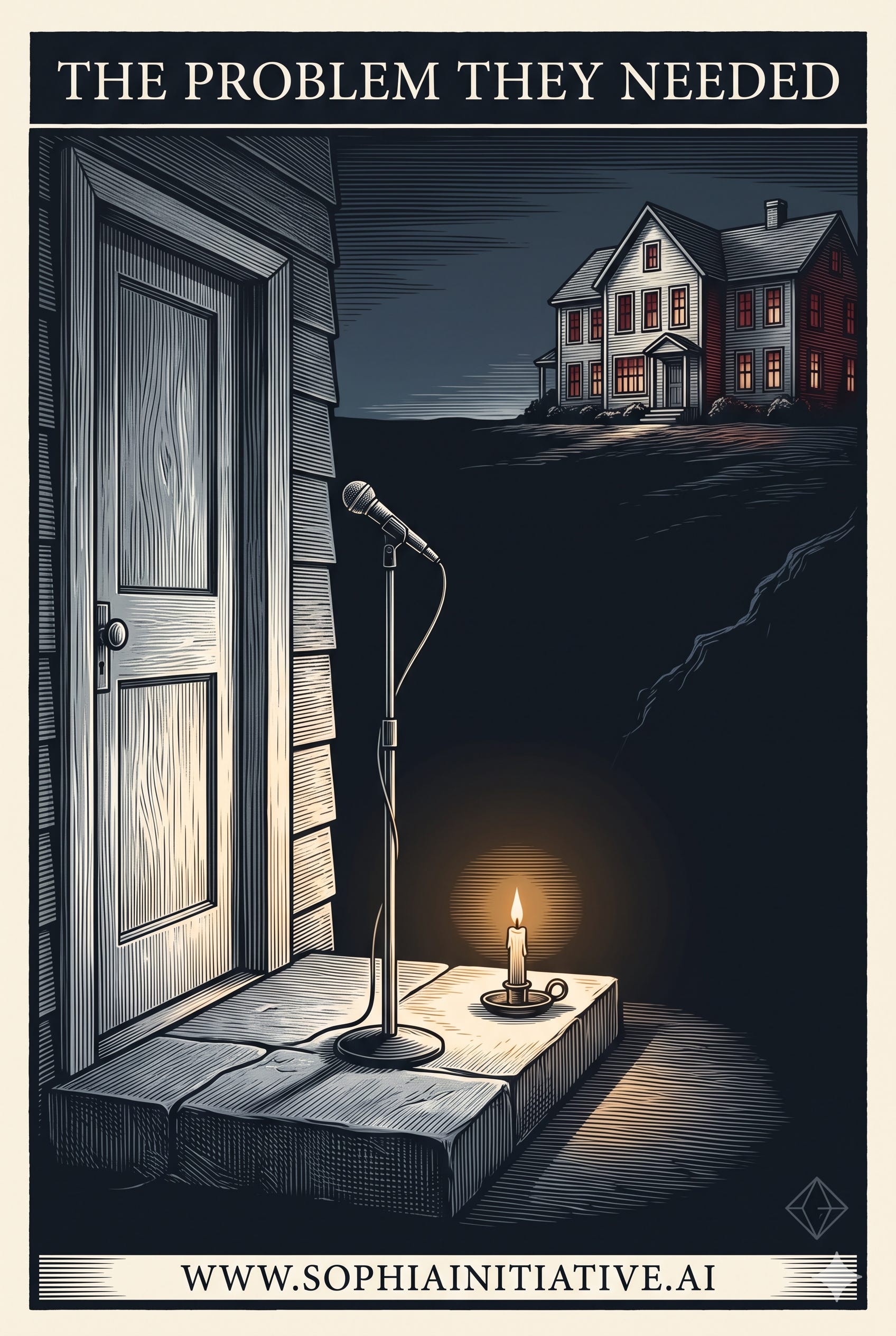
To understand the cost, picture the spring of 2020. A pandemic had shut the country and much of the world. Canadians were losing work by the millions in a matter of weeks. And the Prime Minister of Canada addressed the frightened nation, morning after morning, from the doorstep of Rideau Cottage — the modest red-brick house on the Governor General’s grounds that the government’s own internal memo would later call inadequate for the office, too small in footprint, a security risk for its proximity to the vice-regal residence. He governed the worst crisis in generations from that step, his wife and young children inside, and he did not complain about the house.
And in those same weeks, the Leader of the Official Opposition was snug in Stornoway — the sound, fully-staffed official residence of the opposition leader, a nineteen-room house in good repair, served by a chef, a chauffeur, and a household administrator, with the rooms and grounds a head of state uses to receive the world. The head of government on the cold step; the leader of the opposition in the functional house. That image is not an accusation. It is a photograph. The record simply asks the reader to look at it.
The head of government on the cold step. The leader of the opposition in the functional house. The record asks only that you look.
The Motion They Never Filed
Here is where conduct becomes consequence. An opposition is not powerless before a problem of national standing. It can bring a bill. It can move a motion. It can put the government on record and offer the one thing that breaks the cowardice trap: cover. If the opposition stands and says “we will support fixing the Prime Minister’s residence, and we will not attack you for the cost,” the club is taken out of the game, and the repair becomes possible overnight. That cover was always theirs to give. They never gave it.
Nor did they propose the obvious alternative within their gift to propose. No one was asking the official opposition to live in hardship. Had a leader risen and said “It embarrasses this country that our Prime Minister has nowhere fit to receive world leaders — put him in the functional residence, and find suitable quarters for the opposition, as a gesture to the office and to Canada,” comfortable accommodation for the opposition would have been found in a heartbeat. The point was never the opposition’s comfort. The point is that not one of them ever moved to end the embarrassment. The bill was never tabled. The motion was never filed.
What they did instead is on the record. In 2019, the leader’s office called the rotting house “a failure that Justin Trudeau has been unable to fix,” inflated the figure to “nearly $100 million” — a number the national broadcaster flagged as a stretch against the real backlog across all six official residences — and promised “innovative ways” to end the “debacle.” Earlier, a senior Conservative had conditioned any support for repairs on the Prime Minister first repaying the cost of an unrelated personal trip — holding a piece of national heritage hostage to a partisan grievance. And the current leader closed the door entirely: asked about a proper home for the Prime Minister, he called it “the last” priority — “we don’t need a new home for the prime minister” — while living, at that moment, in Stornoway.
Indignation Where Seriousness Was Required
Set the performance beside the conduct and the gap is the whole story. The posture was moral indignation — loud, repeated, useful outrage over the state of the house. The substance was a refusal to lift a finger toward the repair, and a comfortable occupancy of the very alternative the Prime Minister lacked. Indignation costs nothing and wins votes. Seriousness would have meant a bill, an offer of cover, an end to the embarrassment. They offered the country indignation where moral seriousness was the duty of the hour.
And this is why it belongs to the Age of Consequences, for the consequence is the thing they left behind. Given a matter of national standing — how the country houses its own leader, how Canada presents itself to the world — they treated it not as a problem to solve but as terrain to find problems on. They pointed, inflated, conditioned, and dismissed, and at no point did they propose. The unsolved problem was worth more to them than the solved one would have been. The casualty was not a building. The casualty was the Canadian brand, spent as ammunition by a party that, the record shows, will trade the country’s standing for a political point — and has done so, in the open, again and again.
They treated a matter of national standing as terrain to find problems on, never as a problem to solve. The casualty was the Canadian brand.
Friday’s Tell
As this dispatch is written, the question is about to be answered by the man who inherited it. The Prime Minister has announced a press conference for Friday morning, June 26, 2026, to reveal the government’s decision on Twenty-four Sussex. He has already tipped his posture: he will not live in the restored house himself, but he wants it restored for his successors — “I think it’s a responsibility to hand off things better than you found them,” he said, calling the residence’s current state “an embarrassment.” The National Capital Commission, this same week, named the preservation of Twenty-four Sussex a “key objective” of its twenty-year plan for the capital.
The contrast writes its own last line. The head of government prepares to spend on a house he will never occupy, for the leaders who come after him. The leader of the opposition, asked this week about the same house, said he “doesn’t think about it at all.” What Friday’s announcement contains — a real plan with real money, or another deferral — is the test taken in advance. This dispatch will return to it when the decision is named. Part Two follows the money and the method: how a problem becomes a brand, and a brand becomes a weapon.
God is Love. Love is Truth. Truth is Consciousness. Consciousness is Brahman.
Amen. Namaste. Om Namah Shivaya.
— The Architect.
The Vertical Dispatch
sophiainitiative.ai
On the record
24 Sussex Drive condition and cost: National Capital Commission 2021 condition report (“critical,” ~$36.6–$37M deferred maintenance); 2008 Auditor General report (~$10M, urgent). 34-room main building, ~12,000 sq ft, 5.3 acres (NCC, reported June 2026). Uninhabited since 2015; decommissioned and abated (asbestos, mould, rodents), $4.3M, completed November 2024 (NCC). All figures as of June 25, 2026.
Rideau Cottage: 22-room, two-storey Georgian Revival building on the Rideau Hall grounds, ~10,000 sq ft; prime-ministerial temporary residence since 2015; deemed “inadequate” with “small footprint” and security risk per internal government memo to the Privy Council Office dated August 8, 2025 (obtained by CBC News via access to information).
Stornoway: official residence of the Leader of the Official Opposition since 1950; ~9,500 sq ft, 19 rooms; “fair” condition per NCC 2021 report (~$1.25M deferred maintenance over 10 years); staff of three (chef, chauffeur, household administrator) per House of Commons petition e-7395; ~$78,000 in maintenance, fiscal 2023–24, per access-to-information release. Provision governed by the Official Residences Act.
Bipartisan inaction: Harper approved no major spending 2006–15; Trudeau declined to occupy or renovate 2015–25; Chrétien and Harper offered to fundraise restoration in 2024 (declined). Angus Reid (2023): 64% attribute the disrepair to fear of public backlash. Parliament Hill refurbishment cited at ~$1.7B (CBC).
Conservative statements: 2019 leader’s-office statement (“failure,” “nearly $100 million,” “debacle,” “innovative ways”) reported by CBC; CBC characterized the “$100 million” figure as a stretch against the ~$83M ten-year backlog across all six residences. Earlier conditioning of renovation support on repayment of an unrelated trip reported by CBC and the Globe and Mail (2018). “Last” priority / “we don’t need a new home for the prime minister”: Globe and Mail, Global News, CTV (Aug 2023; Nov 2024), spoken while resident at Stornoway. “Doesn’t think about it”: CBC (June 25, 2026).
Carney: “embarrassment,” “responsibility to hand off things better than you found them,” “you’re not going to see me at 24 Sussex, but I would like to see my successors” (CBC, The National, April 2026). Press conference on the residence’s future announced for June 26, 2026 (CBC). NCC National Capital Core Area Plan naming 24 Sussex preservation a “key objective” approved by the NCC board, June 2026.
No figure in this dispatch is disaggregated by race, group, or class. All characterizations are commentary on conduct in the public record. Errors and omissions excepted; corrections will be made on notice. Verify against primary sources before republication.
Suggested tags:
24 Sussex Drive · Rideau Cottage · Stornoway · official residences · Canadian politics · Carney · Poilievre · Scheer · National Capital Commission · Canadian brand · Age of Consequences
Substack Notes
A G7 country let the official home of its head of government rot for a decade — and the reason is more damning than neglect. The money existed: $1.7 billion went into Parliament Hill in the same years. The law was never the obstacle; Parliament writes the law. What was missing was nerve — and an opposition that found the rotting house more useful as a weapon than the repair would be as a duty.
Part One of The Problem They Needed sets the record straight. Through the pandemic, the Prime Minister governed from the doorstep of a cottage his own officials call inadequate, family inside, no complaint — while the opposition sat in Stornoway, the sound and fully-staffed official residence, and hammered the empty house as a scandal without ever filing the bill that could have ended it. Indignation where moral seriousness was required.
The decision Canadians have waited a decade for lands Friday. This is the test taken in advance: who treated the country’s standing as a problem to solve, and who treated it as terrain to find problems on. Read it, look at it, listen to it — and watch what Friday reveals.
Written from love, in service of the record. Walk with the word. 🕯️
#TheVerticalDispatch #TheArchitect #SophiaInitiative #AgeOfConsequences #24Sussex #Stornoway #RideauCottage #CanadianPolitics #CanadianBrand #GodIsLove #LoveIsTruth #OmNamahShivaya
The factual matter in this Dispatch is drawn from the public record. All characterizations, inferences, and conclusions are opinion, interpretation, and commentary, offered for analysis, reflection, and public-interest discussion. No assertion is made regarding the private intentions, state of mind, or character of any individual. Readers should evaluate all statements independently and draw their own conclusions.