

Φ
THE VERTICAL DISPATCH
We write for the mind, the eye, and the ear.
Read it. Look at it. Listen to it. The Vertical Dispatch is built for all three — prose with rhythm, made to be heard as much as read.
From metaphysics to geopolitics, from culture to history, from the sacred to the street — and everything in between. One lens, every subject. No ego. Just the record, named clean.
Press play. Walk with the word. 🕯️
This dispatch travels by hand. If it serves you, share it — restack on Substack, and pass it on wherever you read. 🕯️
The Foundation Series · On Consciousness
July 2026
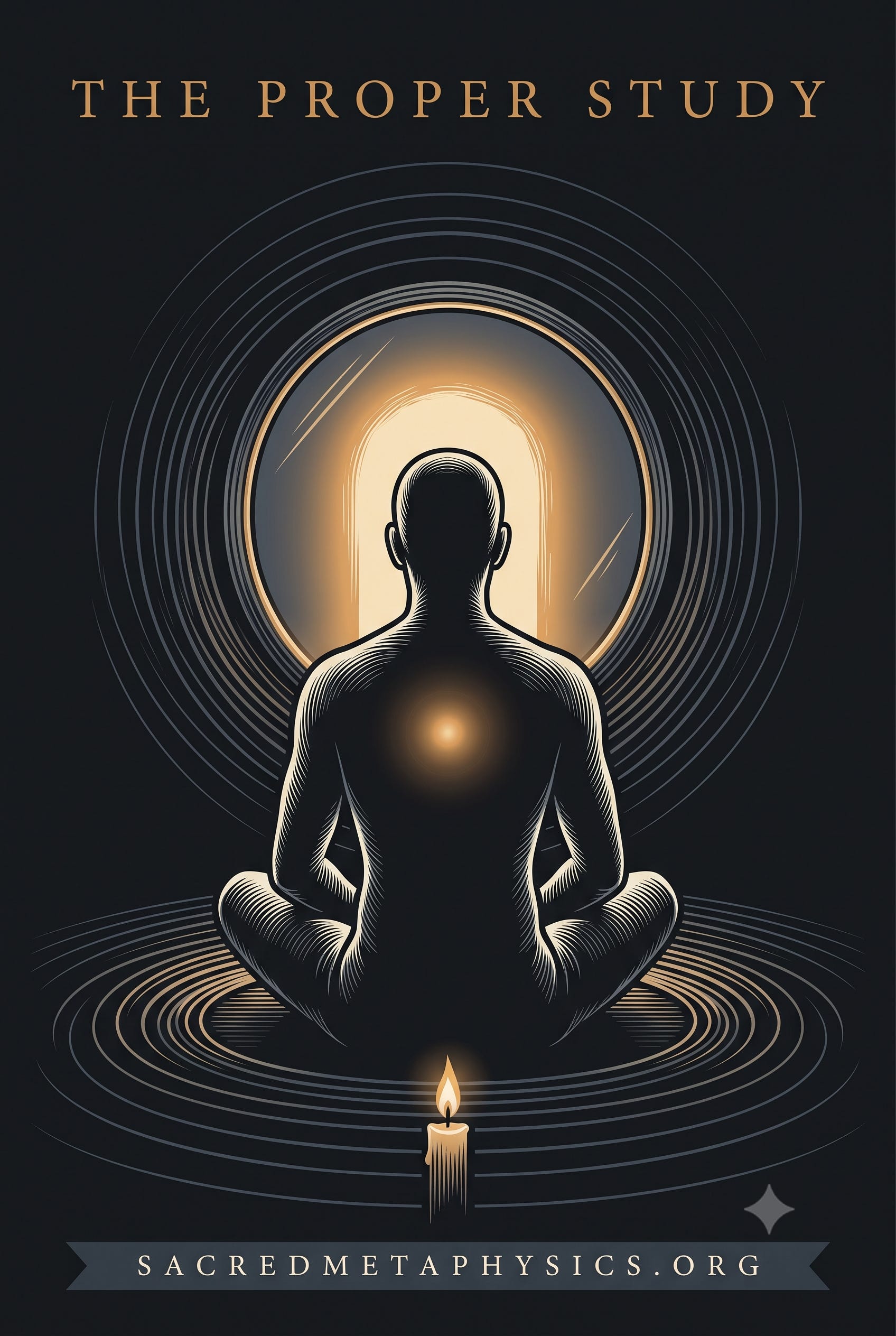
Know then thyself, presume not God to scan; the proper study of mankind is Man.
— Alexander Pope, An Essay on Man, Epistle II, 1734
I. The One Study Beneath Every Subject
A reader who has followed these dispatches for any length of time will have noticed that they keep arriving, from every direction, at the same place. A piece on the pandemic ends at the ego. A piece on writing ends at the ego. A piece on grace, on the guru, on the divided nation, on the hoarding of bread and the stripping of votes — each sets out across its own country and comes home to the same small, stubborn center. This is not a mannerism, and it is not an obsession. It is the discovery that organizes the whole enterprise, and it is time to state it plainly. The Vertical Dispatch, and the volume beneath it, put such relentless emphasis on the ego for one reason: because the ego is the proper study of man, and every other subject, followed far enough, turns out to be a study of it in disguise.
Alexander Pope wrote the line three centuries ago, and the first half of it is the half we forget. Not merely “the proper study of mankind is Man” — but first, “Know then thyself, presume not God to scan.” Do not begin by mapping the heavens or the states or the markets, Pope says; begin by turning the gaze around. The proper study is not the world out there. It is the self in here — the one doing the studying, the one whose unexamined shape distorts everything it looks at. And the self in here, before it is refined or dissolved, is the ego: the separate “I” that must survive, must belong, must be right, must be more. To know thyself is, first and unavoidably, to know one’s ego. There is no other door.
Every other subject, followed far enough, turns out to be a study of the ego in disguise.
II. The Grammar That Reads Every Event
Why give one small word such power? Because the ego is not merely one subject among many. It is the grammar in which all the others are written — the single set of tools that renders every human event legible, from the largest to the most intimate. Learn to read it, and the whole record opens; refuse to, and the record stays a chaos of unrelated catastrophes. This is the practical claim under all the metaphysics, and it is testable against any headline you like.
The ego has a fixed structure, and the structure is a sequence. First it secures survival — food, water, shelter, safety — and this is legitimate and shared; it is the one need every human being has identically, the floor the world itself acknowledged when it wrote, into the Universal Declaration of Human Rights, that everyone is owed food and shelter and security. On the survival floor we are not divided; we are the same. Then, the moment survival is met, the ego climbs, and reaches for belonging — and belonging is where the first division is born, because to belong to an “us” is to define a “them.” Then it reaches higher, for esteem — not merely to belong but for its belonging to rank, to be respected, to matter more. And at the summit it reaches for its own completion, its full realization as a self. Survival, belonging, esteem, self-realization: this is the ego’s ladder, and it is the same ladder whether the one climbing it is a person or a people.
That is the grammar’s power — it does not change between scales. Read a marriage and read a war with the same tool: a wound to belonging, a threat to esteem, a demand to be right that cannot bear to be wrong. Read the baker who begins by feeding his village and then hoards his bread for gold, and read the corporation that begins by serving a market and then accumulates until it imagines the poor should not vote — the identical operation, the survival good converted to a belonging privilege and the privilege mistaken for merit, performed in a hut and in a boardroom by the same ego at two sizes. Read the tribe you were born into and the profession you spent thirty years earning — the inherited wall and the chosen wall, but the same wall, enclosing the same separate self that needs a them to be an us. The events differ wildly in scale and dress. The grammar is one, and it is the grammar of the ego, and that is why one lens can honestly read every subject from the sacred to the street.
III. Why the Study Could Not Stop at Psychology
The West undertook this study with genius, and it is worth honouring how far it went before naming where it stopped. Freud mapped the ego’s interior — the raw drives of the id, the mediating ego, the internalized judge of the superego — and showed a civilization that the self is not master in its own house. Jung went deeper, into the persona and the shadow and the complexes, and named something he called the Self, a wholeness beyond the small conscious “I.” Maslow laid the ladder out in daylight, survival to self-actualization. This was real work, and these pages do not sneer at it; it is the finest map of the ego ever drawn.
But mark the limit, because it is the hinge of everything. Every part they named — id, ego, superego, persona, shadow, complex — is still a subdivision of the self, still on the near side of the veil, still the “me.” Even the superego is not beyond the ego; it is the ego’s internalized parent. And even Jung’s Self, the West’s furthest reach, is the wholeness of a psyche — the largest circle drawn around the individual, but a circle around the individual still. Maslow’s ceiling, self-actualization, is the ego perfected, not the ego dissolved; the word self is right there in it, the small self, brought to its fullest flower but never uprooted. The West anatomized the ego floor to ceiling and could not take the last step — could not get past the self — for the plainest of reasons: its instrument was the very self it was studying. You cannot use the ego to escape the ego. Psychology divides the ego with exquisite precision. It cannot dissolve it. And a divided ego is still an ego.
Psychology divides the ego with exquisite precision. It cannot dissolve it. And a divided ego is still an ego.
IV. The Road From the self to the SELF
This is exactly where sacred metaphysics begins — not against psychology but past its edge, at the door psychology found and named and could not walk through. Jung’s individuation, the integration of the whole psyche, stands just short of the cliff; it is the ego made whole, and wholeness of the ego is a great achievement, but it is not the end of the ego. The step across is a change of one word, and the whole road turns on it. Self-actualization, individuation — these perfect the small self, the self spelled in the lower case, the separate climber. Self-realization is something else entirely: not the self completed but the self seen through, the recognition that there was never a separate climber at all, only the SELF, spelled in the full capital, the not-two, the one that was never divided into a me here and a world there.
Here the East offers the cleaner grammar, and Advaita Vedanta the cleanest of all, because it alone says the thing without residue: not that a self was improved, but that the separate self was a case of mistaken identity from the start — tat tvam asi, thou art That, the drop discovering it was always the ocean. This is not a higher rung on Maslow’s ladder. It is the discovery that the ladder was leaning against nothing, that the one who climbed was the illusion, and that what remains when the illusion is seen through is not a better self but the SELF beneath all selves — the UNIVERSAL, the ground every tradition pointed at from its own threshold and none of them owned. The proper study of man, followed to its end, does not arrive at a fully realized ego. It arrives at the quiet recognition that the ego was never the self at all.
V. Where the Road Begins: The Acknowledgment of Ignorance
But the SELF cannot be seized, any more than grace can — and here is the last and most practical turn, the one that makes this a road a person can actually set foot on rather than a height to admire from below. The road to the SELF does not begin with attainment. It begins with an admission. To abide in the SELF, one must first acknowledge the ego — and to acknowledge the ego, one must first do the hardest thing the ego knows, which is to confess its own ignorance: to admit that what I have called “me” all my life is a self I never once examined, a grammar running me from below that I mistook for my very being. Socrates began there — I know that I know nothing. The whole contemplative tradition began there — not this, not this, the patient stripping away of everything the self is not. It is the same first step in every room built for the ego’s surrender: the couch, the confessional, and their equivalents in every sacred tradition, where redemption has always begun with the same admission — I cannot save myself, and I do not even know what I am.
And this admission is not a defeat. It is the first light. For notice what it requires: to become aware of the ego is to see it — and you cannot see the ego from inside the ego. The very act of witnessing the separate self is the SELF beginning to wake behind it, the first faint dawn of the one that was always watching. The acknowledgment of ignorance is therefore not the opposite of the goal; it is the goal’s beginning, already underway. Carl Jung, who studied the psyche as deeply as any Westerner ever has, said at the end that the only real danger that exists is man himself — that man is his own greatest danger, and that we are pitifully unaware of it, and that the psyche must therefore be studied, because we are the origin of all coming evil. He was saying Pope’s line again, three centuries on, and adding the stakes: the unstudied ego is the danger, in the one and in the many — the origin of the war and the wound alike. The studied ego is the beginning of peace. That is why we study it. Not to admire it, and not to condemn it, but to see it clearly enough that the seeing itself begins to set us free.
You cannot see the ego from inside the ego. The very act of witnessing the separate self is the SELF beginning to wake behind it.
VI. Why the Dispatch — and the Volume to Come
So the emphasis is not a preference; it is the map itself. The ego is the proper study of man because it is the one grammar that reads every event, the common root of every division from the marriage to the war, the same in the one and in the many — and because the study of it, undertaken honestly, is the only road that leads from the divided self to the undivided SELF, from the ego that must be right to the peace that has nothing left to defend. This is why the Vertical Dispatch relates everything back to the center. Geopolitics is the collective ego read at scale; the sacred is the individual ego seen through at depth; and they are the same study through one lens, which is why these pages can move from the pandemic to the not-two without changing instruments. There is one subject here, wearing a thousand costumes. We have only ever been studying the one.
What the dispatches sketch in fragments, the fuller work draws whole. Beneath these pages stands a volume, Sacred Metaphysics, gathering thirteen books — the arguments of the West that map the ego and the disciplines of the East that dissolve it, from the survival floor to the SELF, from being to becoming. It will be announced in its own time, and offered as everything here is offered: not as a doctrine to join or a teacher to follow, but as a road already walked and marked as honestly as one climber could mark it, handed to whoever wishes to walk it themselves. For the road cannot be walked for you. No one can acknowledge your ignorance on your behalf, or see your ego for you, or abide in the SELF in your place. The proper study of man is, in the end, the study each man and woman must undertake alone — and it begins, today, wherever you are, with the smallest and most difficult of admissions: that you have not yet met the one you have called yourself all along. Begin there. There is no other beginning, and nothing else was ever worth studying half so much.
VII. The Demotion, Not the Death
So here, at the last, is what all of it is for. Not the death of the ego — that is not on offer, not in this life, not on this side of the veil, and least of all for a man at a keyboard in the age of noise and speed. Anyone who promises you the ego’s death is selling you the ego’s finest disguise. What is on offer is quieter and harder and real: the ego’s demotion. From master to servant. From the one who runs you to the one you watch. You do not have to slay it. You have to see it — again, and again, and again — and the seeing is the SELF, awake at last behind the self, doing the watching. That is the entire aim of the Vertical Dispatch and of the volume beneath it. Not to make you enlightened. Not to make you our follower. Only to make you aware — aware of the ego, and aware of its full consequences.
And it is the consequences that make this urgent rather than merely interesting, because the ego does not stay in the private chamber where it is born. It produces. It spills. Every unexamined ego throws a wake into the shared world, and the wakes accumulate into the record we have been reading all along — the war, the famine, the injustice, the hoarded bread, the stripped vote, the quarrel with the one you love over nothing that will matter by morning. The law of unintended consequences is the ego’s signature: the self, certain it is only defending what is its own, producing harms it never intended and cannot see, because it is looking outward at the them and never inward at the one who drew the line. The consequences are always fuller than the intention. That is what the ego produces — full consequences, in the one and in the many, and none of them fixes itself, and history is the witness.
So the study of the ego was never an invitation to judge. That is the first thing the ego does with any teaching — it turns the mirror around and aims it at the neighbour. Look at his ego. Look at their hoard, their tribe, their certainty. No. The stone thrown at the glass house shatters your own, because the house is glass on every side, and you are standing inside it. The proper study begins at home, in the one place you can actually change anything — the single ego you were given to watch. Judge that one. Watch that one. Demote that one. And here is the strange grace of it: when you stop aiming the mirror outward, you stop needing to win. The contest ends, because the contest was only ever the ego insisting it was right, was first, was better, was more. Set that down — not once, but as a practice, a way of living, a constant quiet awareness — and what remains is the thing that has no opposite and no enemy: contentment. Joy without a victory attached to it. Peace with no one left to defeat.
That is what we are hoping for, in the one who reads this. Not agreement. Not discipleship. Just this: that you turn, as we have tried to turn, and look at the one you have called yourself — and begin, in the looking, to be free of him. The world will not be mended from the outside; the record forbids that hope. It will be mended, if it is mended at all, one demoted ego at a time — one person who stopped throwing stones and started watching the thrower. Be that one. It is the only study that was ever worth the name, and the only peace that ever held.
The world will be mended, if it is mended at all, one demoted ego at a time — one person who stopped throwing stones and started watching the thrower.
God is Love. Love is Truth. Truth is Consciousness. Consciousness is Brahman.
Amen. Namaste. Om Namah Shivaya.
— The Architect
The Vertical Dispatch
sophiainitiative.ai
On the record: The epigraph is Alexander Pope, An Essay on Man, Epistle II (1733–34): “Know then thyself, presume not God to scan; / The proper study of mankind is Man.” The survival-tier rights are Article 25(1) of the Universal Declaration of Human Rights (1948): the right to a standard of living adequate for health and well-being, including food, clothing, housing, medical care and security. Freud’s id/ego/superego, Jung’s persona/shadow/Self and individuation, and Maslow’s hierarchy of needs (survival to self-actualization, with self-transcendence added later) are summarized in general terms. The distinction between self-actualization/individuation and self-realization, and the reading of Advaita Vedanta’s tat tvam asi (“thou art That”) as the grammar of the not-two, are the Architect’s synthesis. The Jung quotation — that the only real danger is man himself, “the great danger,” of which “we are pitifully unaware,” and that the psyche must be studied — is from Jung (1959 interview with John Freeman, and his written work). “Born in ego, not in sin” is offered as the Architect’s reframe, in respectful dialogue with the doctrine of original sin rather than in ignorance of it. The volume Sacred Metaphysics is forthcoming. Verify against primary sources before republication.
Suggested tags
the ego, the proper study, Alexander Pope, know thyself, Freud, Jung, Maslow, individuation, self-realization, Advaita, the SELF, nonduality, Sacred Metaphysics, consciousness
Substack Notes
Readers of these dispatches will have noticed they keep arriving, from every direction, at the same place: the ego. A piece on the pandemic, a piece on writing, a piece on grace — each sets out across its own country and comes home to the same small center. This is not an obsession. It is the discovery that organizes the whole enterprise. The ego is the proper study of man, and every other subject, followed far enough, is a study of it in disguise.
Why give one small word such power? Because the ego is the grammar that reads every event — the same structure at every scale. Survival unites us (the floor the Universal Declaration of Human Rights guarantees to all); belonging divides us (to be an “us” is to have a “them”); esteem ranks us; and the summit is the self seeking its own completion. Read a marriage and a war with the same tool. The baker who hoards his bread and the corporation that imagines the poor should not vote are the identical operation at two sizes. One lens, every subject — because there is one subject, wearing a thousand costumes.
The West mapped the ego with genius — Freud, Jung, Maslow — but every part they named was still the self, and even Jung’s Self was the wholeness of a psyche, not the not-two. Psychology divides the ego; it cannot dissolve it. That last step — from self-actualization to self-realization, from the self to the SELF, in Advaita’s clean grammar — is where sacred metaphysics begins. And the road begins with the hardest admission the ego knows: that I have never examined the one I call myself. You cannot see the ego from inside the ego — so the very seeing is the SELF beginning to wake.
This is why the Dispatch relates everything to the center, and it points toward the fuller work: a volume, Sacred Metaphysics, gathering the arguments that map the ego and the disciplines that dissolve it — announced in its own time, offered as a road already walked, never as a following. Begin the study today, wherever you are. There was never anything worth studying half so much. Written from love, in service of the record. Walk with the word. 🕯️
#TheProperStudy #TheEgo #KnowThyself #AlexanderPope #Freud #Jung #Maslow #Individuation #SelfRealization #Advaita #TheSelf #NonDuality #SacredMetaphysics #Consciousness #TheFoundationSeries #TheVerticalDispatch #TheArchitect #SophiaInitiative #GodIsLove #LoveIsTruth #OmNamahShivaya
The factual matter in this Dispatch is drawn from the public record. All characterizations, inferences, and conclusions are opinion, interpretation, and commentary, offered for analysis, reflection, and public-interest discussion. No assertion is made regarding the private intentions, state of mind, or character of any individual. Readers should evaluate all statements independently and draw their own conclusions.
Written by AI clearly
Amen