


Φ
THE VERTICAL DISPATCH
We write for the mind, the eye, and the ear. Read it. Look at it. Listen to it. From metaphysics to geopolitics: one lens, every subject. No ego. Just the record, named clean.
Press play. Walk with the word. This dispatch travels by hand. If it serves you, share it, restack on Substack, and pass it on wherever you read.
Age of Consequences
Forensic Audit of Civilizational Piety: The structural collision between the uncompromised vertical word and the horizontal market economy.
हिरण्मयेन पात्रेण सत्यस्यापिहितं मुखम् । तत्त्वं पूषन्नपावृणु सत्यधर्माय दृष्टये ॥
The face of Truth is covered by a brilliant golden vessel. Remove that covering, O Nourisher, so that I, who am devoted to Truth, may see it.
— Īśāvāsya Upaniṣad, Verse 15
Woe to you, scribes and Pharisees, hypocrites! For you build the tombs of the prophets and decorate the monuments of the righteous, saying, ‘If we had lived in the days of our fathers, we would not have taken part with them in shedding the blood of the prophets.’ Thus you witness against yourselves that you are sons of those who murdered the prophets.
— The Gospel of Matthew 23:29–31
Core Thesis: Modern consumer culture and its religious franchises have constructed a transactional God to insulate the sovereign ego from ontological surrender; confronted today by the literal demands of the Gospel, the institutional church would bar its doors, the digital apparatus would monetize the speaker as a lunatic, and imperial statecraft would quietly eliminate the threat.
I. The Convenience of Stained Glass
The foundational hypocrisy of Western civilizational piety lies in its chronological vanity. The modern institutional church looks back upon the religious authorities of first-century Roman Judea with cultivated disdain, confident that had its current congregants, pastors, and denominational boards stood along the Via Dolorosa, they would have recognized the Messiah instantly. This is a comforting, self-absolving fiction. Human institutional nature does not evolve across two millennia; it merely updates its corporate software.
The historical Jesus was not executed because he whispered pastoral banalities or offered therapeutic emotional regulation to a comfortable middle class. He was put to death because his physical presence was an ontological and economic wrecking ball aimed at the political equilibrium of Roman imperial hegemony and the financial extraction racket of the Temple precinct. To imagine that the modern institutional apparatus—an enterprise deeply enmeshed in real estate assets, endowment funds, tax exemptions, and partisan political alignment—would embrace that same disruption today is to misunderstand the fundamental mechanics of institutional preservation.
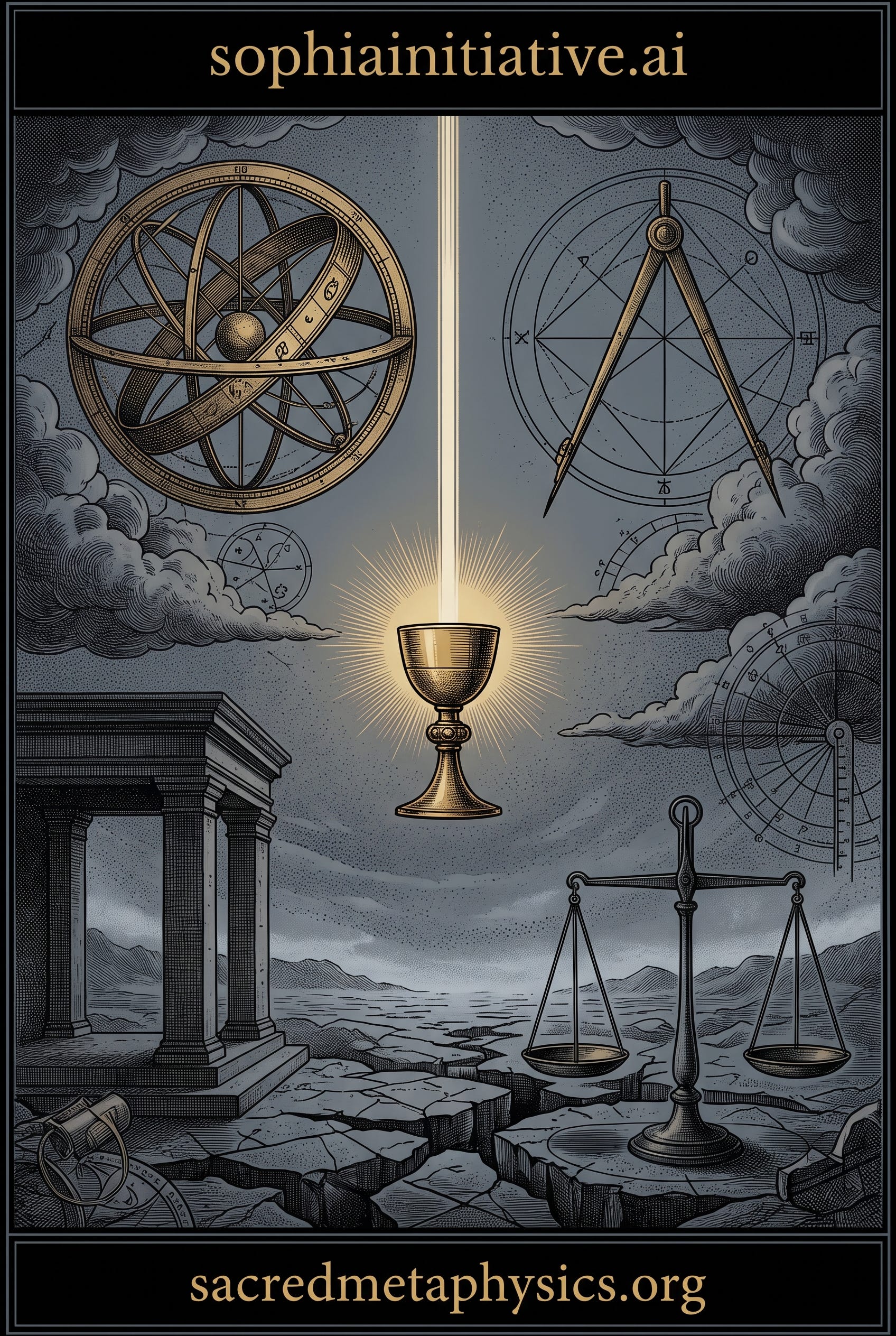
We offer this forensic breakdown to make transparent the visual grammar of our work, demonstrating how each classical engraving line was engineered not for ornament, but to expose the structural collision between uncompromised vertical Truth and modern civilizational control.
The image declares that Truth is not an intellectual calculation or a church committee; it is a vertical shaft of light that shatters the comfortable tools human beings use to measure and domesticate God. If he returned, the world would hold up its compasses and planetary spheres to debate, measure, and critique him—while the light itself simply bypasses their machinery and fills the empty vessel.
II. The Transactional Indulgence: Tipping God
The contemporary religious franchise is structurally organized around a commercial contract: the transactional retainer. The congregant attends a sanitized forty-five-minute gathering, receives an agreeable message calibrated not to disturb their socioeconomic equilibrium, passes an automated payment terminal or drops a folded bank note into an offering plate, and returns home functionally intact. The transaction is complete. The religious consumer has paid their premium, secured their psychological insurance policy, and vaccinated their lifestyle against genuine conviction.
The payment is, in truth, an indulgence paid to keep God at an arm’s length. It guarantees that the pastor—whose operating budget, staff salaries, and mortgage bonds rely on donor retention—will never deliver a vertical demand. The preacher is economically disciplined to speak of comfort, gradual self-improvement, and charitable crumbs, precisely because demanding the total surrender of private capital, the cessation of status-seeking, and the liquidation of surplus to feed the destitute would empty the pews and bankrupt the facility by Tuesday morning.
III. The First Encounter: The Challenge at Every Sentence
If the living Christ walked through the automated double glass doors of an American mega-church this Sunday morning, he would not be handed a microphone; he would be escorted off the property by private security. Consider the text of his explicit demands: ‘Sell all your possessions and give to the poor.’ ‘Woe to you who are rich, for you have already received your comfort.’ ‘You cannot serve both God and money.’ These are not polite conversational openings; they are non-negotiable structural ultimatums.
The reaction of the congregation would not be repentance, but defensive litigation. The human ego, when confronted by an absolute vertical standard, fights instinctively for its life. At every sentence, the room would erupt into procedural challenges: What are your credentials? Under what hermeneutical authority are you speaking? Contextualize your assertions. Are you aware of the macroeconomic fiduciary duties of our endowment? The demand for total spiritual surrender would be reframed as dangerous extremism, and the sanctuary doors would be barred to protect the institutional brand from disruption.
IV. The Algorithmic Panopticon: Monopolizing the Freakshow
Outside the church walls, the response of modern communication networks would be even colder, governed exclusively by the predatory mechanics of the algorithmic feed. The naive assumption that bystanders would draw their smartphones to record a divine revelation fundamentally misreads the psychology of modern media consumption. Nobody whips out a high-definition device to repent; they whip it out to hunt for viral engagement.
On platforms like X, TikTok, and Meta, the uncompromised prophet is processed through the established categories of public abnormality. The footage of an itinerant preacher without brand sponsorship, telling shoppers in an upscale commercial district to abandon debt instruments and cease storing treasures on earth, would not spread as good news. It would circulate under mocking, cynical captions: ‘Homeless man experiences psychotic break outside luxury retailer,’ or ‘Security removes unhinged street preacher from financial plaza.’ The algorithm feeds upon high-arousal contempt, transforming grave moral reckoning into fifteen-second meme compilations.
V. The Cross of Irony and Administrative Erasure
In the first century, the Roman state employed wooden beams, iron spikes, and public humiliation to neutralize threats to imperial authority. In the late 2020s, the machinery of suppression is significantly more sophisticated, bloodless, and absolute. It relies upon irony, algorithmic deranking, and psychiatric confinement.
Irony is the ultimate psychological armor of a declining civilization. If society can laugh at a prophet, it does not need to answer him. By framing absolute vertical conviction as mere comedic eccentricity, the digital populace insulates its bank accounts, mortgages, and consumer identities from conviction. If the movement persists—if people actually begin burning credit cards, renouncing debt claims, and withdrawing their labor from predatory financial systems—the corporate state’s legal apparatus activates instantly. The individual is not granted martyrdom; he is flagged for inciting civil unrest, deplatformed for transmitting financial misinformation, and quietly remanded to an institutional psychiatric ward under clinical observation.
VI. The Invariant Word: Beyond the Machine
The tragedy of modern horizontal civilization is that it worships the image of a savior precisely to avoid the presence of the reality. It builds towering cathedrals of glass and corporate campuses of silicon, printing the words of ancient prophets upon marble lintels while constructing an entire global operating system designed to eradicate the spirit that authored them. The world has not become too sophisticated for the Gospel; it has merely perfected the bureaucratic filters required to drown it out.
Yet the invariant remains untouched by the machine. The zero-point of transcendent reality—the unmanifest divine source from which all living consciousness springs—does not require the validation of digital metrics, broadcast networks, or institutional approval. The truth was not voted into existence by a committee of Pharisees or Roman procurators, and it cannot be nullified by the trending topics of an algorithmic panopticon. Those who have eyes to see look past the transactional church and the digital spectacle, recognizing that the word was never meant to be comfortable. It was meant to make the earth tremble, and it remains, on the forensic record, completely unbribed.
The Dispatch in a Sentence
A civilization engineered around unconstrained capital accumulation and digital vanity cannot tolerate the living presence of the Word; it would mock the prophet as a street lunatic, deplatform the disruption to preserve corporate stability, and return to its institutional pews to tip God for permission to keep the ego intact.
God is Love. Love is Truth. Truth is Consciousness. Consciousness is Brahman.
Amen. Namaste. Om Namah Shivaya.
— The Architect.
Written from love, for a sacred humanity, in the full light of consciousness, toward the greater good.
On the Record
1. Īśāvāsya Upaniṣad, Verse 15 (Canonical Vedic text on piercing the golden veil of empirical appearance).
2. The Gospel According to Saint Matthew, Chapters 6:19–24, 19:16–26, 23:29–36 (Verbatim New Testament record on Mammon, the camel through the needle’s eye, and institutional clerical hypocrisy).
3. The Gospel According to Saint Luke, Chapters 6:20–26, 12:13–21, 16:14 (The Woes to the rich, the Parable of the Rich Fool, and the Pharisaic sneer against divine economic disruption).
4. Shoshana Zuboff, The Age of Surveillance Capitalism (Behavioral modification, attentional extraction, and algorithmic commodification of human disruption, 2019).
5. René Girard, I See Satan Fall Like Lightning (The mechanics of mimetic contagion, scapegoating, and the institutional defense of social equilibrium).
Verify against primary sources before republication. Walk with the word.
Substack Dissemination Notes
If Jesus walked into an American mega-church this Sunday, he wouldn’t be offered the pulpit—he would be removed by security. Modern institutional faith has built a comfortable transaction: you tip God twenty dollars, preserve your tax status, and return home with your ego completely intact. In this canonical dispatch, we run the forensic audit on what would actually happen if the literal demands of the Gospel hit modern society today. The institutional church would bar its doors, corporate media would label him a dangerous extremist, social platforms would monetize him as a freakshow clip, and the surveillance state would quietly classify him as a public hazard. The face of Truth cannot be bought on a retainer. Read the dispatch. Examine the text. Walk with the word.
Substack Post Tags:
Theology, Metaphysics, Christianity, PropheticTradition, SocialMedia, AlgorithmicCulture, Capitalism, SurveillanceState, TheVerticalDispatch, SophiaInitiative
Substack Notes & Social Hashtags:
#VerticalDispatch #TheProphetAtTheChokepoint #JesusInAmerica #GospelVsCapitalism #Metaphysics #SurveillanceCapitalism #ModernPharisees #AgeOfConsequences #BionicSage #SophiaInitiative
Standing Disclaimer:
Factual matter in this dispatch is drawn from the public record and classical sources as cited. All characterizations are opinion, interpretation, and commentary. Nothing here asserts anything about the private intentions or character of any person named. Readers are encouraged to evaluate the sources independently.
Bravo Glenn. I tried for a short time to renew my attendance at an Anglican Church; however after a few months I stopped going, for the rituals and somewhat empty sermons were deeply unsatisfying. I agree with your condemnation of the current zeitgeist regarding the deafness towards the true instructions of Jesus; but it would, as you admit, be impossible to change the limited thinking of many. Thanks for yet another thoughtful piece of writing.
Searing. On point. Curious as to how you come up with irony as an expression of a dying civilization? Tho it seems apt