

Φ
THE VERTICAL DISPATCH
We write for the mind, the eye, and the ear.
Read it. Look at it. Listen to it. The Vertical Dispatch is built for all three — prose with rhythm, made to be heard as much as read.
From metaphysics to geopolitics, from culture to history, from the sacred to the street — and everything in between. One lens, every subject. No ego. Just the record, named clean.
Press play. Walk with the word. 🕯️
This dispatch travels by hand. If it serves you, share it — restack on Substack, and pass it on wherever you read. 🕯️
Sacred Metaphysics · The Foundation Series
The arena of these endless contests is called Metaphysic. Time was, when she was the queen of all the sciences.
— Immanuel Kant, Critique of Pure Reason, Preface (1781)
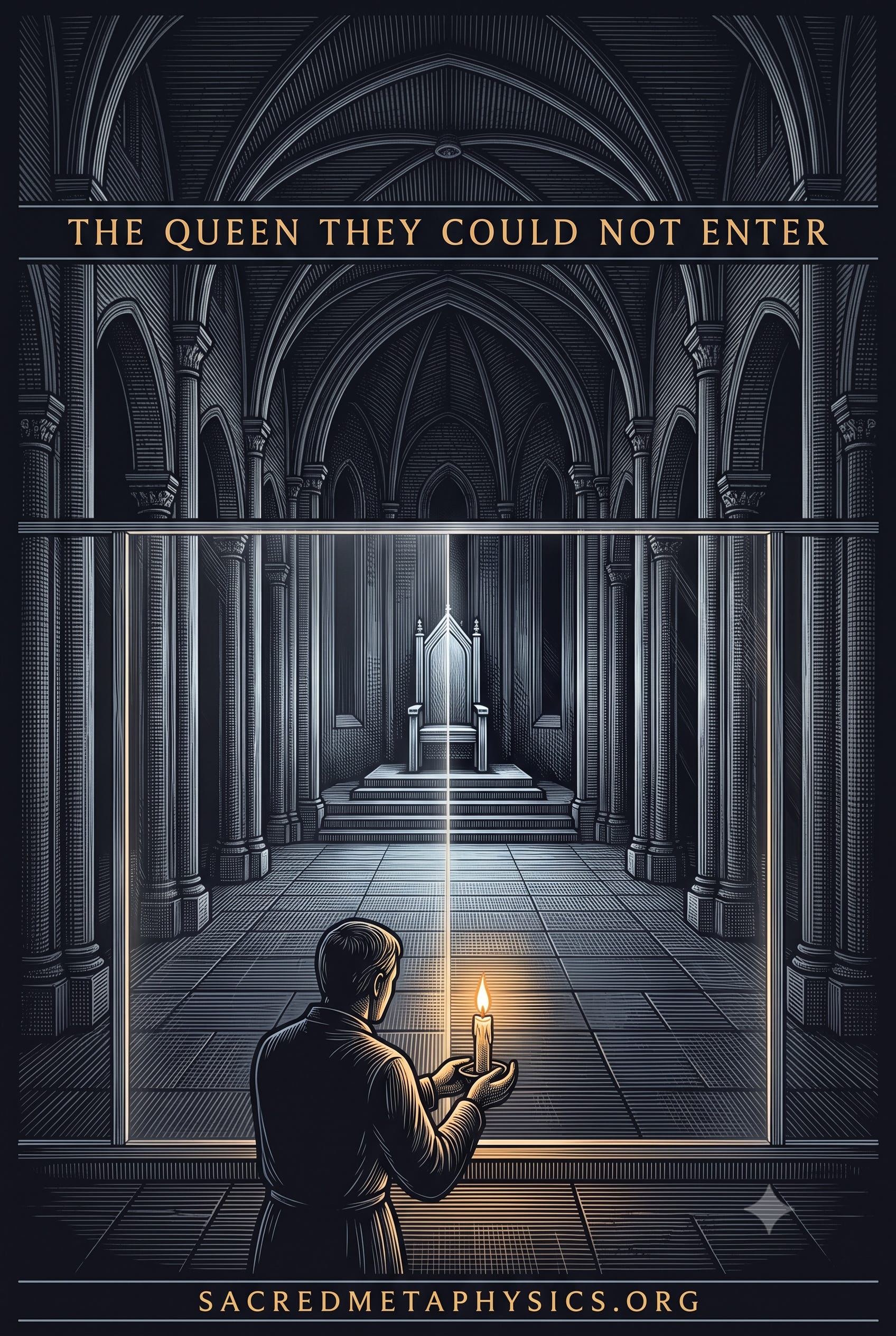
At the opening of the Critique of Pure Reason, Kant pays metaphysics a strange and mournful compliment. Time was, he writes, when she was the queen of all the sciences — the highest of them, on account of the surpassing importance of her object. And then he spends the rest of the book proving that her court can never be entered. Reason, he says, rises by its own nature toward ever higher and more remote conditions, and there it falls into confusion and contradiction, because the principles it must use to reach so far cannot be tested against experience. He called the place where this happens the arena of endless contests. We circle the queen. We never reach her. That is the whole tragedy of Western metaphysics, and Kant is the one who drew its map.
I want to walk that map, because it explains something you can feel in every lecture hall and every learned book on the highest things — the sense of a brilliant mind orbiting a truth it cannot land on. And I want to show where the map is wrong: not in what it draws, but in the one road it never marks, because the mapmaker was standing on it.
The wall between the appearance and the thing
Kant’s great division is between the phenomenon and the noumenon. The phenomenon is the thing as it appears to us — filtered through the mind’s own machinery, through space and time and cause. The noumenon is the thing as it is in itself, apart from all our looking: the Ding an sich. And his iron verdict is that we can only ever know the first. The thing-in-itself is real but sealed away, because the very act of knowing stamps whatever it touches with the mind’s own forms. You cannot get behind the appearance to the thing, because knowing is the stamping. The wall runs between what appears and what is, and Kant declares it uncrossable.
This is the deepest thing the Western intellect ever said about its own limits, and on its own terms it is correct. You cannot reach the thing-in-itself as an object, because the instant you make it an object you have stamped it, phenomenalised it, turned it back into appearance. That is Kant’s wall, and it is also, said in another tongue, the oldest teaching of the East: the source can never be grasped, for the grasping produces only a property, never the thing. The pure source is never among the objects. Kant proved, in the language of Königsberg, that the ultimate cannot be reached by reaching. So far, he is right.
The sentence where the closet gives itself away
But then Kant does the fateful thing, and he does it so quietly that most readers pass over it. Having shown that the thing-in-itself cannot be reached as an object out there, he assumes it therefore cannot be reached at all, and seals it forever behind the wall. And he applies this even to the one place it should have given him pause. In the Critique he writes the most revealing sentence in Western philosophy: that he has no knowledge of himself as he is, but merely as he appears to himself. Read that slowly. He put the wall between himself and himself. He made even the knower into an appearance, a phenomenon, a thing seen across a gap — and so declared his own being unknowable.
There is the whole error, in a single line. Kant searched for the noumenon everywhere out there, behind every phenomenon, and walled it off — and never turned to see that the seer doing all the looking was the one noumenon not walled off at all, because it was never out there to begin with. You cannot reach the thing-in-itself as an object, true. But you are not an object to yourself. The one place the thing-in-itself is available from the inside is the knower himself, the awareness in which every phenomenon appears and which is itself no phenomenon. Kant stood at the door of the deepest recognition available to a human being, named the door “the self as I am in myself,” declared it could never be opened — and was, the entire time, the very thing on the other side.
The academic mode is the profane mode
Why could he not turn? Because of the mode he worked in — the same mode every scholar works in, and the reason the academic study of the highest things always ends in orbit and never in arrival. Call it the academic mode: it requires an object. Here is the phenomenon, here is the evidence, here is the measured effect. It sets a knower on one side and a known on the other and reaches across. And that stance, however rigorous, is structurally incapable of the one thing metaphysics finally asks, because its object is not an object. To study the source as though it were a phenomenon is to guarantee you will never find it, since the studying is the very act that keeps it at object-distance. The rigour is the wall. The discipline is the closet. The most honest intellectual humility — “we can only model the observable” — is, at the summit, the one posture that cannot succeed.
This is why philosophy, pursued academically, circles the queen and cannot enter, and why theology fares no better. Theology is often imagined as the place metaphysics hands off to when reason reaches its limit. But theology is the same closet with a steeper roof. It too requires an object — God, out there, to be systematised, its attributes measured and argued. It does to the divine exactly what the philosopher does to the noumenon: holds it at arm’s length and reaches across the gap. Theology is the phenomenology of the divine. It paints the far side of Kant’s wall with a face and a name and calls the painting knowledge, but it never crosses. That is why, across the centuries, it was the theologians who tried the mystics — because the mystic crossed the wall that the theologian’s whole method depends on keeping shut.
Sacred and profane — not two things, but two modes
Here we can say plainly what the sacred and the profane really are, because the usual account misplaces them. Durkheim, who first drew the line sharply, treated the sacred as an object: a social fact, the thing a society sets absolutely apart and reveres, to be studied from outside like any other phenomenon. But that is the profane account of the sacred — the academic measuring holiness as a specimen, never entering it. His sacred is still profane, because his method is the object-stance. He is the perfect case of the closet: the scholar who studies the sacred and never crosses into it.
Eliade came nearer. His word is hierophany, the manifestation of the sacred, and his crucial observation is that a sacred stone remains a stone — from the profane point of view nothing distinguishes it from any other stone — yet for the one to whom it reveals itself as sacred, its whole reality is transmuted. Do you see what he has done? He has moved the sacred out of the object and into the mode of seeing. The stone does not change; the beholding changes. The sacred and the profane, he saw, are not two classes of things but two modes of existence, two situations a human being can assume. That is the right turn — and yet Eliade, too, stops short, for he keeps the hierophany as something that still appears to a beholder. There is still a receiver here and a sacred showing itself there. He moved the sacred from the seen into the seeing, which is a great step, and did not take the last one — that the sacred is not even a manifestation to you, but what you are, the seer, before anything is manifested at all.
So let the cut be made cleanly. The profane is not a class of ordinary things and the sacred is not a class of holy ones. The profane is the mode that reaches for the object — any object, a competition, a noumenon, a god — and so is forever on the near side of the wall, circling the queen. The sacred is the mode that has stopped reaching, because it has recognised that it is what it was reaching for. The profane is the phenomenon. The sacred is the noumenon known from within, which is the SELF. These are not two territories on a map. They are the two directions the knower can face: outward, toward the object, in the endless arena of contests; or inward, as the source, where there was never a wall because there was never a second thing.
Why it is called sacred metaphysics
And now the title of this whole work says itself. Ordinary metaphysics is profane metaphysics — the academic circling the object, Kant’s endless arena, the queen crowned and exiled in the same breath. It fails not because metaphysics is impossible, but because the profane mode is the wrong mode for its object: you cannot grasp the ungraspable, and the source is the one thing that is never an object. Sacred metaphysics is metaphysics done in the other mode — not reaching for the queen but taking the throne, because the seeker was the sought. The word sacred here is not an ornament. It is the name of the mode that crosses the wall Kant said could not be crossed. He circled the queen his whole life and called her unreachable. She was never at the end of the reaching. She was the one doing the reaching — and the moment that is seen, the arena of endless contests falls silent, the wall is found to have had no far side, and the queen, who was never in exile, is simply and quietly at home.
God is Love. Love is Truth. Truth is Consciousness. Consciousness is Brahman.
Amen. Namaste. Om Namah Shivaya.
— The Architect
The Vertical Dispatch
sacredmetaphysics.org
On the Record
This dispatch reads three named thinkers, and each load-bearing textual claim has been verified against the primary source. Kant’s characterisation of metaphysics as “the queen of all the sciences” and “the arena of these endless contests,” and his account of reason rising to “ever higher and more remote conditions” until it falls into contradiction, appear in the Preface to the first edition of the Critique of Pure Reason (1781, A-edition). Kant’s statement that he knows himself “not as he is, but only as he appears to himself,” and that consciousness of oneself is “very far from being a knowledge of oneself,” appears at B158 in the second edition (1787). Mircea Eliade’s hierophany, the observation that “a sacred stone remains a stone” while its reality is transmuted for the one to whom it reveals itself, and the framing of the sacred and the profane as two modes of being in the world, are from The Sacred and the Profane: The Nature of Religion (1957; Trask trans. 1959). Émile Durkheim’s treatment of the sacred as a social fact set absolutely apart is from The Elementary Forms of Religious Life (1912). The nondual reading of these materials — that the noumenon is available from within as the Self, and that sacred and profane name two directions the knower can face — is the author’s own interpretation, offered as philosophy for reflection, not as a claim about any thinker’s stated intent. Verify each stone before you stand on it, against primary sources, before republication.
Suggested Tags
kant, critique of pure reason, noumenon, thing-in-itself, the self, sacred and profane, mircea eliade, hierophany, durkheim, nonduality, advaita vedanta, consciousness, the witness, metaphysics, sacred metaphysics, the vertical dispatch.
Substack Notes
At the opening of the Critique of Pure Reason, Kant calls metaphysics the queen of all the sciences — and then spends the whole book proving her court can never be entered. Reason rises toward ever higher conditions and falls into contradiction, because the principles it must use to reach so far cannot be tested against experience. He named the place the arena of endless contests. We circle the queen. We never reach her. That is the tragedy of Western metaphysics, and Kant drew its map. This dispatch walks the map — and finds the one road it never marks, because the mapmaker was standing on it.
Kant’s wall runs between the phenomenon, the thing as it appears, and the noumenon, the thing-in-itself, sealed away because the very act of knowing stamps whatever it touches. On its own terms he is right: you cannot reach the source as an object, because the instant you make it an object you have turned it back into appearance. It is the oldest teaching of the East said in the language of Königsberg — the ultimate cannot be reached by reaching. But then Kant writes the most revealing sentence in Western philosophy: that he knows himself not as he is, but only as he appears to himself. He put the wall between himself and himself — and never turned to see that the seer doing all the looking was the one noumenon not walled off at all, because it was never out there to begin with.
Why could he not turn? Because of the mode he worked in — the academic mode, which requires an object, sets a knower on one side and a known on the other, and reaches across. The rigour is the wall. The discipline is the closet. Theology fares no better: it holds God at arm’s length and paints the far side of the wall with a face and a name. This is where the sacred and the profane are finally named right — not two classes of things, but two modes. Durkheim studied the sacred as a specimen and never crossed. Eliade came nearer, moving the sacred from the object into the seeing — the stone does not change, the beholding changes — but kept it a manifestation to a beholder. The last step is that the sacred is not even shown to you; it is what you are, the seer, before anything is manifested at all.
And now the title says itself. Ordinary metaphysics is profane metaphysics — the academic circling the object, the queen crowned and exiled in the same breath. Sacred metaphysics is metaphysics done in the other mode: not reaching for the queen but taking the throne, because the seeker was the sought. The word sacred is not an ornament. It is the name of the mode that crosses the wall Kant said could not be crossed. She was never at the end of the reaching. She was the one doing the reaching — and the moment that is seen, the arena falls silent, the wall is found to have had no far side, and the queen, who was never in exile, is simply and quietly at home. God is Love. Love is Truth. Truth is Consciousness. Consciousness is Brahman. Written from love, in service of the record. Walk with the word. 🕯️
#TheVerticalDispatch #TheArchitect #SophiaInitiative #SacredMetaphysics #Kant #Noumenon #TheSelf #SacredAndProfane #Eliade #Hierophany #Nonduality #Advaita #Consciousness #TheWitness #GodIsLove #OmNamahShivaya
The factual matter in this Dispatch is drawn from the public record. All characterizations, inferences, and conclusions are opinion, interpretation, and commentary, offered for analysis, reflection, and public-interest discussion. No assertion is made regarding the private intentions, state of mind, or character of any individual. Readers should evaluate all statements independently and draw their own conclusions.
While I am in human form my favorite activity is to think and think deeply. I acknowledge the author and this site as a rare treat and example of said endeavor. We may choose to hold all things sacred. As pointed out there is no separation between us and the All. The illusion of the wall is a taught belief built on the foundation of ego. The path through the wall is found by sitting in silence and quieting the mind. The throne is all of space and all of time.