


Φ
THE VERTICAL DISPATCH
We write for the mind, the eye, and the ear.
Read it. Look at it. Listen to it. The Vertical Dispatch is built for all three — prose with rhythm, made to be heard as much as read.
From metaphysics to geopolitics, from culture to history, from the sacred to the street — and everything in between. One lens, every subject. No ego. Just the record, named clean.
Press play. Walk with the word. 🕯️
This dispatch travels by hand. If it serves you, share it — restack on Substack, and pass it on wherever you read. 🕯️
The Age of Consequences · On the Platforms · Companion to “The Bar and the Vision”
As of July 18, 2026
Television can make so much money doing its worst that it can’t afford to do its best.
— Fred Friendly, former president of CBS News
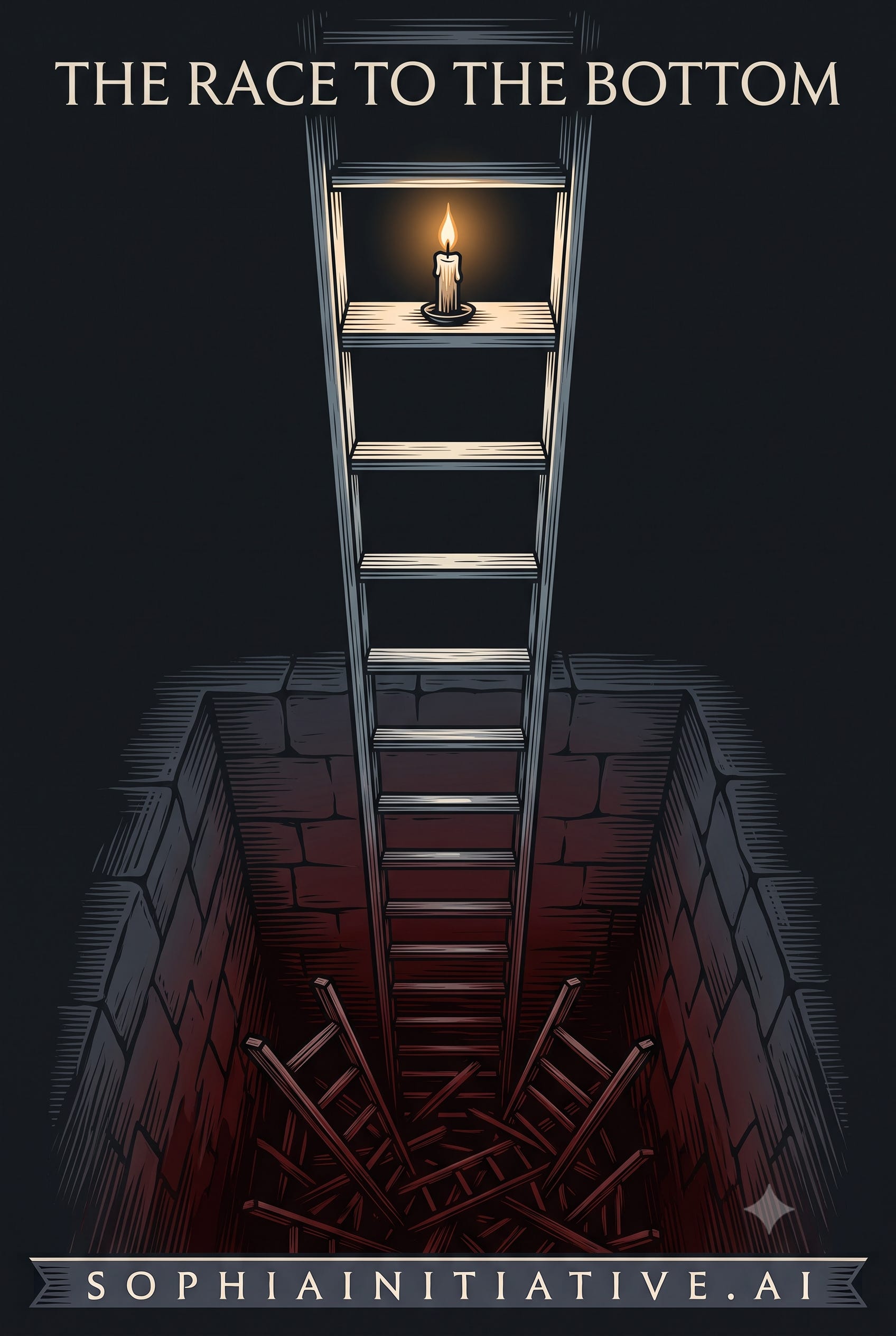
There is a temptation, watching the platforms fill with opinion and outrage, to think the decline began with them. It did not. The race to the bottom is older than the feed — older than the smartphone, older than the internet. It began the day the news stopped being understood as a public trust and started being understood as a place to make money. That day can be dated, roughly, to the late 1970s, and the fifty years since are one long descent, run in laps, each platform inheriting the race from the last.
When News Was Not a Business
It is difficult now to imagine, but there was a time when the news was not expected to turn a profit — and was not meant to. Richard Salant, who ran CBS News through the 1960s and 1970s, put it plainly: his division was not regarded as, or expected to be, a profit center. Ted Koppel, who was there in the early days, described the arrangement more bluntly still: the network handed the news division a few million dollars a year and told it to go do whatever it was that news people did — and not to come back asking for more. The news was a cost the broadcasters carried in exchange for the privilege of using the public airwaves. It was a duty, not a product.
This is the world of Walter Cronkite — the anchor once called the most trusted man in America. The trust was not incidental to the economics; it was made possible by them. Because the newsroom was not asked to earn its keep, it could report what was true rather than what would sell. It could run the expensive foreign bureau, the slow investigation, the story that offended without flinching, because no advertiser’s comfort and no quarterly number sat in judgment over it. The freedom from profit was the freedom to tell the truth.
The freedom from profit was the freedom to tell the truth.
The Hinge: When News Learned to Pay
The change has a name, and it is not a villain’s name. It is a program: 60 Minutes. Through the middle and late 1970s, this newsmagazine did something no news program had done before — it turned a profit, and a large one. Koppel, who watched it happen from inside the industry, called it the shift: once it was proven that news could make money, making money became part of what news was for. The wall between the newsroom and the ledger, which had protected the reporting, developed its first crack — and the crack ran the length of the next fifty years.
What followed was not conspiracy but gravity. In the 1980s the three great networks all changed hands — new corporate owners who saw no reason a news division should be exempt from the profit standards applied to every other division. The pressure came down: cover the news more cheaply, cover what draws an audience, trim the bureaus, favor the story that holds eyes over the story that serves citizens. Cronkite himself, near the end, named what had become of it — a “trivializing,” a “sound-bite culture” — and lamented the general decline in the standards of the work he had given his life to. He had watched the bar lowered, one reasonable business decision at a time.
A film had seen it coming. Released in 1976, at the very hinge of the shift, it dramatized a news division devoured by ratings and entertainment, a newsroom turned to spectacle. It was satire then. It has aged into documentary. The prophecy was not that someone would corrupt the news on purpose; it was that the logic of profit, left to run, would do it on its own, with no villain required.
What followed was not conspiracy but gravity.
The Control Group
There is a way to test whether the profit motive was truly the cause, and it is the kind of test that makes a claim hard to knock down: find the case where the cause was absent, and see if the effect was absent too. That case exists. The public broadcasters — the CBC in Canada, the BBC in Britain — were funded not primarily by advertisers or the demand for profit, but by public money and license fees. They were, by their structure, exempt from the pressure that reshaped the commercial networks. And it is precisely there, in the broadcasters shielded from the profit demand, that serious investigative reporting most durably survived the last fifty years.
This is not to call them perfect. Public funding carries its own pressures — a broadcaster funded by government is not wholly free of government, and that is a real limit, honestly named. But the comparison holds where it matters: the institutions freed from the profit demand kept doing the expensive, slow, unprofitable work of investigation longer and more consistently than the institutions bent to it. That is the tell. It was not the journalists who changed. It was the structure they worked inside. Change the funding, and you change what the newsroom is permitted to do.
The Vision That Tried to Escape
It is against this fifty-year descent — not against nothing — that this platform, the one you are reading on, was founded. Its makers looked at the wreckage plainly and said so: the classified advertising that once funded newspapers gone to the internet, the display advertising gone to two or three giant companies, the newsrooms shuttering, the journalists laid off — and, at the same time, the social feeds optimizing for engagement, rewarding outrage, building an attention economy that damaged the very culture it fed on. Their stated conclusion was that for good writing to survive, the media world needed an alternative to advertising itself.
So they built one. The model was direct payment — the reader paying the writer, with no advertiser in between and, at the founding, no algorithmic feed at all. The writer they said they wanted was the serious, independent voice: you just have to be a great writer, one founder said, and they would take care of the rest. Journalism was the flagship case. The whole design was, in effect, the structural cure for the disease this dispatch has been tracing — sever the advertiser’s leash, sever the feed’s outrage, and let the reader fund the truth directly. The vision was not merely good. It was the exit from the fifty-year race.
The vision was not merely good. It was the exit from the fifty-year race.
Pennies, or Dollars
Beneath the whole fifty-year descent lies a single choice, and it is worth naming plainly, because it is the choice every one of these institutions faced and it is the choice this platform faces now. There are two ways to run a business. One chases pennies on the dollar — thin margins won back only in vast volume. To win on pennies you must lower the price; to survive the lower price you must lower the cost; to lower the cost you lower the standard; and the standard, lowered again and again, is the culture lowered with it. This is the race to the bottom, and its cruelty is that it has no floor — someone can always undercut you by one more cent. The other way seeks dollars on the dollar — fewer transactions at full worth, the deep relationship that commands its full value and never enters the volume war at all.
The great conglomerates chose the first game, and made a law of it. When Peter Drucker, the management thinker, sat down with the new head of General Electric in 1981, he asked a single question of every business the company owned: if you were not already in it, would you enter it today? From that question came the famous rule — be number one or number two in your market, or fix it, sell it, or close it. The reasoning was pure pennies-on-the-dollar logic: only the dominant one or two can protect their margins; the third, fourth, fifth players bleed. It is a rule for empires. It is why, in any mass market, you find room at the top for two or three — and everyone below them squeezed. It is also, precisely, the rule a niche must never accept, because the moment a niche agrees to be number one or exit, it has stopped being a niche and entered the empire’s stadium, where it will lose.
The race to the bottom has no floor. Someone can always undercut you by one more cent.
There is a deeper trap still, named by the scholar Clayton Christensen in his study of why great companies fail. The incumbent fails not by foolishness but by discipline — it listens to its best customers, keeps improving its profitable product, and so cannot bring itself to build the cheaper, humbler thing that would cannibalize its own margins. So a leaner newcomer builds that humbler thing instead, improves it, and rises from below to take the market. The lesson is brutal and simple: to survive, the incumbent must be willing to kill its own product before someone else does. And the deepest irony, the one that should keep every disruptor humble, is that the disruptor always becomes the incumbent it once unseated — and then faces the very same test.
The New Gatekeeper
And here honesty requires the turn, because the exit has not been as clean as the vision. A platform built to end the gatekeepers has, in its economics, grown a new one — not made of editors this time, but of fame and money. The record shows it plainly. Venture funding was spent, in part, on advances to lure writers who were already famous onto the platform. The rewards concentrate steeply at the top: the leading handful of writers earn sums in the millions while the unknown independent — the very writer the vision named — begins at the bottom of a long hill that the already-famous started halfway up.
It is important to be exact here, and to claim only what can be shown. There is no proof, and this dispatch makes no claim, that any recommendation system is deliberately weighted to favor the top earners or any political camp; what runs inside a private company’s code cannot be seen from outside, and a claim about a hidden mechanism is a claim one cannot stand behind. The provable point is simpler and stronger: the outcome advantages who arrived already established. Whatever the intent of any system, the structure rewards the writer who brought an audience with them — which is, precisely, the inequity the founding vision promised to end. The gatekeeper was not abolished. It was rebuilt out of new material.
So this is the shape of fifty years. The news was a public trust, and its freedom from profit was the freedom to tell the truth. It learned to pay, and the wall between newsroom and ledger cracked, and the crack ran down the decades. The commercial networks were bent to the number; the public broadcasters, shielded, kept the flame longer. A platform rose that named the disease exactly and built the cure — and then found, in its own growth, the old gravity pulling the cure back toward the race. Everywhere the same fork: pennies on the dollar, or dollars on the dollar. The race to the bottom, or the courage to hold the standard while the whole market runs downward.
For that is what it finally requires — not cleverness, but courage. The pull toward the bottom is constant, and every voice in the market urges the same descent: lower the price, widen the reach, chase the volume, take the money, become the empire. To hold the full worth of deep work while everyone around you races for pennies is not a business tactic. It is a discipline, and disciplines cost. This is not a counsel of despair. It is the naming of a pattern, so it can be seen — and so that the reader, who in the end funds whichever future arrives, can choose with open eyes which one to pay for. The race to the bottom is not a law of nature. It is a series of choices — and some of them are yours.
God is Love. Love is Truth. Truth is Consciousness. Consciousness is Brahman.
Amen. Namaste. Om Namah Shivaya.
— The Architect
The Vertical Dispatch
sophiainitiative.ai
On the record
(as of July 18, 2026). The profit-center history is drawn from the public statements and recollections of people who worked inside network news: Richard Salant, president of CBS News in the 1960s–70s, on the news division not being expected to be a profit center; Ted Koppel, on the early funding arrangement and on 60 Minutes marking the shift once news was shown to be profitable; Fred Friendly, former CBS News president, quoted on television’s incentives; and Walter Cronkite’s own later remarks lamenting a “sound-bite culture.” The 1970s newsmagazine referenced is 60 Minutes; the 1976 film referenced is invoked as prophetic satire, not as evidence. The 1980s network ownership changes (NBC/GE, ABC/Capital Cities, CBS/Tisch) are matters of record. The “number one or number two” rule is Jack Welch’s, launched at General Electric in the early 1980s; the prompting question (“if you weren’t already in this business, would you enter it today?”) is attributed to Peter Drucker, GE’s longtime advisor. The disruption analysis is Clayton Christensen’s, from The Innovator’s Dilemma (1997). Substack’s founding rationale and stated vision, and its 2025 funding round valuing it at roughly 1.1 billion dollars alongside its stated focus on growth, are drawn from the founders’ own public statements and independent business reporting. The concentration of earnings and the use of advances to recruit established writers are drawn from independent business reporting; no claim is made about the internal workings of any recommendation algorithm, which cannot be verified from outside. Public-broadcaster comparisons (CBC, BBC) describe funding structure, not a claim of perfection. Figures and datable events vary by source; verify against primary sources before republication.
Suggested tags
news media, investigative journalism, profit center, Cronkite, 60 Minutes, public broadcasting, CBC, BBC, Substack, the attention economy, media history, the reader’s choice.
Substack Notes
The decline of the news did not begin with the feed. It began fifty years ago, the day the newsroom stopped being a public trust and started being a profit center — and the race to the bottom has been running ever since. This is the history behind “The Bar and the Vision.”
There was a time — the Cronkite era — when the news was not expected to make money, and that freedom from profit was the freedom to tell the truth. Then, in the late 1970s, a newsmagazine proved news could pay, the wall between newsroom and ledger cracked, and the crack ran down the decades. The public broadcasters, shielded from the profit demand, kept the investigative flame longest — the tell that it was the structure, not the journalists, that changed.
This platform was founded to be the exit from that race — reader pays writer, no advertiser, no feed. The vision was the cure. But its own economics have grown a new gatekeeper, made now of fame and advances rather than editors. Held only to what can be proven: the outcome advantages who arrived already established — the very inequity the vision promised to end.
Not a counsel of despair — the naming of a pattern, so it can be seen. The race to the bottom is not a law of nature. It is a series of choices, and some of them are the reader’s.
Written from love, in service of the record. Walk with the word. 🕯️
#TheVerticalDispatch #TheArchitect #SophiaInitiative #NewsMedia #InvestigativeJournalism #MediaHistory #Substack #AttentionEconomy #PublicBroadcasting #GodIsLove #LoveIsTruth #OmNamahShivaya
The factual matter in this Dispatch is drawn from the public record. All characterizations, inferences, and conclusions are opinion, interpretation, and commentary, offered for analysis, reflection, and public-interest discussion. No assertion is made regarding the private intentions, state of mind, or character of any individual. Readers should evaluate all statements independently and draw their own conclusions.