


THE VERTICAL DISPATCH
We write for the mind, the eye, and the ear.
Read it. Look at it. Listen to it. The Vertical Dispatch is built for all three — prose with rhythm, made to be heard as much as read.
From metaphysics to geopolitics, from culture to history, from the sacred to the street — and everything in between. One lens, every subject. No ego. Just the record, named clean.
Press play. Walk with the words. 🕯️
On Culture · The Age of Consequences
May 2026
“There must be something in books, something we can’t imagine, to make a woman stay in a burning house.”
— Ray Bradbury, Fahrenheit 451
There was a time when a society inoculated itself against its own worst tendencies, and it did so through books. Not because books are sacred objects, but because of something the books required of the person holding them. To receive the warning, you had to do the work. You had to read.
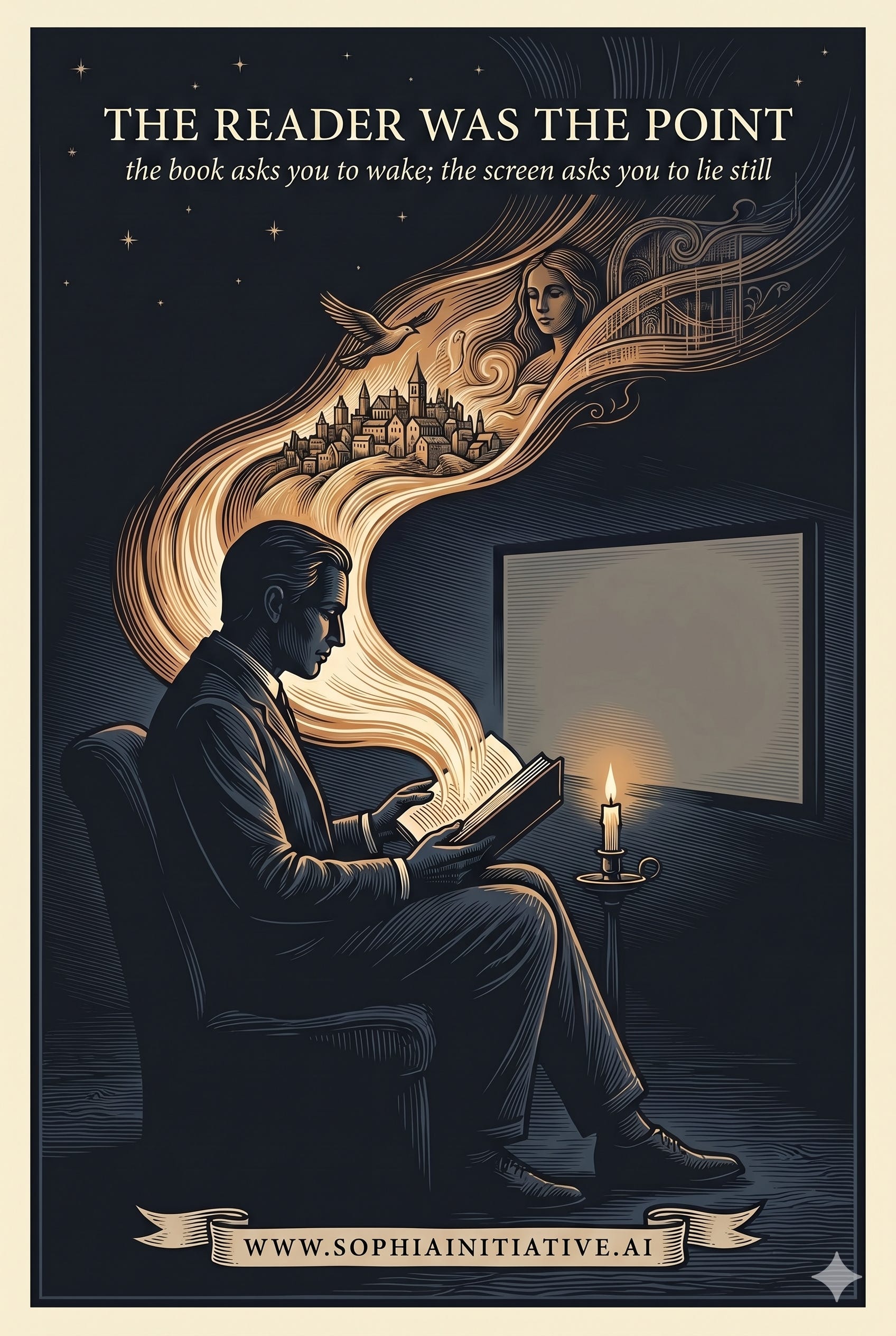
That requirement was not incidental. It was the entire mechanism. And when we replaced it with a mechanism that requires nothing, we did not simply change the format. We broke the inoculation. This dispatch is about that break — how the works that woke a generation needed the generation to wake, and how the screen that replaced them asks only that we lie still.
I. The Books That Woke Us
Consider three books, and what each one did to the people who read it.
In 1949 George Orwell gave us Winston Smith, a man slowly destroyed for the crime of trying to think his own thoughts inside a state that owned even his memory. A generation read 1984 and came away permanently inoculated against the language of total power — against the rewritten record, the surveillance, the boot stamping on a human face forever. The word Orwellian entered the language because the book entered the reader.
In 1953 Ray Bradbury gave us Guy Montag, a fireman whose job was to burn books, who slowly woke to what was being burned. And here is the thing worth pausing on: Bradbury, writing seventy years ago, predicted the very machine that would replace his readers. He filled Montag’s world with wall-sized televisions, with little ‘seashell’ earpieces murmuring all day, with ‘families’ who lived in the walls and a population that stepped out of its doors at the same moment because the screen told it to. Montag’s own wife chooses the television over the book, over her own husband, over her own life. Bradbury saw it coming. He wrote the screen that numbs into the very book meant to warn us against it.
And in 1951 J. D. Salinger gave us Holden Caulfield, a boy raw with grief and disgust at the phoniness of the adult world, who became the voice of every adolescent who ever felt the wrongness of things and could not yet name it. A generation read The Catcher in the Rye and felt, for the first time, that their own inner refusal was shared, was real, was human.
Three books. Three warnings. Each one lodged so deeply in the culture that its hero became a permanent reference for a whole category of human experience. And every one of them worked the same way: the reader had to enter the book, sentence by sentence, and assemble its world inside their own mind. The warning did not wash over them. They built it, themselves, in the only place a warning can ever do its work — the interior.
II. Why Reading Inoculates
This is the mechanism, and it is worth naming precisely, because everything turns on it.
A book transfers nothing on its own. The words on the page are inert until a mind takes them in and does the labour of meaning — pictures the room, hears the voice, feels the dread, follows the thought to its end. The reader is not a spectator. The reader is the second half of the act. A book is a set of instructions for building an experience inside yourself, and you must do the building. Nothing arrives unless you assemble it.
And that labour is exactly what inoculates. Because to read about Winston broken in Room 101, you must construct his fear in your own nervous system. To read Montag’s awakening, you must awaken alongside him in the only theatre available — your own mind. The warning becomes part of you because you made it part of you. You cannot un-know what you have built with your own attention. The reader was never the audience. The reader was the point.
A vaccine works by making the body do the work — by provoking the system to build its own defence, so that the defence is real and lasting and owned. Reading is the same. It provokes the mind to build the warning itself, and so the warning holds. This is the law we have named before in these pages: knowledge is not declared by the sender; it is consummated by the receiver. The book offers. Only the reader completes. And in the completing, the reader is changed and protected at once.
III. The Screen That Asks Nothing
Now consider what changed when the warning moved from the page to the screen.
There is a great deal that is good in film, and it would be foolish to pretend otherwise. Some have used the moving image to awaken the public to real things — to wake people, in numbers a book could never reach, to the machinery of money and power and exploitation. That work has genuine worth, and the reach is real. The awakening of millions is not nothing.
But the screen asks of its receiver almost nothing, and that is the hinge. Where the book required you to build the world, the film builds it for you and pours it in. The image arrives finished. The dread is scored by music so you know what to feel; the meaning is cut and lit and paced so you cannot miss it; the work of assembly that the reader once had to perform is performed for you, in advance, by other hands. You are not the second half of the act. You are the surface it lands on.
And what is poured in without effort does not inoculate. It accumulates. A warning you did not build, you do not own; it sits on the surface and is washed off by the next image. This is why a culture can watch a thousand depictions of horror and grow not wiser but number. The horror was received, but it was never assembled, never made part of the interior, never owned. It washed over and washed off. The screen can awaken — but it can just as easily anaesthetise, and the same property does both: it asks nothing of the one receiving.
IV. From the Warning to the Worship
Watch, then, what a culture does with violence once the screen has taken over the telling.
There was a film, sixty years ago and more, that strapped a young man to a chair and forced his eyes open and made him watch violence until he was sick of it — a warning about exactly this, about what happens when the image is used to recondition a soul against its will. It was a horror held up as a horror. The culture was meant to recoil.
Follow the line forward and watch the recoil disappear. The violence that was once the warning becomes the entertainment. The image that was once the horror becomes the spectacle we pay for. We arrive, in time, at the beloved action series built entirely on the choreography of killing — the elegant, balletic, endlessly extended slaughter that audiences adore, that we quote, that we celebrate as craft. The violence is the same violence the old films held up to frighten us. But it is no longer a warning. It is a pleasure. The culture has been walked, image by image, from recoil to applause — from the man strapped to the chair being force-fed violence, to the audience that volunteers for it and calls it a good time.
This is the consumer of violence — the receiver trained by a thousand effortless images to take in slaughter as delight. And here is the cost, the real one, the one that closes this dispatch. A mind anaesthetised to staged death has no defence left against the real kind. The same culture that can watch hours of beautiful killing and feel only entertained will scroll past a city under siege and feel nothing at all. The screen that asked nothing of us trained us to feel nothing — and the proof is that the largest humanitarian catastrophe on earth, a real war with real children starving, cannot hold our attention for the length of a single fight scene we have watched a dozen times for fun.
The Reader Was the Point
So the warning of this dispatch is the same shape as the warnings in those three old books, and it is this: the inoculation was never in the content. It was in the labour. Orwell and Bradbury and Salinger did not protect a generation by delivering a message. They protected it by requiring the reader to build the message inside themselves, where it would hold. The moment we replaced the building with the pouring-in, we kept the message and lost the protection — and a population that is poured into rather than built up can be made to feel anything, or nothing, on command.
Bradbury knew. He put the screen in the wall and the seashell in the ear and the wife who chooses the television over her own life, and he made his hero a man who had to put down the screen and pick up the book to become human again. The cure was in the book all along, and the cure was never the words. It was the reading.
That which is not good for the hive is not good for the bee. A hive that has been trained to watch and not to read, to receive and not to build, to consume horror as pleasure and ignore horror as fact — that hive cannot see Sudan, cannot feel it, cannot be moved by it, because the faculty that would have been moved was anaesthetised for entertainment years ago. The repair is not a better message. It is the return of the labour. Read it. Build it inside yourself. Be the second half of the act. The reader was the point — and the reader is the only thing that ever woke, or ever will.
The book asked you to wake. The screen asks you to lie still. Choose the one that asks something of you.
God is Love. Love is Truth. Truth is Consciousness. Consciousness is Brahman.
Amen. Namaste. Om Namah Shivaya.
— The Architect
The Vertical Dispatch
sophiainitiative.ai
#TheReaderWasThePoint #Fahrenheit451 #RayBradbury #1984 #Orwell #CatcherInTheRye #Salinger #ReadingMatters #AttentionEconomy #ConsumerOfViolence #DesensitizationCulture #AClockworkOrange #ScreenCulture #DontLookAway #Sudan #VerticalThinking #SacredMetaphysics #TheVerticalDispatch #TheArchitect #SophiaInitiative #AgeOfConsequences #GodIsLove #LoveIsTruth #OmNamahShivaya