


THE VERTICAL DISPATCH
We write for the mind, the eye, and the ear.
Read it. Look at it. Listen to it. The Vertical Dispatch is built for all three — prose with rhythm, made to be heard as much as read.
From metaphysics to geopolitics, from culture to history, from the sacred to the street — and everything in between. One lens, every subject. No ego. Just the record, named clean.
Press play. Walk with the words. 🕯️
Building Canada Strong · The Age of Consequences
As of June 3, 2026
— without malice and without flattery
“The map is not the territory; a single number is not an economy.”
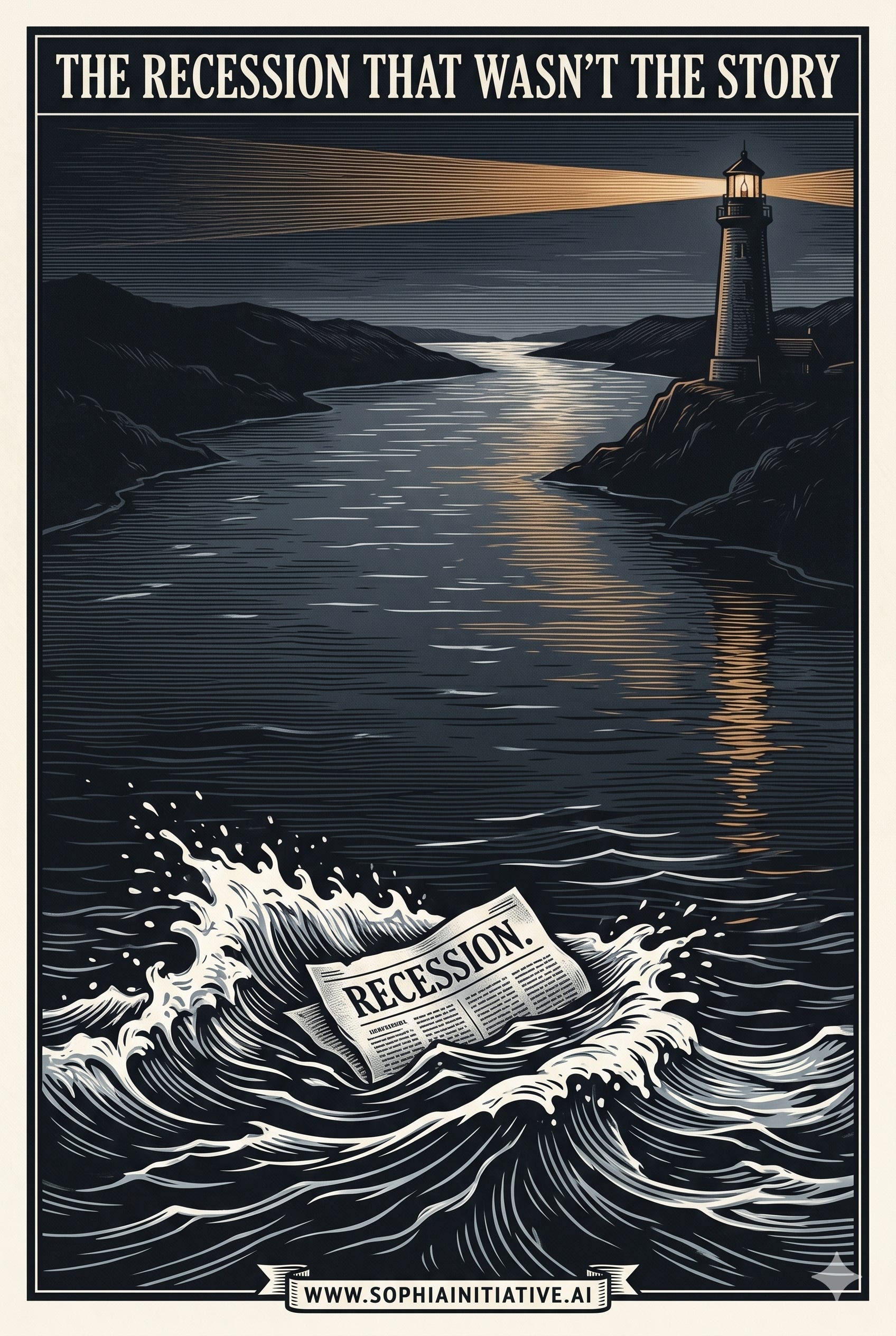
On May 29, 2026, Statistics Canada reported that the economy had contracted for a second consecutive quarter, and by the most common definition the word arrived on schedule: technical recession. Within hours the word was a weapon. This dispatch does two things with it. First, it reports the reality the number sits inside — not the headline, the record — and asks what a Leader of the Opposition is actually for. Second, it sets down, as a standing method this publication will carry forward, how we read an economy: not from one figure, and not from whatever the stock index did this afternoon, but from the whole complex construct that a country’s economic life actually is.
I. The Politics of the Reality
Begin with the fact, stated plainly, because the keel of this publication is that the symbol is not the referent and a headline is a symbol. By the conventional rule — two consecutive quarters of negative growth, measured on an annualized basis — Canada met the definition of a technical recession in the first quarter of 2026. Real GDP fell one per cent annualized in the fourth quarter of 2025, a figure Statistics Canada revised downward on May 29, and a further one-tenth of one per cent in the first quarter of 2026. Two quarters down. The label applies. That is true, and an honest looking does not flinch from it.
Now the referent the label points at, which is a different and larger thing. The first-quarter decline was one-tenth of one per cent — a rounding error’s distance from no decline at all. On a per-person basis, real GDP actually rose two-tenths of a per cent, because the population shrank for a second consecutive quarter while output held essentially flat. Unemployment in April stood at 6.9 per cent. Set that against the recessions Canadians actually remember: the worst single quarter of 1982 ran to nearly fifteen per cent annualized decline, and unemployment that year reached 12.8 per cent; the recession of 1990–91 pushed unemployment to 11.4 per cent; the crisis of 2008–09 cut business investment by more than a fifth. By those measures this is, if it is a recession at all, the mildest in more than forty years — so shallow that the chief economist of one of the country’s largest banks, asked whether the contraction was truly a recession, answered, in substance, no, not really. Several economists expect the one-tenth-per-cent figure may be revised away entirely when fuller data arrives. The early estimate for the spring already points to a rebound.
And the cause is not a mystery, nor is it homegrown. Statistics Canada tied the weakness to the resource and construction sectors and to inventory and trade movements; economists have called it, repeatedly, a trade-induced contraction. Canada is the most trade-exposed major economy on earth toward a single partner — roughly three-quarters of its trade runs to the United States — and that partner has spent the past year waging a tariff war, with duties of twenty-five per cent running in both directions on steel, aluminum, and automobiles. When the largest economy on your border attacks your trade, your trade-exposed sectors feel it. That is not a Canadian failure of management. It is the cost of an external assault, landing exactly where an external assault would be expected to land.
But the aggregate is not the whole of it, and honesty cuts both ways. Beneath the flat GDP line, the human floor tells a harder story. Consumer insolvency proposals in the first quarter of 2026 ran higher than at any point since 2009, the year of the global financial crisis. Business capital investment fell again — a fifth consecutive quarterly decline — which is an economy quietly deciding to wait. Food Banks Canada reported record use, with more than two million visits a month and food insecurity reaching into nearly one in three children. The April unemployment rate, while low by recession standards, was a six-month high and rising. None of that is erased by a reassuring per-capita figure. A country can post a shallow contraction on paper and still have a real and rising squeeze on the people inside it. Both are true, and both belong on the page.
So hold the readings together, because each is true and none is the whole: the aggregate says mild; the human floor says strained; the cause says external. The right response depends on holding all three at once. Now watch what was done with them instead.
The Leader of the Opposition called it an emergency. He wrote to the Prime Minister that he had become “the only leader in the G7 to have taken your country into a recession.” He told reporters there was “nothing technical about this downturn.” He dismissed the role of the tariffs and the broader global picture as “excuses” that “do not work.” He demanded an emergency debate, which the Speaker denied. And in the same season he has framed national unity itself — the strains in Alberta and Quebec — as the Prime Minister’s responsibility and, by extension, his failure, while telling the governing party to “stop the divisive rhetoric.” Those are his words, on the record, in late May and early June of 2026.
This publication holds to a discipline: judge the chair, not the man. So judge the chair. The office is Leader of the Official Opposition, and that office has a function in a parliamentary democracy — a real and honourable one. The constructive opposition’s job is to take the government’s numbers and make them better: to look at a one-tenth-per-cent contraction concentrated in resource extraction and construction under tariff pressure and say, in effect, here is the sector that is hurting, here is the specific measure that would shore it up, here is where your plan is too slow or too thin, and here is mine. That is opposition as a sharpening stone. It improves the country’s response to a real external threat. It is what the chair is for.
Calling the mildest contraction in forty years an “emergency,” assigning a foreign trade war to the Prime Minister as though he had authored it, waving away the documented external cause as an “excuse,” and folding the whole thing into a message that the country is broken — that is a different use of the chair. It does not sharpen the national response to the tariff war. It substitutes for one. The distinction is not partisan; it is structural. A trade attack from outside is precisely the circumstance in which a country’s institutions, government and opposition alike, are meant to face outward together — and a framing that turns the country’s attention inward, toward blame, at the moment it can least afford the distraction, works against that, whatever unity is professed alongside it.
We make no claim about what is in any individual’s heart; the discipline forbids it and the record does not require it. We claim only this, and the reader may weigh it: a contested, shallow, trade-induced dip has been narrated as a national emergency of the Prime Minister’s making, and that narration is a choice about how to use the chair. A constructive opposition could take this very section — these very numbers — and say, “the resource sector contracted; here is what I would do for it.” That dispatch we would read with respect. We are still waiting for it.
II. How This Publication Reads an Economy
What follows is a standing method, not a one-time argument — a boilerplate the Vertical Dispatch will carry into every economic piece, so that readers know the frame through which we read the numbers. The premise is simple and it is the premise of everything we write: a country is a complex construct, not a single figure. “The economy grew” or “the economy shrank” is the symbol. The referent is a living system of many measures, often pointing in different directions at once, and to report one number as though it were the whole is to mistake the map for the territory. We will not do it, and we will teach our readers not to accept it. Here are the categories through which we read, and which we will report — in prose, plainly, because a list of figures in a feed is not understanding.
Output, measured more than one way. Gross domestic product is not a single number. It is measured by expenditure, by industry, and per person, and these can disagree by design, each built from different data. A headline “recession” on the expenditure measure can sit beside flat-to-positive growth by industry and rising output per person. We report all three, and we name which one a given claim rests on. When they diverge, the divergence is the story.
Sector by sector. An economy does not rise or fall as one body. In any quarter some sectors expand while others contract. We report which — resource extraction and oil and gas, construction, manufacturing, services, agriculture, the auto sector — because a contraction concentrated in one tariff-struck sector means something entirely different from a broad decline across all of them. The composition is the diagnosis.
The human floor. Behind the aggregates are people, and certain measures read the floor of a society more honestly than GDP does. We report unemployment, insolvency filings, and food-bank use — not as rhetorical ammunition but as the human ledger. When insolvencies reach their highest since 2009 and food-bank visits set records even as GDP holds flat, that gap between the aggregate and the lived is itself a finding, and we name it.
Investment and the horizon. Business investment is the economy betting on its own future; when it falls for several quarters running, the country is quietly deciding to wait. We distinguish private capital investment from government capital spending, and capital spending from operating spending, because the collapse of that distinction is the single most common way an economy is misreported and a long-horizon investment is made to look like a short-horizon expense.
Prices and the rate. Inflation and the Bank of Canada’s policy rate set the weather over everything else. We report them together with output, because a soft economy with easing inflation calls for a different response than a soft economy with prices still climbing, and the two are routinely confused.
Trade and exposure. For a country that runs roughly three-quarters of its trade to a single partner, exposure is not a footnote; it is the central vulnerability. We report who the partners are, what tariffs are in force and in which direction, and how diversification is faring — the new agreements, the Pacific energy exports, the critical-minerals build-out — because resilience is measured by how many baskets the eggs are in.
History as the yardstick. A number means nothing without a scale. A one-per-cent annualized decline is not a five-per-cent one; 2026 is not 1982. We place every contraction beside the recessions Canadians have actually lived through, so that the word “recession” carries its true weight and not a borrowed one. Depth and duration are the difference between a ripple and a flood, and we will always say which we are looking at.
Read this way, the picture clears. A country is not its worst headline and it is not its best one. It is the whole construct, read across all of these at once, each referred to its place — which is, in the end, the same discipline this publication brings to everything: the binding of the symbol to the thing it points at, the eye trained on relationship, the refusal to let one number stand in for the living whole. We report the river, not today’s ripple on its surface.
Final Thoughts
The waters are genuinely rough. A trade war launched from across the border has struck the sectors most exposed to it, and real people — the insolvent, the food-bank line, the unemployed in April’s higher count — are feeling a real squeeze that no reassuring aggregate erases. None of that is denied here. To name a recession shallow by historical measure is not to tell a struggling family their struggle is small. It is to insist that the struggle be met with the right response, on the right scale, aimed in the right direction — outward, at the cause, and not inward, at one another.
That is the whole of the matter. An external squeeze is the oldest test a country faces, and the record of this one is that Canada has, twice in living memory under far greater external pressure, answered not by tearing at itself but by building — turning the whole industrial body to the task and holding together, imperfectly and at real cost, but together. The chair of the opposition can sharpen that answer or it can substitute blame for it. The reader has the record now, and the method to read it by. The keel of an honest economy is the same as the keel of an honest mind: do not mistake the ripple for the river, or the number for the nation. Read the whole. Then decide.

God is Love. Love is Truth. Truth is Consciousness. Consciousness is Brahman.
Amen. Namaste. Om Namah Shivaya.
— The Architect
The Vertical Dispatch
sophiainitiative.ai
On the record — sources (as of June 3, 2026). GDP figures: Statistics Canada, May 29, 2026 release (Q4 2025 revised to -1.0% annualized; Q1 2026 -0.1% annualized; real GDP per capita +0.2% in Q1 amid a second straight quarterly population decline). Unemployment: StatCan Labour Force Survey (6.9% April 2026, released May 8; 6.5% January; 7.1% September 2025 peak). Historical comparison: StatCan historical GDP and labour series (1981–82 ~12.8% unemployment, worst quarter near -14.7% annualized; 1990–91 ~11.4%; 2008–09 business investment down over 20%). Business capital investment: StatCan, fifth consecutive quarterly decline (-0.7%, Q1 2026). Insolvency: Equifax / Office of the Superintendent of Bankruptcy, Q1 2026 consumer proposals highest since 2009. Food-bank use: Food Banks Canada, HungerCount 2025. Tariffs: 25% U.S.–Canada duties on steel, aluminum, and autos in both directions; roughly three-quarters of Canadian merchandise trade is with the United States. Recession-label skepticism: BMO chief economist Doug Porter, public comments. Poilievre statements: his June 1, 2026 letter to the Prime Minister; Parliament Hill remarks June 1–2, 2026; Surrey, B.C. media scrum May 22, 2026 (CPAC). Characterizations of the opposition’s framing are interpretation and commentary. Errors and omissions excepted; corrections will be made on notice. Verify against primary sources before republication.
#TheRecessionThatWasntTheStory #CanadaEconomy #TechnicalRecession #GDP #StatCan #BuildingCanadaStrong #TradeWar #Tariffs #ElbowsUp #ConstructiveOpposition #PierrePoilievre #MarkCarney #BankOfCanada #Insolvency #FoodBanks #CriticalMinerals #TMX #TradeDiversification #SymbolNotReferent #TheAgeOfConsequences #TheVerticalDispatch #TheArchitect #SophiaInitiative #GodIsLove #LoveIsTruth #OmNamahShivaya
Substack Notes
Canada met the technical-recession definition this week — and the word became a weapon within hours. This dispatch does two things with it. First, it reports the reality the headline sits inside: a 0.1% Q1 contraction, the mildest in over forty years, with GDP-per-capita actually rising, unemployment far below every recession Canadians remember, and a cause that is not homegrown but a foreign trade war striking the most trade-exposed economy in the G7. Then it asks what a Leader of the Opposition is actually for — and judges the chair, not the man.
The constructive opposition’s job is to take the government’s numbers and make them better: name the hurting sector, propose the specific fix, sharpen the national response to an external attack. Calling the mildest dip in forty years an “emergency,” blaming a foreign tariff war on the Prime Minister, and waving the documented cause away as an “excuse” is a different use of the chair — it substitutes blame for the response, and turns the country inward at the moment it most needs to face outward together.
The second half is a standing method we’ll carry forward: how this publication reads an economy. Not one GDP number, not what the index did today — but the whole complex construct, across output measured three ways, sector by sector, the human floor of insolvency and food-bank use, investment and the horizon, prices and the rate, trade and exposure, and history as the yardstick. A country is not its worst headline. We report the river, not the ripple.
Read the whole, then decide. That is the keel of an honest economy, and of an honest mind. Walk with the words. 🕯️
The factual matter in this Dispatch is drawn from the public record. All characterizations, inferences, and conclusions are opinion, interpretation, and commentary, offered for analysis, reflection, and public-interest discussion. No assertion is made regarding the private intentions, state of mind, or character of any individual. Readers should evaluate all statements independently and draw their own conclusions.
Good overview! The economy and influences is very complex.