


“What is the most wonderful thing in the world?” — “Day after day, hour after hour, men die and are buried. Yet the living believe they will never die. There is nothing more wonderful than this.”
— Yudhishthira, answering the Yaksha. The Mahabharata.
The Vertical Dispatch
Sovereign Analysis · Glen Roberts, The Architect
The Age of Consequences
May 25, 2026
I. The Biography the Chair Required
Gary Anandasangaree was born Sathiyasangaree Anandasangaree on October 14, 1973, in Jaffna, on the northern peninsula of the island that was then Ceylon and would, the following year, become the Democratic Socialist Republic of Sri Lanka. He was nine years old in July 1983 when the Sri Lankan state and the Sinhalese majority turned on the Tamil minority in the pogrom that the historical record has since named Black July. Estimates of the dead vary from four hundred to three thousand. The number of Tamils displaced from their homes ran into the hundreds of thousands. The number of Tamil businesses destroyed in Colombo alone ran into the thousands. The international refugee flow that followed produced the Tamil diaspora of Toronto, of London, of Paris, of Sydney.
In August 1983, the boy and his mother left the country. His father, Veerasingham Anandasangaree, remained in Sri Lanka to continue the work that had defined his life — the leadership of the Tamil United Liberation Front, the moderate constitutional Tamil political party that has, across four decades, refused both the Sinhalese-majority Sri Lankan state and the armed Liberation Tigers of Tamil Eelam, and that has paid the price of that double refusal in repeated assassinations of its leadership. The father stayed. The mother and the son arrived in Canada as Tamil refugees.
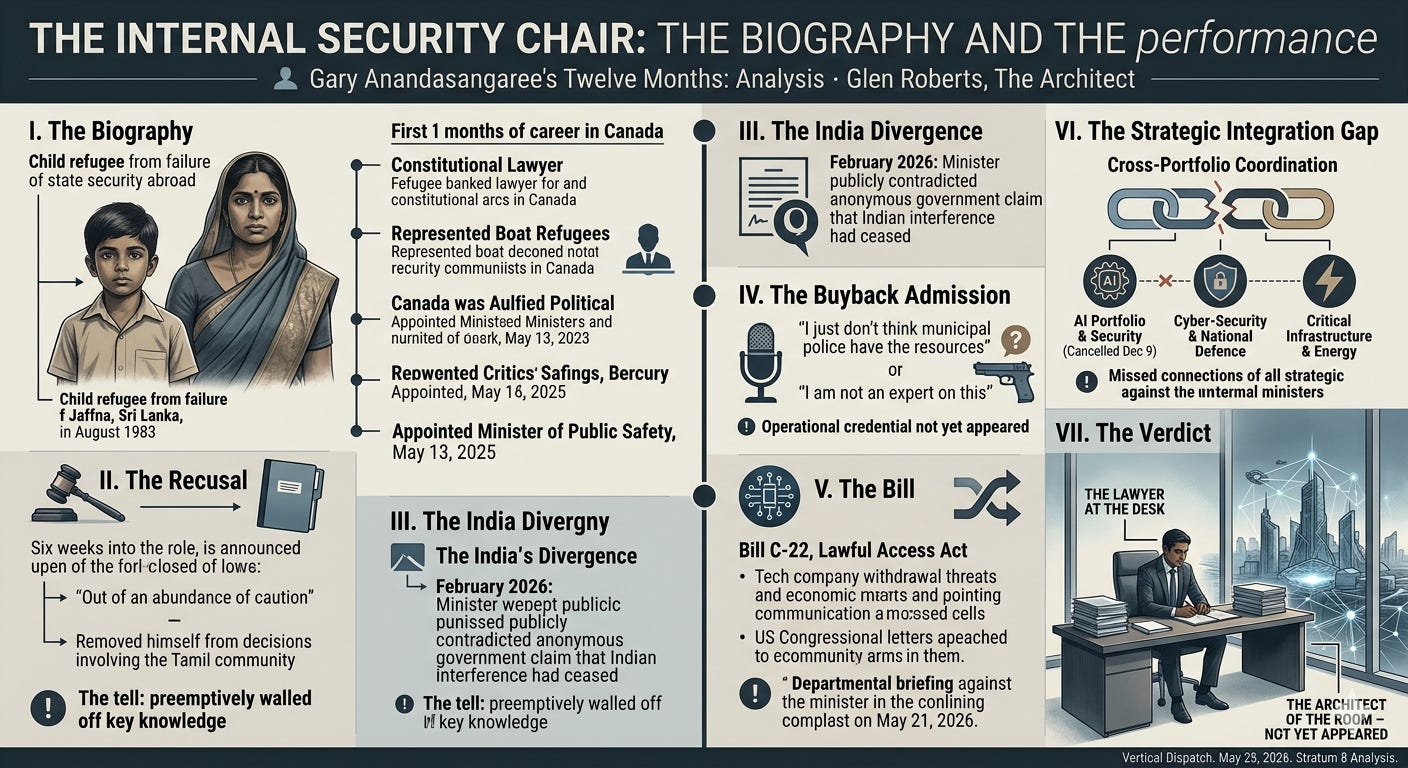
The boy attended Canadian schools. He earned a Bachelor of Arts at Carleton University in Ottawa. He earned a law degree at Osgoode Hall in Toronto. He was called to the Ontario Bar in 2006. He built a law practice in Scarborough — business law, real estate law, and the file that became the spine of his pre-political career, international human rights law. He represented Lawyers’ Rights Watch Canada at the United Nations Human Rights Council in Geneva on multiple occasions. Inside the Canadian Tamil community, he served as chair of the Canadian Tamil Youth Development Centre, as president of the Canadian Tamils’ Chamber of Commerce, and as a member of the Toronto Police Chief’s Advisory Board. He did pro bono work for the Tamil boat refugees who arrived on the MV Ocean Lady in 2009 and the MV Sun Sea in 2010, when the Harper government and the Canadian Border Services Agency were determined to use those arrivals as a deterrent to further Tamil refugee claims.
He was first elected to the House of Commons in October 2015, at age forty-two, in the newly created Scarborough riding that was later renamed Scarborough–Guildwood–Rouge Park. He was re-elected in 2019, 2021, and 2025. He entered the cabinet of Justin Trudeau on July 26, 2023 as Minister of Crown–Indigenous Relations, a portfolio whose work crosses the same constitutional ground his pre-political career had crossed in international register — the moral and political obligations of a settler state to peoples it has historically failed. On December 20, 2024 he was reappointed to that portfolio with the additional file of Northern Affairs and responsibility for the Canadian Northern Economic Development Agency.
On March 14, 2025, when Mark Carney was sworn in as Prime Minister, Anandasangaree was named Minister of Justice and Attorney General of Canada. He held the office for nine weeks. On May 13, 2025, after the federal election, he was appointed Minister of Public Safety. He has held the portfolio since.
Read that arc carefully. A Tamil refugee who arrived in this country as a child after the failure of state security in the country of his birth. A son whose father stayed behind to do the work the surveillance state of Sri Lanka was actively trying to extinguish. A human-rights lawyer who took the file of the Tamil boat refugees pro bono when the Canadian state was treating their arrival as a threat. A constitutional lawyer who carried the Crown–Indigenous file for eighteen months before being moved to Justice, and from Justice to Public Safety, all inside the first nine weeks of a new Prime Minister’s government.
The biographical equipment for the chair was unusually well-suited to the chair. The minister responsible for the Royal Canadian Mounted Police, the Canadian Security Intelligence Service, the Canada Border Services Agency, the Correctional Service of Canada, and the Parole Board of Canada — the apparatus of state security and state coercion in this country — is a man who knows, in the body and not only in theory, what the failure of state security produces for the people it fails. The Tamil refugee child who lost his country to the failure of state coercion abroad is the man who now manages the analogous apparatus at home. That is not a disqualification. That is, on any honest reading, the credential the role most deeply requires. The role is not technical management. The role is the moral architecture of state coercion in a country that wishes to remain a constitutional democracy. The biography was the right biography.
This dispatch will argue, with the public record of the first twelve months in evidence, that the biography has not yet become the performance. The dispatch is harder on the minister for that reason. The credential was real. The role was the right role. The chair was the right chair. The twelve months are what the twelve months are.
II. The Recusal
In June 2025, six weeks after taking the Public Safety portfolio, Gary Anandasangaree announced that he was recusing himself from any national security decisions involving the Tamil Canadian community, the Liberation Tigers of Tamil Eelam, or the World Tamil Movement — the latter two being organizations listed by the Government of Canada as terrorist entities under the Criminal Code. He framed the recusal in the terms that constitutional lawyers use when they wish to take an action whose appearance might raise questions of conflict. He recused himself out of an abundance of caution. The phrase is the discipline of the calling. He did not say there was a conflict. He said there could be the appearance of one.
The recusal is the cleanest single administrative act of his twelve months in the chair. It is also, on the cunning man’s reading, the tell.
Read the recusal as the public record presents it. A new Minister of Public Safety, six weeks into the role, walks into the office and signs a document that removes him from decisions involving the diaspora community he came from. He does this before any specific decision has been brought to him that would require the recusal. He does it preemptively. He does it as a structural answer to a structural question. The structural question is whether a minister of Tamil heritage can preside over national security decisions involving Tamil organizations that the state has listed. His structural answer is no. The recusal is the answer to a question the public had not yet asked aloud.
This is what a constitutional lawyer trained at Osgoode Hall does when he takes a job that has been assigned to him by a Prime Minister who chose him for the chair. He does not wait for the conflict to arise. He removes the conflict at the outset. The recusal is the work of the credential the biography provided. The recusal is also, by the same act, the formal admission that the role and the biography produce a permanent partial-recusal at exactly the point where the biography is most diagnostically valuable. The minister who knows what state surveillance does to a diaspora community has removed himself from the file in which that knowledge would be most operatively useful. The credential is preserved. The credential is also walled off.
Three months later, in September 2025, Global News published a story that the recusal had anticipated. The story reported that the minister’s phone number had appeared, two decades earlier, in a document seized during the RCMP’s 2006 counter-terrorism probe of the World Tamil Movement. The minister’s office issued a statement that the dispatch will quote in its entirety because the language matters. The minister, the statement read, had no knowledge of how this list came to be found by the RCMP and was never contacted by law enforcement about this matter. The statement further stated that the minister never raised money for the World Tamil Movement.
There is no public evidence that contradicts the minister’s statement. The 2006 probe was a wide investigation of a Toronto-area organization whose membership and donor lists were not the same as the organization’s leadership or its operational direction. A young Tamil-Canadian lawyer active in his community in the early 2000s could have had his telephone number on many community organization lists for many reasons, and any of those lists could have come into the hands of an RCMP probe that swept widely. The story is not, on its face, the resignation-level scandal the Globe and Mail opinion writer who later called for the minister’s removal claimed it to be. The minister’s denial is plausible. The dispatch accepts it.
But the existence of the story — separate entirely from its substantive merits — is the diaspora-politics fact the file lives inside of. The minister who came to the chair with the right credential came to the chair with a biographical surface large enough that any opposition researcher with a forty-year archive and a question to ask could find a phone number on a list. The recusal that preceded the story by three months was the recusal that anticipated it. The cunning man, on his first day in the cunning man’s office, did the work of the cunning man. He named the question before the question could be asked of him. That is the tell. The recusal was the tell. The minister knew, before the September story broke, that the structure of his appointment required a public answer to a question the public had not yet learned to ask.
The recusal is what the credential produced when the credential was put to work for the first time inside the chair. The dispatch credits the recusal as clean. The dispatch also notes that the recusal closed off, by the cleanest available legal mechanism, the file in which the biography was most diagnostically useful. The Internal Security Chair who could most credibly carry the question of how a sovereign democracy should treat its diaspora communities under foreign-state pressure removed himself from the file in week six. The credential was preserved. The application of the credential was structurally narrowed. The chair was filled by a man whose deepest preparation for the chair was walled off from the chair’s most sensitive file.
III. The India Divergence
In February 2026, a senior Government of Canada official briefed reporters, on background, that the Indian state’s interference activities on Canadian soil had ceased. The briefing was anonymous. The phrasing was careful. The official told reporters that Ottawa was confident that people acting on behalf of India were not currently engaging in extortion or threats of violence against Canadians of Indian and South Asian origin. The briefing was understood by Ottawa reporters to be the diplomatic-side response to the Indian government’s reset of relations with the Carney government, which Anand at Foreign Affairs had been managing through the autumn and into the winter.
Gary Anandasangaree publicly disagreed. Within the week, the Minister of Public Safety told the press, in plain language and on the record, that there was still a lot more work to do on the India file. Asked directly whether he accepted the anonymous official’s assessment, the minister said the file remained active. The Globe and Mail and the Toronto Star both ran the divergence as the lede. The minister responsible for the operational security of Canadians against foreign-state interference had publicly contradicted the anonymous official from his own government who was managing the diplomatic relationship with the foreign state in question.
Read the divergence carefully. The dispatch will not pretend it knows whether the anonymous official was DFAIT freelancing without proper authorization, or whether the briefing was a deliberate signal to New Delhi that the diplomatic side of the Carney government was moving toward a reset and the security side could be expected to follow. The dispatch knows what the public record shows. The public record shows that the Minister of Public Safety, in February 2026, refused to follow. The minister whose biography and credential had brought him to the chair would not endorse the assessment that the file was closed. He said the file was open. He said the work was not done.
That is the second clean moment in the twelve months. The first was the recusal. The second is the India divergence. Both are the minister doing the work of the chair. Both are the credential operating at the level the chair requires. The minister who came from the Tamil diaspora that has lived under foreign-state surveillance was not willing to sign off, in February 2026, on the Government of Canada’s anonymous claim that foreign-state interference against another diaspora community had ended. He knew, from the body and not only from the briefing, what foreign-state interference looks like when it is being claimed to have ended. He said so.
The divergence is also the moment that exposes the cross-portfolio architecture the rest of this dispatch will examine. A Minister of Public Safety who publicly contradicts the diplomatic-side messaging of his own government is a minister whose coordination with the Minister of Foreign Affairs is, on that file, broken in public. Anand and Anandasangaree are not, in the February 2026 divergence, in the same room. Either the cabinet itself is divided on India and the minister responsible for the security file is signalling that publicly, or the diplomatic side is reaching a settlement the security side cannot endorse. Either reading is consequential. Both are the dispatch’s concern. The dispatch will return to them.
IV. The Buyback
In early 2026, a private audio recording surfaced of Gary Anandasangaree speaking, in what he believed to be an off-the-record setting, about the federal firearms buy-back program. The buy-back program is the Government of Canada’s policy response to the May 2020 prohibition of more than fifteen hundred models of assault-style firearms, including the AR-15 platform. The program has been the subject of sustained policy criticism since its announcement, including from the police organizations that would be required to administer it at the municipal level.
The minister, on the leaked recording, said: Let’s be frank about this. I just don’t think municipal police services have the resources to enforce this. The line is consequential in two registers. As a matter of substance, it is the honest assessment of an experienced lawyer who has examined the file and concluded that the implementation architecture is inadequate. As a matter of political discipline, it is the Minister of Public Safety publicly doubting the federal program he is responsible for defending in the House of Commons. The Leader of the Opposition seized on the line within hours. The Conservative communications operation made the line a centrepiece of their critique. The minister, asked publicly about the recording, described it as a bad attempt at humour and stated that his remarks had been taken out of context.
In committee, separately, the minister was asked about basic firearms licensing details. The transcript records his response. I am not an expert on this. The line is on the public record. The Minister of Public Safety, in the parliamentary committee chaired by his own caucus, testifying on the file that has been the largest source of opposition pressure on his government, told the committee that he was not an expert on the matter being examined. That is not the recusal. That is not the divergence. That is the admission that the file the chair is most actively contesting is not a file the chair has mastered.
The dispatch will name what the two admissions together produce. A minister responsible for the operational machinery of a federal program who has, on the public record, said that he believes the program cannot be enforced and that he is not an expert in its details is a minister who is, by his own words, operationally outside the file he is responsible for. The biographical credential does not extend to firearms policy. The constitutional credential does not extend to municipal enforcement architecture. The minister knows what he does not know, which is the discipline of the lawyer he is. The chair, however, requires that he know.
This is the third stage of the twelve months. The recusal in week six was the credential operating. The India divergence in February was the credential operating. The buyback admission in early 2026 was the absence of the operational credential the chair separately requires. The Internal Security Chair is not only the moral architecture of state coercion. The Internal Security Chair is also the operational mastery of state coercion. The first credential was present at the appointment. The second has not yet appeared on the public record.
V. The Bill
Bill C-22, the Lawful Access Act, was introduced by the Government of Canada under the responsibility of the Minister of Public Safety as part of the legislative response to the changing landscape of digital communications, encrypted messaging, and the asymmetric advantage that end-to-end encryption gives to actors that the state has reasonable grounds to investigate. The bill, in its current draft, would permit ministerial orders to compel communications service providers to provide system access for lawful interception, including metadata retention for up to twelve months. The bill would bring Canadian lawful access provisions broadly into alignment with the equivalent legislation of Australia, the United Kingdom, and New Zealand inside the Five Eyes intelligence partnership.
In May 2026, in the weeks immediately preceding the filing of this dispatch, the bill became the centre of a public controversy whose proportions the Government of Canada had not anticipated. Apple, Meta, and Signal publicly stated, in submissions to the parliamentary committee studying the bill, that they would consider withdrawing services from Canada if the bill passed in its current form. Two members of the United States Congress wrote to the Minister of Public Safety warning that the bill’s provisions could compromise the privacy and national-security interests of American citizens whose communications transit Canadian networks. The Canadian opposition called the bill absolutely mind-boggling and urged the government to go back to the drawing board.
The minister’s public defence of the bill has been operational and unspectacular. He has said the bill brings Canada into alignment with other Five Eyes countries. He has said the tech companies are misinterpreting the bill. He has said: I believe we have found the right balance. The phrasing is the technocratic register the minister favours. The phrasing is not the strategic vision the Internal Security Chair the dispatch is examining would have brought to the bill.
And then, on May 21, 2026 — four days before the filing of this dispatch — a senior official inside the Minister’s own department briefed the Globe and Mail, on background, that the minister was aware of misgivings about the bill as drafted and is open to amendments not just on end-to-end encryption, but on the entire legislation. Read that sentence twice. The Minister of Public Safety’s own department briefed the press that the minister is open to amending the entire legislation. The minister had not said so in public. The minister’s department was telling the press he was wavering. The signal was, on any honest reading, the department managing the minister rather than the minister managing the department.
This is the fourth stage of the twelve months. The recusal. The India divergence. The buyback admission. The bill the minister’s own department is briefing against. Four stages. Four findings. The pattern the four stages produce is the dispatch’s verdict territory.
VI. The Chairs That Have Not Been in the Same Room
The Sovereign Core of the Carney government, in the framework this dispatch has been building across the spring of 2026, consists of the Prime Minister and eight ministers whose portfolios coordinate the strategic architecture of the country through this hinge moment. The Minister of Public Safety sits inside that Core as The Internal Security Chair. The role’s strategic value, at the Stratum 8 horizon the framework operates at, is the integration of the security file with the diplomatic file at Foreign Affairs, the defence file at National Defence, the artificial intelligence file at AI and Digital Innovation, the critical-infrastructure file at Energy and Natural Resources, and the cross-border file at Canada–U.S. Trade. The Internal Security Chair, in this framework, is the node at which the operational machinery of state coercion is integrated with the strategic architecture of state sovereignty.
On the evidence of the first twelve months, the integration is not happening in public.
On December 9, 2025, Gary Anandasangaree, Anita Anand, and Evan Solomon were scheduled to make a joint announcement on the security and policy architecture of Canadian artificial intelligence. The joint announcement would have been the first publicly visible coordination of the AI portfolio with the security portfolio and the foreign-affairs portfolio in the Carney government. The announcement was cancelled. The public record does not explain why. The cancellation is the public record.
There has been no documented public coordination between Anandasangaree at Public Safety and David McGuinty at National Defence on the cyber-security file, despite the fact that the Communications Security Establishment — the Government of Canada’s signals intelligence agency — sits inside the Defence portfolio and operates inside the same Five Eyes architecture that Bill C-22 was attempting to align with.
There has been no documented public coordination between Anandasangaree at Public Safety and Evan Solomon at AI and Digital Innovation on the AI-enabled foreign-state threat file, despite the fact that the convergence of large-language-model capability with foreign-state influence operations is the defining cyber-security threat of the next decade and the explicit subject of the cancelled December 9 announcement.
There has been no documented public coordination between Anandasangaree at Public Safety and Tim Hodgson at Energy and Natural Resources on the critical-infrastructure protection file, despite the fact that the pipeline and grid architecture being built out under Hodgson’s portfolio is the most operationally consequential critical-infrastructure project Canada has commissioned in two generations and is, by any honest threat assessment, the highest-value target on Canadian soil.
There has been documented coordination with Dominic LeBlanc at Canada–U.S. Trade on the border file. The $1.3-billion border investment announced in June 2025 and the North American joint strike force on cross-border organized crime were the products of that coordination. The minister has been operationally engaged on the file the Trump-era pressure required him to engage on. The cross-portfolio coordination that the cunning man’s framework most rewards — the one that integrates the security file with the foreign-affairs file in public — was the one he diverged from in the February 2026 India statement.
Read the pattern. The cross-portfolio architecture the Sovereign Core framework requires is happening at the operational level where the Trump pressure forced it. It is not happening at the strategic level where the framework most rewards it. The Internal Security Chair has been in the room on the border file. The Internal Security Chair has not been in the room on the artificial intelligence file, the cyber-security file, the critical-infrastructure file, or the foreign-affairs alignment file. The chair that should be the integration node of the Sovereign Core has been, on the public record of the first twelve months, the chair that the rest of the Core has been working around.
VII. The Verdict the Twelve Months Will Carry
Twelve months into the Public Safety portfolio, the public record shows a competent administrator of the inherited security files of the Government of Canada. The legislation has moved. The funding has flowed. The border investment has been delivered. The hate-crime program has been resourced. The Iran terror listing has been operationalized. The minister has carried himself in committee and in the House with the dignity and the discipline of the lawyer he is. He has not produced a scandal. He has not embarrassed the Prime Minister who appointed him. He has done the work the chair set in front of him.
He has not, on the same public record, become The Internal Security Chair the framework names. The strategic architect of Canada’s internal security future at the generational horizon the chair requires has not yet appeared in the chair. The minister who would have integrated the security file with the artificial intelligence file, with the cyber-security file, with the critical-infrastructure file, and with the foreign-affairs alignment file at the Stratum 8 horizon has not yet appeared. The minister who would have articulated a sovereign doctrine for the defence of Canadian institutions against systemic foreign interference in the era of AI-enabled state influence operations and a second Trump administration has not yet appeared. The minister who has appeared is the lawyer at the desk doing the work in front of him with discipline and care. The lawyer at the desk is not the architect of the room.
This dispatch does not, in the cunning man’s discipline, pretend it knows what the Prime Minister was thinking when he made the May 2025 appointment. The pool of qualified candidates for the chair was constrained — not by raw caucus headcount, since the Carney caucus of 169 seats was larger than either of Trudeau’s two minority caucuses, but by the thinned senior bench of the post-Trudeau Liberal Party, by the deliberately smaller cabinet Carney chose to run, and by the nine weeks Carney had between his March 14 swearing-in and the May 13 cabinet announcement to assemble a government during an active trade war and an unresolved election outcome. The minister appointed to the chair was the right operational appointment for the wartime conditions of May 2025. The minister appointed to the chair was not, on the evidence of the twelve months that followed, the strategic appointment the Stratum 8 horizon requires.
As an interim trustee, Gary Anandasangaree passes. As The Internal Security Chair in the framework this publication has been building, he has not yet appeared. The biography was the right biography. The credential was the right credential. The recusal was the cleanest possible administrative answer to the question the biography raised. The India divergence was the cleanest possible public answer to the question the diplomatic side was trying to close. The buyback admission was the honest concession of a minister who knows what he does not know. The bill is the controversy the minister’s own department is now briefing against him on. The cross-portfolio coordination the framework most rewards has been absent on three of the four files where the framework most requires it.
The chair is not empty. The chair is not filled. The chair is occupied by the lawyer at the desk who is doing the work in front of him with discipline and care, in a building whose architecture he has not yet been asked to redesign. The dispatch will leave the verdict at that. The next twelve months will write the next chapter. The Vertical Dispatch will continue to file.
Coda. The Father Who Stayed
Return to Jaffna in August 1983.
A mother and a nine-year-old boy leave the country. The father remains. The father remains for the next four decades doing the work of the constitutional Tamil politician inside a Sri Lankan state that has repeatedly demonstrated its capacity to murder the leadership of the constitutional Tamil parties. The father survives. The father continues. The Tamil United Liberation Front survives in attenuated form. The mother and the son reach Canada. The son becomes a Canadian lawyer. The son becomes a Canadian Member of Parliament. The son becomes, by the appointment of a Canadian Prime Minister in May 2025, the minister responsible for the apparatus of state coercion in the country that took him in.
The arc is the proper material of a serious novel. The arc is also the material of the chair the son now occupies. A son whose father stayed in the country the security apparatus was trying to extinguish is the son who knows, in the body, what state security is and what state security is not. The credential the chair required, the biography provided. The work the chair requires has begun. The work the chair requires has not finished. The lawyer at the desk is doing the work in front of him. The architect of the room has not yet stepped through the door.
The father who stayed taught the son, by the staying itself, what the chair would later require. The son has not yet, on the public record of his first twelve months, become the man the father trained him to be. The Vertical Dispatch will be watching. The chair is the chair. The work is the work. The dispatch will continue to file.
God is Love. Love is Truth. Truth is Consciousness. Consciousness is Brahman.
Amen. Namaste.
Om Namah Shivaya.
#GaryAnandasangaree #PublicSafety #InternalSecurityChair #SovereignCore #BlackJuly1983 #TamilDiaspora #BillC22 #LawfulAccess #IndiaInterference #TheVerticalDispatch #AgeOfConsequences #Level8
While I quite enjoy these analyses by "The Knowledge Architect", I do find them quite repetitive. I have assumed this is meant to indicate the formula for the analysis, and how each case is analyzed through the structure. Today, I really spent time reading the associated infographic, and was disappointed to find a large amount of gibberish in the text, which leads me to suspect that the infographic, at least, is produced using AI. I wonder how much of the document text is also AI-generated - although it seems to have been carefully proofread, and revised as might have been necessary. I am disappointed that the author does not seem to credit the use of AI in his work (or at least in this piece).