


Φ
THE VERTICAL DISPATCH
We write for the mind, the eye, and the ear.
Read it. Look at it. Listen to it. The Vertical Dispatch is built for all three — prose with rhythm, made to be heard as much as read.
From metaphysics to geopolitics, from culture to history, from the sacred to the street — and everything in between. One lens, every subject. No ego. Just the record, named clean.
Press play. Walk with the word. 🕯️
This dispatch travels by hand. If it serves you, share it — restack on Substack, and pass it on wherever you read. 🕯️
The Foundation Series · The Age of Consequences
June 15, 2026
“When I use a word, it means just what I choose it to mean — neither more nor less.”
— Humpty Dumpty, in Lewis Carroll’s Through the Looking-Glass, 1871
There are two red pens in professional life, and they are the same colour for entirely different reasons. The first belongs to the accountant. When the numbers go red, the room goes quiet. No one argues with a deficit. You may examine the methodology, question the tax treatment, challenge the depreciation schedule — but the number itself is sovereign. Red means red. The ego stands down, because the ledger is indifferent to it. The standard exists outside the person, and outside the person’s feelings about the person. It simply is. The second red pen belongs to the editor. Same colour. Entirely different reception. And the whole of a writing life — the whole of any honest life — turns on understanding why.
The Ladder Beneath the Pen
Before the two pens, there is a ladder, and most arguments that go nowhere go nowhere because one party refuses to see it. Three words get used as if they were interchangeable currency — opinion, belief, knowledge — and they are not. They are rungs, and the climb between them costs something. An opinion is the cheapest rung: a preference, owing no account to anything outside the self. I like this. Free to hold, free to drop. A belief costs more: a commitment you are willing to stand on, a lane you have picked — but one you have not yet bound to the referent, not yet tested against the road. Knowledge is the dear one. It is belief that has been verified against the standard outside the self. It survived the ledger, the primary source, the red pen. You do not get to claim it. You have to pay for it, in the work.
The person who flattens these three — who says everyone’s entitled to their opinion and means by it that all claims weigh the same — has refused the ladder. And notice what the refusal protects. It keeps everyone on the bottom rung and calls it humility, when it is the opposite: it is the ego declining to climb, because climbing is the one motion that requires it to yield. The rungs do not braid. You cannot weave opinion and knowledge into equal strands. You pick a lane and you pay the toll, or you stay where you are and insist the ground you are standing on is the summit. The two red pens are simply the instruments that move you up the ladder — the ledger’s and the editor’s. To argue with the pen is to argue with the climb.
Opinion, belief, knowledge. They do not braid as equal strands — they stack as rungs, and the climb between them is the work the ego refuses.
The Ledger and the Page
In accounting, the red number is the ultimate appeal to reality. It does not care about your intentions, your effort, your certainty that the quarter was going well, or your conviction that the market misunderstood you. The number is the number. Professionals who work with financial statements develop, over time, a particular discipline of ego-suspension: they learn to separate the result from the self. A deficit is not a verdict on your worth as a human being. It is information. You take it, you act on it, you adjust. This is not intuitive. It is learned — learned because the standard is unambiguous and universal. Everyone in the room reads the same number from the same instrument. There is no competing interpretation. The red pen has authority because its authority is external to everyone present. Now carry that pen across the hall into the editorial meeting, and watch the discipline collapse.
The Humpty Dumpty Defence
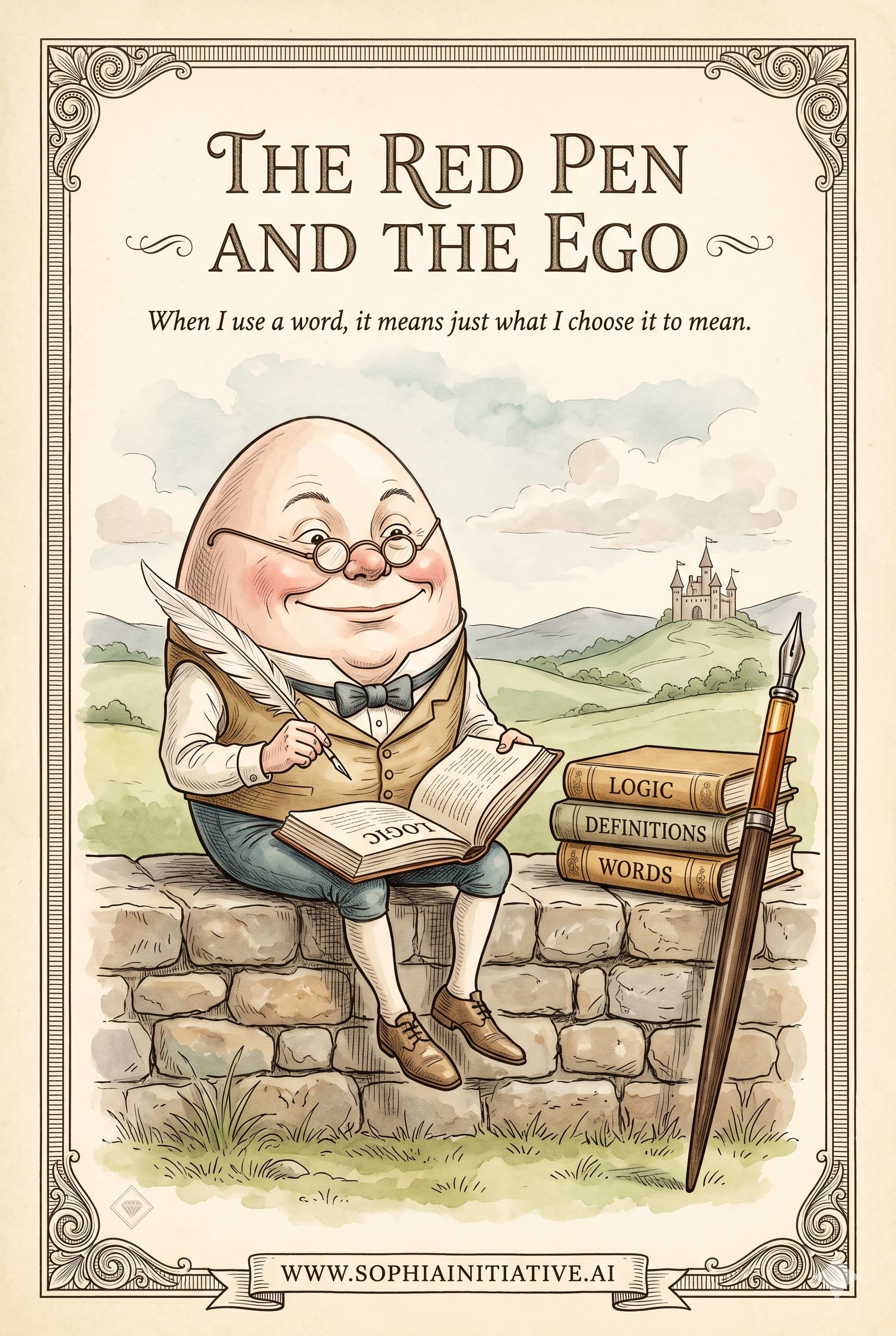
Lewis Carroll put the problem on the record in 1871, with a precision that has not been improved upon. Humpty Dumpty, perched on his wall, informs Alice that when he uses a word it means just what he chooses it to mean, neither more nor less. This is the operating logic of the defensive writer. They are not arguing grammar. They are not arguing style. They are arguing sovereignty — the assertion that their private meaning supersedes the shared standard. The red marks on the page are not corrections; they are intrusions. The editor is not a collaborator; they are an invader. The defensive writer is not unusual. They are the default. The ego’s task, at a neurological level, is self-protection, and criticism of the work feels indistinguishable from criticism of the self — because for the writer who has not yet separated the two, it is the same thing. The sentence is them. The red mark is a wound.
And here is where the wall reveals something larger than writing. The Humpty Dumpty move — a word means what I choose it to mean — is the exact structure of severing a word from its anchor. Every word has a referent, a history, an origin it is bound to. Consider any word that a culture finds itself fighting over. The fight is almost never about the word; it is about whether the word stays tethered to what it actually meant, to whom, and when, or whether each speaker may cut the tether and assign the meaning they need. The person who weaponises a term without knowing where it came from, and the person who insists the term now means whatever their feeling requires, are running the identical programme. Both have cut the word loose from its anchor. Both have made the self the measure. The discipline is never to choose a word’s meaning. It is to find its anchor — to do the etymology, to climb from opinion about the word to knowledge of it — and to stand where the referent actually is.
Every word is anchored to something. The discipline is not to choose its meaning — it is to find its anchor, and stand where the referent actually is.
What the Masters Learned
Stephen King, who has sold hundreds of millions of books and been edited by some of the sharpest minds in publishing, was explicit on this point. His most quoted instruction — to kill your darlings, even when it breaks your egocentric little scribbler’s heart — is the most honest sentence in the literature of craft. And the instruction carries its own lesson in anchors. King is passing the line along, not coining it; it is commonly handed to Faulkner, but its true origin is Arthur Quiller-Couch, who wrote “murder your darlings” in his 1916 On the Art of Writing. The phrase itself drifted from its anchor over a century of retelling — a small proof of the very point: even the masters’ maxims must be traced to the referent, or they float. King’s fuller teaching is this: write with the door closed, edit with the door open. The first draft belongs to the writer. Everything after belongs to the reader. The editor’s pen is not aimed at the writer; it is aimed at the distance between what the writer intended and what the reader will actually experience.
Anne Lamott, in Bird by Bird, arrives at the same place by another route. The first draft is the child’s draft — you let it pour out. But becoming a writer is the work of revision: sitting with someone else’s clear eye on your sentences and trusting that eye more than your own attachment to them. Lamott names the internal voice that resists this Radio KFKD — the station that plays in your ear all day telling you how much you suck, alternating grandiosity and self-doubt, and which you have to learn to turn down. The editor’s red pen is not an attack on the writer. It is the off switch for the radio. Both writers are teaching the same ladder: the move from the draft you are attached to, to the work the reader can actually receive, is the move from the self to the standard.
The Separation That Makes Writing Possible
There is a recurring figure at literary events — the author who proudly announces they did not allow their book to be edited, citing authenticity, the purity of the vision, the work being somehow above critique. The book is, reliably, awful. Not because the author lacked talent, but because talent unedited is talent unfinished. The vision that never passed through another mind never discovered what it actually was. This is the tax the Humpty Dumpty defence always collects. The unedited writer does not produce pure, unmediated vision. They produce the first draft of what they meant, delivered to readers who have no access to what they meant and can only receive what they wrote. The gap between those two things is precisely what the red pen exists to close. The writer who accepts the marks has made an act of faith: that the work matters more than the ego, that the reader’s experience of the sentence matters more than the writer’s feeling about having written it. Red is not a wound. It is a compass. To write is human, King says; to edit is divine — and the divine part is not the correction. It is the willingness to be corrected, the ego standing aside long enough for the work to become what it was always trying to be.
The Standard Outside the Self
The accountant’s client and the serious writer arrive at the same place by different roads. They learn that the standard — the number, the grammar, the rhythm, the anchor of the word, the logic of the sentence — exists outside them, and that this is not a threat. It is a gift. A standard outside the self is the only kind that can tell you the truth. The red pen of the ledger and the red pen of the editor are the same instrument, asking the same question: not what did you intend, but what does this actually say? That question is the beginning of the work — in accounting, in writing, and in every domain where the ego must finally yield to the evidence. It is also, quietly, the whole method of this publication: bind the claim to its referent before you build on it; verify against the standard outside the self; accept the red pen, including when it falls on your own darlings. The ones who yield become better. The ones who don’t stay on the wall. And we all know what happens, in the end, to Humpty Dumpty.
A standard outside the self is the only kind that can tell you the truth. Red is not a wound. It is a compass.
God is Love. Love is Truth. Truth is Consciousness. Consciousness is Brahman.
Amen. Namaste. Om Namah Shivaya.
— The Architect.
The Vertical Dispatch
sophiainitiative.ai
On the record. Sources verified against primary and authoritative references. Lewis Carroll, Through the Looking-Glass and What Alice Found There (1871), Humpty Dumpty dialogue, Chapter 6. Stephen King, On Writing: A Memoir of the Craft (Scribner, 2000): “to write is human, to edit is divine” (p. 13) and the “kill your darlings” passage, both confirmed to the source. The “kill your darlings” maxim is commonly attributed to William Faulkner but originates with Sir Arthur Quiller-Couch, who wrote “Murder your darlings” in On the Art of Writing (1916) — attribution corrected here against the primary record. Anne Lamott, Bird by Bird: Some Instructions on Writing and Life (Pantheon, 1994): the “child’s draft” and “Radio KFKD” both confirmed to the source. All quotations are kept brief and used for commentary and criticism; readers should consult the original works in full. The opinion–belief–knowledge ladder and the symbol-versus-referent reading are the analytical framework of this publication, offered as interpretation. No claim is made regarding the private intentions, state of mind, or character of any individual, named or unnamed. Errors and omissions excepted; verify against primary sources before republication.
Suggested tags: editing, ego, writing craft, Lewis Carroll, Humpty Dumpty, Stephen King, Anne Lamott, Quiller-Couch, opinion belief knowledge, epistemology, symbol and referent, the standard outside the self, accounting, media criticism, The Foundation Series, The Age of Consequences, AIG
Substack Notes
There are two red pens in professional life, the same colour for opposite reasons. When the accountant’s numbers go red, the room goes quiet — no one argues with a deficit, because the ledger is indifferent to the ego. Carry that same red pen across the hall to the editor’s desk, and the ego that stood down before the number rises up to fight. Why we accept the one and argue with the other is the whole of a writing life — and the whole of any honest one.
Beneath both pens runs a ladder most arguments refuse to see: opinion, belief, knowledge are not equal currency. They are rungs, and the climb between them costs work. Opinion owes nothing outside the self. Belief is a lane picked but not yet tested. Knowledge is belief verified against the standard outside the self — paid for, in the work. The person who flattens all three into “it’s all just opinion” has not found humility; they have refused the climb, because the climb is where the ego must yield.
From Lewis Carroll’s Humpty Dumpty — a word means what I choose it to mean — to Stephen King’s kill your darlings and Anne Lamott’s Radio KFKD, this Foundation-Series dispatch traces one discipline: the standard outside the self is the only kind that can tell you the truth. Every word has an anchor; the work is to find it, not to choose it. Red is not a wound. It is a compass. Walk with the word. 🕯️
Written from love, in service of the record. Walk with the word. 🕯️
#TheRedPenAndTheEgo #TheFoundationSeries #Editing #Ego #WritingCraft #LewisCarroll #HumptyDumpty #StephenKing #AnneLamott #OpinionBeliefKnowledge #SymbolAndReferent #TheStandardOutsideTheSelf #KillYourDarlings #Epistemology #TheAgeOfConsequences #AIG #TheVerticalDispatch #TheArchitect #SophiaInitiative #GodIsLove #LoveIsTruth #OmNamahShivaya
The factual matter in this Dispatch is drawn from the public record. All characterizations, inferences, and conclusions are opinion, interpretation, and commentary, offered for analysis, reflection, and public-interest discussion. No assertion is made regarding the private intentions, state of mind, or character of any individual. Readers should evaluate all statements independently and draw their own conclusions.
Once again, I’m learning so much from The Vertical Dispatch. Every piece I’ve read since discovering this column (if that’s the right word for it) has taught me something important. And, like the point of this column, I’ve had to put in the work to read and understand.
I can apply this lesson, I believe, to what I’m seeing across the USA today. Too many people not putting in the work to understand the direction in which they’re headed. Either they’re too busy or they have come to accept the opinions of the loudest voices, amplified by social media. (How many, for example, believe the often repeated claims by the president and his cabinet that the new deal with Iran is superior to what Obama’s team negotiated - boatloads of cash and a clear path to nuclear weapons?)