


The Vertical Dispatch · The Age of Consequences
By Glennford Ellison Roberts · The Architect · May 2026
If you love Canada, please share and restack.
Nobody in the national press is asking the question that ends the separation argument in a single paragraph. So let us ask it here, plainly, in the register this moment demands.
If Alberta separates — or even seriously pursues the legal and political machinery of separation — it forecloses the pipeline infrastructure that is the only mechanism by which Alberta’s oil wealth can be fully monetized. Not eventually. Not after a rough transition. Immediately. Structurally. Permanently, on any timeline that matters to a living Albertan.
That is not an opinion. It is arithmetic. And the arithmetic is devastating.
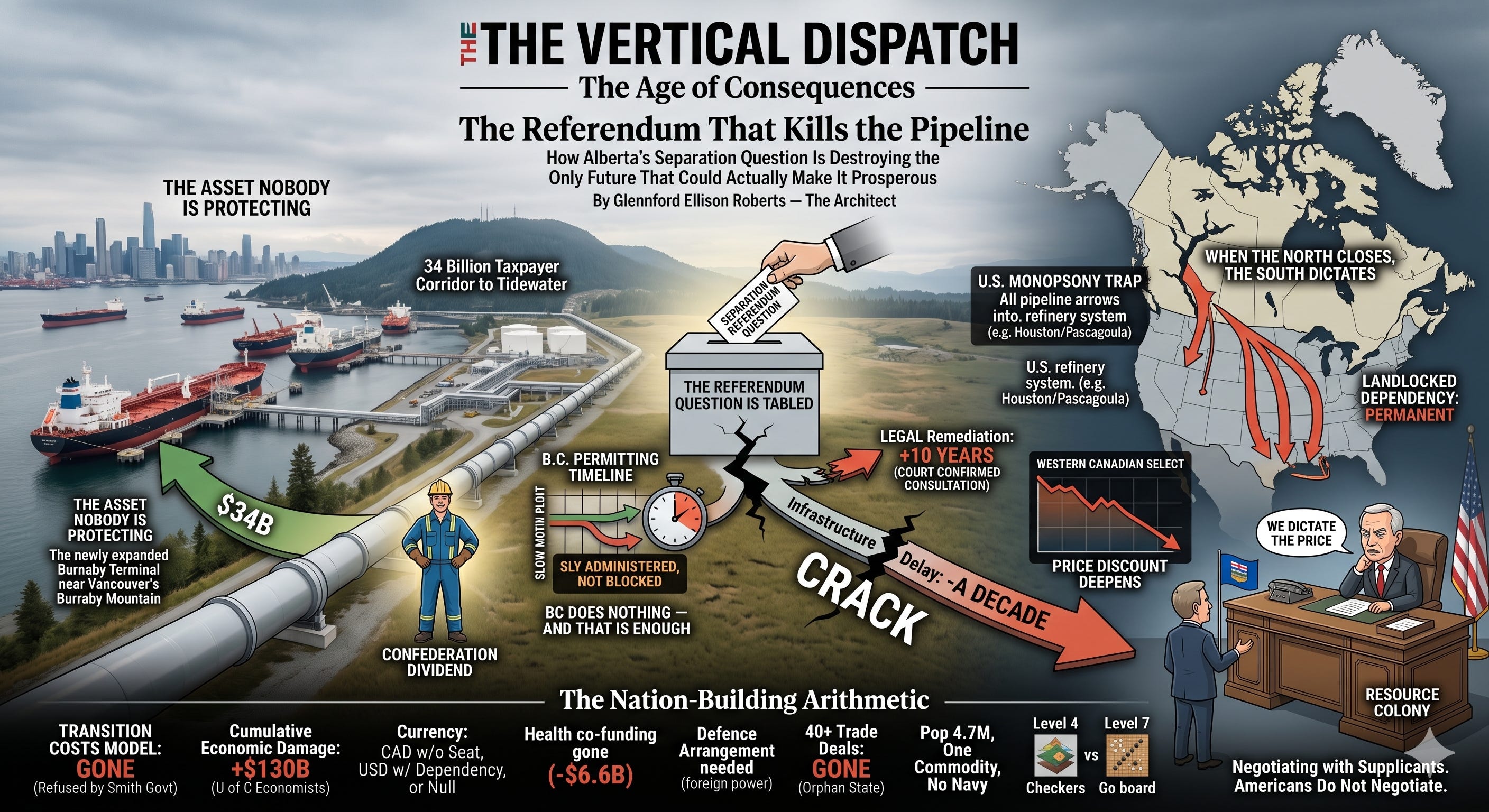
THE ASSET NOBODY IS PROTECTING
Trans Mountain is built. Operational. Delivering Alberta crude to tidewater — to Asian markets, to price discovery beyond the American monopsony, to the export corridor Alberta fought for across two federal governments and thirty-four billion dollars of Canadian taxpayer capital.
That pipeline, right now, represents the single greatest Confederation dividend Alberta has ever received. The federal government spent public money from coast to coast to give Alberta a second outlet. The Trans Mountain expansion doubled throughput capacity. The technical case for doubling Alberta’s oil production — which is a real possibility, the resource base supports it — rests entirely on that corridor and whatever follows it.
This is what the separation movement is volunteering as collateral damage.
THE MOMENT THE REFERENDUM QUESTION IS TABLED, BC DOES NOTHING — AND THAT IS ENOUGH
British Columbia does not need to block a pipeline to kill it. They need only administer it slowly. Every operational permit renewal. Every environmental monitoring review. Every expansion application. Every First Nations consultation process along a corridor where title claims are active, legitimate, and now directly amplified by an Alberta government simultaneously threatening to blow up the country those First Nations have treaty relationships with — not with Alberta, with the Crown of Canada.
BC has no incentive whatsoever to facilitate Alberta’s energy export infrastructure while Alberta is pursuing an exit that would leave British Columbia geographically severed from the rest of Canada. This is not ideology. It is provincial self-interest at its most basic. Why would any government in Victoria hand Alberta the tidewater access that makes separation fiscally viable?
The answer is they would not. And they will not. The separation referendum question does not have to pass. It does not even have to reach the ballot in its current legally contested form. The damage is done the moment it becomes a serious political proceeding. Every year of that proceeding is a year in which the second pipeline corridor — the one that would complete Alberta’s tidewater strategy and underwrite the doubling thesis — cannot be built, financed, or politically negotiated.
That is not ten years of delay. On treaty consultation grounds alone — which a court has already confirmed are mandatory before a referendum can proceed — you are looking at a legal and political remediation timeline that swallows a decade before the first shovel touches ground on new corridor infrastructure.
WHEN THE NORTH CLOSES, THE SOUTH DICTATES
With the BC corridor compromised and new infrastructure financing impossible to underwrite against a backdrop of separation uncertainty, Alberta has one remaining export route. South. Into the American refinery system. Onto American pricing terms. Under American trade negotiating conditions. Without a federal government standing behind Alberta at the table.
The Americans do not negotiate with supplicants. They set the price. The Western Canadian Select discount — already a structural wound in Alberta’s fiscal position — deepens. The landlocked dependency that separation was supposed to cure becomes permanent, because the only cure for landlocked dependency is tidewater access, and tidewater access requires BC cooperation that the referendum question has made politically impossible.
This is the trap. Alberta agitates for sovereignty to escape the terms Canada imposes. The separation question forecloses the infrastructure that would create genuine leverage. The only open door is south. And what walks through that door is not a sovereign Alberta dictating terms to the American energy market. It is a price-taking, landlocked, politically destabilized resource province that Washington prices accordingly.
You wanted freedom from federal interference. You got a continental extraction arrangement on American terms. Congratulations.
THE NATION-BUILDING ARITHMETIC NOBODY IS PUBLISHING
Let us do the accounting the prosperity movement refuses to do publicly, because the numbers do not survive contact with daylight.
A sovereign Alberta on day one requires a currency decision — adoption of the Canadian dollar without a seat at the Bank of Canada table, or dollarization into the USD with all the monetary dependency that implies, or a new currency that no energy importer will accept as settlement for contracts priced in USD. It requires a border and passport infrastructure with both the United States and the now-foreign nation of Canada. It requires immediate full-cost assumption of health services currently co-funded by a $6.6 billion Canada Health Transfer — gone from the first budget. It requires a military or a defence arrangement with a foreign power, because a landlocked sovereign state cannot secure its own pipelines without one. It requires renegotiation of every trade agreement Canada holds, because Alberta inherits none of them. CUSMA — gone. The forty-plus bilateral trade agreements Canada has negotiated over decades — gone. Alberta begins its sovereign existence as a trade-deal orphan negotiating from scratch with partners who have no incentive to offer preferential terms to a new state of 4.7 million people with one dominant export commodity and no navy.
The Alberta Prosperity Project’s fiscal plan acknowledges none of this with rigour. It has a revenue projection. It has an equalization savings figure. It does not have a transition cost model, because a transition cost model would end the conversation.
The University of Calgary’s own economists have estimated that a five percent increase in the cost of moving goods into or out of Alberta shrinks the provincial economy by four percent — roughly $20 billion in annual lost activity. Extrapolated across the decade of legal, constitutional, and infrastructure remediation that actual separation would require, that approaches $130 billion in cumulative economic damage. The Smith government has refused to commission any analysis of these costs. The explanation offered is that the civil service does not model hypothetical scenarios.
The government is contemplating a referendum on national dissolution and will not model the cost.
Read that sentence again.
THE QUESTION BENEATH THE QUESTION
If the fiscal math of true sovereignty does not work on a ten-year horizon without the pipeline revenue that the separation process forecloses — and it does not — then there are only two exits from the logical trap. Return to Canada on worse terms than Alberta holds today, having spent a decade burning political capital and infrastructure opportunity. Or deeper economic integration with the United States that is structurally indistinguishable from absorption.
Trump-era America does not receive sovereign partners. It receives acquisitions. An Alberta outside the Canadian constitutional framework, dependent on American markets, negotiating without federal backing, is not a sovereign energy power. It is a resource colony with a flag.
The people driving the separation petition are not wrong that Confederation has extracted value from Alberta. The equalization formula has structural absurdities that genuine federalism should have corrected decades ago. The federal government’s historical interference in Alberta’s resource development is a legitimate grievance. The National Energy Program was a genuine wound. These things are true.
But the separation question does not cure any of them. It forecloses the one infrastructure outcome — a completed tidewater strategy — that would give Alberta real leverage inside or outside Confederation. It hands BC the excuse it has been waiting for. It opens the door to Washington’s terms. It burns the asset that thirty-four billion dollars of Canadian public money built for Alberta’s benefit.
And it does all of this while the legal architecture — treaty obligations, constitutional amendment requirements, court-mandated consultation processes — ensures that actual resolution takes longer than most of the people signing the petition will be alive to see.
THE STRATIFIED QUESTION
This movement is being processed at the wrong level of abstraction. The grievances are real. The solution being proposed is not calibrated to the complexity of the problem. A Level 4 emotional register — we are being treated unfairly, we want out — is being applied to a Level 7 or Level 8 governance problem that requires modelling trade corridors, constitutional law, treaty obligations, international finance, energy market structure, and continental geopolitics simultaneously.
The checkers players are at the table. The Go board is the one that matters.
No serious sovereign wealth strategy for Alberta burns its tidewater infrastructure to make a political point. It secures the corridor. It maximizes throughput. It uses genuine export leverage to renegotiate the terms of federation from a position of strength rather than from the position of a province that has just announced it cannot be trusted to remain in the country its pipelines run through.
That is the conversation Alberta needs to be having.
Nobody is asking these questions.
We just did.
God is Love. Love is Truth. Truth is Consciousness. Consciousness is Brahman.
Amen. Namaste.
#Alberta #AlbertaSeparation #AlbertaSovereignty #TransMountainPipeline #CanadianEnergyPolicy #BCPipelineCorridor #WesternCanadianSelect #AlbertaProsperity #DanielleSmith #EqualizationReform #CanadianFederalism #AlbertaReferendum2026 #PipelineInfrastructure #CanadianOilSands #EnergyExports #AlbertaEconomy #StayFreeAlberta #AlbertaProsperityProject #TidewaterAccess #CanadianConstitutionalLaw #FirstNationsTreatyRights #AlbertaFiscalPolicy #CanadianSovereignty #EnergyGeopolitics #ContinentalEnergy #AlbertaIndependence #ResourceEconomics #CanadianPolitics2026 #AgeOfConsequences #UniversalDynamics #TheVerticalDispatch
Quebec separatists shot themselves in the foot and Alberta wants to emulate them. I was transferred to Alberta from Quebec during a large HQ move after the 1995 referendum. They announced their move to media 3 days after the referendum and did not inform employees first. That is how hush hush it was. So for all those Albertan’s who say they have a right to a referendum on separation, I say an election is more suitable as the separatist UCP party can put forward their campaign including their separatism referendum plans. No hiding their agenda. Be open like the Quebec separatist party was. Everyone knew who they were voting for and knew their agenda when they cast their ballot during that election. This did not occur in Alberta. Those in the UCP running for office intentionally disguised their separatist agenda and the seoaratist party membership and referendum plans. The election was based on fraud and misrepresentation. There is zero mandate for a referendum on separation as they were elected under false pretences. An election must be called.
That question (and others) need to be asked and you can bet the oil sands companies are thinking about them. A new pipeline will need oil and increasing oil production will require workers. Many of these will come from outside Alberta or Canada. Yet, Alberta is holding a referendum on the level of services to be provided to those who are not permanent residents. A series of political decisions are killing the very political agreement that is meant to move things forward and the companies won't take the risk.
Alberta needs to be prepared to become AlbertaRico, a territory of the USA that has limited influence. The USA wants the oil, not the people. More decisions affecting Alberta's future will be made in Washington than are currently made in Ottawa and a greater share of resource revenues will go to Washington than currently goes to Ottawa. Congratulations - you won!