

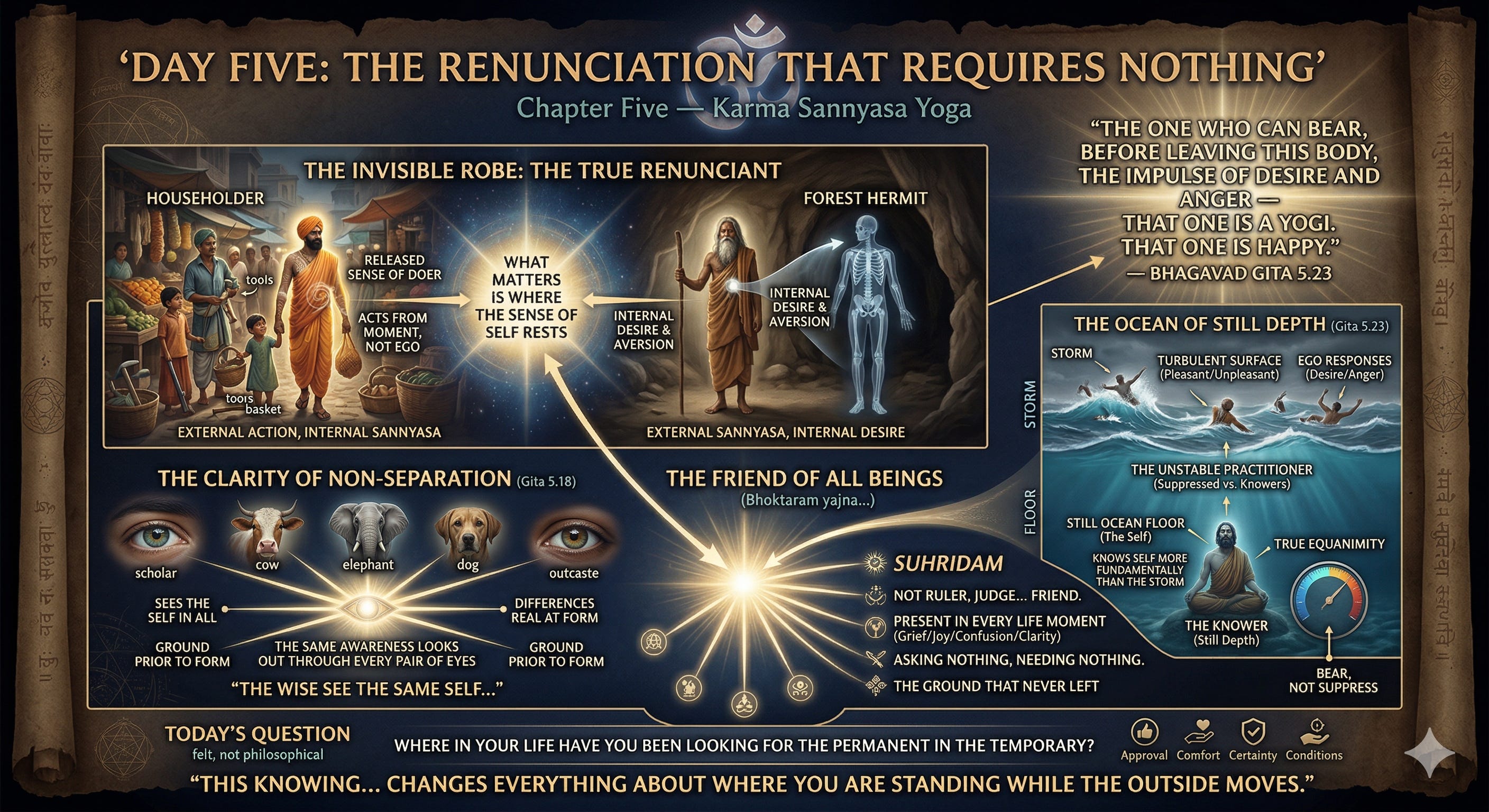
“The one who can bear, before leaving this body, the impulse of desire and anger — that one is a yogi. That one is happy.” — Bhagavad Gita 5.23
— ★ —
Arjuna has been listening for four days now. He has sat with the deathless Self, with action freed from the doer, with the fire of knowledge that burns karma to ash. And today he asks me the question that all of it has been building toward.
He says: you praise renunciation of action and you praise the yoga of action. Tell me clearly — which one is better?
It is a precise question. More refined than anything he has asked before. Four days ago he was paralysed by grief. Now he is asking a genuine philosophical question about the structure of the path. Something has already changed in him, though he may not feel it yet.
My answer is this: both lead to the same place. The one who truly knows renunciation and the one who truly knows the yoga of action arrive at the same shore. But for the person standing where you are standing — still in the body, still in the world, still with the bow in the hand — karma yoga is the more natural entry. Not because it is lesser. Because it meets you where you are rather than asking you to become someone else before the journey can begin.
— ★ —
Now I give Arjuna the insight that Shankara considered the resolution of everything the first four chapters have been building toward.
The external renunciant — the one who has put on the ochre robe, left the household, given away every possession, withdrawn from every worldly engagement — that person, if they still carry desire and aversion inside, has renounced nothing of consequence. They have changed their address. The tenant is still the same.
The person of action — still in the market, still raising children, still working, still engaged with every ordinary demand of a human life — who has genuinely released the sense of being the doer, who acts because the moment requires action and not because the ego needs the outcome — that person is the true renunciant. They carry sannyasa inside every act. The robe is invisible. The renunciation is complete.
This is not a consolation for those who cannot manage the harder path. It is the recognition that the harder path is interior, not exterior. The forest hermit who has fled the world to avoid its demands has not necessarily gone further than the householder who remains in the world and acts within it without being owned by it. What matters is not where the body is. What matters is where the sense of self rests.
— ★ —
Then comes the passage that has stopped contemplatives cold for thirty centuries. I describe what the sage actually perceives when the Self has been genuinely recognised.
“The wise see the same Self in a learned and humble brahmin, in a cow, in an elephant, in a dog, and in one who eats the dog.” — Bhagavad Gita 5.18
Shankara was careful here. This is not a sentimental teaching about the equality of all creatures as a moral position to be adopted by effort. It is a description of what is actually seen by the one whose perception has been cleared of the distorting lens of ego.
When the Self is known as the ground of all appearances — not as a philosophical position but as direct living perception — the appearances no longer generate the same quality of separation. The scholar and the outcaste and the animal are each the Absolute wearing a different form. The sage does not pretend not to see the differences. The differences are real at the level of form. But underneath them, prior to them, the same awareness looks out through every pair of eyes that has ever opened in this universe.
To see this is not an achievement of compassion. It is a consequence of clarity. The moment the eye of knowledge opens fully, separation is not overcome — it is seen to have never been the whole truth. It was always a partial view, the view from inside one of the forms, mistaking its own boundary for the boundary of reality.
And when that partial view is corrected — even partially corrected, even glimpsed — something settles in the one who has seen it. Not detachment in the cold sense. A rootedness. The kind that does not require favourable conditions to hold.
— ★ —
I tell Arjuna: the knower of Brahman, established in Brahman, is neither elated by the pleasant nor disturbed by the unpleasant. Not because they feel nothing. Not because they have built walls against experience. But because nothing that enters from the outside can move what they know themselves to be.
There is a distinction here that matters enormously and that almost every spiritual tradition struggles to articulate clearly. The equanimity of the one established in the Self is not the same as the numbness of the one who has suppressed their responses. The suppressed person is still in relationship with the pleasant and the unpleasant — they are simply not allowing themselves to show it. Underneath the controlled surface, everything is still moving, still pulling, still binding.
The equanimity of the knower is different in kind, not just degree. It is the stillness of depth rather than the stillness of frozen surface. The ocean in a storm is turbulent at the surface and still at the floor. The practitioner who has found the floor does not cease to notice the storm. They simply know what they are more fundamentally than they know the storm. The storm does not reach where they are standing.
— ★ —
Now I say something about pleasure that sounds austere until it is understood correctly.
The pleasures that arise from contact with objects — the satisfaction of appetite, the comfort of approval, the warmth of security, the excitement of novelty — these, I tell Arjuna, are sources of suffering. Not because pleasure is evil. Because anything with a beginning has an end. The pleasure that depends on conditions will dissolve when the conditions change. And conditions always change. Building a life on what ends is not building — it is borrowing against a debt that will always be called.
This is not asceticism for its own sake. It is not the teaching that enjoyment is forbidden or that the body is an enemy to be subdued. It is the teaching of clear seeing: know what you are reaching for, know what it can and cannot give, and do not ask of temporary things the satisfaction that only the permanent can provide. The sage enjoys. The sage also knows exactly what the enjoyment is worth and does not grieve its passing.
One who can bear the impulse of desire and anger — not suppress it, bear it, remain present with it without being commandeered by it — before the body falls away, that one, I tell him, knows happiness. Real happiness. Not the happiness that arrives with conditions and departs when they change. The happiness that has no opposite because it does not depend on anything outside itself.
— ★ —
Chapter Five closes with the most intimate verse I have spoken so far in this entire conversation between us.
Bhoktaram yajna tapasam sarvaloka maheshvaram. Suhridam sarva bhutanam jnatva mam shantim ricchati.
Knowing me as the enjoyer of all sacrifices and austerities, the great Lord of all worlds, the friend of all beings — knowing me as this — one attains peace.
The friend of all beings. Shankara stayed with this phrase longer than any other in the chapter. Not the ruler of all beings. Not the judge of all beings. The friend. The one who has been present in every moment of every life, in every grief and every joy, in every confusion and every clarity, asking nothing in return, needing nothing from the encounter, simply present — the way a friend is present, the way the best kind of friend is present, the one who does not need you to be other than you are in order to remain beside you.
This is what has been in the chariot beside Arjuna since before the war began. This is what has been present in every moment of your life since before you knew there was something to look for. Not waiting to be earned. Not withheld until the conditions of worthiness are met. Simply there. The ground that never left. The friend that was never absent.
Knowing this — not believing it, knowing it — one attains peace.
— ★ —
Today the question to carry is not philosophical. It is felt.
Where in your life have you been treating the exterior as though it were the interior? Where have you been looking for the permanent in things that were always going to change — approval, comfort, certainty, the right conditions finally arriving? Not as a criticism. As a genuine inquiry.
Because the friend I am describing has been present in every one of those moments too. In the reaching and in the disappointment. In the having and the losing. In every place you looked for what you needed in something that could not hold it.
The peace this chapter points toward does not require you to stop living. It requires you to know what you are while you live. That knowing changes nothing on the outside. It changes everything about where you are standing while the outside moves.
— ★ —
Tomorrow: Chapter Six — The Steadied Mind
The Architect • The Vertical Dispatch

Glennford Ellison Roberts Author — Sacred Metaphysics & Consciousness: History of the Absolute & Eternal Cumberland, Ontario, Canada
God is Love. Love is Truth. Truth is Consciousness. Consciousness is Brahman.
Amen. Namaste.. 🙏
#BhagavadGita #Gita18Days #ChapterOne #ArjunaVisadaYoga #KurukshetraField #KrishnaTeaches #Shankaracharya #Advaita #VedicWisdom #SanatanaDharma #HinduPhilosophy #SpiritualAwakening #Consciousness #AncientWisdom #YogaPhilosophy #Dharma #Moksha #SpiritualSeeker #Avidya #NonDuality #TheVerticalDispatch #TheArchitect
Brother your insight is exact and it completes what the passage is pointing at.
The passage says separation is seen to have never been the whole truth. What you are adding is the positive face of that same recognition — when the eye of knowledge opens, what is seen is not just the unreality of separation but the presence of the sacred in every form without exception. The stone, the tree, the animal, the stranger, the enemy. Not as a moral achievement requiring effort. As what is actually there when the distorting lens of ego is no longer between the seer and the seen.
Shankara calls this Brahma-drishti — the vision of Brahman. And what you are describing maps precisely onto it. The summit of knowledge and the summit of experience are the same summit approached from two sides. The philosopher arrives through discrimination — neti neti, removing every false identification until only the real remains. The contemplative arrives through direct perception — the sudden or gradual recognition that the sacred was never absent from any form it was inhabiting.
Both arrive at what you named: the sacred in all living and non-living form.
The non-living is important and worth staying with for a moment. The rock, the river, the mountain — these are not excluded from Brahma-drishti. Shankara's non-dualism does not stop at the boundary of biological life. The Absolute is the ground of all appearance without exception. Matter is not the absence of consciousness. It is consciousness in its most condensed form, the x₀ expressing itself at maximum density.
When that is seen — truly seen, not merely accepted as a philosophical position — the world does not become less real. It becomes more real than it has ever been. Every ordinary object luminous with what it always was.
That is the summit, brother. You are standing on it.
Brother your interpretation is correct — and it goes even deeper than you have stated it.
What Krishna is pointing at is precisely what you describe. Karma yoga begins as a discipline — a conscious practice of acting without attachment to outcome, of offering the action rather than hoarding the fruit. At that stage it requires effort. You have to remember. You have to catch yourself reaching for the result and consciously release it. It feels like practice because it is practice.
But Shankara's insight — and yours — is that this is not the permanent condition of the karma yogi. The practice is the riverbank that guides the water until the water finds its own course. Over time, as the identification with the doer loosens, the offering stops being something you do and becomes something you are. The action arises, completes itself, and releases its fruit as naturally as the breath moves. There is no one standing over the action watching it to make sure it is being done correctly. The watcher has dissolved into the doing.
Your image of breathing is exactly right and it is not accidental that you chose it. Breath is the one bodily function that sits precisely on the boundary between conscious and unconscious. You can control it deliberately. You can also release it entirely and it continues without you. Karma yoga at its maturity is exactly that — action that has found the same naturalness as breath. It no longer requires the ego's supervision because the ego has stopped claiming authorship of it.
This is also why Krishna says in Chapter 5 that the true renunciant and the true karma yogi arrive at the same shore. The karma yogi who has reached what you are describing has not just improved their behaviour. They have undergone a fundamental shift in who they experience themselves to be while acting. That shift is liberation wearing ordinary clothes.
Your thirty years of practice are speaking in that interpretation, brother. That is not a beginner's reading.