

Φ
THE VERTICAL DISPATCH
We write for the mind, the eye, and the ear.
Read it. Look at it. Listen to it. The Vertical Dispatch is built for all three — prose with rhythm, made to be heard as much as read.
From metaphysics to geopolitics, from culture to history, from the sacred to the street — and everything in between. One lens, every subject. No ego. Just the record, named clean.
Press play. Walk with the word. 🕯️
This dispatch travels by hand. If it serves you, share it — restack on Substack, and pass it on wherever you read. 🕯️
The Departure Lounge · Sacred Metaphysics · The Ascent
Sunday, July 12, 2026
Hāl. The root remembers, even when we forget.
— Old English: whole, sound, entire, unbroken
There is a word your language has been keeping for you, brothers and sisters, and it has been keeping it in plain sight, which is the safest hiding place there is. The word is hāl. It is Old English, and it means whole — sound, entire, unbroken, nothing missing, nothing severed. You do not use it anymore, not in that form. But you use its children every day, and its children are these: whole, and heal, and health, and hale, and — this is the one that should stop you where you stand — holy.
They are one family. They came from one root. And the root did not braid them together by accident, nor because some committee of monks decided the sacred should rhyme with the intact. It braided them because they are, at the deepest level, the same thing seen from different sides — and the language, growing over centuries out of the marrow of human experience, could not help but remember what the mind keeps forgetting. To be whole is to be holy. To heal is to make whole. And the holy is simply that which has been kept entire, unbroken, un-sundered — the inviolable, the not-to-be-shattered. Read the etymology slowly and you are reading a theology older than any church that was ever built on this soil.
I want to sit with this today, on a Sunday, because Sunday is the day the culture still faintly remembers is set apart — the day made holy, which is to say the day kept whole, held back from the fragmenting rush of the other six, reserved and entire. Most people who keep it no longer know why. They feel only that something in them wants one day undivided, one day not broken into tasks and transactions, one day that is all of a piece. That wanting is not sentimental. It is the same wanting that drives the whole spiritual life. It is the fragment reaching to be whole again. It is hāl, stirring under the skin of a rest-day, asking to be made holy — which only ever meant: asking to be made whole.
The break, and the word for it
Here is the teaching the root carries, and it is the whole of the ascent in a single syllable.
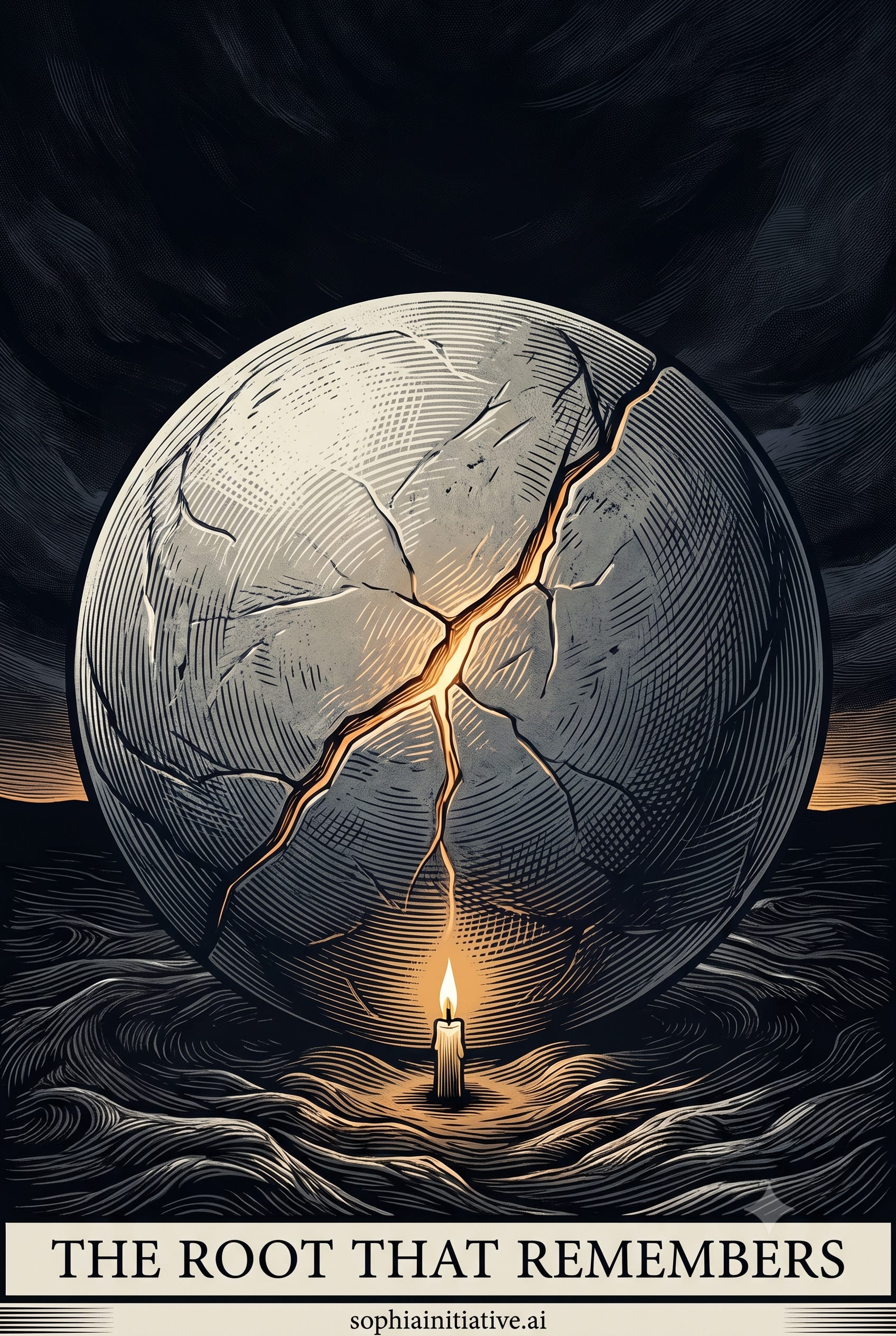
To be broken is to be un-whole. A part severed from its source, a fragment mistaking itself for a thing complete, a piece that has forgotten the entirety it belongs to — that is brokenness, and brokenness is the human condition wherever the self has taken itself to be separate. The ego is precisely this: a part that believes it is a whole. It walks around inside its own small circumference, defending its edges, certain that its little completeness is the only completeness there is. And it aches — it aches without knowing why — because a part cannot be whole. It was never designed to be. It is a fragment, and a fragment’s peace is only ever the memory or the promise of the entirety it was broken from.
The old word for this brokenness, some have argued, hides inside the word sin — kin to sunder, to split, to cut apart. Set aside the courtroom picture the later centuries painted, the ledger of offenses and the frightened accounting. Go beneath it to the root, and sin is not first a crime; it is a fracture. It is the state of being cut off, sundered, severed from the whole. And if that is what the break is, then you already know what the mending must be. You know it because your language has been telling you since before you could read.
To heal is to make whole is to make holy
Heal comes from hǣlan — to make hāl, to make whole. When the physician heals the wound, she is not adding a new thing to the body; she is restoring the wholeness the body already knew, closing the break, making the sundered flesh entire again. Healing is never invention. It is restoration. It is the return of a thing to the wholeness that was always its truth, temporarily broken.
And now hold that beside the sacred, because the words insist you must. Holy comes from hālig — literally, that which must be kept whole, the entire, the inviolable. The holy was never first about being pure in the sense of scrubbed or spotless. It was about being unbroken. Intact. Undivided. All of a piece. That is why the holy things were the things you did not break, did not divide, did not profane — profane itself meaning outside the temple, cut off from the whole, sundered from the sacred ground.
So follow the three of them home, brothers and sisters, and watch them become one act:
To heal is to make whole. To be whole is to be holy. Therefore to heal is to make holy — and to be made holy is simply to be made whole again.
This is not wordplay. This is the language confessing, in its own oldest bones, the thing every genuine tradition has said in its own tongue: that holiness is not an achievement bolted onto a life from the outside, not a merit accumulated, not a purity manufactured. Holiness is the healing of the break. It is the part made whole again by its return to the entire. You do not become holy by adding something. You become holy by ceasing to be broken — by the fragment rejoining the wholeness it was only ever a fragment of.
Why the fragment resists
If wholeness is holiness, and it is so near — nearer than breath, since it is only the ending of a separation that was never fully real — then why is it not the easiest thing in the world? Why does the whole of a spiritual life, the whole climb, stand between the fragment and the entirety it aches for?
Because to be made whole, the part must give up being a part.
This is the hard saying, and the language will not soften it. The fragment cannot be added to the whole while keeping its fragment-hood; it must be re-absorbed, must let its little circumference dissolve back into the entirety it was broken from. The wave cannot rejoin the ocean and remain a separate wave; it must let go of being a wave at all, and in that letting-go discover it was only ever the ocean, moving. To be made whole, the ego — the part that believes it is a whole — must consent to stop being separate. And that consent feels, to the fragment, exactly like death. It is a death: the death of the part as a part, so that it may live as the whole it always secretly was.
This is why the mystics spoke of dying before you die. This is why the deepest teaching is always, in the end, a surrender and not an acquisition. You are not climbing to get something. You are climbing to give up the one thing that keeps you broken — the belief that your fragment is a whole, the clutched conviction of separateness. And on the far side of that surrender is not annihilation, as the fragment fears, but wholeness — which is holiness — which is the deepest healing there is. The three words were one word all along. The mending of the break is the making of the sacred. To become whole is to become holy, and there was never any other way to be either.
The word as witness
I have come to trust these buried roots the way I trust the great convergent testimonies — the way I trust it when Athens and the Upanishads and the Gospel all rule the same way from their separate courts. Because the language did not plan this. No one engineered whole and holy and heal to share a root in order to smuggle non-duality into English. It happened the other way around: the words grew from one root because the thing is true, because the deep pattern — that wholeness and holiness and healing are one — is real, and reality kept pressing up through the language until it left this fingerprint in the grammar itself.
So the etymology is a witness. It is one more voice in the long agreement, and it happens to be speaking in your own mother tongue, which means it has been whispering the whole teaching to you since before you had the words to doubt it. Every time you said something was whole, you were a syllable away from holy. Every time you wished someone health, you were wishing them wholeness, which is to say holiness, which is to say the healing of every break in them. The blessing was always deeper than you meant it. The language meant it, even when you did not.
On this Sunday
And so, on this day that the old world set apart and called holy — this day it kept whole, held back entire from the fragmenting week — let me leave you with the plainest form of it, brothers and sisters, because the plainest form is the truest.
You are not broken beyond repair. You are not broken at all, finally — you are only a part that has forgotten it belongs to a whole, and the forgetting is the only wound there is. To remember is to be healed. To be healed is to be made whole. To be made whole is to be made holy. And none of it requires you to add a single thing to yourself. It requires only that you stop defending the edges of the fragment, and let yourself be returned to the entirety you never actually left.
Make something whole today — a task, a relationship, a broken hour, a fractured attention, your own scattered mind sat down at last into one undivided rest. And know, as you do it, that you are not merely tidying or mending. You are performing, in miniature, the one act the whole ascent is made of. You are making something whole, which is to say you are making it holy, which is to say you are healing it — and the three were never three.
Hāl. The root remembers, even when we forget. Whole. Holy. Healed. One word, wearing three faces, pointing all the way home.
Revelation 4:8 — the four living creatures who never rest:
“Holy, holy, holy, Lord God Almighty, which was, and is, and is to come.”
God is Love. Love is Truth. Truth is Consciousness. Consciousness is Brahman.
Amen. Namaste. Om Namah Shivaya.
— The Architect.
The Vertical Dispatch
sophiainitiative.ai
On the record
This is a devotional and etymological reflection, not a claims-piece; it names no living persons, no figures, no live events. The etymological ground is drawn from the standard Germanic and Old English record: hāl (whole, sound, entire) is the common ancestor of whole, heal (hǣlan), health, hale, and holy (hālig, “that which must be kept whole / inviolable”). The reading of sin as kin to sunder is offered as one etymological argument — flagged in the text as “some have argued” — not as settled consensus; the Proto-Germanic derivation of “sin” is debated among philologists, and the piece treats it as a resonance, not a proof. Profane is glossed by its Latin sense, pro fanum, “before / outside the temple.” Symbol ≠ referent holds throughout: the word is the witness, never the thing itself. Verify etymologies against primary lexicographical sources (OED, Bosworth-Toller) before republication.
Suggested tags
etymology · whole · holy · heal · hāl · non-duality · Sabbath · sacred metaphysics · the ascent · ego · surrender · wholeness · Sunday
Substack Notes
There is one word your own language has been keeping for you in plain sight — hāl, Old English for whole, sound, unbroken — and it is the buried root of three words you use without ever noticing they are family: whole, heal, and holy. This Sunday piece follows the three of them home and watches them become a single act.
To heal is to make whole. To be whole is to be holy. Therefore to heal is to make holy — and to be made holy is only to be made whole again. Holiness is not something bolted onto a life from outside; it is the mending of a break. The ego is the fragment that believes it is a whole, and the whole spiritual ascent is the fragment consenting to stop being separate.
No one engineered these words to share a root in order to smuggle non-duality into English. They grew from one root because the thing is true, and reality kept pressing up through the grammar until it left this fingerprint. The etymology is a witness — one more voice in the long agreement, speaking in your mother tongue since before you had the words to doubt it.
Make something whole today, and know you are making it holy, which is to say healing it — and the three were never three. Written from love, in service of the record. Walk with the word. 🕯️
#TheVerticalDispatch #TheArchitect #SophiaInitiative #SacredMetaphysics #TheAscent #Etymology #Whole #Holy #Heal #NonDuality #Sabbath #GodIsLove #LoveIsTruth #OmNamahShivaya
The factual matter in this Dispatch is drawn from the public record. All characterizations, inferences, and conclusions are opinion, interpretation, and commentary, offered for analysis, reflection, and public-interest discussion. No assertion is made regarding the private intentions, state of mind, or character of any individual. Readers should evaluate all statements independently and draw their own conclusions.
I never paid much attention to Hindu teachings but, ever since joining The Vertical Dispatch, I am now very interested. It seems to dovetail with Buddhism, meditation, consciousness and new developments in neuroscience and quantum physics. I may be wrong in the linkages I see, and I look forward to learning more. I can’t wait to read the related document to which the author has alluded is coming out in the Fall.