


How Iran is bleeding the most expensive military machine in history — one $30,000 drone at a time
Kinshasa, October 30, 1974. George Foreman — undefeated, ferocious, the most feared puncher alive — spent eight rounds throwing everything he had at Muhammad Ali, who leaned against the ropes and let him. The crowd thought Ali was losing his mind. He was winning the fight. When Foreman had punched himself empty, Ali stepped off the ropes and ended it in the eighth.
The rope-a-dope. The greatest strategic bait-and-drain in sports history.
Fifty-two years later, Iran is running the same play. And the United States military — the most powerful, most expensive fighting force ever assembled — is George Foreman. Throwing punches. Burning through gloves. Getting tired. This is the war that the Pentagon’s trillion-dollar procurement machine was never built to fight.
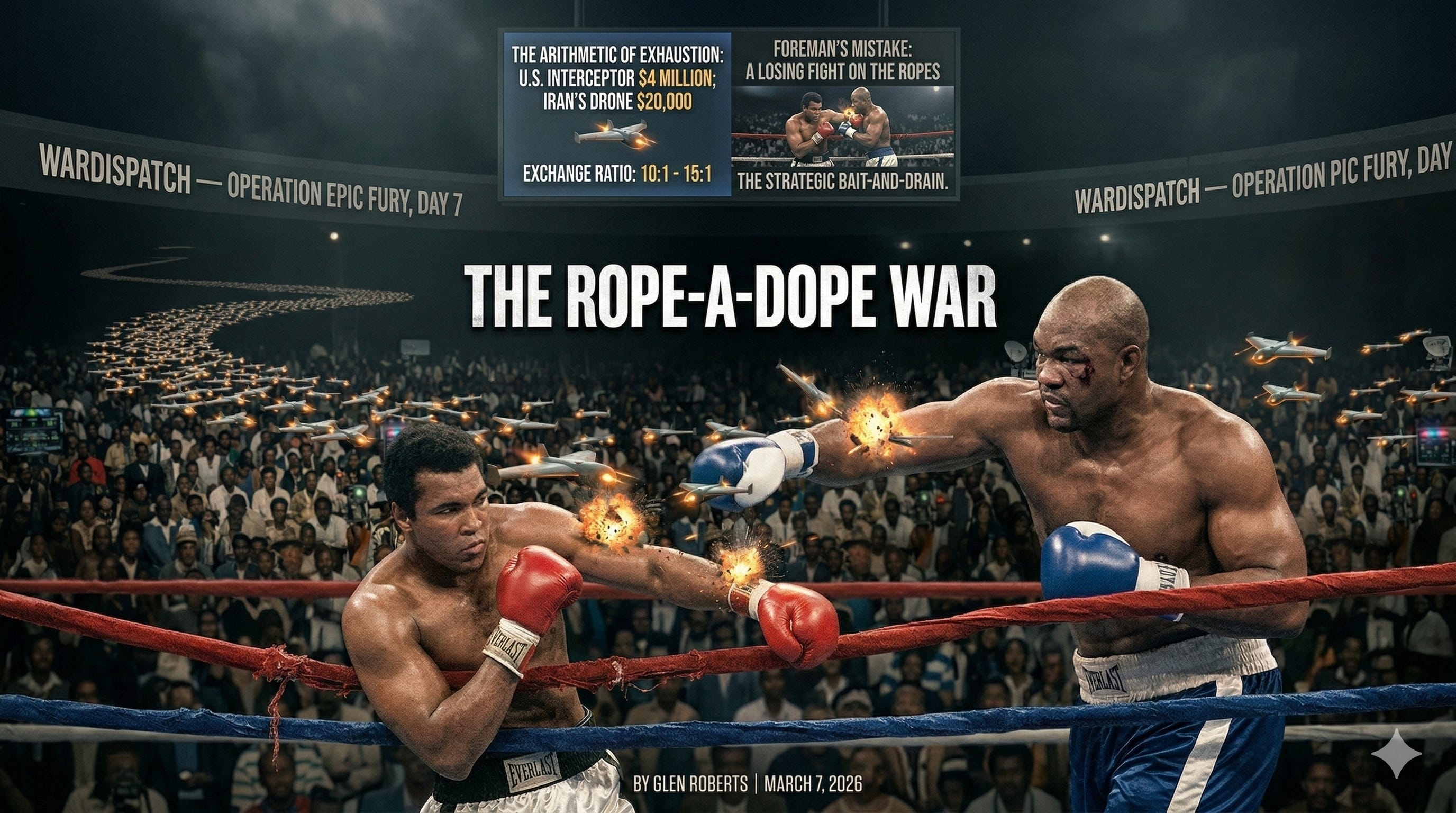
THE ARITHMETIC OF EXHAUSTION
Since Operation Epic Fury began on March 1st, Iran has launched over 2,500 drones and ballistic missiles at targets across Israel and the broader region. In the first 100 hours alone, the U.S. and its allies burned through an estimated $3.7 billion in interceptor missiles. That is $891 million per day. Unbudgeted. Coming out of stockpiles that take years to replenish.
Iran’s Shahed-136 drone costs somewhere between $20,000 and $50,000 to build and field. A Patriot PAC-3 interceptor costs $4 million. An Arrow 3 runs $3 to $4 million per shot. The U.S. Navy’s SM-3 interceptors, fired from destroyers operating in contested waters, cost over $10 million each.
When the accountants eventually run the full ledger, the exchange ratio will settle somewhere around ten to fifteen dollars spent defending for every one dollar Iran spent attacking. That is not a military equation. That is a financial hemorrhage.
The United States produces roughly 550 Patriot interceptors per year. At the current rate of consumption, this conflict could exhaust months of production inside a single week. Raytheon’s assembly lines do not surge on command. The supply chain for precision guidance components stretches across continents and cannot be compressed by executive order or wartime urgency. What takes a day to launch takes two years to replace.
THE DRONE THAT REGENERATES
This is where the Ali analogy deepens into something more dangerous. Ali was still burning energy on those ropes. He had finite reserves. He was gambling that Foreman would exhaust faster than he would.
Iran’s production lines do not get tired. Iran fields an estimated 300 to 400 Shahed drones per month from known facilities inside its borders. Russia has licensed the design. North Korea is supplying components. The drone Iran launches on Monday is being replaced by Tuesday. The interceptor Israel fires to stop it will not be replaced for two years.
Iran does not need to win a single engagement. It does not need to destroy a single Iron Dome battery or sink a single American destroyer. It needs to maintain the exchange rate long enough for the political mathematics in Washington to shift.
Every senator who has to explain an unbudgeted billion-dollar weekly burn to constituents facing domestic economic pressure is doing Iran’s strategic work for it. The rope is not just the physical munitions. The rope is American political will. And Iran knows exactly how long that rope is.
FOREMAN’S MISTAKE
Foreman’s error in Kinshasa was fighting Ali’s fight. He kept punching when every punch was costing him more than it was costing Ali. The strategically correct response was to change the terms of engagement entirely — to stop, breathe, force Ali off the ropes, fight a different fight.
The U.S. and Israel have the technological capacity to change the terms. Directed energy weapons — military lasers — cost approximately one dollar per shot with no supply chain constraint. They cannot be exhausted through attrition. A sufficiently fielded laser battery turns the entire cost equation on its head, reducing Iran’s exchange rate advantage to zero.
The problem is that those systems do not yet exist at operational scale. They are in testing. They are in procurement discussions. They are in the kinds of five-year development timelines that make sense during peacetime and become catastrophic liabilities during war.
Operation Epic Fury’s offensive campaign is the other answer — strike the launch infrastructure before the drones leave Iranian soil. U.S. Central Command claims a 90 percent reduction in Iranian launch rates since day one. That number deserves skepticism; military commands in active conflict have institutional incentives to report favorably.
But even if directionally accurate, it describes the right strategy: not intercepting the punch after it is thrown, but breaking the arm before it swings.
THE EIGHTH ROUND
The question this war will answer is not whether Iran can defeat the United States or Israel on a conventional battlefield. It cannot. The question is whether Iran can outlast American strategic patience long enough for the political environment to force a ceasefire on terms that leave its nuclear program intact, its proxy network functional, and its regional influence expanded.
That is the counter-punch Ali threw in the eighth round — not a knockout, but a precise strike to a target that had been deliberately weakened over seven rounds of calculated endurance.
Iran has studied this country carefully. It has watched two decades of American wars in which military superiority translated into operational tactical dominance and strategic political failure simultaneously. It has watched the United States win every battle and lose every war it has fought since 2001.
It understands that the rope is real, that American political will has a measurable elasticity, and that $891 million per day has a way of clarifying congressional priorities.
Muhammad Ali called the rope-a-dope the most dangerous thing he ever did. He absorbed real punishment. He took genuine damage. He was betting everything on the theory that his opponent would collapse before he did.
Iran is making the same bet. The mullahs are leaning into the ropes, watching the American interceptor magazines drain, counting the unbudgeted billions, reading the congressional reaction, waiting.
The only question is whether Washington has the strategic clarity to recognize the game being played — and the discipline to stop fighting it on Iran’s terms before the eighth round arrives.
Glen Roberts is a metaphysician, author, and independent researcher. He is the author of Sacred Metaphysics Volume 1 and the architect of Project 2046.
#OperationEpicFury #RopeADopeWar #AsymmetricWarfare #Geopolitics #TheVerticalDispatch #Project2046 #Vajra #SacredMetaphysics #DefenseProcurement #MilitaryTech #Iran #USMilitary #DroneWarfare #StrategicAttrition #EconomicWarfare #GlobalAffairs #TheVertical #GlenRoberts #Kinshasa1974 #StrategicLogic #ArithmeticOfExhaustion