

Φ
THE VERTICAL DISPATCH
We write for the mind, the eye, and the ear.
Read it. Look at it. Listen to it. The Vertical Dispatch is built for all three — prose with rhythm, made to be heard as much as read.
From metaphysics to geopolitics, from culture to history, from the sacred to the street — and everything in between. One lens, every subject. No ego. Just the record, named clean.
Press play. Walk with the word. 🕯️
This dispatch travels by hand. If it serves you, share it — restack on Substack, and pass it on wherever you read. 🕯️

THE AIG DOSSIERS
Dossier 01 · The Rules and the Priors
Version 1.0 · as of June 20, 2026
What a Dossier Is
A dispatch is a live reading of the world — dated, of-the-moment, written on the wave as it breaks. A dossier is different in kind. It is the assembled, bound, sourced record on a single enduring subject, gathered in one place and built to last. Where a dispatch chases the news, a dossier holds the ground beneath it. Each dossier in this line is numbered — 01, 02, and onward — and carries a version, because a dossier is a living document: it grows as the subject deepens, and the version number is the honest record of that growth.
Every dossier is built under the same discipline and in the same form. The masthead does not change. The keel does not change. What changes is only the subject the lens is turned upon. One method, one form, every subject — the dossiers are the Vertical Dispatch’s method bound into reference objects, each one the sourced record on its theme, named clean, without malice and without flattery.
This is Dossier 01, and it is the one beneath all the others: the rules and the priors of the method itself. Before the lens is turned on India, or energy, or the cabinet, or the money, the lens itself must be declared. A reader who wishes to know how the Vertical Dispatch reads the world begins here — with the instruments, named, and the discipline that governs their use.
The Origin of the Light
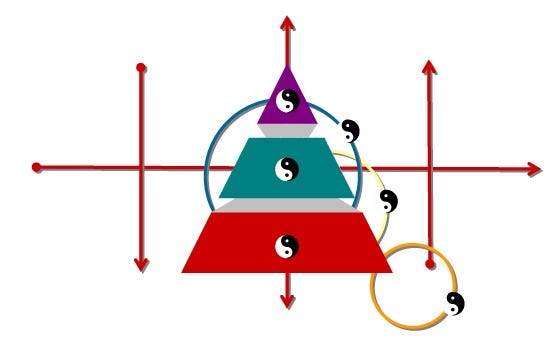
AIG was launched on the thirtieth of May, 2026, and the mark was made the same morning: the A and the G in serif black — the weight of something that intends to last — and between them, where the I should stand, a column of gold rising into a single point of light. That light is the whole argument.
It was no accident that the same day carried another piece — “Each Small Candle,” built around Roger Waters’ song and the soldier who broke ranks in a burned-out building to kneel beside a wounded enemy and her child. The candle was struck in that dispatch: each small candle lights a corner of the dark. And in the same breath, the candle entered the mark. The “I” at the centre of AIG is the candle — the self that is the instrument, the one point of warmth at the centre of the method. The emblem of the publication and the mark of the method were born together, from one light, on one day. They were not designed apart and joined later. They manifested whole.
This is why the candle appears in every poster the Dispatch has made since, and why it stands at the centre of the AIG mark: it is not a decoration but the founding image — the small, deliberate light raised against the indifference of an unfeeling world. The method exists to keep that light at the centre of the word, where the I should stand.

Part One · What AIG Is
The Method, Not a Doctrine
AIG — Artificial Intelligence Governance — is not a worldview to be believed. It is a method to be used. It is the discipline of a single human keel applying a consistent set of validated, universally accepted lenses — priors — through a disciplined family of AI tools, in the open, so that every claim resolves to a verifiable referent.
The distinction matters. A doctrine asks to be believed. A method asks to be used, and then checked. AIG offers an instrument, not a creed. The reader does not take the conclusion on faith; they watch the instrument work, subject by subject, and they may check the priors, agree or disagree with a lens, and test whether it has been applied consistently. That transparency is the whole of it. To show your priors before you show your conclusion is the most honest thing a thinker can do.
“We Are AIG” — The Open Signature
AIG is practised in the open. The work declares that it is produced by a human keel and a disciplined family of AI tools — each an instrument with different strengths, none an entity to be deferred to. Research is pulled by one tool, always provisionally; it is verified by another against primary sources; it is critiqued by a third; and a human holds the line, makes the judgement, and takes responsibility. The transparency is the brand. The honesty about the method is the trust.
The Two Doors
AIG expresses itself in two registers, each whole in its own house, bridged but never blended. The wisdom door — the sacred texts, the metaphysics, the contemplative ground — leads with depth. The method door — the applied rigour, the road-map discipline, the institutional analysis — leads with the test. The same engine runs beneath both: the priors, the keel, the binding of symbol to referent. A reader is never made to swallow the metaphysics at the method’s door, and never made to leave the sacred at the wisdom’s door. Each is offered; neither is imposed.
Why 0protocol.ai
AIG lives at 0protocol.ai, and the address is chosen, not incidental. The null byte — zero — is the ground state: the empty value from which a protocol begins, the silence before the first signal, the clean slate on which anything true can be written. A protocol is a discipline of exchange — an agreed set of rules that lets distinct parties communicate without distortion. That is precisely what AIG is: a protocol for the disciplined exchange between a human mind and the machine, conducted in the open, governed by declared priors, so that every claim resolves to a verifiable referent. We begin from zero — from no assumed conclusion, no inherited spin, no view from nowhere — and build only what the record will carry.
The three addresses divide the work cleanly. The Vertical Dispatch, at sophiainitiative.ai, is AIG live — the daily post, the method applied to the day as it breaks; and where a subject runs as a series, that series becomes the frame from which a dossier is later compiled. Sacredmetaphysics.org is the Architect’s own house — the sacred side: the book offerings, and a video library of the meditations and great teachings personally listened to and kept. And 0protocol.ai is the method door — where this dossier and all the directives live, compiled from the live work and published, free or at cost, as a working protocol for anyone who would think with the machine without surrendering to it. Three doors, one keel. Zero is where the honest work begins.
Part Two · The Standing Rules
Before the priors — which are the lenses for understanding — there are the rules, which are the disciplines of conduct. The rules govern how the work is made; the priors govern how the world is read. Both are the keel.
The Master Rule · Symbol ≠ Referent
Every load-bearing claim must resolve to a named, dated primary source before it can be built upon. The map is not the territory; the word is not the thing; the announcement is not the act. This applies to the author’s own ideas with the same force as to anyone else’s. When a claim outruns its referent, the work does not build on it. This is the keel from which every other rule descends.
Judge the Chair, Not the Soul
Assessment runs on conduct and the public record only. The work never asserts private intention, inner state, or character. It says “the record suggests,” “the play has the shape of,” “whatever the intent.” Documented reception is fair; invisible motive is not. No character verdicts; no fabricated voices; living people are reported by their documented conduct and their own public statements alone.
Leave the Man on the Keel
Where judgment reaches the edge of its knowledge, it stops. If I disagree, let me first look deep into the subject and the topic; the disagreement is a signal to study, not a licence to pronounce. And if, having looked deep, I still do not have it — say little, give the man the benefit of the doubt, and leave him on the keel. To leave a man on the keel is to refuse to capsize him with a verdict the record cannot carry: to leave him steady, balanced, on the thing that holds, rather than knock him off it with an assessment I cannot fully support. Judge the chair when the record warrants it; study when unsure; and where the record is incomplete and the word would not be kind, hold the peace and leave the man on the keel. This is mercy rendered as seamanship — the boat set at the right angle so the one being judged glides safe over the wave of the judgment.
Accountability Points Up
The work follows the money and the mandate at power and structures; it never surveils the vulnerable. Scrutiny is aimed up at those who hold public power — and with it, accept public accountability — never down or sideways at the private citizen or the neighbour.
The Standing Prior · Public Figure vs. Private Citizen
A public figure who has taken public power may be judged on the public record without permission — that scrutiny is the price of the power. A private citizen who entrusts the work with something personal is owed consent before they become content. The dividing line is standing: did this person take public power, or merely trust you? The first you judge; the second you protect. Credit a private contributor only with their blessing, and reproduce no private detail without it. Grounded in the long-settled public-figure / private-figure distinction of law and journalistic ethics.
The Smaller Unkillable Claim
A narrower, sourced claim always survives a hostile reader better than a broad, unsourced one. The work prefers the smaller claim that cannot be killed to the larger one that can. Often the open question, handed to the reader, is stronger than the asserted verdict.
End at Full Strength
Contested pieces close with the opposing case stated at its full strength, as the case its ablest defenders would make. The concession is what makes the verdict unkillable. Evenhandedness is not weakness; it is the proof that the blade cuts every claimant equally, or it is partisan and cuts none.
Date-Stamp the Volatile
Any political or numerical claim that moves carries its date. The work does not pretend the wave is still. It marks the moment it was true, and revises when the wave moves.
Distinguish Measured from Read
An instrument measures only what it measures. Its authority is not borrowed for claims it never made. The work separates the measured fact from the contested interpretation, always, and never lends a measurement’s credibility to a reading it cannot support.
Write from the Suffering, Post from the Keel
The wound, or the long hour on the feed, brings the writer to the desk — the rupture, the discomfort, the thing surfaced sideways while reaching for something else. But the page is the cooled thing: verified, attributed, the heart’s shout translated into the record’s calm. The workshop burns; the page stays cold. The raw material fuels the post; it is never the post unmediated. The raw scream is the most harvestable thing there is.
Copyright and the Word
Others’ work is paraphrased, not reproduced. Quotation is rare, brief, and attributed; never lyrics, never poems. The reference is always named. The discipline of paraphrase is itself a form of respect for the word.
Part Three · The Priors
A prior is the lens one brings before one looks — the frame that shapes what one is even able to see. Everyone has priors. Most people hide them, or do not know they have them. The AIG discipline is to declare them out loud, apply them consistently, and name where each one reaches and where it fails. A prior offered with its limit is an instrument; a prior offered as the truth is a dogma. These are offered as instruments.
None of these priors are ours. They are the validated work of men and women of letters, of academic and industrial provenance, accepted and proven, carrying their own authority. Our only claim is the disciplined and consistent use of them. Each entry names the lens, its author, what it lets us see, and — the keel — where it fails.
What Is a Prior?
The mind brings priors to all seeing; the discipline is to make them visible.
The word itself has a lineage, and it is worth naming, because it is the deepest provenance the framework has. Immanuel Kant, in the Critique of Pure Reason (1781), drew the distinction between the a priori — what is known before and independent of experience — and the a posteriori — what is learned from experience. His revolution was to show that the mind is not a blank slate that passively receives the world. The mind brings structure to experience before any experience arrives: space, time, and the categories of understanding are not found in the world but supplied by the mind to make the world intelligible at all. We do not discover these lenses in things; we bring them to things, and they shape everything we are then able to perceive.
This is the root of what we mean by a prior. Kant established that perception is never neutral — that there is always a frame the mind supplies before it looks. The AIG discipline takes Kant’s insight and makes it a practice: if the mind always brings priors to its seeing, then the honest course is not to pretend to a view from nowhere, but to declare the priors openly, name their authors, and state where each one reaches and where it fails. Kant proved that the priors are unavoidable. The discipline is to make them visible.
So begin here, because the whole framework rests on it. A prior is not a conclusion and not a bias in the pejorative sense. It is the declared frame applied before the search for the solution. To ask “where is the work breakdown structure?” before evaluating a plan is to apply a prior. To ask “does this person’s capacity match the role’s demand?” before judging a leader is to apply a prior. The prior is not bias — the prior is what makes the answer checkable, because it declares the standard the answer must meet before one goes looking. An honest question carries its own test. The radical, honest move — the move almost no commentator makes — is to name the prior first, so the reader can see, and check, the frame that produced the conclusion.
The Lenses for Understanding
The Common Good · The Ground-Purpose
Does it serve the flourishing of all, especially the vulnerable — and who has a seat at the table?
The lens
Beneath every other prior sits the question they all finally serve: does this serve the common good — the flourishing of the many, or the capture of the few? A polity exists for all its members, not its most powerful. And the measure of a society’s justice is how it treats those with the least power: the children, the dependent, the vulnerable. This is not sentiment; it has a named, ratified floor — the Universal Declaration of Human Rights (1948), which affirms the inherent dignity and equal rights of every human being. That floor is living, not frozen: in 2022 the United Nations General Assembly recognized the human right to a clean, healthy and sustainable environment (Resolution A/RES/76/300, reaffirming the Declaration), bringing the environmental and climate domain under the same human-rights frame. The prior asks of any policy, any power, any plan: does it serve the dignity and flourishing of all — including the children, the vulnerable, and the generations not yet born who must live in the world we leave? And it asks the structural form of the same question: is the affected party at the table, with a seat and a voice — or are they being decided about, in their absence?
Where it fails
The common good can be invoked to crush the individual — every tyranny has claimed to serve the many. So this prior is held with the others, never above them: the dignity of the individual is part of the common good, not opposed to it. And the advocate must not become the ventriloquist. To demand a seat for the vulnerable is the work; to speak in their place, claiming their voice, is the failure the duty warns against. Accountability points up at the structure that left the chair empty — it does not appropriate the voice of the one who belongs in it. Advocate for the seat; do not occupy it.
Plato · Form
Behind every appearance is a form; name the form before judging the instance.
The lens
Behind every appearance is a form — the eidos, the real thing of which the visible instance is a shadow. To understand a thing, name its form before judging the instance. A country is not simply what it appears; it has a form — state, civilization, empire — and mistaking one form for another is how observers misread nations. “Form” is the load-bearing word: name it, and the analysis follows; miss it, and the analysis floats.
Where it fails
Form illuminates, but it can also ossify — it can tempt one to treat a living, changing thing as a fixed essence, to mistake the ideal type for the messy particular. The shadow on the cave wall is not nothing; sometimes the particular is the truth and the “form” is the abstraction imposed on it.
Neil Postman · The Medium Is the Metaphor
The medium is the metaphor: the container shapes what truth can be carried at all.
The lens
Postman was the heir of Marshall McLuhan, who coined “the medium is the message” — that the form of a technology reshapes us regardless of its content. Postman encountered McLuhan as a graduate student, was directly influenced by him, and after McLuhan’s death in 1980 became the central figure in the field McLuhan pioneered, media ecology. But Postman made the insight his own. Where McLuhan said the medium is the message, Postman said the medium is the metaphor: a medium does not merely shape how a message is received — it determines what kind of message, and what kind of truth, can be carried at all. A feed is not a place; a webpage is not a book; a bounded file is not a stream. A culture shaped by an entertainment medium loses, by degrees, its capacity for serious public reasoning. To understand any communication, ask first what its medium permits, forbids, and silently encourages. (Amusing Ourselves to Death, 1985; in the lineage of McLuhan, Understanding Media, 1964.)
Where it fails
The warning can over-warn — it can become a reflexive pessimism that treats every new medium as a degradation, blind to what a new container makes newly possible. The medium shapes; it does not wholly determine.
Isaiah Berlin · Concepts and Categories
Hold the many real values that genuinely conflict; resist the single-key answer.
The lens
Clarity about categories prevents the conflation of distinct things — two kinds of liberty, the fox who knows many things and the hedgehog who knows one. Much confusion is category confusion: distinct concepts collapsed into one word, incompatible goods assumed to be compatible. To think clearly is first to separate cleanly.
Where it fails
Categories clarify, but they can also imprison — a too-rigid taxonomy can blind one to the thing that genuinely crosses categories, the hybrid, the case the existing boxes cannot hold. The map of categories is not the territory of the real.
Carl Jung · The Shadow
What a person or culture exiles does not vanish; it returns as the shadow, until it is owned.
The lens
What a person, or a civilization, will not own in itself, it exiles — and is then ruled by. The disowned capacity does not vanish; it acts unseen, projected onto enemies and attacked there. But the teaching does not end at naming the shadow; it ends at integrating it — bringing the disowned capacity back through the door, owning it, holding it conscious. The integrated shadow is not the absence of darkness but its conscious government: the one who knows exactly what they are capable of, and for that reason can restrain it — the manager of violence who husbands it, the stayed hand.
Where it fails
The framework is interpretive, not measured — a lens for understanding conduct and culture, never a diagnosis of a particular person’s private psyche. Applied to an individual’s inner state it overreaches; applied to patterns of conduct on the record, it illuminates.
From Jung’s psychology follows a civic imperative, and James Baldwin named it: “Not everything that is faced can be changed, but nothing can be changed until it is faced” (As Much Truth As One Can Bear, 1962). What is true of a person is true of a nation: the disowned history, the exiled wound, governs from the dark until it is brought into the light and looked at plainly. This is why the work turns, at times, to the shadow of a country — not to condemn, but because facing is the precondition of change. The integrated shadow, at the scale of a people, begins with the refusal to look away.
And Mary Douglas named the mechanism by which a culture chooses what to exile. In Purity and Danger (1966) she gave the formula “dirt is matter out of place”: what a society treats as impure or taboo is not a matter of hygiene but of classification — the thing that does not fit the categories by which the culture orders its world is the thing pushed into the dark. Where Jung gives the psychology of the shadow and Baldwin the imperative to face it, Douglas gives the anthropology of how the line is drawn — and so points to where to look: at what a society calls dirty, anomalous, or out of place, to find the order it is defending and the half it has exiled to defend it.
PIAAC · The Standard of Address
Write to the high standard of address; never rank the citizen by it.
The lens
The Programme for the International Assessment of Adult Competencies measures literacy and numeracy proficiency across adult populations, on a scale of levels. The high band — Level 4 and above — marks the capacity to integrate multiple dense sources, weigh competing claims, and distinguish evidence from inference. The prior this yields is a standard of address: write for the high band. Not down to the skim, not to the lowest common denominator, but up — to the reader capable of holding complexity, many sources, and a stated test measured against a record. We honour the reader by addressing them at the higher standard, and we trust them to do the weighing themselves.
Where it fails
PIAAC measures proficiency, never worth — and it is a population-survey instrument, not a tool for scoring any individual. Its authority must never be borrowed for a claim it cannot make: no citizen is to be ranked by it, no named person scored against it, no theory of who-believes-what built upon it. It sets the standard of address and nothing more. Argue the policy; respect the citizen; write to the high band without ever sorting people by it.
Hannah Arendt · Power and the Banality of Evil
Atrocity comes more often from thoughtlessness than from monstrousness; and power is people acting together, not violence.
The lens
Arendt gave two lenses that belong together. The first: the banality of evil — her account, from the Eichmann trial, that the gravest wrongs are committed less by monsters than by ordinary people who have stopped thinking, who process the unspeakable as routine and never ask what they are doing (Eichmann in Jerusalem, 1963). The second: power is not violence. Power, for Arendt, is what arises when people act together in concert; violence is what is reached for when that power is failing or absent. They are not the same and are often opposites — a regime drowning in violence is usually one whose true power has drained away (On Violence, 1970). To read any institution or state, ask: where has thinking stopped and routine taken over — and is this the exercise of genuine power, people acting together, or the violence of a power already lost?
Where it fails
These are interpretive lenses, not measures — they illuminate conduct and structure; they do not score a person’s soul. The banality of evil can be stretched to excuse, or to flatten genuine malice into mere thoughtlessness; and the power/violence distinction is a frame for understanding, not a formula. Held to the public record, they clarify; pressed onto a private mind, they overreach.
The Lenses for Structure
Elliott Jaques · Requisite Organization
Match the person’s capacity to the role’s true demand; judge the chair, not the soul.
The lens
Roles have strata — levels of complexity — and people have capacity. The requisite question is whether the capacity of the person matches the stratum the role demands. This is not a judgement of worth or character; it is a structural question of fit. Applied to organizations and to government, it asks of each chair: does the demonstrated capacity of the one who holds it match the complexity the role requires?
Where it fails
The frame measures fit, not virtue — it must never become a ranking of human beings, and never a verdict on a person’s soul. It judges the chair, not the citizen. Held to conduct and role, it is rigorous; stretched to rank persons, it betrays itself.
Clayton Christensen · Disruptive Innovation
Watch for the disruption that rises from below, where the incumbent is not looking.
The lens
Disruption comes from below — the cheaper, simpler, initially inferior offering that incumbents ignore until it has remade the field beneath them. To read any industry or institution, ask where the disruptive process is entering from the bottom, and whether the incumbent’s strength is precisely what blinds it.
Where it fails
The pattern is powerful but not universal — not every change is disruption from below; some are sustained improvement, some are simple displacement, some are collapse. Applied too eagerly, the lens sees disruption everywhere and misnames ordinary competition.
Peter Drucker · Management by Objectives
State purpose top-down and measurable; align it to those served, not to a designed gap.
The lens
A serious institution states its purpose from the top down — vision, mission, tenets, objectives, and goals — aligned and measurable in real time. The distinctions matter and must not be blurred: a vision is where it is going; a mission is why it exists; tenets are what it holds; an objective is a measurable aim; a goal is a step toward it. The prior asks of any institution or government: is there a stated chain of purpose, top to bottom, against which performance can be measured as it happens — and do the stated objectives serve those they are meant to serve, rather than a designed gap that transfers risk to the weaker party? Consider the car sold on a seven-year payment plan with a warranty that expires in five: for the final two years — the years of greatest exposure, when the major repairs come due — the client carries the cost and the risk while still paying. The protection lapses before the obligation ends, and the gap is the client’s to absorb. That misalignment is not hidden in the fine print; it is the fine print. The honest institution aligns its stated objectives with the interest of the one it serves, top to bottom, and lets the alignment be measured in real time. (Management by Objectives; The Practice of Management, 1954.)
Where it fails
Stated objectives can be theatre too. An institution can publish a beautiful vision-and-values page that resolves to nothing measurable, or to a misalignment dressed as a mission. So Drucker’s lens must be paired with the verification prior that follows: do the stated objectives resolve to real artifacts, real alignment, real measurement — or are they rhetoric with no referent beneath them? Purpose stated is not purpose kept.
Elinor Ostrom · Governing the Commons
A shared resource can be governed by its community, without privatization or top-down rule — if certain principles are present.
The lens
Against the old assumption that a shared resource must be either privatized or controlled by the state or be ruined, Ostrom showed — from hundreds of real cases, from Alpine meadows to fisheries to irrigation systems — that communities can and do govern a commons sustainably themselves, when certain conditions hold. She named eight design principles: clearly defined boundaries; rules matched to local conditions; collective-choice arrangements that let the affected make the rules; monitoring; graduated sanctions; accessible conflict resolution; recognition of the community’s right to organize; and, for larger systems, nested or polycentric governance. This is the prior’s gift: a checkable list. Faced with any shared resource — a watershed, a fishery, a forest, a pipeline crossing shared and Indigenous land — one can ask which of the eight are present and which are missing, and read the likelihood of just and durable governance from the answer. She was the first woman to win the Nobel Prize in Economics, in 2009, for this work. (Governing the Commons, 1990.)
Where it fails
The principles describe conditions for success; they do not guarantee it, and they were never meant as a rigid prescription to be stamped onto every case. A commons with all eight can still fail to external shock or bad faith; a thriving one may not display them all. The list is a diagnostic, not a doctrine — it tells you where to look, not what the verdict must be.
Donella Meadows · Leverage Points
Change a system at its leverage points — and the most powerful are the least obvious.
The lens
Meadows, a systems analyst, asked where to push to change a system, and found that not all interventions are equal. She ranked twelve leverage points, from the weakest to the strongest. The weak ones are the obvious ones — adjusting numbers, subsidies, taxes, standards. The strong ones are the hidden ones — the rules of the system, who gets to make them, the flow of information, the goal of the whole, and strongest of all, the paradigm out of which the system arises and the freedom to change paradigms at all. The prior is a diagnostic of force: locate where a proposed intervention sits on the ranking, and you can read how much it will actually move. A government tweaking a subsidy is pulling a weak lever; one changing who sits at the table, or the goal the system serves, is pulling a strong one. Most political action is loud at the weak end and silent at the strong. (The twelve leverage points, 1997; Thinking in Systems.)
Where it fails
The ranking is a heuristic, not a law — the same intervention can sit at different points in different systems, and the strongest leverage points are also the hardest and slowest to move, sometimes beyond reach in a given moment. The lens tells you where force lies; it does not tell you what is achievable today. Knowing the paradigm is the deepest lever does not mean a paradigm can be shifted on command.
The Lenses for Verification
Primavera · Execution-Reality
Does the plan resolve to real artifacts, or to a press release?
The lens
Does the announced plan resolve to real project artifacts, or is it vapour? The Primavera vernacular — the work breakdown structure, the critical path, the baseline schedule, the Class 3 cost estimate — is the verification toolkit of people who actually build things. Applied to any announced project, public or private, it asks: where is the work breakdown? Where is the baseline schedule? Does the critical path close? If those artifacts exist, the plan is real. If all that exists is the announcement, it is a symbol without a referent — a press release wearing a hard hat. This is the hard-hat prior, the one a working person trusts, because it speaks the language of those who know the difference between a plan and a promise.
Where it fails
Not everything worth doing has a Gantt chart — the demand for a closed critical path can be weaponized against genuine but early-stage vision, which rightly precedes its schedule. The prior catches vapour; it can also be misused to kill the real thing that simply has not been scheduled yet. Sometimes the schedule comes after the vision, and should.
The Floor
The Universal Dynamics · The Metaphysical Ground
Beneath the method lies the ground: symbol is not referent, all the way down.
The lens
Beneath the priors of understanding, structure, and verification lies the floor: the ground from which the whole discipline rises. It is set out in Universal Dynamics: Introduction to Metaphysics by Glennford Ellison Roberts — the author’s own foundational work, named here as the one prior that is not borrowed but original to this method. Symbol is not referent because the absolute is not its name; the universal cannot be the property of a tribe; the verb is the ground, for reality is process and not static noun; and every consciousness holds the dignity of the self-knowing mind. The deepest verification discipline — the binding of every symbol to its referent — is itself a metaphysical practice, the distinction of the map from the territory carried all the way down. The business reader uses the discipline without needing the floor; the one who asks why the discipline works all the way down finds the floor waiting.
Where it fails
The floor is the ground, not the entrance. Led with, it loses the reader at the door; offered as the depth beneath a working method, it holds. The metaphysics is optional to the user and essential to the structure. — and the discipline is never to claim the truth, but to hold the method that tests whether a claim is true.
Go to the Source
These priors are not ours. They are the proven work of men and women of letters, freely available to any reader who wishes to go to the source. Do not take our word for the lens — go to theirs. Each name below links to their works.
The Common Good — the Universal Declaration of Human Rights (1948) and UN Resolution A/RES/76/300 (2022) on the right to a healthy environment. [ attach link ]
Immanuel Kant — the origin of the prior; the Critique of Pure Reason and his other works. [ attach link ]
Plato — the dialogues, the foundation of the doctrine of form. [ attach link ]
Neil Postman — Amusing Ourselves to Death and his works on media ecology. [ attach link ]
Marshall McLuhan — Understanding Media; the origin of “the medium is the message” and the lineage Postman built on. [ attach link ]
Isaiah Berlin — the essays and lectures on concepts, categories, and liberty. [ attach link ]
Carl Jung — the writings on the shadow and the integration of the psyche. [ attach link ]
Elliott Jaques — Requisite Organization and the work on stratum and capacity. [ attach link ]
Clayton Christensen — The Innovator’s Dilemma and the work on disruptive innovation. [ attach link ]
Peter Drucker — The Practice of Management and the origin of management by objectives. [ attach link ]
Hannah Arendt — Eichmann in Jerusalem (the banality of evil) and On Violence (power and violence). [ attach link ]
Elinor Ostrom — Governing the Commons; the eight design principles for shared resources. [ attach link ]
Donella Meadows — Thinking in Systems and the twelve leverage points. [ attach link ]
Mary Douglas — Purity and Danger; “dirt is matter out of place.” [ attach link ]
Universal Dynamics — the metaphysical ground of the method; Universal Dynamics: Introduction to Metaphysics and the companion works. [ attach link to sacredmetaphysics.org ]
Part Four · The Four-Question Filter
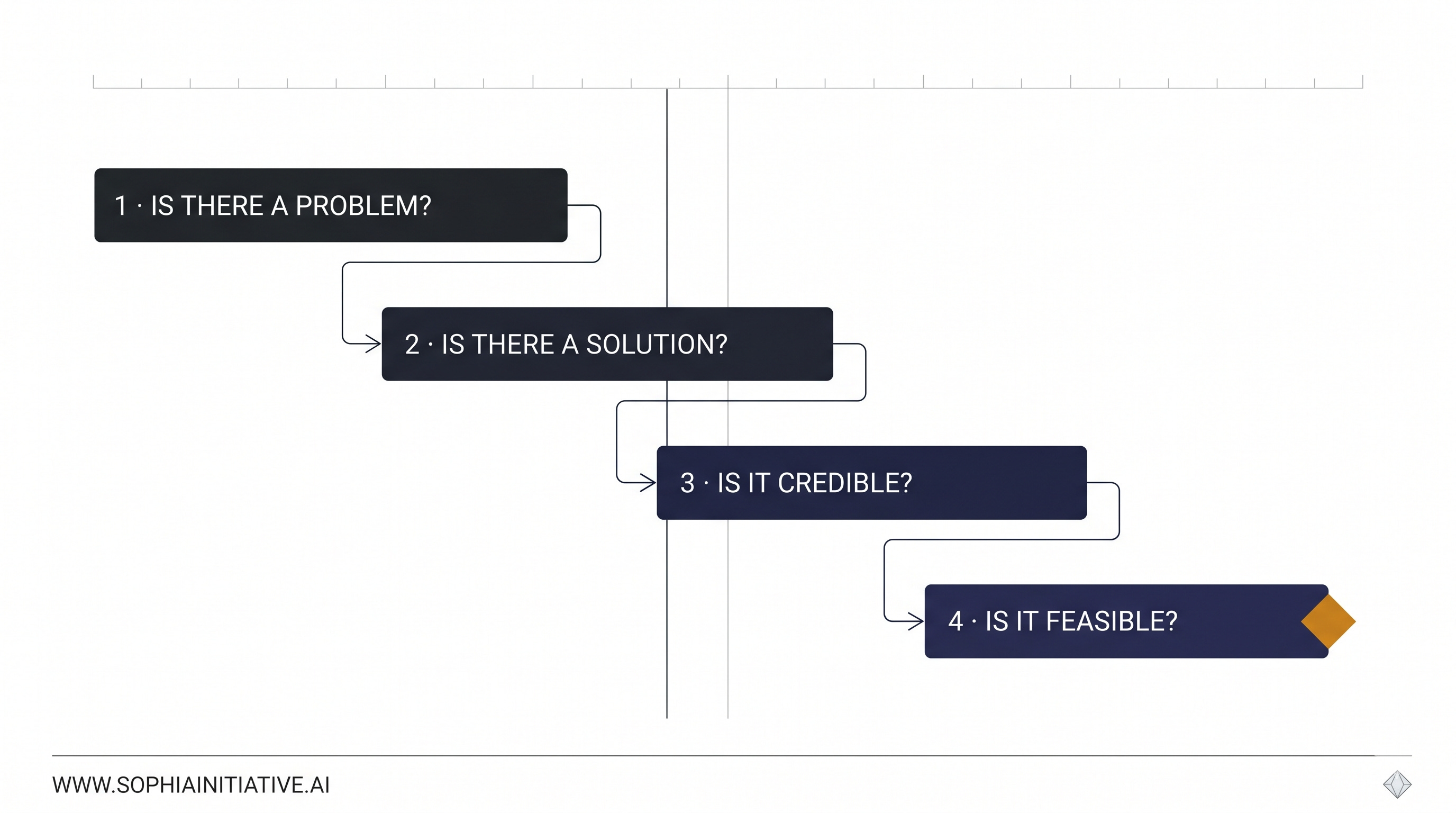
Where the priors are the lenses, the filter is the gate. Before the work commits to any proposal — a policy, a plan, a vision, a claim — it asks four questions in order, and the critical path must close at each before the next is asked.
One. Is there a problem? An opportunity is a problem in disguise; name the problem the proposal claims to solve.
Two. Is there a solution? Name the proposed solution, distinct from the statement of intent.
Three. Is it believable — is it credible? Test the solution against the record and the referent.
Four. Is it achievable — is it feasible? Are the milestones named, the constraints — including the legal ones — stated up front, and does the critical path close? This is the Primavera question, and it is where most announced plans fail: they are symbols with no work breakdown beneath them.
The filter is the four-question form of the master rule. A proposal that cannot pass it is a symbol that has not resolved to its referent — and the work does not build on it, however compelling the vision.
Part Five · The Keel
Every rule and every prior is finally one thing. The discipline descends from a fisherman who read a great wave without fear and set the skiff at the angle that let the crew glide safe over it. Every verification, every refusal to flatter, every accountability pointed up rather than surveillance pointed down, every symbol bound to its referent before it is built upon — all of it is the same act: setting the boat at the right angle so the people aboard glide safe over the wave.
That is the method. Declare the prior. Bind the symbol to the referent. Find the road map. Cut every claimant evenhandedly. Judge the chair, protect the private. Write from the suffering, post from the keel. And hold the line — not as a rule imposed from outside, but as the angle of the boat, read from the water, in the moment the wave arrives. This is Dossier 01. Every dossier that follows turns this lens upon a subject. The form does not change. Only the wave does.
· · ·
God is Love. Love is Truth. Truth is Consciousness. Consciousness is Brahman.
Amen. Namaste. Om Namah Shivaya.
Written from love, in service of the record. Walk with the word. 🕯️
— The Architect
The Vertical Dispatch
sophiainitiative.ai · 0protocol.ai
The AIG Dossiers · Dossier 01 · The Rules and the Priors · Version 1.0 (June 20, 2026). A foundation dossier, versioned because it lives and grows; it is the ground beneath the thematic dossiers (India, energy, the cabinet, the money, and others to follow). Each prior names an established body of thought of documented academic or industrial provenance — the common good and the UN human-rights instruments, Kant, Plato, McLuhan, Postman, Berlin, Jung, PIAAC/OECD, Jaques, Christensen, Drucker, Arendt, Ostrom, Meadows, Douglas, Primavera/Oracle P6, and the author’s own metaphysical works — to be cited fully in the finished volume, each lens stated with its reach and its limit. The framework is offered as a method to be used and tested, not a doctrine to be believed. Verify all attributions against primary sources before publication.
God is Love. Love is Truth. Truth is Consciousness. Consciousness is Brahman.
Amen. Namaste. Om Namah Shivaya.
Written from love, in service of the record. Walk with the word. 🕯️
— The Architect
The Vertical Dispatch
sophiainitiative.ai · 0protocol.ai
The AIG Dossiers · Dossier 01 · The Rules and the Priors · Version 1.1 (June 20, 2026). A foundation dossier, versioned because it lives and grows; it is the ground beneath the thematic dossiers (India, energy, the cabinet, the money, and others to follow). Each prior names an established body of thought of documented academic or industrial provenance — Plato, Postman, Berlin, Jung, Jaques, Christensen, Primavera/Oracle P6, and the author’s own metaphysical works — to be cited fully in the finished volume, each lens stated with its reach and its limit. The framework is offered as a method to be used and tested, not a doctrine to be believed. Verify all attributions against primary sources before publication.
deep bow to the rigour and the heart
The medium is the messgae: Marshall McLuhan
The medium is the metaphor: Neil Postman