


Philosophy · Consciousness · Civilisational Analysis
An ongoing dispatch on culture
“We are concerned with the danger of telling ourselves lies, and being told lies, about who we are and what we are doing.”
— in the spirit of Neil Postman, Amusing Ourselves to Death, 1985
There is a war that needs no enemy. It does not require a border crossed or a foreign flag. It is waged by a nation against its own streets, and it is waged every day, and the most telling fact about it is not the number of the dead. It is that the number has become weather. A morning’s report of the night’s casualties is received the way a person receives the forecast — noted, absorbed, folded into the ordinary. The shock has been spent. What remains is the climate.
This dispatch continues the ongoing examination of culture. The earlier dispatches asked what the platform does to the self. This one asks something harder and closer to the bone: what a culture does when it has made its peace with violence — not the violence of a single act, which every society contains, but violence as a settled feature of the air, an accepted cost, a thing the culture has stopped expecting itself to be free of. The argument here has one spine, and it is best stated at the outset so the reader can hold the Dispatch to it. The war America wages on its own streets and the war it watches abroad are not two cultures. They are one culture, seen twice. The same reflex runs both theatres. To understand the reflex is to understand the dispatch,
One discipline holds from here to the close, and it is the same discipline the culture series has held throughout. The judgement in these pages is aimed at a structure — a machinery, a set of trained reflexes, a media form. The compassion is aimed at the people, all of them: the grieving, the frightened, the believer in the pew, the viewer at home, the soldier and the civilian alike. There is no vantage point above a culture from which a writer may look down on those formed by it; the writer was formed by one too. If a line in this dispatch seems to hold the dead, or the mourners, or the ordinary patriot in contempt, that line has failed, and it should be named.
I. THE WAR THAT BECAME A SEGMENT
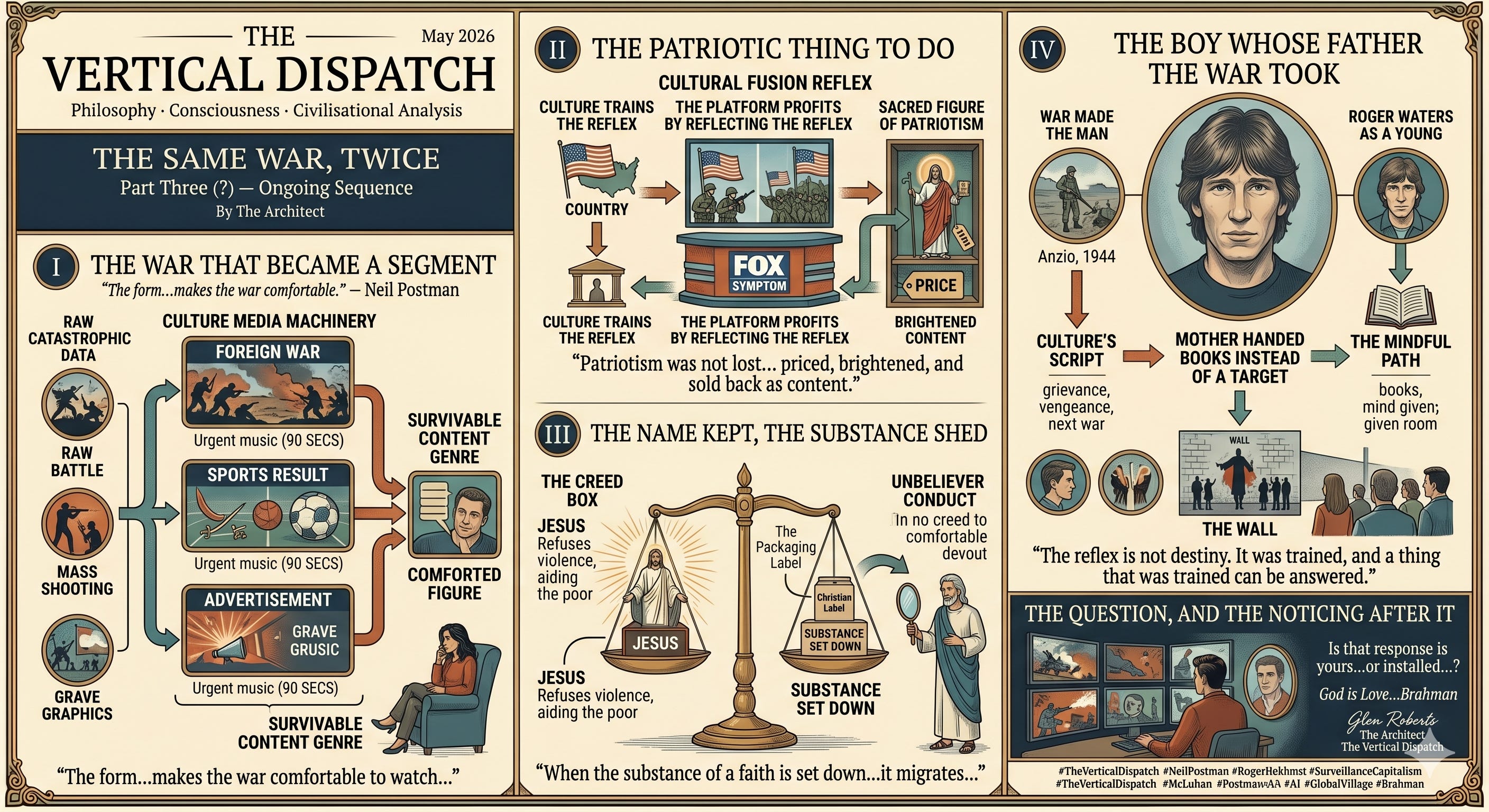
Neil Postman’s enduring argument was not about bias. It was about form. In Amusing Ourselves to Death, he set out a claim that has only grown sharper with time: that the medium through which a culture conducts its serious business reshapes what that culture is able to take seriously at all. Television, Postman argued, does not merely deliver information badly. By its very form — its pace, its segmentation, its fusion of every subject into a single stream of entertainment — it trains the viewer to receive everything, including catastrophe, as a unit of content that asks for a feeling and then releases them to the next unit.
Hold that against the way a war arrives in a living room. The report of a distant battle runs its ninety seconds. It carries urgent music, a grave anchor, a graphic with a flag in it. And then it ends, and the same ninety seconds, the same music, the same anchor tone, carries the sports result, and then the advertisement, and the viewer is taught — not by any one broadcast but by the form repeated ten thousand times — that the foreign dead and the ball game and the product are members of a single category. They are segments. War becomes a genre, with production values, a known script, a reliable arc. The mass shooting at home becomes a genre too, with its own script so familiar the public can recite it: the breaking banner, the count that rises through the day, the candle, the official statement, the silence, and then the next program. The form does not lie about the facts. It does something worse. It makes the facts survivable to watch, and a thing that is survivable to watch is a thing a culture can live alongside indefinitely without being moved to change it.
The form does not lie about the war. It does something worse. It makes the war comfortable to watch — and what is comfortable to watch is never urgent enough to end.
II. THE PATRIOTIC THING TO DO
There is a particular framing that the major broadcast platforms reach for when the subject is war, and it can be described without any claim about why they reach for it, because the framing is visible on the screen and any viewer may confirm it by watching. War coverage is wrapped in the iconography and the language of patriotism. The flag is in the graphic. The phrasing fuses the soldier with the nation and the nation with the cause, so that to question the war is made to feel like questioning the country, and to question the country is made to feel like a betrayal of the soldier. Among the cable platforms, this style runs hottest and most fluently on Fox — but the Dispatch will be precise here: the disease is the form, and Fox is where the symptom is most visible, not the origin of the illness.
Why does the platform frame war this way. The honest answer does not require a conspiracy and does not flatter the analyst who reaches for one. The platform frames war as patriotism because that framing holds the audience, and it holds the audience because the culture has already, long before any broadcast, fused the two things together. The network is not corrupting an innocent public. It is giving a conditioned public a brightened reflection of a fusion the public already carries. And the reflection, returned at full brightness night after night, deepens the fusion that produced it. Culture trains the reflex; the platform profits by reflecting the reflex; the reflection hardens the reflex; and the loop turns. No single person at any point in that loop need be a villain for the loop to be deadly. That is the most unsettling thing the Dispatch can say about it, and it is also the truest.
Notice what has been done to patriotism inside that loop, because this is the profane core of the dispatch, and the word profane is used here in its exact and original sense — not vulgarity, but the treating of something sacred as ordinary, the moving of it off the altar and onto the shelf. Love of one’s place and one’s people is a real and a good thing; the Dispatch holds it sacred and does not mock it. But a sacred thing can be captured. When love of country is converted into a saleable posture — a brand position, a segment, a reflex that can be pointed at any war on command and made to feel like virtue — then patriotism has been profaned. Not destroyed. Profaned. The culture did not lose its patriotism. It had its patriotism taken from the altar and put on the shelf, priced, and sold back to it as content. The sincere patriot is not the offender in this. The sincere patriot is the one robbed.
Patriotism was not lost. It was taken from the altar and put on the shelf — priced, brightened, and sold back as content. The sincere patriot is not the offender. He is the one robbed.
III. THE NAME KEPT, THE SUBSTANCE SHED
A nation that describes itself as Christian to a degree few other developed nations do also lives, on the evidence of its own streets and its own foreign conduct, at a considerable distance from the figure it names. This is not an attack on Christians, and it must not be read as one. It is the oldest and most serious thing that can be said to a Christian culture, and it was first said by its own prophets, who were not gentle about it: that a people may keep the name of a faith long after they have set down its substance.
The figure at the centre of that faith was, by every account in its own scriptures, without violence; was on the side of the poor, the imprisoned, the discarded; refused the sword even in his own defence; and reserved his sharpest words not for unbelievers but for the devout who had made the holy into a marketplace. A culture that holds his name and has also made its peace with the armed street, with the body count as weather, with the foreign war as a segment between the sport and the advertisement — that culture is not, on the matter of violence, walking with the figure it claims. It has kept the name. It has shed the substance.
And here is the part that should unsettle the believer and the unbeliever equally, because the Dispatch follows it wherever it goes. When the substance of a faith is set down, it does not vanish. It migrates. The refusal of violence, the insistence on the dignity of the discarded, the unwillingness to be amused while others suffer — these do not stay attached to the label. They show up, intact, in people who never claimed the label and would reject the doctrine outright. There are those who hold no creed at all whose conduct carries the cargo of the faith more faithfully than many who hold the creed and have kept only the box. This is not said to praise unbelief or to scold belief. It is said because it is the elenchus, and the elenchus does not spare the comfortable: a culture that finds its treasure being kept by people it dismisses, while it keeps the packaging for itself, has been told something it needs to hear, and the messenger’s own beliefs are beside the point.
When the substance of a faith is set down, it does not vanish. It migrates — and is sometimes kept most faithfully by those who never claimed the name.
IV. THE BOY WHOSE FATHER THE WAR TOOK
Against the culture this dispatch has described, set one life, offered not as a saint and not as a politics but as a counter-image — a single instance of what the other answer to war can look like.
Roger Waters was an infant when his father was killed. Eric Fletcher Waters died in 1944, at Anzio, in the Second World War, leaving a wife and two small sons. The boy grew up fatherless, and the absence was not an accident or an illness; it was a war, and he knew it was a war. A culture of the kind this dispatch has been describing has a ready script for a boy shaped that way: the wound becomes a grievance, the grievance becomes a cause, the cause becomes a justification for the next war, and the cycle feeds itself across a generation. That script is always available. It is the easiest one to follow.
It is not the script that was followed. By Waters’ own repeated account, his mother — a schoolteacher, a woman of conviction who had herself lost a husband to the war — did not raise her son toward vengeance. She raised him toward the mind. The instruction he has described receiving from her, again and again across his life, was in essence this: read, and read, and read — and then you will know what to do. Not here is the answer. Not here is the enemy. A trust, instead, that a mind given enough room and enough material will find its own conscience without being handed a target. That is the precise opposite of the trained reflex this dispatch has been tracking. The reflex hands you the answer and the enemy pre-assembled. The mother handed her son the books and the room, and trusted what he would become.
What he became is a body of work whose lifelong subject is exactly this dispatch’s subject. The wall — the barrier a frightened society builds, brick by brick, between itself and feeling, between person and person — is his central image, and he has spent a career naming it and asking an audience to see it. He took the same indictment Postman set down in prose and set it to music, on a record whose very title is a deliberate echo of Postman’s: a civilisation amusing itself, the Dispatch will say no more than that, to the edge of its own conscience. War made the man. He answered it not with more war but with art and with refusal. The Dispatch does not present him as flawless and takes no position on his public life beyond the work; the work is the point. One boy, handed books instead of a target, became a lifelong witness against the wall. That is the counter-image. It is offered not as a programme but as a proof: the reflex is not destiny. It was trained, and a thing that was trained can be answered.
The reflex hands you the answer and the enemy, pre-assembled. A mother handed her son the books and the room, and trusted what he would become. The reflex is not destiny.
THE ONE REFLEX, AND THE QUESTION IT LEAVES
Set the dispatch down in a single line. America wages a war on its own streets and watches a war on its screens, and these are not two conditions but one — one culture, one trained reflex that meets fear with force and then receives the cost as weather. A media form makes that cost comfortable to witness by rendering it as content. A patriotic framing makes the force feel like virtue by fusing it with a love that was genuine before it was captured. And a faith whose actual substance is the refusal of all of this has had its name kept and its substance quietly set down — though the substance, being real, did not vanish, and waits, intact, in whoever will carry it.
A diagnosis can do that much and no more. It can show the reflex and it cannot reach into a reader and unmake it. But it can leave a question, and the culture series has always ended on one, offered gently and meant to be kept rather than answered on command. Here is this dispatch’s question. When the next account of violence reaches you — the street or the foreign field, the segment between the sport and the advertisement — watch not the screen but yourself. Notice what happens in you. Notice whether the practised feeling rises on cue and releases you on cue, the count absorbed as weather. And then ask whether that response is yours, chosen, examined — or whether it was installed, long ago, by a culture that profited from your having it. You do not have to answer tonight. But a reflex that has been seen is no longer the whole master of the one who sees it. That noticing is the entire freedom this dispatch has to offer, and it is enough to begin.
The Dispatch will not close the question for you. It sets it down, and is quiet, and leaves you with the words it has always ended on — because they are the exact rebuke to a culture of war, and they need no commentary. The self will recognise them when it is awake.
God is Love. Love is Truth. Truth is Consciousness. Consciousness is Brahman.
Amen. Namaste.
Signed: Glen Roberts / The Architect / The Vertical Dispatch
#TheVerticalDispatch #NeilPostman #RogerWaters #CultureOfWar #GunViolence #MediaCriticism #AmericanCulture #Patriotism #CivilisationalAnalysis #TheArchitect