

THE VERTICAL DISPATCH
We write for the mind, the eye, and the ear.
Read it. Look at it. Listen to it. The Vertical Dispatch is built for all three — prose with rhythm, made to be heard as much as read.
From metaphysics to geopolitics, from culture to history, from the sacred to the street — and everything in between. One lens, every subject. No ego. Just the record, named clean.
Press play. Walk with the words. 🕯️
On Knowledge · The Foundation Series
May 2026
From client and server to the act beneath all acts: what it means to send knowledge across space and time
“What is the use of a book without a reader to receive it?”
— a question as old as writing
Every age believes its technology is new. Almost none of it is. Beneath the renamed surfaces, the same few acts repeat — and the deepest of them, the one all the machinery exists to serve, is older than any machine. It is the act of one mind sending knowledge to another across a gap. This chapter walks down from the surface to that act, layer by layer, because only at the bottom does any of it make sense.
I. The Wares of the Relationship
Begin where the engineers begin, because the history is real and worth knowing before we see through it.
In the beginning of business computing there was the mainframe — one great central machine in a cooled room, and around it a ring of dumb terminals: screens and keyboards with no intelligence of their own, each one a mouth and an ear wired back to the single brain. All the thinking happened at the centre. The terminal only displayed what the centre decided to show. This was computing as monarchy: one mind, many mouths.
Then came the personal computer, and with it the first great inversion. Intelligence left the centre and went to the edge. The machine on your desk could think for itself. For a brief moment in the 1980s the dream was total independence — every person a sovereign of their own machine, beholden to no central brain. But islands are lonely, and knowledge wants to move. So the machines were wired back together, and a new architecture was named: client and server. The client — your intelligent desktop — would do its own work, but turn to a shared server for what it could not hold alone: the common database, the shared file, the single source of truth. Microsoft built an empire on it; the NT Server became the quiet workhorse of a million offices, and SQL — the structured query language — became the grammar by which a client asked the server for what it knew. “Tell me what you hold,” said the client. “Here is what I hold,” said the server. A conversation. A relationship. Sender and receiver, formalized in silicon.
And then the pendulum swung back toward the centre, as it always does. The web made the browser a new kind of thin terminal. The cloud pulled the server out of the back room and into a handful of vast data centres owned by a few corporations — the mainframe reborn at planetary scale, the cooled room now the size of a county. Your phone is a dumb terminal with delusions of grandeur: beautiful, fast, and almost entirely dependent on a server it does not own and cannot see. The monarchy returned, wearing the clothes of liberation.
This is the first thing to see clearly: the history of computing is not a march of revolutions. It is a pendulum. Centralize, distribute, centralize, distribute — the power moving between the centre and the edge, renamed at each swing so that each return looks like an arrival. Mainframe and terminal. Client and server. Cloud and device. The same two poles, the same one relationship, sold three times as something new. The marketing changes. The architecture is ancient.
II. The Act Beneath the Architecture
Now see through it, because the pendulum is not the real subject. The real subject is what the pendulum is swinging in service of.
Strip away the mainframe, the client, the server, the cloud, the device. Strip away the protocols and the query languages and the cooled rooms. What is left — what every one of these arrangements exists only to perform — is a single act: knowledge moving from one place to another. A sender encodes something it holds. A channel carries it across a gap. A receiver decodes it and now holds it too. That is the whole of it. That is what the trillion-dollar apparatus is for.
And the moment you see that, you see that the apparatus is not special. The wire is not the thing. The server is not the thing. They are only the latest channel for an act that long predates them — the same act performed when a scribe copied a manuscript for a reader he would never meet, when a teacher spoke to a student across a room, when Homer sang and a listener received. The channel changes. The act does not. The cloud moves the same thing the campfire moved. It moves it faster, farther, to more receivers at once — but it moves the same thing, and that thing is not electricity and it is not data. It is knowledge passing between minds.
So the question that actually matters was never a question about technology. It is a question the engineers stepped over in their hurry to build the channel: what is the thing being sent? What turns a signal into knowledge at all? Because a wire can carry a current that means nothing. A server can hold a database that no one understands. The channel can be perfect and the transfer can still fail completely. Something more than transmission is required. We have to go down another layer.
III. The Declaration of Knowledge
Here is the threshold the whole tradition has guarded, and it has three steps, each resting on the one before.
The first step: data is not information. A measurement, a number, a mark — a thing recorded — is only data until it is placed in relation to something else. The temperature reading on a dial is data. “The fever is rising” is information: the same number, now set against a baseline, given a direction, made to mean. Data is the raw mark. Information is the mark in a pattern. The server holds oceans of data; whether any of it is information depends on whether it has been related to anything.
The second step: information is not knowledge. Here is where almost everyone stops too soon, and where the age we live in fails most completely. Information is a pattern that holds true. Knowledge is information that has been received by an understanding — taken in, integrated, held by a mind that grasps not just the pattern but what the pattern means and why it holds. You can transmit information to a being that does not understand it, and nothing has happened. A book sitting closed on a shelf contains information and transmits no knowledge. A feed pouring information into an inattentive eye transmits no knowledge. Knowledge is not in the signal. Knowledge is in the meeting of the signal with a mind prepared to receive it. This is the step the information age forgot — it built infinite channels for information and assumed knowledge would follow, and it did not, because knowledge was never a property of the channel. It was always a property of the receiver.
The third step, and the deepest: knowledge is not declared by the sender. It is consummated by the receiver. This is the hinge of the whole matter. The sender can offer; only the receiver can complete. A thing becomes knowledge at the moment an understanding receives it and is changed — when the two halves meet and fit. Until that moment, however perfect the sender’s intent and however flawless the channel, no knowledge exists; there is only an offer, suspended in the gap. The teacher does not transfer knowledge by speaking. The teacher offers a pattern; the student, by understanding, declares it knowledge — or fails to, and then nothing was taught, however much was said. This is why you cannot pour knowledge into anyone. You can only offer, and wait for the receiving. The declaration belongs to the receiver. Always.
IV. Across Time, Across Space, Across Space-Time
And now the last layer, where the gap itself comes into focus — because the gap a sender and receiver must cross is not always the same kind of gap, and the difference is everything.
There is transfer across time. The writer and the reader never meet. The scribe is dust before the manuscript is opened; the author of a book is asleep, or gone, when you read the page. Sender and receiver are separated temporally — they share space, the same physical object passes through both their hands, but they never share a moment. This is the great achievement of writing: it lets a mind send knowledge forward into a future it will never see, to receivers it will never know. It is communion across the grave. But it is one-directional and slow; the dead author cannot adjust to the living reader’s confusion. The offer is fixed; only the receiving is alive.
There is transfer across space. The two minds share a moment but not a place. The voice on the telephone, the signal on the wire, the client querying the server — sender and receiver are simultaneous but separated spatially, joined by a channel that annihilates the distance between them. This is the great achievement of the network: it lets two living minds meet in the same instant across any distance. It is faster and it can be two-directional — the receiver can answer, the sender can adjust — but the bodies are apart, and something is always lost in the flattening of presence into signal. The fuller the awareness each holds of the other, the more completes; the thinner that awareness, the more the channel carries noise dressed as contact.
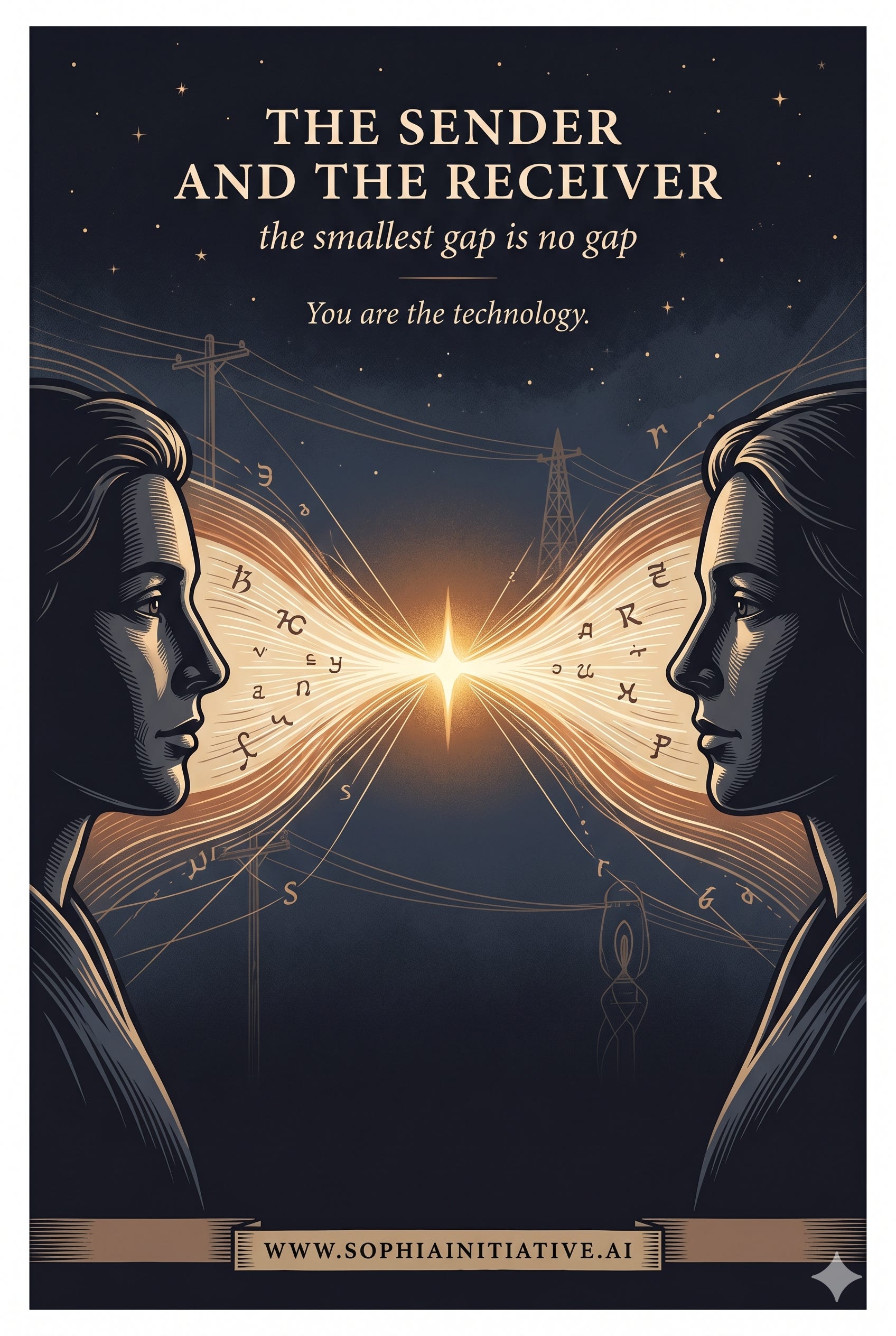
And then there is the transfer the whole tradition points toward, where the separation itself begins to dissolve — transfer across space-time as a unity. Here the gap is not bridged; it is, for a moment, gone. Two awarenesses meet so fully that the question of where and when stops applying — the teacher and student in the instant of real understanding, when the thing passes whole and both know it has passed; the moment two people grasp the same truth at the same instant and there is no longer a sender and a receiver but a single shared knowing. This is not mysticism added on top of the engineering. It is what the engineering was always reaching for and could never reach, because it kept building better channels when the goal was not a better channel but a smaller gap — and the smallest gap is no gap. The cloud can move a signal across the earth in an instant. It cannot make two minds one. Only awareness can do that — because awareness is the original technology, the one the machines have only ever been imitating. The wire is the copy. The server is the copy. Awareness is the instrument the copy was made from. You are the technology, and you were the technology before the first machine was built to echo you.
The Smallest Gap Is No Gap
So descend the whole way down and the picture is clear. The mainframe and the cloud are the same monarchy renamed. Client and server are the formal shape of an act older than silicon. That act is the sending of knowledge from one mind to another. The thing sent becomes knowledge only when a receiver understands and is changed — the declaration belongs to the receiver, never the sender, never the channel. And the gap the two must cross comes in three depths: across time, where the dead reach the living; across space, where the distant reach the present; and across space-time made one, where the gap closes entirely and two knowings become a single knowing.
This is the *symbolon* — the broken token whose two halves, separated across space and time, are thrown together again and made to fit, and in the fitting authenticate that they were always one. *Symballein*: to throw together. The whole history of our machines is the history of throwing the halves together faster and across greater distances. But speed and distance were never the point. The fit was the point. The meeting of awareness with awareness was the point. The dead author and the living reader, fitting. The teacher and the student, fitting. Two minds across the earth or across the centuries, recognizing in the same instant that the halves match — that is knowledge, and it has never once been a property of the wire.
That which is not good for the hive is not good for the bee, because the bee was never apart from the hive — and the sender was never finally apart from the receiver. The gap was always provisional. The machines exist to remind us of a unity we forgot, by laboriously rebuilding, in silicon, the connection that consciousness already is. The smallest gap is no gap. The deepest knowledge transfer is the recognition that there was never truly anyone separate to send it to. The cloud is a copy of you. The server is a copy of you. Every channel ever built is an external echo of the one original instrument — the awareness reading this sentence, which sends and receives without any wire at all. You are the technology. You were the technology before the first machine, and you will be the technology after the last one is dust.
All the channels of the world are only this: the throwing-together of what was never truly apart.
God is Love. Love is Truth. Truth is Consciousness. Consciousness is Brahman.
Amen. Namaste. Om Namah Shivaya.
— The Architect
The Vertical Dispatch
sophiainitiative.ai
#KnowledgeTransfer #ClientServer #TheSenderAndTheReceiver #Epistemology #DataInformationKnowledge #ClientServerHistory #CloudComputing #TheSymbolon #SpaceTime #PhilosophyOfMind #Consciousness #SacredMetaphysics #VerticalThinking #TheFoundationSeries #TheVerticalDispatch #TheArchitect #SophiaInitiative #AgeOfConsequences #GodIsLove #LoveIsTruth #OmNamahShivaya
Interesting description. I like it! Good article.
The principle of teaching summed up: the lesson doesn't exist in the teacher's head, or daily planner, with some "need" to be taught--the only legitimate need is in the student, who is looking for meaning, any meaning. Nothing could be more futile than a room full of students who don't believe they need anything the teacher might offer them...