

Φ
THE VERTICAL DISPATCH
We write for the mind, the eye, and the ear.
Read it. Look at it. Listen to it. The Vertical Dispatch is built for all three — prose with rhythm, made to be heard as much as read.
From metaphysics to geopolitics, from culture to history, from the sacred to the street — and everything in between. One lens, every subject. No ego. Just the record, named clean.
Press play. Walk with the word. 🕯️
This dispatch travels by hand. If it serves you, share it — restack on Substack, and pass it on wherever you read. 🕯️
Sacred Metaphysics · The Universal Grammar of Non-Duality
The Metaphysics of Zero and the Physics of One
Coming Soon
sacredmetaphysics.org
“All happy families are alike; each unhappy family is unhappy in its own way.”
— Leo Tolstoy, Anna Karenina, opening line
Tolstoy opened his great novel with a sentence that has outlived its story, and it holds a truth deeper than the marriage it introduced. Happy families are alike, he wrote, and each unhappy family is unhappy in its own way. Read it once and it sounds like an observation about households. Read it again, slowly, and it becomes a law of the soul. For there is only one way to be whole — the divided self made one, the wound owned and released, the darkness faced and forgiven — and so all wholeness has the same shape and the happy are alike. But there are a thousand ways to be broken, because there are a thousand things a person can refuse to look at, a thousand shapes the disowned darkness can take. Wholeness is single. Brokenness is various. And the difference between them is one act, performed or refused, that this dispatch is written to name.
The act is the confrontation of the shadow, and its first and plainest form is the sentence a broken soul cannot say: I am truly sorry. Not the reflex “sorry” that oils a passing moment, and not the counterfeit — mistakes were made, if anyone was offended — that wears the shape of an apology with the ownership hollowed out of it. The real thing: I did this, it was wrong, and it was mine. Watch for who can say it and mean it to the depths, and who cannot, and you are watching the single clearest tell the human soul offers of whether the inner work has begun. For to say it truly, a person must first do the very thing the whole spiritual life is built upon — turn and face the dark thing in themselves, admit it is present and real, and claim it as their own. The apology is not politeness. It is shadow work, spoken aloud.
The Man Who Named the Dark, and Was Misunderstood
The one who mapped this most carefully is also, of all who studied the psyche, the most quoted and the least understood. Carl Jung has been flattened, in the popular mind, into personality types and half-remembered lines about synchronicity — a horoscope with a diploma. The real Jung was graver and more demanding than that. He taught that every human being carries a shadow: the disowned portion of the self, the cruelty and greed and cowardice and vanity a person refuses to see in himself, and therefore lives out unconsciously and casts upon everyone else. To become conscious of the shadow, he wrote, requires considerable moral effort, for it means recognizing the dark aspects of one’s own personality as present and real — and this act is the essential condition of all self-knowledge. There is no shortcut around it. A person who will not look at their own darkness does not thereby escape it. They simply hand it to others.
And Jung was explicit about the two things most people get wrong. The first: shadow work is never finished in a single act. One honest apology, one moment of self-seeing, does not cure a soul; the shadow is vast, and its integration is the patient labour of a lifetime, one acknowledgment after another, never complete. The second: it need not be named to be done. A person who says sorry and means it, who forgives from the heart, who refuses to pass their wound to their children, is doing the work whether or not they have ever heard the word for it. The naming is optional. The labour is everything. Grace reaches people through a mother’s example, through a faith, through a hard lesson well learned, long before they could tell you whose theory they are living.
The Abyss That Gazes Back
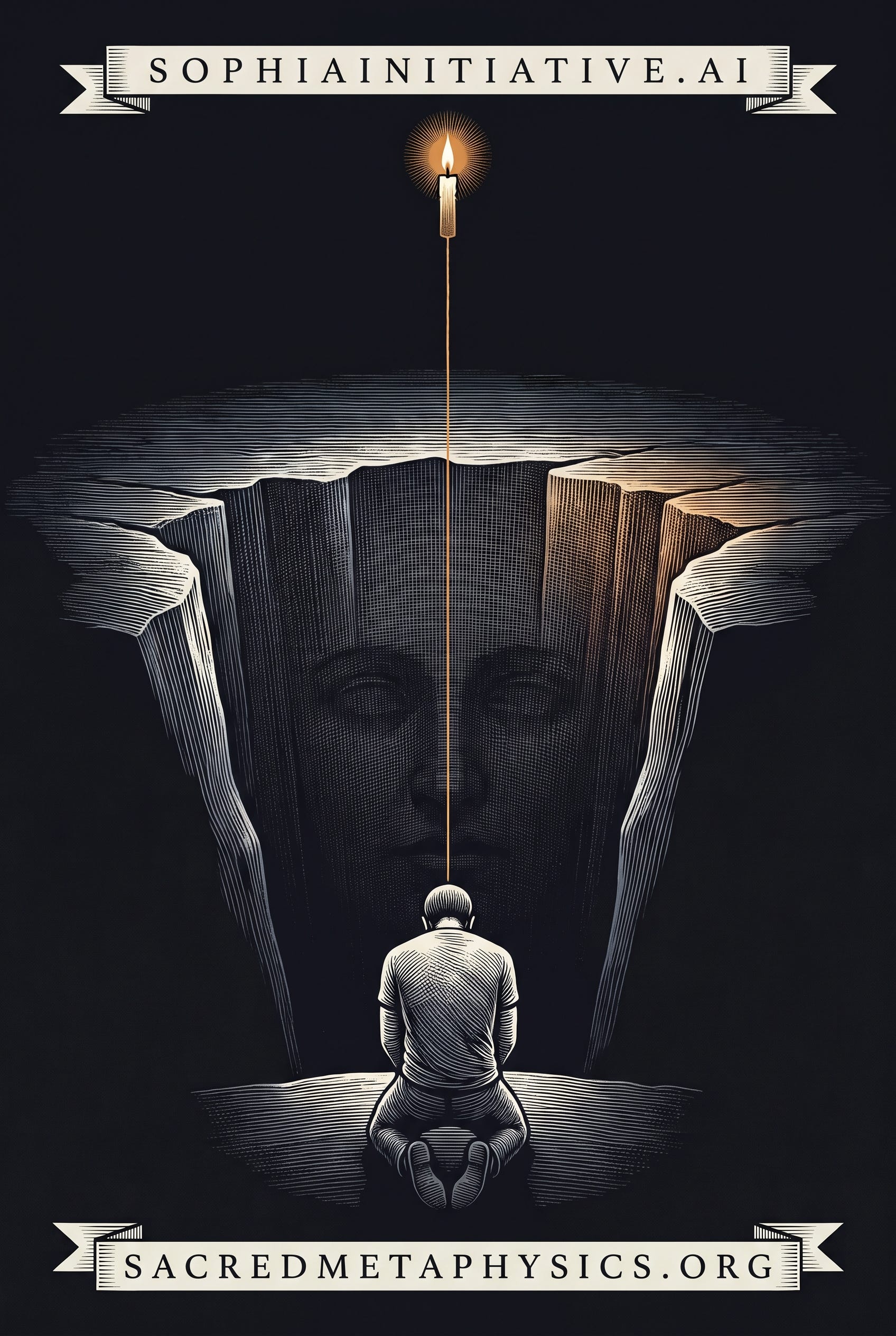
There is a danger in this work that the fighters of evil almost never see coming, and it was named most sharply not by Jung but by Nietzsche, who saw the abyss so clearly that it finally took him. He who fights monsters, Nietzsche warned, must see to it that he does not himself become a monster; and when you gaze long into the abyss, the abyss gazes also into you. The warning is not about the monster. It is about the one who fights it. The peril is not that the darkness wins the battle. The peril is that the one who battles darkness, by staring into it day after day, is slowly filled with the very thing he opposes.
Consider how this operates now, in the ordinary life of a decent person. There is a vile figure in the public eye — there is always one, and today there are many — and the good person, rightly, opposes him. But opposing him has become a daily immersion: the feed, the channel, the endless scroll of his cruelties, consumed at waking and carried all day and returned to at night. The rage is justified. That is precisely the trap. For justified rage is still rage, and rage does not care in which direction it is aimed; it corrodes the vessel that carries it, whichever way it points. Day by day the good person is colonized by the man they hate. He lives rent-free in their nervous system; they hand him their peace each morning and take back his poison each night. They set out to fight the monster and are, by slow degrees, remade in his image — harder, more contemptuous, more consumed, more willing to hate. This is not a failure of their goodness. It is the abyss, doing exactly what Nietzsche said it does. The vile man’s deepest victory is not power. It is that he has taught the good to hate, all day, every day, and hollowed them out with it.
The writer of these lines is no exception, and will not pretend to stand outside the thing he describes. To read the record and name it clean is this dispatch’s whole vocation, and the reading exacts its price; there are mornings the abyss gazes back, and one feels the pull to be consumed by the very figures one opposes. To claim immunity would be to fail the first discipline — the admission that the shadow is one’s own. The mirror this piece holds up is held, first, before its own author.
What the Century Already Showed Us
Jung did not reason his way to these conclusions in a quiet study. He watched them proven, in his own lifetime, in the catastrophe of his century. In the Germany of the 1930s a whole people refused to face its own darkness, projected it outward onto a scapegoat, and was swallowed by the very evil it would not see in itself. From that horror Jung drew his gravest conclusion: that any nation which believes itself righteous becomes the prey of the darkness it refuses to see — and that the winners of that war were no purer than the losers, for the shadow belongs to no single people and no single side. A shadow disowned by one person is a private tragedy. A shadow disowned and then celebrated by a nation is a collective permission, and Nietzsche’s abyss operating at the scale of millions.
Set against that darkness one small, true light. There are those who pass through the century’s worst and come out of it carrying no hate — who meet the very shadow that consumed a nation and refuse to let it own them. The author was raised by such a one: an Austrian mother who lived through that time and taught her son, as the first lesson of his life, to say he was sorry and to carry no hatred, because she had seen with her own eyes what the unfaced shadow does when a people indulge it. That is the whole teaching in a single life. Not “I am better than those who hated,” which is only the shadow wearing a righteous mask. But “I will not hate, even them” — which is the abyss met, and refused entry. It is the rarest strength there is, and it can be handed from one soul to the next like a lit candle passed in the dark.
Blood Begets Blood, and the Only Way Out
Here we reach the oldest law, and the only escape from it. Blood begets blood. Killing begets killing. Hatred answered with hatred makes more hatred; the abyss answered by gazing into the abyss makes only more abyss. Meet the monster’s darkness with darkness — even righteous darkness, even darkness the record would call justified — and you do not end the darkness. You propagate it. The cycle of retaliation is the deepest groove worn into the human animal, and left to itself it never closes; it feeds forever, each wound answering the last.
There is exactly one thing that breaks the cycle, and it comes from outside the cycle, because nothing inside it can. It is forgiveness — the refusal to strike back, the choice to release rather than retaliate, the wound owned and then, at last, let go. And here the whole ascent of this dispatch reveals itself, for forgiveness is not weakness and not mere sentiment. It is the specifically human act — the very crossing from beast to human. The beast cannot forgive; the animal runs on the older circuit of threat and retaliation, the immediate reflex to wound what wounded it. To forgive is to override that reflex, to refuse the strike the whole body demands — and that override is precisely what lifts a consciousness out of the beast and into the human, and beyond the human toward the divine. Every genuine act of forgiveness is a small evolution, enacted rather than inherited, chosen in the heart each time. It is the seat of consciousness itself performing the act that no creature below it can perform.
This is why forgiveness is the beginning of all shadow work, and not merely one virtue among many. To forgive — another, or oneself — one must first own the wrong, name it real, and only then release it; and that owning is the first confrontation with the dark, the first integration of the divided self. It is also why there is no healing of body or soul without it. The unforgiven wound stays lodged; the disowned shadow festers and grows, in Jung’s words, blacker and denser, until it emerges in ways no one controls. Forgiveness from the heart is the one medicine, because it is the only act that both owns the darkness and lets it go — and a thing owned and released is a thing, at last, healed.
The Mirror
So the dispatch ends where all true dispatches end — not out there, with the monster or the nation or the vile man of the hour, but here, in the reader’s own chest. The question was never whether some other soul has met its shadow; that soul must answer for itself. The question the whole of this has been circling is yours. Can you say, and mean to the depths, I am truly sorry? Can you forgive the one who wronged you — not for their sake, but for your own, because the hatred you carry toward them is corroding no one so much as you? Can you gaze at the abyss of this age, as you must, and not let it in — opposing the darkness without becoming it? These are not questions about the world. They are the only questions there are, and the answer to each is the same single act, refused by the broken and chosen by the whole: the turning to face one’s own darkness, and the releasing of it in love. Every family, every nation, every soul stands or falls on it. It is the beginning of the work, and the end of it, and the whole of the way home.
God is Love. Love is Truth. Truth is Consciousness. Consciousness is Brahman.
Amen. Namaste. Om Namah Shivaya.
— The Architect.
Written from love, for a sacred humanity, in the full light of consciousness, toward the greater good. 🕯️
The Vertical Dispatch
sophiainitiative.ai
On the Record
The opening line is from Leo Tolstoy, Anna Karenina (1878). The account of the shadow, the moral effort its integration requires, its incompleteness in any single act, and its collective operation in the Germany of the 1930s is drawn from the published writings of C. G. Jung. The warning that “he who fights monsters” risks becoming one, and that gazing into the abyss invites the abyss to gaze back, is from Friedrich Nietzsche, Beyond Good and Evil (1886), aphorism 146. The reflection on forgiveness as the act that breaks the cycle of retaliation, and as the specifically human crossing, is this dispatch’s own synthesis, offered in the devotional register and not as clinical or doctrinal claim. The account of the author’s mother is offered as personal witness; no other living person is named or described, and the mirror of this piece is turned, first and last, upon its author and its reader alike. Walk with the word.
Suggested Tags
the shadow, Jung, Nietzsche, forgiveness, Tolstoy, shadow work, the abyss, nonduality, consciousness, the sacred.
Substack Notes
Tolstoy said all happy families are alike and each unhappy one unhappy in its own way — and beneath that famous line lies a law of the soul: wholeness is single, brokenness is various, and the difference is one act. This dispatch names that act. It is the confrontation of what Jung called the shadow, and its plainest tell is the sentence a broken soul cannot truly say: I am truly sorry.
But the piece goes further, into the danger Nietzsche named — that he who fights monsters may become one, that gazing into the abyss invites the abyss to gaze back. The good, immersed daily in the cruelties of the vile, are quietly being remade in the image of what they oppose. And there is only one way out of the cycle of blood begetting blood: forgiveness — not as weakness, but as the specifically human act, the crossing from beast to human, the one medicine that heals because it both owns the darkness and lets it go.
The mirror this piece holds up is turned, first, on its own author, and then on you. Written from love, in service of the record. Walk with the word. 🕯️
#TheVerticalDispatch #TheArchitect #SophiaInitiative #Jung #Nietzsche #Tolstoy #TheShadow #Forgiveness #ShadowWork #Nonduality #GodIsLove #LoveIsTruth #OmNamahShivaya
This Dispatch is a work of devotional and philosophical reflection, offered for contemplation and public-interest discussion. It makes no clinical claim regarding any individual, and no assertion regarding the private state of mind or character of any living person. Readers should weigh all statements independently and draw their own conclusions.
Lots to unpack here in a well thought out post.
I do agree with the author's warning about the abyss that the usual human response to hatred is answered with more hatred. This erpetuates the wound and there is genuine danger in becoming psychologically inhabited by the very thing we oppose.
I do, however, question his conclusion that there is “exactly one thing” that breaks this cycle, and that thing is forgiveness.
What if forgiveness is not the source of freedom at all
What if forgiveness is one possible consequence of something deeper, namely the freedom of mind.
Consider the question:
"How would your life change if you were free of the whims of your mind?
What would that feel like if you directed your mind and never, for a single moment, the other way around?
That changes the meaning of Nietzsche's abyss.
The danger now is not simply that I gaze into darkness, the danger begins when what I encounter there gains authority over my mind.
Someone harms me.
Anger arises.
Resentment arises... perhaps even hatred arises.
Those responses are real, but they are not commands.
The moment I recognize that distinction, another possibility appears where I can choose to experience what my mind produces without being governed by it.
That, to me, is freedom.
From that freedom alliws ne the choice andI may forgive or I may not.
I may seek reconciliation, restitution, separation, justice, compassion, or simply refuse to return the injury.
I do not have to forgive someone in order to refuse to hate them.
I do not have to forget the wound in order to stop allowing the wound to direct my life.
This is precisely why I hesitate over the author's movement from “beast” to “human” to “divine.”
Humans are not standing outside nature upon some spiritual ladder.
We remain equal participants in the same interdependent circle. Nature does not keep a moral ledger of apology and forgiveness.
I don't see relationships are disturbed and equilibrium is continually sought again.
We humans have placed words such as sorry, forgiveness, debt and redemption upon that process and sometimes mistake the symbol for the thing itself.
Perhaps “I am truly sorry” matters not because the words possess some intrinsic healing power, but because they can represent recognition, ergo, that I understand that something I did disturbed the relationship between us.
Perhaps forgiveness matters when it represents another movement in that I will no longer allow what happened between us to govern what I return to the world.
But neither word is the thing itself.
The deeper thing is agency.
The author writes that the vile person can come to “live rent-free” in the mind of the person who opposes him.
I agree, but eviction does not necessarily require forgiveness it only requires reclaiming ownership of the mind.
That is where the cycle actually breaks.
The abyss can show me hatred without requiring me to hate.
A wound can give me reasons for vengeance without requiring vengeance. Fear can demand protection without being allowed to determine my behaviour, and my mind can produce all of these things... and still I can CHOOSE.
Perhaps that is the freedom we have been searching for, not a mind emptied of darkness but a consciousness no longer obedient to everything the mind produces.
It is pethaps there that forgiveness finds its proper place.
It is no longer an obligation, no longer “the only way out,” and no longer a debt owed by the wounded to the person who wounded them.
It becomes one of many things a free mind may choose.
I bringbup the circle, that does not require me to forgive, its only requirement asks only what I will return to it.
And when the wound no longer determines the answer, I am free.
The author's model still contains a subtle “must” in that the action of "you must forgive" is a requirement to become free.
Mind freedom reverses the causality.
"When I am free, forgiveness becomes something I may choose, not something I must perform in order to become free.
free.
Thoughts?
gazing into the abyss of my news feed. Feeling the tug of the algorithm and the abyss. Grateful for the reminder.