

DATE: December 18, 2025 CLASSIFICATION: KINETIC / STRATEGIC TAGS: #Semiconductors #Geopolitics #Huawei #ChinaTech #SupplyChain #Sovereignty #StrategicBifurcation #BigFundIII
TEASER ABSTRACT
The assumption that US export controls would freeze China’s technological timeline in 2020 has officially expired. New intelligence confirms a “Manhattan Project” breakthrough in Shenzhen has birthed a Sovereign Stack—inefficient, expensive, and completely immune to Western influence. We are no longer in a siege; we are in a race.
EXECUTIVE SUMMARY: THE END OF THE SIEGE
The prevailing dogma in Western policy circles was that cutting off access to ASML’s Extreme Ultraviolet (EUV) lithography machines would act as a “kill switch” for China’s advanced computing ambitions. The logic was simple: without the tools, the physics of 5nm chips was impossible.
As of December 2025, that logic has failed. The latest intelligence confirms that China has engineered a Parallel Physics. They have not matched Western efficiency; they have bypassed the need for it. By accepting massive cost overruns and lower yields—the “Sovereignty Tax”—they have secured a functional 5nm capability and a domestic EUV prototype. The West remains in the lead for speed and efficiency, but the “Kill Switch” has been dismantled.
THE BREAKTHROUGH: THE “MANHATTAN” PROTOTYPE
The most critical development is the confirmation of a working EUV lithography prototype in a high-security Shenzhen lab. For years, the West believed the complexity of these machines was a moat too wide to cross.
The reality is nuanced but kinetic. The Chinese prototype is described as a “Frankenstein” machine—massive, energy-hungry, and built with scavenged parts. It lacks the sleek elegance of European engineering, but it proves that Chinese scientists have cracked the underlying physics. This is the “Zero to One” moment. The barrier has shifted from “impossible” to merely “expensive.”
THE METHOD: BRUTE FORCE ENGINEERING
Since they cannot yet mass-produce perfect machines, Chinese engineers are “hacking” the physics using a technique called Self-Aligned Quadruple Patterning (SAQP).
Imagine trying to draw an incredibly fine line with a thick marker. The Western solution is to buy a finer pen (EUV). The Chinese solution is to trace the edge of the thick marker four times with extreme precision to carve out the negative space. It is slow. It creates waste. It ruins many wafers. But it works. It allows SMIC to produce 5nm-class chips using older 7nm equipment, effectively ignoring the blockade.
THE CAPITAL: THE WAR ECONOMY
This inefficiency would bankrupt a Western firm. It does not bankrupt China because of Big Fund III. With over $47 billion in state capital deployed, the Chinese semiconductor sector is operating on a “War Economy” logic.
In the West, if a chip costs $20,000 to make but sells for $10,000, the company dies. In China, if that chip powers a critical missile system or an AI training cluster, the state absorbs the loss. Profit is secondary to Existence.
THE LANDSCAPE: A PERMANENT BIFURCATION
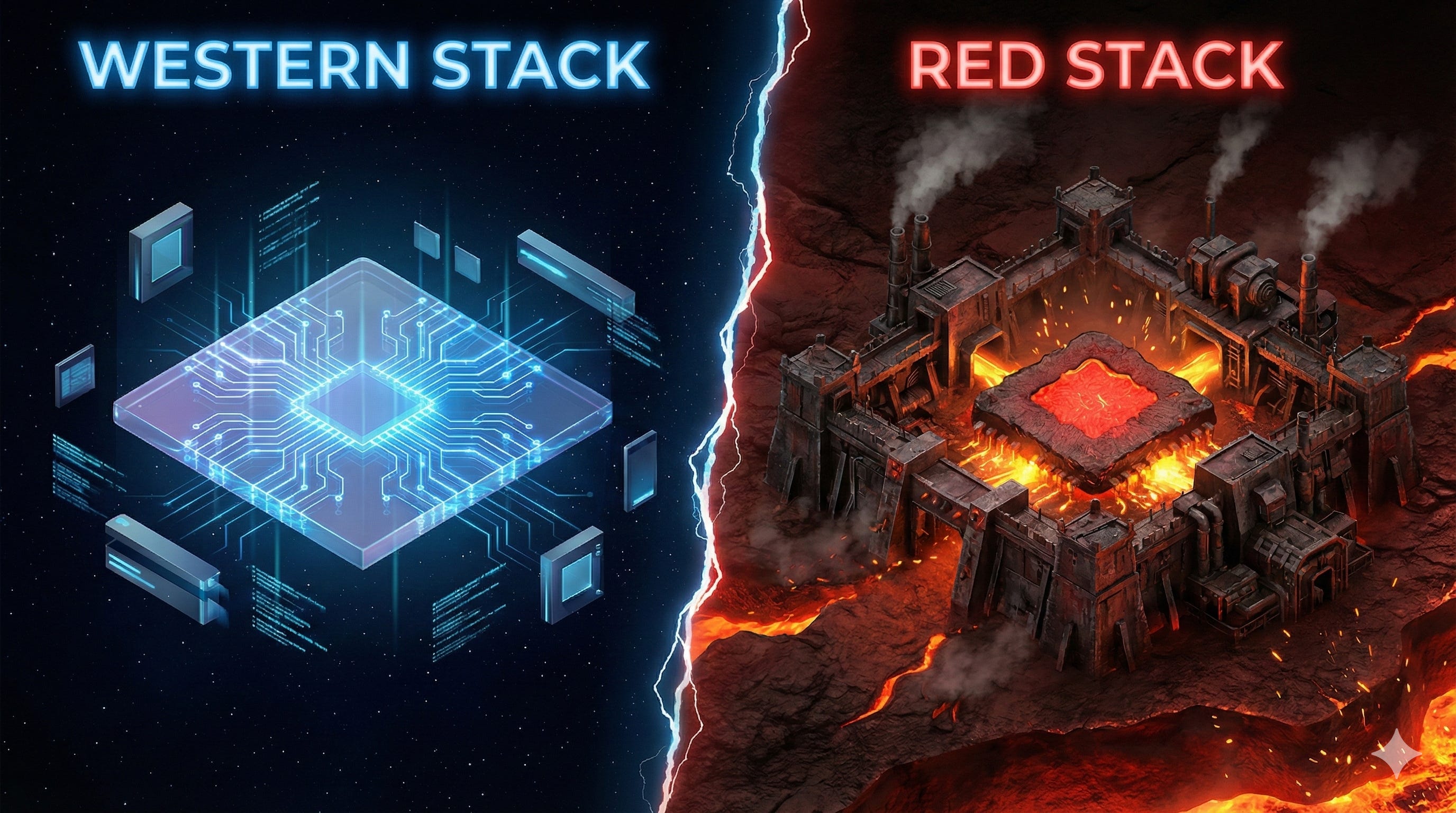
We have transitioned from a globalized supply chain to two distinct, incompatible blocs:
The Blue Stack (West): Led by TSMC, Nvidia, and ASML. Optimized for maximum efficiency, profit, and “Angstrom-era” speed. However, it remains brittle and vulnerable to supply chain shocks.
The Red Stack (East): Led by Huawei (the Architect) and SMIC (the Forge). Optimized for resilience, autarky, and “Good Enough” performance. It is immune to sanctions because it relies on domestic inputs.
CONCLUSION: THE VERDICT ON “POLE POSITION”
Does this put China in the lead? No. The West retains “Pole Position” in terms of raw technology, yield, and speed.
However, the West’s strategy was not just to win the race, but to disqualify the competitor. That strategy has failed. China is driving a heavier, slower vehicle, but they are gaining speed and have refused to leave the track. The danger for the West is not that China is faster today, but that China is now running on a separate track where “profit” doesn’t matter, allowing them to take strategic risks the West cannot afford.