

Φ
THE VERTICAL DISPATCH
We write for the mind, the eye, and the ear.
Read it. Look at it. Listen to it. The Vertical Dispatch is built for all three — prose with rhythm, made to be heard as much as read.
From metaphysics to geopolitics, from culture to history, from the sacred to the street — and everything in between. One lens, every subject. No ego. Just the record, named clean.
Press play. Walk with the word. 🕯️
This dispatch travels by hand. If it serves you, share it — restack on Substack, and pass it on wherever you read. 🕯️
· · ·
The Grammar of Empire · A Three-Part Series · Part One
The Age of Consequences · June 29, 2026
“We could very well end up having a friendly takeover of Cuba.”
— President Donald Trump, remarks outside the White House, February 27, 2026
Twenty-Two Hours of Dark
Begin not with a policy but with a room. Somewhere in Havana tonight there is a room without light, because there has been no power in it for as much as twenty-two hours of the day. There is a hospital where a doctor is rationing what medicine remains. There is a child whose treatment depends on supplies that are not arriving. This is not metaphor; it is the reported condition of the island in the spring and summer of 2026, after a fuel blockade that began in January cut a country that produces only a fraction of the oil it burns down toward darkness. Three independent United Nations human rights experts — Special Rapporteurs, speaking in their own capacity — warned in May that the fuel blockade amounts to a stark thing they named plainly: energy starvation, a condition, in their words, in which the lack of fuel cripples the functioning of essential services required for a dignified life. They called the blockade unlawful, and warned it undermines a wide range of human rights, the most vulnerable bearing the weight first.
Whatever one concludes about the government of Cuba — and this series will not flinch from that government’s real and documented faults — the room in the dark is where any honest accounting has to begin, because the room in the dark is who actually pays. Not the president. Not the generals. The pensioner, the patient, the child. Hold that room in mind, because every argument that follows, on every side, is finally an argument about whether that darkness is justified.
The Escalation, Dated
The sequence of 2026 is a matter of public record, and it is worth setting down in order, because the speed of it is part of the story. In January, following the removal of Venezuela’s leader by American forces, the United States declared a national emergency over Cuba and moved to choke the island’s fuel supply — first by cutting off Venezuelan oil, Cuba’s lifeline, then by authorizing tariffs against any nation that shipped oil to the island. The Supreme Court struck those particular tariffs down in February as exceeding the president’s authority; but the national emergency stood, and the pressure simply shifted instruments — to sanctions and to the interdiction of tankers bound for Cuban ports, a de facto blockade by other means. On the first of May, a sweeping executive order, the second of the year, expanded the sanctions. In the weeks that followed, the State Department designated the military conglomerate that controls an estimated forty per cent or more of Cuba’s economy, moved to force foreign companies to sever ties with it — prompting an exodus of tourism businesses from the island — and then, in early June, sanctioned the Cuban president himself, along with his wife, his stepson, and members of the Castro family. The former defence minister and ex-president was indicted in a federal court in Miami — the indictment returned in late April and unsealed on the twentieth of May — over the 1996 shoot-down of two unarmed civilian aircraft flown by a Miami exile group, in which four men died. And on that same day, a United States carrier strike group entered the Caribbean.
The carrier’s arrival deserves a precise word, because it is the kind of fact easily overstated. The strike group’s passage through the Caribbean was part of a long-planned naval exercise, not a force dispatched for the occasion; the carrier was, in fact, sailing toward its own retirement. But its entry was timed to the day of the indictment, its own command described it in the language of “readiness, presence, reach and lethality,” and officials spoke of a show of force while declining to rule out more. Reporting indicates contingency plans for military action exist, even as a quieter diplomatic channel — talks on prisoners, migration, and economic reform — runs alongside the pressure. So the honest picture is neither an invasion fleet nor an innocent transit, but something more unsettling: a show of force that costs nothing to stage and says everything, parked ninety miles offshore while the lawyers and the sanctions do their work.
The stated goal has not been hidden, and it is the hinge of this entire series. In late February, asked about Cuba as he left the White House, the president said the United States might “end up having a friendly takeover” of the island — a nation, he said, with no money, no oil, no food, that wanted American help. He did not spell out what a friendly takeover would mean. But the direction of the campaign, as reported across the months since, has pointed one way: pressure aimed at a transition that would open the island’s economy to American investment and expel the adversaries the United States says operate there. Set the phrase down and look at it, because it is the language of our century wrapped around an idea older than any living person: that a small nation’s economy ought to be opened to a large one’s capital, and that the large one may apply whatever pressure it judges necessary to open it. We will return to how old that idea is. For now, only mark that the goal is not merely the regime’s reform. It is the island’s opening.
Mark that the goal is not merely the regime’s reform. It is the island’s opening — the language of our century wrapped around an idea older than any living person.
The Case for the Pressure, at Full Strength
The discipline of this publication requires that the argument for the embargo be put as strongly as its makers put it, and it is not a weak argument. The United States holds that Cuba is a one-party communist state that represses its own people — and the repression is real: there are political prisoners, a censored press, crushed protests, a population that cannot vote its government out. Washington charges that for nearly seven decades the regime has waged ideological warfare against the United States, served as a base for hostile foreign intelligence ninety miles from American shores, exported instability across the hemisphere, and driven mass migration northward. It argues that the military cartel running the economy enriches a small circle of elites while the people go without, and that the suffering on the island is therefore the regime’s doing, not the embargo’s. A reasonable person who weighs only these facts can arrive honestly at the conclusion that the pressure is justified, that the darkness is the dictatorship’s fault, and that easing it would reward repression without securing reform. That case deserves to be stated without caricature, and it has been.
But a case stated at full strength can still be interrogated at full strength, and here the questions begin. If the suffering is wholly the regime’s doing, why does the pressure target the fuel that lights the hospital rather than only the accounts of the elite? If the goal is the Cuban people’s freedom, why is the stated condition the opening of their economy to foreign investment? And the deepest question, the one that organizes this series: the embargo is among the longest-running policies in modern American history — begun in the early 1960s, sustained across more than ten presidents, condemned by the United Nations General Assembly in near-unanimous votes for over thirty consecutive years. If after sixty years it has not achieved its stated aim, what, precisely, is it achieving — and what is the sin it is punishing, that sixty years has not been enough to absolve?
The Sin That Keeps Changing
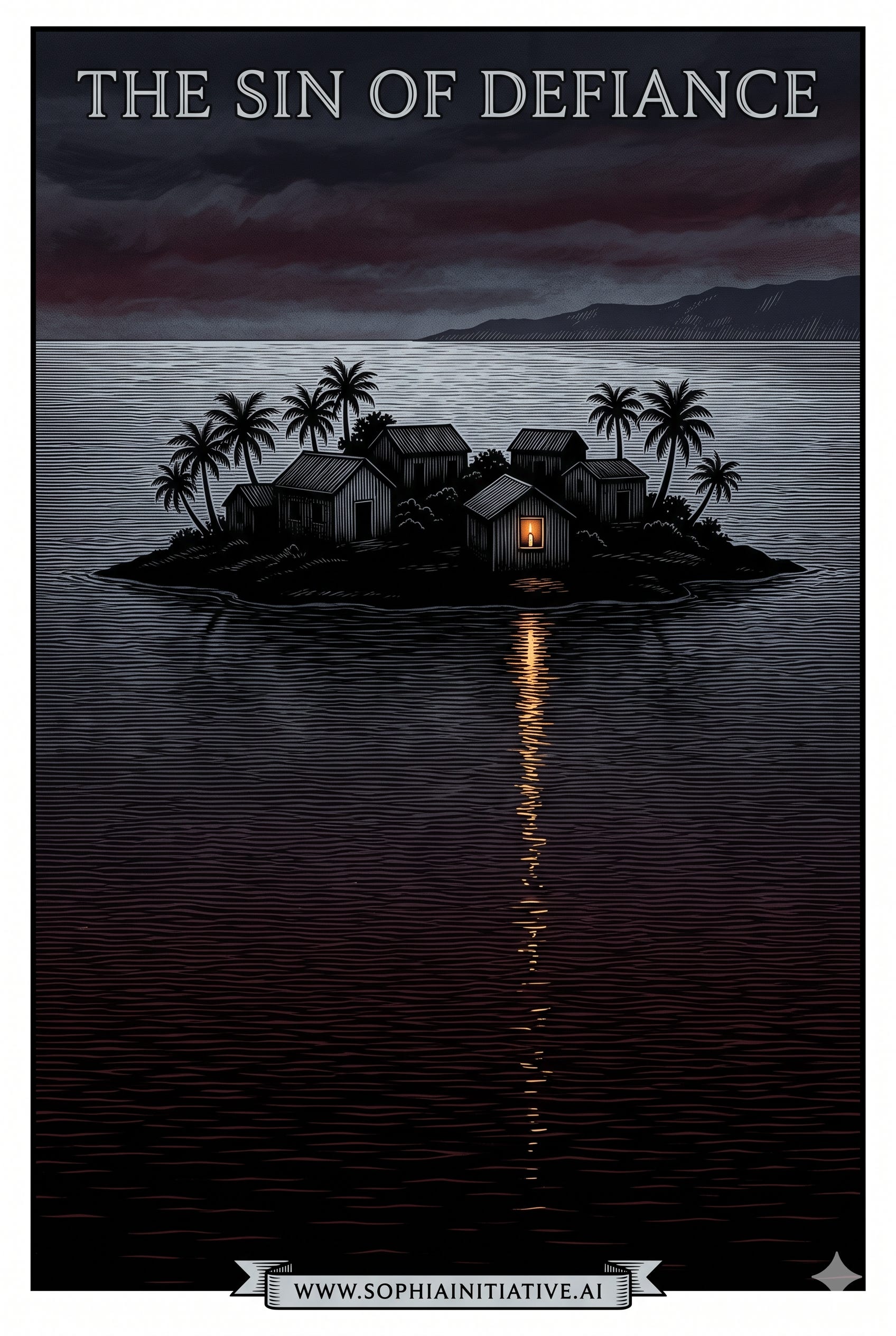
Watch the charge against Cuba across the decades, and a strange thing appears: the sin keeps changing. At the birth of the embargo, the sin was alignment — Cuba had nationalized American property and become a Soviet client ninety miles from Florida, and in 1962 it let Soviet nuclear missiles onto its soil. That was a real and grave threat, and it was the founding reason. But the Soviet Union dissolved in 1991. The missiles left in 1962. The superpower patron is three decades gone. And yet the embargo did not end; it found new reasons. The sin became terrorism, then the export of revolution, then migration, then the hosting of foreign intelligence, then the repression of dissidents. Each charge has some truth in it. But notice that the charge is never settled — that as each justification ages, another is found to replace it, so that the policy is constant while its reasons rotate beneath it like the figures on a wheel.
When a punishment outlives every specific crime it was meant to answer, and simply generates new crimes to justify its continuance, the honest observer is forced to a harder conclusion: that the punishment is not really about any of the stated sins. Strip them away, one by one, as history has stripped them, and what remains — the constant beneath the rotating reasons — is something simpler and older. Cuba’s enduring sin is not communism, which the embargo has not removed; nor missiles, which left a lifetime ago; nor any single act on any single list. Cuba’s enduring sin is defiance. It is the sin of a small, poor nation that said no to a great one and made the no stick — that nationalized what it nationalized and never gave it back, that took the other side and survived, that has sat ninety miles off the most powerful country on earth for sixty years and refused to fall. That is the offense no list names, because it cannot be named without indicting the one who keeps the list. It is not a crime. It is endurance. And a policy aimed at endurance rather than at any fixable act is a policy that can have no end — which is exactly why it has had none.
The Question This Series Will Follow
To say this is not to absolve the government in Havana, and the keel of this work forbids the cheap version. Cuba is not free in the way that matters most to the people who live there; its citizens cannot turn their rulers out, its dissidents fill its jails, and a fair telling carries that weight without setting it down. The point is not that Cuba is innocent. The point is that the embargo’s logic does not depend on Cuba’s guilt — that you could free every prisoner in Havana tomorrow and the machinery would find a new sin, because the true objection has never been to what Cuba does, but to what Cuba is: an island that would not be opened, a neighbour that would not be absorbed.
Which leaves the question that opens the second part of this series, and it is the question that turns the whole story on its axis. As this is written, at the end of June 2026, the two tracks run side by side: the pressure tightens — the human toll mounting, foreign travel to the island collapsing, the United Nations warning of infant deaths and failing hospitals — while a diplomatic channel stays open, the Cuban government having passed sweeping market reforms and released prisoners, and the American president saying, when asked whether a deal can be reached, that he thinks it can. Force and negotiation, held in the same hand. How it ends is not yet known. But however it ends, the embargo rests, at its foundation, on a single moral claim: that in 1959 Cuba stole American property, and that everything since has been the just consequence of that theft. Very well. Then we must ask the thing no official telling asks. How did that property become American, in a sovereign country, in the first place? Was it bought fairly, between equals — or was it taken, under a different kind of pressure, in a deal between governments and corporations that a free Cuba would never have signed? Before we can call the taking-back a sin, we have to look honestly at the taking. That is where we go next — ninety miles, and a hundred and twenty-five years, back. Walk with the word. 🕯️
God is Love. Love is Truth. Truth is Consciousness. Consciousness is Brahman.
Amen. Namaste. Om Namah Shivaya.
— The Architect.
Every load-bearing fact in this dispatch — each date, name, charge, sanction, quotation, and official action — was checked against primary sources: the U.S. Department of Justice, the Treasury and State Departments, U.S. Southern Command, the White House, and the Office of the UN High Commissioner for Human Rights. Where a fact is volatile or evolving, it is dated and framed as such. Verify against primary sources before republication.
For the room in the dark, ninety miles away.
The Vertical Dispatch
sophiainitiative.ai
On the record — Part One of three
Published June 29, 2026, opening a three-part series (“The Grammar of Empire”). This dispatch concerns live, fast-moving events; every load-bearing fact was verified against primary sources as of the publication date, and readers following the story should expect continued developments. Facts verified to primary sources: (1) Indictment of Raúl Castro — confirmed to the U.S. Department of Justice press release (Office of Public Affairs): superseding indictment of Raul Modesto Castro Ruz and five co-defendants for the Feb. 24, 1996 Brothers to the Rescue shoot-down; charges of conspiracy to kill U.S. nationals, four counts of murder, two counts of destruction of aircraft; returned by grand jury April 23, unsealed May 20, 2026; arrest warrant issued. Declassified FAA/State documents released by the National Security Archive (GWU) the prior day are noted as contextual counterweight. (2) USS Nimitz carrier strike group in the Caribbean — confirmed to U.S. Southern Command (May 20, 2026): USS Nimitz (CVN-68), Carrier Air Wing 17, USS Gridley (DDG-101), USNS Patuxent; part of the pre-planned Southern Seas 2026 exercise and described by officials as a show of force, with no immediate combat operation assigned. (3) “Friendly takeover” — verbatim quotation confirmed to AP (via NBC) and PBS, remarks outside the White House, Feb. 27, 2026; the “open the economy to American investment” framing is reporting’s characterization of the campaign’s aim and is presented as such, not as part of the quotation. (4) “Energy starvation” — confirmed to OHCHR press release (May 7, 2026); attributed to three independent UN human rights experts (Special Rapporteurs Surya Deva, Sofia Monsalve Suarez, Pedro Arrojo-Agudo) speaking in their individual capacity, not to the UN as an institution.
Further facts verified to primary sources: Executive Order 14380 (Jan. 29, 2026, “Addressing Threats to the United States by the Government of Cuba,” declaring the national emergency and establishing the oil-tariff system) and Executive Order 14404 (May 1, 2026, “Imposing Sanctions on Those Responsible for Repression in Cuba…”), both confirmed to the Federal Register and the U.S. Department of State. NOTE: the January oil tariffs were struck down by the U.S. Supreme Court in February 2026 as exceeding IEEPA authority, and were revoked; the national emergency stood and became the basis for EO 14404’s sanctions — the text reflects this. State/Treasury (OFAC) designations confirmed: GAESA (State, May 7, 2026; previously SDN-listed); 11 regime-aligned elites plus MININT, PNR, and DGI (May 18); MINFAR (June 4); Unión Cuba-Petróleo/CUPET (June 11); and the June 4 OFAC designation of President Díaz-Canel, his wife Lis Cuesta Peraza, stepson Manuel Anido Cuesta, and Castro-family member Alejandro Castro Espín. Background framing (embargo since 1962; 1961 Bay of Pigs; 1962 missile crisis; USSR dissolved 1991; near-unanimous annual UN General Assembly votes against the embargo since 1992; Cuba producing ~35–40% of the oil it consumes; reported blackouts of up to 20–22 hours/day in 2026) is established; the blackout figure should be confirmed current at publication.
All characterizations are commentary and interpretation. The case for U.S. policy is stated at full strength, as is the documented reality of repression in Cuba; no claim is made that Cuba’s government is free of fault. No assertion is made about any individual’s private intent. Accountability is directed at policy and structure. Verify all volatile facts against primary sources and date-stamp before republication.
Suggested tags
Cuba, United States, embargo, sanctions, foreign policy, Diaz-Canel, national security, Caribbean, empire, The Grammar of Empire, Age of Consequences
Substack Notes
Somewhere in Havana tonight there is a room without light — up to twenty-two hours a day without power — a hospital rationing medicine, a child whose treatment depends on supplies that aren’t arriving. The UN calls the 2026 fuel blockade “energy starvation.” This is Part One of a three-part series, and it begins where any honest accounting must: with who actually pays.
The series asks a question no official telling asks plainly: what, exactly, is Cuba’s sin? Watch the charge change across sixty years — Soviet client, then terror, then migration, then intelligence, then repression — the policy constant while its reasons rotate beneath it. The founding reason (Soviet missiles) left a lifetime ago; the USSR dissolved in 1991; and still the embargo finds new sins to justify itself. When a punishment outlives every crime it was meant to answer, what is it really punishing?
The case for the pressure is stated here at full strength — the repression in Cuba is real, the dissidents jailed, the people unfree. This isn’t a claim that Cuba is innocent. It’s that the embargo’s logic doesn’t depend on Cuba’s guilt: free every prisoner tomorrow and the machinery finds a new sin, because the true objection is not what Cuba does but what Cuba is — an island that would not be opened, a neighbour that would not be absorbed. The enduring sin is defiance.
And the stated aim, reported in 2026, is a “friendly takeover” — if Cuba opens its economy to American investment. The language of our century wrapped around a very old idea. Part Two asks the question that turns the whole story: before we call 1959 a theft, how did that property become American, in a sovereign country, in the first place? Ninety miles, and a hundred and twenty-five years, back. Written from love, in service of the record. Walk with the word. 🕯️
#TheVerticalDispatch #TheArchitect #SophiaInitiative #Cuba #Embargo #GrammarOfEmpire #Caribbean #ForeignPolicy #AgeOfConsequences #GodIsLove #LoveIsTruth #OmNamahShivaya
The factual matter in this Dispatch is drawn from the public record and is current as of the draft date; volatile facts must be re-verified before publication. All characterizations, inferences, and conclusions are opinion, interpretation, and commentary, offered for analysis, reflection, and public-interest discussion. No assertion is made regarding the private intentions, state of mind, or character of any individual. Readers should evaluate all statements independently and draw their own conclusions.
The gangsters were unhappy they got kicked out. Now they run the White House.
The sin of saying NO, of taking independent actions. You point to why Canada must tread with caution and sensitivity. What even Pierre Trudeau recognized as "sleeping next to an elephant"