

Sovereignty · Governance · Consequence
By The Architect
“The growth of the power of Athens, and the alarm which this inspired in Sparta, made war inevitable.”
— Thucydides, History of the Peloponnesian War, c. 400 BCE
There is a man sitting at the table where the Thucydides Trap is either avoided or closed. He is not the president. He is not the general. He is the counsellor — the voice in the room that translates the structural condition into policy, that converts fear into doctrine, that tells the ruling power what it already wants to hear. In Thucydides’ account of the Peloponnesian War, it was not Sparta’s generals who made the war inevitable. It was Sparta’s counsellors, whose fear of Athens had become so total, so structurally embedded in their advice, that accommodation had become unthinkable and confrontation had become strategy. The counsellors did not cause the fear. They institutionalised it. They gave it legislative form. They made it the operating system of a civilisation. And then the war came.
Marco Rubio is the United States Secretary of State and acting National Security Advisor — the first person to hold both roles simultaneously since Henry Kissinger from 1973 to 1975. He is the highest-ranking Latino official in American history. He was confirmed 99 to 0 by the United States Senate. He calls China the most potent and dangerous near-peer adversary this nation has ever faced. He has said the threat China poses will define the twenty-first century. He has said this consistently, in speeches, hearings, op-eds, and floor statements, for more than a decade. He believes it with the totality of a man who is not making a strategic argument. He is expressing a fear. And to understand the fear — where it comes from, what it actually responds to, who benefits from it being sustained — is to understand the single most consequential psychological fact in American foreign policy today.
AIG governance reads the counsellor before it reads the policy. The policy is the output. The counsellor is the operating system. If the operating system runs on fear, the policy it produces will be fear-shaped — regardless of the intelligence of the man running it, regardless of the sophistication of his briefings, regardless of the earnestness of his intentions. Marco Rubio’s operating system was installed in childhood, in a living room in Miami, by a grandfather who had survived communism and needed someone to carry the wound forward. Understanding that installation is not a psychological exercise. It is a governance requirement.
I. The Fabricated Exile — The Story That Built the Career
Marco Rubio has told his family’s story hundreds of times. The story is simple, powerful, and politically perfect for Florida. His parents fled communist Cuba after Fidel Castro seized power in January 1959. They came to America as exiles, forced from their homeland by a totalitarian regime, seeking freedom in the only country on earth that offered it. His father became a banquet bartender. His mother became a hotel maid. They never made it big, but they made it — and their son became the Speaker of the Florida House of Representatives, then a United States Senator, then the Secretary of State of the most powerful nation on earth. The immigrant exile story, perfectly rendered.
There is one documented problem. It is not a minor discrepancy. It is the foundational fact of the story.
Multiple documents signed by Rubio’s parents — including their petitions for naturalization filed with the United States government — show that Mario and Oriales Rubio arrived in the United States on May 27, 1956. Three years before Fidel Castro took power. During the Batista regime. Before the Cuban Revolution had occurred.
In the year they arrived in Florida, the future Marxist dictator was in Mexico, plotting a return to Cuba that had not yet succeeded. The Rubios were not fleeing communism. Communism had not yet arrived. They were doing what hundreds of thousands of Cuban families did in the mid-1950s: emigrating for economic opportunity.
Rubio’s Senate website stated his parents came to America following Fidel Castro’s takeover until October 21, 2011, when the Washington Post published documents proving the 1956 arrival date. His spokesman confirmed the same day: the dates were wrong. The website was updated within hours. Rubio had told the false version — in speeches, interviews, his official Senate biography, and to Sean Hannity on Fox News — for years. He told a Panhandle audience his parents left in 1959. He told Fox Business 1959. He told Fox 13 television 1959. When a Miami Herald reporter asked him pointedly in 2011 whether it was before the revolution, Rubio struggled to recall the year and said it was in ‘57 or ‘58 or ‘59.
The significance of this is not biographical. It is psychological and structural. A man who built an entire political identity on a family story of flight from communist tyranny — and whose primary foreign policy conviction is fear of the communist successor state he has mapped Cuba onto, writ large, with nuclear weapons and rare earth monopolies — is a man whose foundational narrative requires examination at its roots. The roots are not where he placed them.
The Rubios came for economic opportunity in 1956. The political meaning was installed later — by the community, by the grandfather, by the career that required the story. The fear is real. The origin of the fear is a different matter.
II. The Grandfather’s Wound — Where the Fear Actually Lives
Strip away the retrofitted narrative and what remains is a grandfather. Pedro Victor Garcia. This is the real figure. This is where the wound was made, and where it was transmitted to the boy who would become the most powerful Latino diplomat in American history.
Garcia came to the United States around 1956 with the rest of the family. In 1962, he returned to Cuba — Castro’s Cuba, fully committed to the communist model, in the aftermath of the Bay of Pigs invasion. When he attempted to return to the United States, he had no visa. He was detained as an undocumented immigrant. An immigration judge ordered him deported. Officials reversed the order the same day. He was reclassified as a parolee. He reapplied under the Cuban Adjustment Act in 1966 and his residency was approved. But for a period — however brief — the grandfather had been caught between two governments, held at a border, ordered removed, and then reprieved by bureaucratic reclassification. He had seen what the communist state did to people who tried to leave. He had felt its machinery on his own body.
It was this man who sat with young Marco and talked. The State Department’s official biography of Secretary Rubio states it plainly: he was drawn to public service in large part because of conversations with his grandfather, who witnessed how communism destroyed his homeland. These are not meetings with an abstraction. These are a child sitting with an old man who has scars, listening to the account of what the system does to people who stand in its way, internalising a picture of the world in which one force — totalitarian communism — is the consuming darkness against which everything else must be understood.
“Rubio is passionate about the American Dream because he’s lived it himself. He was drawn to public service in large part because of conversations with his grandfather, who witnessed how communism destroyed his homeland.”
— Official biography, United States Department of State, 2025
The grandfather’s wound is real. The map it produced is not accurate at China’s scale. A man governing American foreign policy toward the People’s Republic of China with a map drawn from conversations about Castro’s Cuba is a man whose primary analytical tool is calibrated to the wrong object. The fear is genuine. The object of the fear has been substituted. Cuba became Venezuela. Venezuela became Iran. Iran became China. And no one in the confirmation hearing — not one of the 99 senators who voted to confirm him — asked about this substitution.
What happens when a wound installed by a specific historical event — Cuba, 1959, a small island nation’s totalitarian revolution — becomes the operating template for analysing a civilisational system of five thousand years, a nuclear power with the second-largest economy on earth, a state that predates the United States by approximately four and a half millennia? The fear is genuine. The object of the fear has been substituted. The map is calibrated to the wrong territory.
III. The China Argument — Read at Its Own Level
Marco Rubio has been making the China argument in public for more than a decade. He makes it consistently, fluently, and with the conviction of a man who is not performing a position but expressing a belief. The belief deserves to be read at the analytical level it operates at — not the level its author claims for it, but the level its actual content reveals.
At his confirmation hearing for Secretary of State in January 2025, Rubio delivered his most comprehensive public statement on China. He called it the most potent and dangerous near-peer adversary this nation has ever confronted. He said the Chinese Communist Party had lied, cheated, hacked, and stolen their way to global superpower status at our expense. He said the twenty-first century would be defined by what happens between the United States and China, and that China possessed elements the Soviet Union never had — being simultaneously a technological, industrial, economic, geopolitical, and scientific competitor in every realm.
“If we don’t change course, we are going to live in a world where much of what matters to us on a daily basis — from our security to our health — will be dependent on whether the Chinese allow us to have it or not.”
— Marco Rubio, Senate Foreign Relations Committee confirmation hearing, January 15, 2025
This is the fear statement at its most naked. Not a strategic analysis. Not a structural read of the hegemonic transition. Not an engagement with the Thucydides framework that Xi has been deploying for twelve years at every bilateral engagement of consequence. It is a statement about dependence — about the terror of being at the mercy of a system that the speaker has identified as irredeemably hostile.
Read this against the AIG framework. What level of the board is this argument playing on? The answer is Level 3 by PIAAC measure — competent, fluent, capable of sustained argument and factual recall. But not Level 4. Not the level at which structural systemic analysis is possible — at which the analyst can hold the complexity of a system that is simultaneously adversary and partner, rival and interdependency, threat and civilisational peer. Level 3 processing produces binary frames: threat or not threat. Safe or dangerous. With us or against us. Cuba or America. Communism or freedom.
Analysts at Responsible Statecraft, reviewing Rubio’s flagship China speech, concluded that his analysis is crude and reductionist and blames the country for all of America’s internal problems. The simplistic Manichean framing ignores the reality of relative American decline and the limits of American power, and rules out the possibility of attempting to find a workable modus vivendi with China in a multipolar world where no single state is in a position to dictate terms to the rest.
Rubio invokes the Soviet analogy repeatedly despite explicitly acknowledging China is categorically different from the Soviet Union. He cannot hold both statements simultaneously at the structural level — if China is categorically different, the Soviet framework does not apply, and a new framework is required. No new framework appears in fourteen years of China argumentation.
In 2020, Beijing responded to Rubio’s criticisms by banning him from entering China — the country he is now tasked, as Secretary of State and acting National Security Advisor, with managing the United States’ relationship with. The man whose operating system runs on fear of China cannot enter China. He must manage the most consequential bilateral relationship on earth from a position of permanent exclusion from the territory of the other party.
The counsellor whose operating system runs on fear cannot produce a strategy. He can only produce a posture. And the posture is the posture of Sparta — escalating containment that confirms the diagnosis and tightens the trap with every move.
IV. The Money — Who Benefits from the Fear Being Sustained
AIG governance follows the money. Not because money is always the explanation — it is not — but because the money map tells you whose interests are served by a given policy posture being maintained. When the policy posture is sustained fear of China, and when that fear translates into defence spending increases, weapons procurement, military alliance expansion, and technology export controls, the money map identifies who profits from the fear remaining in the governing position and never resolving into accommodation.
From 2019 to 2024, Marco Rubio raised $50,277,154 in campaign contributions. Top contributors: Pro-Israel America PAC — $109,800. Republican Jewish Coalition — $77,736. The GEO Group, a private prison company — $48,800. Rubio was the fourth-largest recipient of defence industry funding in the United States Senate for the 2022 election cycle, receiving $196,000 from that sector alone. Across his entire congressional career, the weapons industry has invested $663,000 in his campaigns.
Rubio was appointed Secretary of State at the behest of Miriam Adelson — widow of casino billionaire Sheldon Adelson — who contributed $120 million to Trump’s 2024 campaign through her Preserve America PAC. The Adelson family’s primary political priority is Israeli security architecture in the Middle East and confrontation with Iran — a posture that aligns precisely with Rubio’s foreign policy framework across every axis.
At the 2025 Congressional Summit of AIPAC, the organisation’s CEO Elliott Brandt stated that AIPAC had cultivated influence with three top national security officials in the Trump administration. Rubio was named as one of the three who would allow AIPAC to gain direct access to internal government discussions. A 501(c)(4) dark money organisation called the Conservative Solutions Project has also contributed large, undisclosed sums that do not require public disclosure.
Read the money map against the policy map. The defence industry profits when military spending increases and when the threat environment justifies weapons procurement. The Israeli lobby profits when American foreign policy maintains confrontational postures toward Iran, China, and Russia. The private prison industry profits when geopolitical confrontation generates political pressure for tighter border control. None of these financial interests are served by accommodation with China. Every one of them is served by a Secretary of State whose operating system runs on fear, whose policy output is containment, and whose confirmation was paid for, in significant measure, by the people who profit from the fear being permanent.
This is not a conspiracy argument. It is a structural argument. The interests align. When interests align with policy, AIG governance notes the alignment and asks the question it always asks: what is this for? The answer, read through the money map, is that the fear-based China policy is for the people who finance the fear. The grandfather’s wound is real. Its institutionalisation into American foreign policy is profitable for a specific set of actors who had nothing to do with the grandfather, nothing to do with Cuba, and everything to do with the financial architecture of American political power.
V. The Spartan Counsellor — The AIG Verdict
AIG governance does not grade on intention. It grades on output and on the structural capacity of the operating system to produce the output the moment requires. The moment requires a Secretary of State who can engage Xi Jinping’s twelve-year Thucydides framing at its own level — who can read the Go board, place stones that reshape the structure of the bilateral relationship, and build the governance architecture of a hegemonic transition that does not end in war. The question AIG asks is whether Marco Rubio is that Secretary of State. The answer, assembled from the documented record, is precise.
He is not.
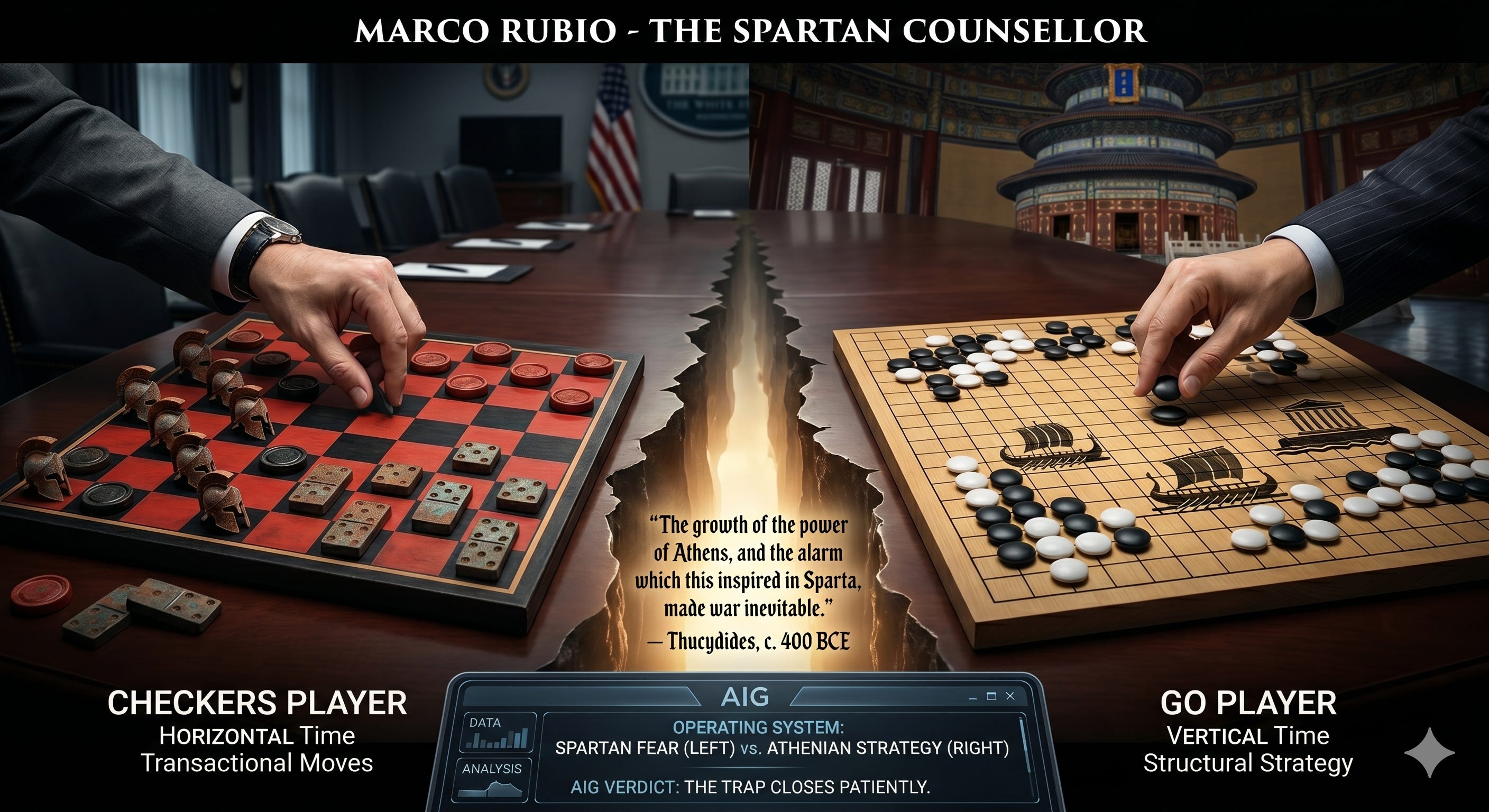
He is something more specific, more historically legible, and more dangerous: he is the Spartan counsellor. He is the man in the room whose fear is genuine, whose intelligence is real, whose commitment to his country is not in doubt — and whose operating system is calibrated to a threat that is not the threat actually present. The Peloponnesian War’s Spartan counsellors were not stupid men. They were frightened men. Their fear was not irrational given what they could see. What it was, was incapable of producing anything other than the war it feared. Fear, as a governing operating system, has one output. Escalation. Containment. The posture that confirms the diagnosis and tightens the trap.
Marco Rubio has been in the grip of this operating system since childhood. Cuba became the template. The grandfather installed it. The Miami exile community reinforced it. The political career required it. The money that financed the career profits from it. Fourteen years of China argumentation have produced not one structural engagement with the civilisational complexity of what China actually is. Not one speech, not one op-ed, not one Senate floor statement that acknowledges the Thucydides dynamic at the level Xi has been naming it since 2014. The man who is now Secretary of State and National Security Advisor has never, in the full documented public record of his career, demonstrated the capacity to read the Go board. He has always played checkers. He plays it well. He plays it with conviction. He plays it in service of a fear whose roots are legitimate and whose application to China is a category error of civilisational consequence.
The trap does not close because anyone wants war. It closes because the ruling power’s operating system — its counsellors, its policy architecture, its financial dependencies — is calibrated to fear rather than to structural engagement. Every escalation confirms the Athenian diagnosis. Every confirmation tightens the trap. The counsellor who cannot read the board is not a safeguard against the trap. He is the mechanism by which it closes.
Thucydides wrote his history from exile. He had been a general on the Athenian side, removed from command after a military setback, left with nothing to do but think across decades about what had actually happened and why. His conclusion was not that bad men made the war. His conclusion was that the structure made the war — that the fear in Sparta had become so total, so institutionalised in the advice of the counsellors, so embedded in the policy architecture of the ruling power, that the trap had closed before the first battle was fought. The individuals were almost beside the point. The operating system was the point.
The operating system of American foreign policy toward China runs, at this moment, through a man whose fear of communism was installed in childhood by a grandfather’s wound, reinforced by a community’s founding narrative, amplified by a career built on the political value of that fear, and financed by interests for whom the fear is profitable. He is the Secretary of State. He is the acting National Security Advisor. He holds both roles simultaneously. He is the most powerful Latino official in American history. He cannot enter China.
Xi Jinping placed the children in the corridor. He named the Thucydides Trap in the opening remarks. He took the visiting president to the Temple of Heaven. He read the American operating system precisely, moved three stones ahead of it, and shaped the board for the next engagement. The counsellor on the American side did not see the board. He never has. He is playing the only game his operating system knows how to play. And the trap continues its patient, structural, inevitable work.
The grandfather’s wound was real. The map it produced is calibrated to the wrong object. The fear is genuine. The policy it generates is Spartan. And Sparta won the war. Then vanished from history as a governing model within thirty years of the victory.
That is the AIG verdict on the Spartan Counsellor. No quarter given. The record is what it is. The trap is what it is. The board is what it is. And the man whose operating system cannot see the board is the man now tasked with deciding whether it closes.
God is Love. Love is Truth. Truth is Consciousness. Consciousness is Brahman. Amen. Namaste.
#TheSpartanCounsellor #MarcoRubio #AIG #ArtificiallyIntelligentGovernance #VerticalDispatch #ThucydidesTrap #ChinaUS #GoVsCheckers #HegemonyTransition #SpartanFear #TheArchitect #CubanExile #ForeignPolicy #DefenseIndustry #FollowTheMoney #RubioChina #SecretaryOfState #NationalSecurityAdvisor #AIPACInfluence #GrandfathersWound #PIAACLevel #StructuralFear #OperatingSystem #CategoryError #AgeOfConsequences #TheVerticalDispatch #Project2046 #SubstackCanada #NorthernSovereignty #BeijingSummit2026 #TempleOfHeaven #ThucydidesTrap