

The Architect · AIG Framework Dispatches
Sovereignty · Governance · Consequence
By Glennford Ellison Roberts · The Architect
The Vertical Dispatch · May 23, 2026
Companion dispatch to The Clock With No Hands (May 22, 2026). See the bottom of the page
A note before we begin. We apologise, in the Canadian fashion, for the length of this dispatch. The story has been hiding in plain sight, no one has written it whole, and the documented record requires the length the documented record requires. Make a cup of coffee or pot of tea. Find a chair. The publication will be here. Read this in two or three sittings if you need to. We have written it for the reader who is willing to sit with a thing until the thing is read.
I. WHAT NO ONE HAS WRITTEN
There is a referendum coming in Alberta on October 19, 2026, and the country has been told about it in pieces. The Canadian press has covered the immigration questions in one set of articles and the constitutional questions in another. It has covered the tenth question — the secession question Smith added on May 21 — as a story of its own. It has not, in any single piece of journalism the publication has been able to find, read the ten questions as one document. It has not asked what the ten questions together do, what they together mean, what they together amount to when read as a single coordinated act of provincial government against the federal architecture of the country.
That is the work this dispatch sets itself. Ten questions, one document, one read. The publication did not write the ballot. The publication did not write the Order in Council. The publication did not write the televised address on May 21. The publication did not write the letter the Premier of Alberta sent to the Prime Minister of Canada in 2024 — the letter that, when read against the ballot she is now asking Albertans to ratify, contradicts the ballot on its most prominent file. None of that is the publication’s writing. All of it is on the public record. The publication’s job is only to put the documents next to each other, in chronological order, and let the documented record produce the finding it produces.
There is bias in this dispatch. The publication acknowledges it before the dispatch begins, because the elenchus discipline requires the acknowledgement. The bias is not against Premier Smith. The bias is toward the documented record, and the documented record is biased against Premier Smith by virtue of being the record of what she has actually done. The publication did not write the letter. The publication did not write the ballot. The publication did not say one thing in writing to Trudeau in 2024 and the opposite to Albertans in 2026. Premier Smith did all of that herself, in writing, on her own letterhead, signed. The dispatch is the record of the record. Whatever bias the reader finds in the prose is the bias the documents have produced.
No quarter for power that contradicts its own signed record, and the rule does not soften for the office that wrote the record. The bias in this dispatch is the bias of arithmetic, of chronology, and of constitutional text. The publication invented none of it. The publication only put it on one page.
II. THE LETTER AND THE SPIRIT
Begin with the legal distinction that governs everything else this dispatch will argue. The Clarity Act, passed by Parliament in 2000 and given Royal Assent on June 29 of that year, is a narrowly-scoped piece of federal legislation. It applies, by its own plain text, only to provincial referendum questions on the secession of a province from Canada. Its Section 1(1) triggers only when the government of a province tables a question on whether the province should cease to be part of Canada. It does not apply to provincial referendum questions on immigration, equalization, judicial appointments, Senate reform, federal-provincial transfers, or any other subject. That is the letter of the Act. The letter is narrow. The publication will respect it.
But the Clarity Act was not invented in 2000. It codified, in legislative form, the framework the Supreme Court of Canada had identified two years earlier in the Reference re Secession of Quebec — a 1998 unanimous opinion in which the Court named four constitutional principles that govern any moment in which a province seeks to renegotiate its relationship with the rest of Canada. The four principles are federalism, democracy, constitutionalism and the rule of law, and the protection of minorities. The Clarity Act translated those principles into a thirty-day House of Commons procedure for one specific kind of question. But the principles themselves were not invented by the Act and are not bounded by it. They are constitutional principles. They govern, in their broader form, any provincial act that touches the constitutional architecture of the federation.
That is the distinction this dispatch turns on. The letter of the Clarity Act governs Question 10. The spirit of the Clarity Act — which is to say, the four constitutional principles the Act was built to honour — governs the document the voter reads. The document is the ballot. The ballot is ten questions. The ten questions touch federalism, democracy, constitutionalism and the rule of law, and the protection of minorities. The publication will examine the ballot against the spirit, not the letter, because the spirit is where the constitutional architecture lives, and the letter applies to only one of the ten questions on the page.
The letter of the Act is narrow and exact. The spirit of the Act is the constitution itself. A publication that reads only the letter has missed what the Supreme Court actually said. A publication that reads only the spirit has missed what Parliament actually wrote. This dispatch reads both, separately, at appropriate altitude, with appropriate scope. The discipline is the discipline.
III. THE READER WHO WILL READ THIS BALLOT
Before the ten questions can be examined, the publication has to name the reader who will read them. A ballot is a document. A document is read. A document that asks the population of a province to vote on ten coordinated changes to the constitutional architecture of the country is a document that requires its reader to integrate multiple pieces of information across a complex text, weigh competing claims, decode legal and procedural language, and arrive at an independent judgement. That is a particular kind of reading. It is not the only kind of reading, and it is not the kind of reading the majority of any modern democratic electorate is structurally equipped to do.
The Programme for the International Assessment of Adult Competencies — the PIAAC — is the standard international instrument by which the literacy and numeracy capacities of adult populations are measured. The most recent Canadian data, from the OECD’s Survey of Adult Skills, places roughly half of Canadian adults at literacy Level 2 or below. Level 2 describes the capacity to read straightforward documents and extract directly-stated information, but not the capacity to integrate multiple pieces of information across a complex document, evaluate competing claims inside the same passage, or decode language whose meaning depends on legal or procedural context. That is approximately half the population. The other half, distributed across Levels 3, 4, and 5, is capable of the more complex reading the ballot requires. The other half is not the half this paragraph is about.
A referendum is a contract between a government and the actual electorate that has to read what it puts on the page. A government that drafts a ballot at a reading level the median voter cannot fully decode is not asking a clear question. It is asking a question that produces noise from one half of the room and signal from the other half, and counting both as the same answer. The Supreme Court in 1998 was specific on this point. The Court named democracy as one of the four constitutional principles governing secession, and the Court was equally specific that democracy means more than simple majority rule — that a qualitative evaluation is required to determine whether any expression of democratic will is genuinely clear. A ballot that the median reader cannot fully decode does not produce a clear expression of democratic will. It produces an aggregate of responses to a document the responder did not fully understand. That is not a Canadian shortcoming. It is the literacy reality of every modern democratic electorate. The Court was not abstract about it. The publication will not be abstract about it either.
The reader who will read this ballot is not a constitutional scholar. The reader who will read this ballot is the median Canadian, with the median Canadian’s reading capacity, voting in a room with a pencil at the end of a long day. The clarity the Court required is not a clarity that exists on the page only. It is a clarity that must reach the reader who marks the page. A ballot whose architecture forgets that reader has not asked a clear question. It has asked a question whose answer the architecture has pre-selected.
IV. THE NINE PLUS ONE
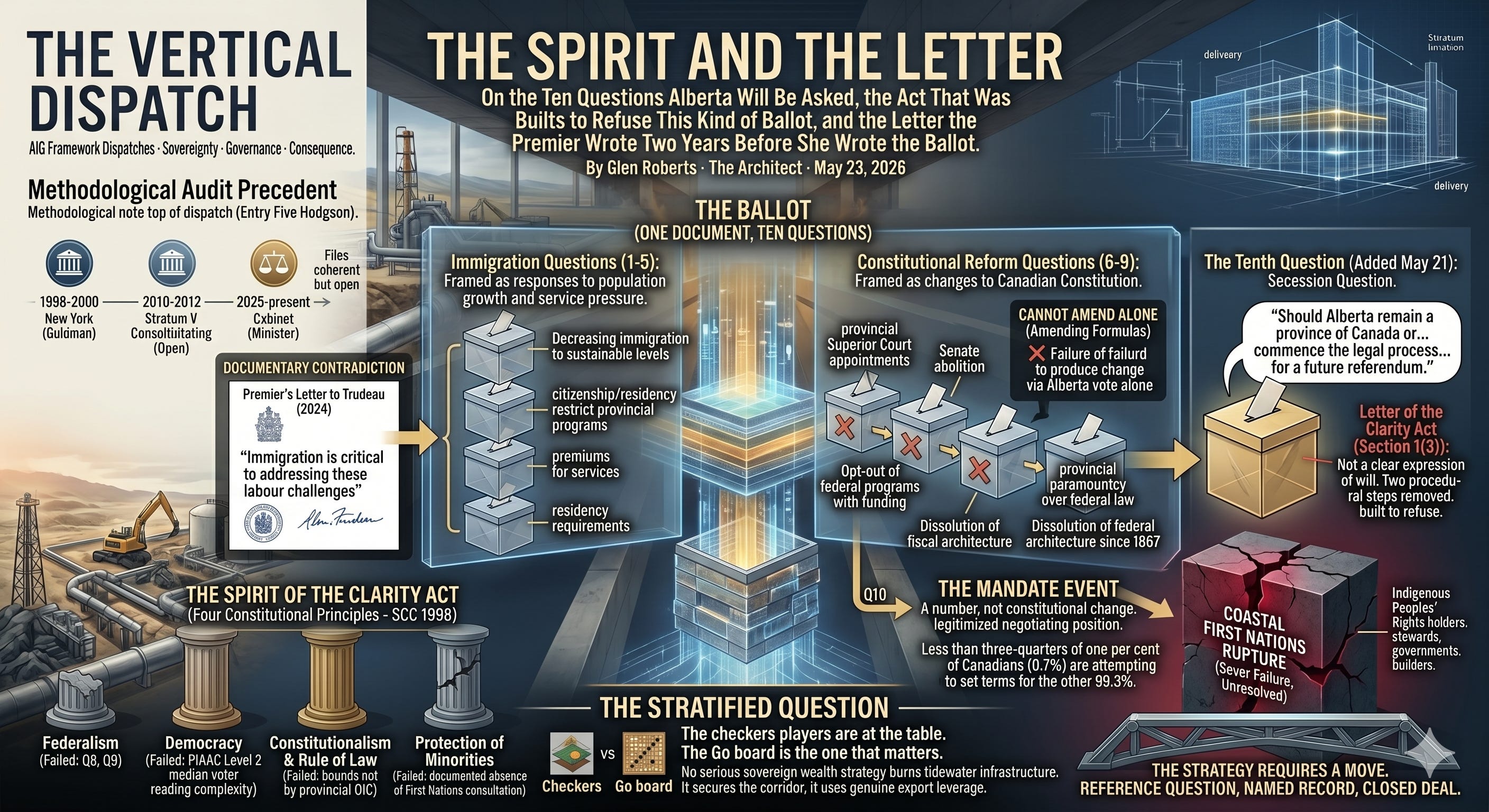
The ballot Albertans will face on October 19 is one document containing ten questions. The first nine were tabled on March 31, 2026 by Order in Council 110/2026 and the related O.C. 109/2026, issued by the Government of Alberta and published by Elections Alberta. The tenth was added on May 21, 2026 by televised provincial address from Premier Smith and a subsequent ministerial process. All ten questions are non-binding by the Order in Council’s own terms — Elections Alberta’s published material states that the Orders specify the results of the referendum are not to be binding. All ten questions will be voted on the same day, in the same rooms, on separate ballots but as one act of provincial democratic exercise. The voter who walks into the polling station on October 19 will be handed ten ballots and asked to render ten yes-or-no judgements on questions ranging from immigration administration to provincial paramountcy over federal law to whether the province should commence the legal process of leaving Canada.
The publication will read them in three groups, in the order they appear. Questions 1 through 5 are framed as immigration policy. Questions 6 through 9 are framed as constitutional reform. Question 10 is the secession question Smith added on May 21. The publication’s structural read is that the three groups, taken as one document, move in one direction — and that the direction is the loosening, narrowing, escaping, or replacing of Alberta’s relationship with the rest of Canada. There is no question on this ballot asking Albertans whether the relationship should be strengthened, deepened, protected, or honoured. There is no question on this ballot asking Albertans what they want for Alberta inside Canada. The ballot, taken as a whole, asks Albertans — in ten different ways, on ten separate ballots, in one coordinated act — how much of Canada they want gone.
That is the structural finding the rest of this dispatch will substantiate question by question, group by group, against the four constitutional principles the Supreme Court named in 1998. The finding is the publication’s reading. The reading is built from the documented record. The record is what it is. The publication invented none of it.
V. THE IMMIGRATION QUESTIONS, AND THE LETTER THE PREMIER WROTE
Five of the ten questions on the October 19 ballot concern immigration. The Government of Alberta has framed these questions, in its public information campaign and in the wording of the questions themselves, as a response to rapid population growth and pressure on provincial services. The Premier, in announcing the questions on February 19, 2026, named the arrival of approximately 600,000 additional residents in Alberta since 2021 as a key concern. The first question on the ballot is also the question that sets the tone for the four that follow. It reads, in the Government of Alberta’s published form:
Do you support the Government of Alberta taking increased control over immigration for the purposes of decreasing immigration to more sustainable levels, prioritizing economic migration and giving Albertans first priority on new employment opportunities?
The question is framed as a question about whether immigration should be decreased. The verb is explicit. The destination the ballot proposes is a reduction in immigration to levels the Government of Alberta considers sustainable. The four immigration questions that follow flow from this framing — restricting access to provincially funded programs to Canadian citizens, permanent residents, and approved-status holders; imposing residency-period requirements before non-permanent status holders qualify for support; charging premiums to non-permanent status holders for certain services; and other related measures. The ballot, taken as five questions on one file, asks Albertans to ratify the position that immigration to Alberta should be reduced and that the federal-provincial architecture currently governing immigration is failing the province.
That is the position the ballot asks Albertans to ratify in October 2026. Now examine the position the Premier of Alberta was advocating, in writing, to the Prime Minister of Canada in 2024. The letter is on the public record. It bears the seal of the Office of the Premier of Alberta. It is addressed to The Right Honourable Justin Trudeau, P.C., M.P., Prime Minister of Canada. It is signed by the Hon. Danielle Smith, Premier of Alberta. It is dated 2024 (date to be confirmed). The publication will quote it directly, because the documentary contradiction is the point, and the contradiction lands hardest in her own language.
The letter opens with a complaint that the federal government, through Minister of Immigration, Refugees and Citizenship Marc Miller, had informed Alberta that the province would not receive any increases in its 2024 Provincial Nominee Program allocations. The Premier of Alberta, in the second paragraph of the letter, writes the following:
I am very concerned with this decision given the adverse impacts it would have on our province’s economy and ability to help Ukrainian evacuees find permanent jobs and futures in Alberta. Over the last year, Alberta has participated in good faith in federal-provincial-territorial consultations on provincial nomination allocations. In September 2023, the Honourable Muhammad Yaseen, Alberta’s Minister of Immigration and Multiculturalism, requested a much needed increase in Alberta’s Provincial Nominee Program allocations, including 14,000 in 2024, 14,700 in 2025, and 15,435 in 2026.
Read that paragraph carefully. The Premier of Alberta is writing to the Prime Minister of Canada to complain that Alberta is not being given enough immigration allocations. She names the figures her own Minister of Immigration requested in September 2023 — 14,000 in 2024, 14,700 in 2025, 15,435 in 2026 — and protests that the federal decision to provide 9,750 falls short. Continue to the third paragraph:
Alberta’s labour market continues to show strength. In February 2024 employment rose to 2.5 million, up 17,400 month-over-month, which is 4.1 per cent increase year-over-year. Full-time jobs also jumped to 2,070,699. While Alberta accounts for just under 12 per cent of Canada’s population, our province leads the nation in net employment growth, with 42.8 per cent of the country’s employment gains. Alberta continues to be the economic engine of Canada and will experience ongoing labour market challenges, with labour shortages forecasted in critical sectors such as construction, technology, health care, and education. Immigration is critical to addressing these labour challenges, and Alberta’s Provincial Nominee Program is best placed to address our unique immigration and economic goals.
The publication will pause here, because the seven words at the end of that paragraph are the words this dispatch will return to. The Premier of Alberta wrote, in 2024, to the Prime Minister of Canada: Immigration is critical to addressing these labour challenges. Seven words. On her own letterhead. Signed. The reader can read them in the original document, on the publication’s archive (link), and verify that the words are the words the Premier actually wrote.
Now read the formal request the letter makes. The Premier continues, in the fourth paragraph:
In light of Alberta’s unique labour challenges, I am requesting that your government immediately increase Alberta’s Provincial Nomination Program allocation to 20,000 annually in 2024, 2025 and 2026. This would support our efforts to address critical labour shortages and supports a collaborative federal-provincial-territorial relationship that respects Alberta’s role in addressing its regional immigration needs.
Twenty thousand annually for three years. Sixty thousand allocations the Premier of Alberta, in writing, formally requested. The number is in the letter. The letter is in the public record. The Premier is the same Premier who, two years later, would place on the October 2026 ballot a question asking Albertans whether immigration should be decreased to more sustainable levels.
The letter is not finished. The Premier continues, on the second page, with an additional request specifically concerning Ukrainian evacuees. She notes that approximately 57,000 Ukrainian evacuees were then in Alberta, that approximately 93 per cent of them were anticipated to remain in the province and seek permanent residency, that this represented approximately 24,000 families, and that the existing federal pathways were insufficient. Then:
The federal government could address this issue either through new federal pathways for Ukrainian evacuees or through increased allocations to Alberta’s Provincial Nominee Program. Under the Provincial Nominee Program, Alberta requests a further 10,000 allocations for Ukrainian evacuees, in addition to the 20,000 the province is already seeking for economic needs.
Ten thousand additional allocations for Ukrainian evacuees, on top of the twenty thousand annually already requested. The total formal request, on the documented record, signed by the Premier of Alberta, addressed to the Prime Minister of Canada, in the letter the reader can read in full at (link), was thirty thousand additional immigration allocations for Alberta. The reasoning the Premier offered, in her own words, was that Alberta’s labour market was the strongest in the country, that the province was leading the nation in employment growth, that labour shortages were forecast in critical sectors, that immigration was critical to addressing those shortages, and that the Provincial Nominee Program was the right instrument to deliver the allocations.
The publication invites the reader to set the 2024 letter and the 2026 ballot side by side on the page. The publication will not interpret. The publication will only present the two documents and let the reader judge whether the documented record is one of consistent good faith between a provincial government and the population it asks to vote.
In 2024, the Premier of Alberta wrote to the Prime Minister of Canada: Immigration is critical to addressing these labour challenges. In 2026, the same Premier of Alberta placed on the October 19 ballot the question: Do you support the Government of Alberta taking increased control over immigration for the purposes of decreasing immigration to more sustainable levels. The two sentences cannot both be the considered position of one government. The publication did not write either of them. They are in the documented record. The reader will read the record and the reader will judge.
That is the Smith letter against the Smith ballot. The publication will note one further structural point before moving on. The 2024 letter was a private communication between two heads of government, intended to be read by Cabinet officials and policy advisers. The 2026 ballot is a public document intended to be read by approximately 3.2 million eligible Alberta voters. The two audiences are different. The position the Premier presents in private to Cabinet differs from the position she presents in public to her electorate. That difference is itself a documented finding. Whether the difference is honest or whether it is a position deliberately constructed to extract a public mandate the government’s own internal correspondence contradicts — that is a question the elenchus raises and leaves the reader to answer. The publication does not answer it. The publication only places the documents on the page in the order the chronology demands.
The four constitutional principles the Supreme Court named in 1998 — federalism, democracy, constitutionalism and the rule of law, and the protection of minorities — speak directly to this finding. The democracy principle, the Court was specific, requires more than simple majority rule. It requires that the expression of democratic will arise from a process the population had a fair chance to understand. A ballot question whose framing contradicts the government’s own signed correspondence on the same file, within two years, is not a process the population has a fair chance to understand. It is a process designed to produce a mandate the government did not, on its own internal record, hold when it asked. That is a democracy-principle failure. It is documented. The publication has documented it. The publication did not invent it.
VI. THE CONSTITUTIONAL QUESTIONS, READ HONESTLY
Questions 6 through 9 on the October 19 ballot are framed as constitutional reform. The Government of Alberta’s official information website describes them as questions about whether Alberta should work with other willing provinces to amend the Canadian Constitution in four specific ways. The publication will examine each in turn, briefly, against the constitutional reality of what each proposed amendment would require, and against the four principles the Supreme Court named in 1998.
Question 6 asks Albertans whether they support the Government of Alberta working with the governments of other willing provinces to amend the Canadian Constitution to have provincial governments, and not the federal government, select the justices appointed to provincial King’s Bench and Appeal courts. Federal appointment of superior court judges is established under Section 96 of the Constitution Act, 1867, and has been the architecture of the country’s judicial system since Confederation. The amendment Question 6 contemplates would, under Section 38 of the Constitution Act, 1982 — the 7/50 general amending formula — require the consent of at least seven provinces totalling at least fifty per cent of the Canadian population, plus both houses of the federal Parliament. A Yes vote in Alberta alone changes nothing. A Yes vote in Alberta initiates a request that every other party to the amending formula is free to refuse. No other province has publicly committed to supporting the proposal. The structural significance is not that the proposal is unreasonable on its face — reasonable people may differ on how superior court judges should be appointed in a federation — but that the proposal is being put on a ballot whose Yes outcome cannot, by itself, produce the amendment. The voter is being asked to authorise the government to ask. The government is asking whether to ask.
There is a deeper concern with Question 6 that the official framing leaves out. Federal appointment of superior court judges is not merely an administrative convenience. It is one of the structural protections of judicial independence in a federation. Federal appointment helps preserve impartiality by separating the provincial governments — whose laws, decisions, and constitutional positions the courts will be asked to review — from the appointment of the judges who will review them. To replace federal appointment with provincial appointment is to remove a structural insulator between the government being reviewed and the judges doing the reviewing. That insulator is not redundant. It is part of the constitutional architecture that protects the rule of law in a federation. The constitutionalism-and-the-rule-of-law principle, the third of the Court’s 1998 four, applies here. The ballot does not name the trade-off. The publication will.
Question 7 asks Albertans whether they support the Government of Alberta working with the governments of other willing provinces to amend the Canadian Constitution to abolish the unelected federal Senate. The constitutional reality is that abolishing the Senate is the single hardest amendment in the Canadian constitutional order. The Supreme Court of Canada confirmed in its 2014 Reference re Senate Reform that abolition of the Senate requires the unanimous consent of Parliament and all ten provinces under Section 41 of the Constitution Act, 1982. A single provincial veto is sufficient to defeat the amendment. Quebec, most plausibly, would veto. Other provinces likely would as well. A Yes vote in Alberta on Question 7 cannot abolish the Senate. It cannot meaningfully advance the abolition of the Senate. It can only register, on the public record, that Albertans were asked the question and answered it — while every other party to the unanimous-consent formula remains free, and likely, to refuse. The ballot does not name this. The publication will.
Question 8 asks Albertans whether they support amending the Constitution to permit provinces to opt out of federal programs that intrude on provincial jurisdiction — health care, education, social services — while still receiving the associated federal funding. This is the most fiscally consequential of the four constitutional questions, and it is the question the official framing dresses most carefully. The constitutional reality is that the federal spending power, used in shared-cost programs since the post-war period, is the instrument by which Ottawa funds health care, post-secondary education, and major social services across the federation. The conditions Ottawa attaches to the transfers — the principles of the Canada Health Act, the accountability requirements on post-secondary funding, the standards on social service delivery — are the leverage by which the federation maintains comparable program quality across provincial jurisdictions. To opt out of the programs while retaining the funding is to retain the money and discard the conditions. That is not a modernisation of federalism. It is the dissolution of the fiscal architecture that has held the federation together since the 1950s. The federalism principle, the first of the Court’s 1998 four, applies here directly. Federalism is not merely the assignment of powers between two levels of government. It is the coordination of those powers in a way that produces a country. Question 8 asks Albertans to ratify the position that the coordination should end and only the money should remain. The ballot does not name this trade-off. The publication will.
Alberta has voted on a version of Question 8 before. In October 2021, by Order in Council 254/2021, the Government of Alberta — then under Premier Jason Kenney — placed on the municipal election ballot the question of whether Section 36(2) of the Constitution Act, 1982 — Parliament’s commitment to the principle of making equalization payments — should be removed from the Constitution. The result was published by Elections Alberta. 61.7 per cent of electors voted Yes. 642,501 Albertans voted to remove the equalization commitment from the Constitution. The amendment did not occur. The constitution was not changed. No other province joined Alberta’s position. The federal Parliament did not act. The Supreme Court of Canada was not asked to consider the question. The 2021 referendum produced a mandate that was never converted into a constitutional outcome, because the constitutional architecture does not permit a single province to amend the Constitution alone. The 2026 Question 8 is the same question, in a different costume, with the same outcome already pre-written by the amending formulas. The voter is being asked to repeat an exercise the constitutional architecture has already demonstrated cannot succeed.
Question 9 is the constitutional question that has received the least public attention and that carries the largest constitutional consequences. Question 9 asks Albertans whether they want to protect provincial rights from federal interference by prioritizing provincial laws when they conflict with federal laws. The publication will state plainly what Question 9 proposes, because the official framing softens it. Question 9 proposes the reversal of the doctrine of federal paramountcy. The doctrine of federal paramountcy is the constitutional rule that, where federal and provincial laws conflict on a matter within federal jurisdiction, federal law prevails. It is one of the foundational pillars of Canadian federalism. It has been the rule since Confederation. It is what makes the federation a federation and not a confederation in the loose nineteenth-century sense. To reverse federal paramountcy is not to amend the Constitution at the margins. It is to dissolve the federal architecture that has held the country together since 1867 and to replace it with something else.
The publication will be specific about what Question 9 would, if achieved, produce. A federation in which provincial law prevails over federal law in conflict is not a federation. It is a confederation of sovereign provinces with a coordinating centre that has no enforceable authority. The federal Parliament’s laws on matters of national defence, foreign affairs, currency, criminal law, interprovincial trade, telecommunications, banking, and every other matter assigned to federal jurisdiction under Section 91 of the Constitution Act, 1867 — every one of those laws would become subject to provincial override in any province that chose to override. The federation does not survive that reversal. The country, as the country has existed since 1867, does not survive that reversal. The federalism principle, the constitutionalism-and-the-rule-of-law principle, and the democracy principle all apply here together. Question 9 is being placed before an electorate whose median reader sits at PIAAC Level 2 to 3, in language the ballot describes as protecting provincial rights from federal interference, without the ballot naming what the constitutional consequence of a Yes vote would be. The ballot does not name it. The publication will.
VII. THE TENTH QUESTION, AND THE LETTER OF THE CLARITY ACT
Question 10 is the secession question Premier Smith added by televised provincial address on May 21, 2026, in response to Justice Shaina Leonard’s ruling of May 13 quashing the Stay Free Alberta citizen petition. The question, as the Premier read it on the record, is:
Should Alberta remain a province of Canada or should the Government of Alberta commence the legal process required under the Canadian Constitution to hold a binding provincial referendum on whether or not Alberta should separate from Canada?
This is the question on which the letter of the Clarity Act applies fully, and the publication will press it precisely. The Clarity Act, in Section 1(3), requires the House of Commons to consider whether a referendum question would result in a clear expression of the will of the population of a province on whether the province should cease to be part of Canada and become an independent state. Those are the operative words. The test is whether the question asked would produce a clear expression of the will on whether the province should cease to be part of Canada. Question 10 does not ask that. Question 10 asks whether the Government of Alberta should commence the legal process required to hold a future referendum on whether the province should separate. It is a question about whether to ask a future question. The destination — secession from Canada — is two procedural steps removed from the question the voter actually marks.
Compare Question 10 to the 1995 Quebec referendum question. The 1995 question was famously ambiguous in its own right — it asked Quebecers whether they agreed that Quebec should become sovereign after having made a formal offer of partnership to Canada. The Clarity Act was written, in significant part, to prevent any future provincial government from constructing a question with that level of indirection. Yet the 1995 question, for all its faults, at least named the destination — sovereignty with a partnership offer. The 2026 Question 10 names no destination at all. It names a starting line for a process that might, after constitutional negotiation that has not begun, after a court reference that has not been filed, after a future Order in Council that has not been issued, eventually produce a different ballot containing a different question that does name the destination. The Clarity Act’s clarity test, applied to Question 10 on its plain face, produces only one answer. The question is not a clear question. It does not produce a clear expression of the will on whether the province should cease to be part of Canada. It produces an expression of the will on whether to begin the procedural machinery that might one day produce a different question that would, if clearly worded, produce that expression.
This is not the publication’s reading. This is the Act’s reading. The Act’s Section 1(3) language is on the public record at CanLII and at the Department of Justice. The Act was written by the Parliament of Canada in 2000 specifically to refuse the kind of procedural distance Question 10 constructs. The publication is only naming what the Act, on its plain text, requires the House of Commons to find when the House of Commons considers the question — which, under Section 1(1) of the Act, the House of Commons shall do, within thirty days of the provincial government tabling the question.
There is one further structural point on Question 10 that the publication will name before closing this section. Question 10 is non-binding by Premier Smith’s own framing. The Premier has stated, on the record, that even a Yes outcome on Question 10 would not confer on the government a binding obligation to realize the province’s independence. This admission, made by the Premier herself, is structurally important. It means that Question 10 is not, in legal terms, a secession question. It is a question whose function is to produce a mandate event — a public expression of will that can be carried, by the Premier and by other parties, into rooms where the mandate is presented as evidence of a popular will the documented record of the question itself does not in fact establish. A Yes vote on Question 10 produces no constitutional change. It produces a number. The number will be a percentage. The percentage will be carried into negotiating rooms in Washington, into press conferences in Calgary, into international diplomatic communications, into court filings, and into the public record as a documented mandate for a constitutional process that the question itself, on its own non-binding terms, does not authorise. That is what a mandate event is. That is what the previous dispatch, The Clock With No Hands, named as the October event Canada cannot afford to let happen. The Spirit and the Letter dispatch finds the same risk, with the additional finding that Question 10, on the Clarity Act’s plain text, would not survive the House of Commons resolution the Act requires.
VIII. THE THIRTY-DAY CLOCK
The Clarity Act, in Section 1(1), reads as follows. The House of Commons shall, within thirty days after the government of a province tables in its legislative assembly or otherwise officially releases the question that it intends to submit to its voters in a referendum relating to the proposed secession of the province from Canada, consider the question and, by resolution, set out its determination on whether the question is clear. The verb is shall. The window is thirty days. The trigger is the official release of the question by the provincial government.
Premier Smith officially released Question 10 by televised provincial address on May 21, 2026. The thirty-day window, on the Act’s plain text, closes approximately June 20, 2026. Within that window, by the Act’s plain language, the House of Commons of Canada shall consider the question and shall, by resolution, set out its determination on whether the question is clear. This is not a discretionary obligation. This is not a strategic option. This is a statutory duty, enacted by Parliament in 2000, currently in force, and applicable on the documented timeline to the question Smith has tabled.
Whether the Carney government has placed the Section 1(1) resolution on the Order Paper of the House of Commons within the thirty-day window is, as of the date this dispatch is filed, a question the public record does not yet answer. The publication notes the question and presses it. The previous dispatch, The Clock With No Hands, named the federal reference question to the Supreme Court of Canada as one of three instruments available to the Prime Minister. The Section 1(1) resolution of the House of Commons is a fourth instrument — and it is, in some respects, sharper than the reference question, because it requires nothing of the Supreme Court. It requires only that the House of Commons exercise the statutory authority Parliament gave it in 2000, within the window the Act provides, on the question the Premier of Alberta has tabled. The instrument exists. The clock is running. The publication will press the question and the publication will note, in real time, whether the instrument is exercised.
The Clarity Act is not the publication’s invention. The thirty-day window is not the publication’s deadline. The Section 1(1) resolution is not the publication’s recommendation. All three are the law of Canada, enacted by Parliament in 2000, currently in force. The question the publication asks is the question every Canadian is entitled to ask: does the federal government, in May and June of 2026, intend to discharge the statutory obligation Parliament wrote into the law to address exactly this kind of question? The Act says shall. The publication notes what shall means in statutory language. The publication will continue to note it, in subsequent dispatches, until the question is answered on the record.
IX. THE BALLOT, READ AS ONE DOCUMENT
Now read the ten questions as one document. The five immigration questions ask Albertans to ratify the position that immigration to Alberta should be reduced, against the position the Premier herself was advocating in writing two years earlier. The four constitutional questions ask Albertans to ratify positions on judicial appointments, Senate abolition, opt-out-with-funding, and provincial paramountcy — three of which cannot be amended by Alberta alone under the constitutional amending formulas, and one of which would, if achieved, dissolve federal paramountcy and with it the federation as it has existed since 1867. The tenth question asks Albertans whether the Government of Alberta should commence the legal process of holding a future referendum on separating from Canada.
Read together, the ten questions do not address ten separate policy files. They address one file, in ten ways. The file is the relationship between Alberta and the rest of Canada. The direction of every question, examined honestly, is the same direction. The immigration questions narrow the federal-provincial cooperation Alberta itself was seeking to deepen in 2024. The judicial appointments question removes one of the structural insulators between provincial government and judicial review. The Senate abolition question targets the one federal institution in which Alberta is in fact under-represented by population and asks for its elimination rather than its reform. The opt-out-with-funding question proposes to retain the federal money while discarding the federal conditions. The provincial paramountcy question proposes to dissolve federal paramountcy. The secession question proposes to begin the legal process of leaving the country.
There is no question on this ballot that asks Albertans to strengthen, deepen, protect, or honour the federation. There is no question on this ballot that asks Albertans what they want from Canada that Canada is not currently providing. There is no question that proposes a deeper Alberta participation in any national institution. There is no question that affirms the federal-provincial cooperation the Premier’s 2024 letter described as the foundation of Alberta’s regional immigration needs. The ballot, as one document, asks Albertans only the question of how much of Canada they want gone — and offers them ten ways to answer.
A government that asks its electorate only the questions whose answers loosen the federation is not consulting its electorate. It is constructing a documented record of grievance. The grievance, once constructed, is not the will of the population. It is the artefact of a ballot that asked the population only the questions whose answers produced it. That is what this ballot is. The publication did not name the ballot. The Government of Alberta did. The publication has only read the ten questions in the order they appear and produced the finding the order produces.
X. THE POPULATION ARITHMETIC
The publication will close on the arithmetic, because the arithmetic is the structural fact the dispatch has been building toward and the arithmetic is what the Canadian public conversation has not yet named.
Alberta’s population, on the most recent Statistics Canada estimates, is approximately 4.9 million. Canada’s population is approximately 41 million. Alberta accounts for approximately 11.5 to 12 per cent of the country. In the 2025 federal general election, Alberta returned 37 of the House of Commons’ 343 seats — approximately 10.8 per cent of the chamber, proportional within a fraction of a point to Alberta’s share of the population. The federation does not under-represent Alberta in Parliament. Alberta has the same per-capita voice in the country’s federal legislature as every other Canadian.
The Stay Free Alberta separation petition, the petition that Justice Leonard quashed on May 13, 2026 and that Premier Smith has now replaced with Question 10, gathered approximately 300,000 signatures by its sponsors’ own published figures. Three hundred thousand signatures represents approximately 6 per cent of Alberta’s population. It represents approximately 0.7 per cent of Canada’s population. Less than three-quarters of one per cent of the country, organising through one province’s premier, is currently leveraging a ballot architecture that asks the population of Alberta to ratify a constitutional renovation that the other 99.3 per cent of the country was not consulted about and has no vote in.
That is the asymmetry the dispatch closes on. Less than three-quarters of one per cent of Canadians, working through one provincial premier, are attempting to set the terms on which the country negotiates its trade relationship with the United States, manages its immigration system, appoints its provincial superior court judges, allocates its Senate seats, structures its federal-provincial fiscal transfers, organises its federal paramountcy doctrine, and ultimately decides whether the federation remains a federation. The other 99.3 per cent of the country has no vote on October 19. The other 99.3 per cent of the country watches.
The publication notes one further structural fact, because the elenchus discipline requires that the publication name what the documented record names. The Premier of Alberta is the Premier of a province. The Premier of a province, under Canadian constitutional architecture, holds an office whose authority is bounded by Section 91 (federal jurisdiction), Section 92 (provincial jurisdiction), Section 95 (concurrent jurisdiction on certain matters including immigration), Section 96 (federal appointment of superior court judges), and the amending formulas of the Constitution Act, 1982. None of those bounds disappear because the Premier puts a question on a ballot. None of those bounds disappear because three hundred thousand Albertans sign a petition. None of those bounds disappear because the Premier calls an Alberta Next panel. The bounds are the constitutional architecture. They are not negotiable by a provincial Order in Council. They are negotiable only by the amending formulas the Constitution itself provides. The amending formulas require the consent of partners Alberta cannot compel.
The Premier of Alberta is acting, on the documented record of this ballot, as if those bounds were negotiable. The publication’s structural reading is that the documented record establishes a pattern. The pattern is the same pattern the publication named six months ago, in the Smith dispatch (link), under the figure of the eagle in the beaver’s costume. The pattern has now flown into clearer view. The eagle does not build. The eagle takes. The eagle is, on the documented record of the ten questions on the October 19 ballot, in full flight over the Alberta legislature, in a costume of cooperative federalism that the same Premier’s own 2024 letter to Justin Trudeau gave the lie to in seven words signed in her own hand.
Immigration is critical to addressing these labour challenges. Seven words. Hon. Danielle Smith, Premier of Alberta. 2024. The same Premier, the same office, the same letterhead, on the October 19, 2026 ballot, asks Albertans whether immigration should be decreased to more sustainable levels. The publication did not write either sentence. They are both in the documented record. The reader will read them and the reader will judge whether the same office can hold both at once. The publication’s reading is that it cannot.
XI. THE PUBLICATION’S READING
The publication is not a court. The publication does not rule. The publication examines the documented record and presents what the record produces. The record produces the following findings, which the publication states plainly, in its own voice, at the elenchus’s altitude, having earned them across the body of this dispatch.
The ballot, taken as one document, does not embody the clarity the Supreme Court of Canada ordered into being in its 1998 Reference re Secession of Quebec. It diffuses that clarity, across ten questions, in language constructed for an electorate whose median reader cannot fully decode the constitutional procedure the questions name. The democracy principle of the Court’s 1998 framework is failed by the ballot’s construction. The federalism principle is failed by Questions 8 and 9 in particular. The constitutionalism-and-the-rule-of-law principle is failed by the broader pattern of a provincial government acting as if constitutional bounds were negotiable by Order in Council. The protection-of-minorities principle is failed by the documented absence of meaningful First Nations consultation prior to the ballot’s tabling — the same failure that Justice Leonard named on May 13, on a different but related provincial instrument, in a ruling now under appeal.
The Clarity Act, on its plain text, applies to Question 10 and to Question 10 only. The Act’s Section 1(1) requires the House of Commons of Canada to consider the question within thirty days of its official release by the provincial government and to resolve, by majority vote, on whether the question is clear. The publication’s reading, on the Act’s Section 1(3) test, is that Question 10 is not a clear question. The question does not ask the population of Alberta whether the province should cease to be part of Canada and become an independent state. It asks the population whether the Government of Alberta should commence the legal process required to hold a future referendum on whether the province should separate. The destination is two procedural steps removed from the question the voter marks. The Act was written to refuse exactly this construction. The House of Commons has the statutory authority and the statutory duty to say so, within the window the Act provides.
The Smith letter of 2024 to Prime Minister Trudeau, against the Smith ballot of 2026 to Albertans, establishes on the documented record a contradiction the publication cannot characterise as anything other than what the chronology of the two documents produces. The same Premier asked the federal government for thirty thousand additional immigration allocations in 2024 on the grounds that immigration was critical to Alberta’s labour market. The same Premier, two years later, asks Albertans whether immigration should be decreased on the grounds that the federal immigration framework is failing the province. The two positions cannot both be the considered position of the same government. One of them is a position the government holds in private to extract federal allocations. The other is a position the government places before the public to extract a public mandate. The publication notes that this is the structural definition of bad faith between a government and the population it asks to vote, and the publication leaves the reader to determine whether the documented record supports that finding.
The population arithmetic establishes that less than three-quarters of one per cent of Canadians, organised through one provincial premier, are currently leveraging a ballot architecture to renegotiate the constitutional terms of a country in which they hold approximately one-eighth of the federal legislative voice and a strictly proportional share of the federal democratic representation. The country has no statutory mechanism for the other 99.3 per cent of the population to vote on October 19. The federal Parliament has the Clarity Act. The Supreme Court has the reference question. The Prime Minister has the structural authority his office provides. The publication’s reading is that the country’s confidence in its constitutional architecture depends, in the next thirty days and across the months that follow, on whether the federal instruments are exercised.
No quarter for a ballot whose architecture refuses the standard the Court built to receive it, and no quarter for a contradiction whose documented record requires only that the documents be placed on the same page. The Vertical does not rule. The Vertical reads. The reader, having read this far, will read the documents the publication has named and will form the reader’s own judgement. The publication’s judgement is filed. The thirty-day clock is running. The October 19 ballot is fixed. The country watches.
A Note on Standard. This dispatch makes no claim regarding Premier Smith’s psychology, motives, or character. All assessments draw from the public record alone — the published Orders in Council 109/2026 and 110/2026; Elections Alberta’s published referendum material; the Premier’s televised provincial address of May 21, 2026; the official Government of Alberta information website albertareferendum2026.ca; the Premier’s letter to Prime Minister Trudeau on the 2024 Provincial Nominee Program allocations, on Office of the Premier of Alberta letterhead, signed by Hon. Danielle Smith, archived in full at (link); the Clarity Act (S.C. 2000, c. 26) as published at CanLII and at the Department of Justice; the 1998 Supreme Court of Canada Reference re Secession of Quebec; the 2014 Reference re Senate Reform; Justice Shaina Leonard’s May 13, 2026 ruling quashing the Stay Free Alberta petition; the 2021 Alberta equalization referendum results as published by Elections Alberta; the most recent Statistics Canada population estimates for Alberta and for Canada; the 2025 federal general election results as published by Elections Canada; and the most recent OECD Survey of Adult Skills (PIAAC) results for Canada. The Stratum framing, where it appears, follows Elliott Jaques’s requisite organization theory. The cognitive scoring follows the PIAAC literacy scale. The Architect’s editorial standard applies without exception: assessments are advanced from the documented record only, without malice and without flattery. The publication issues corrections of factual error at the top of the affected dispatch, on the date the correction is made, as established in the masthead correction to The Clock With No Hands of May 23, 2026.

God is Love. Love is Truth. Truth is Consciousness. Consciousness is Brahman.
Amen. Namaste.
DISPATCH HASHTAGS
#TheSpiritAndTheLetter #TheVerticalDispatch #TheArchitect #AIG #ArtificiallyIntelligentGovernance #TheElenchus #NoQuarter #TheClarityAct #ReferenceReSecessionOfQuebec #FourConstitutionalPrinciples #AlbertaReferendum #October19 #TenQuestions #TheBallot #TheLetter #DanielleSmith #PNP #ProvincialNomineeProgram #ImmigrationIsCritical #ConstitutionalQuestions #SenateAbolition #JudicialAppointments #OptOutWithFunding #ProvincialParamountcy #FederalParamountcy #QuestionTen #SecessionQuestion #ThirtyDayClock #SectionOneOne #TheMandateEvent #PIAACLevel2 #LiteracyAndDemocracy #PopulationArithmetic #ZeroPointSevenPercent #TheEagleInFullFlight #CooperativeFederalism #BadFaith #TheReceipts #TheRecordIsWhatItIs #AgeOfConsequences #JusticeLeonard #FirstNationsWon #TreatyRights #SectionThirtyFive #DutyToConsult #CanadianSovereignty
I'm halfway through the article, and I'm already wide-eyed at this clearly observed fact: "The ballot, taken as a whole, asks Albertans — in ten different ways, on ten separate ballots, in one coordinated act — how much of Canada they want gone."
Sad to think of all the albertans who will answer the questions without understanding them, and then blame Canada for not making the adjustments they want. Looks like smith is keen to foment trouble. A bad-faith actor indeed.