

Φ
THE VERTICAL DISPATCH
We write for the mind, the eye, and the ear.
Read it. Look at it. Listen to it. The Vertical Dispatch is built for all three — prose with rhythm, made to be heard as much as read.
From metaphysics to geopolitics, from culture to history, from the sacred to the street — and everything in between. One lens, every subject. No ego. Just the record, named clean.
Press play. Walk with the word. 🕯️
This dispatch travels by hand. If it serves you, share it — restack on Substack, and pass it on wherever you read. 🕯️
The Standing Appointment · A Vertical Dispatch Chain
June 18, 2026 — the founding entry. Volatile political and economic facts date-stamped as of June 18, 2026.
“The global order is breaking down.”
— Prime Minister Mark Carney, addressing the Australian Parliament, March 2026
A note before we begin, and a small announcement. This Dispatch is doing two things at once. It is opening a new format — a chain — and it is clearing the backlog that the chain will, from now on, keep current. We decided on this while watching the Prime Minister’s final hours at the G7 in Évian, because a pattern had become impossible to miss: this is a Prime Minister who is almost never home. So we are committing to report it, flight by flight, in the same disciplined way we report everything — because Canada is our first focus, Canadian sovereignty is the through-line, and our readership has made unmistakably clear that what happens to Canada is what matters here. This first entry is the long-haul flight: eighteen tours, fifteen months, two to three paragraphs each, the whole ledger walked in order. Every entry after this one will be a single landing — quick, in and out, chained back to this one. Think of this as the full meal, and each one to follow as the coffee at the drive-through. About forty-five minutes. Settle in; we only do the long version once.
Begin with the number that organizes everything, because it is the spine of the whole chain. Mark Carney was sworn in as Prime Minister on March 14, 2025. In the fifteen months since, he has made eighteen distinct foreign tours, touching roughly twenty-five countries on five continents. A word on the count, because we count from the source. The Vertical counts tours, not stamps: where the Prime Minister visited several countries on one continuous trip — Kyiv, Warsaw, Berlin and Riga in a single August week, say — we count that as one tour, not four. Other tallies, counting each country-leg separately, run higher; the running parliamentary record of country-stops sits around twenty-seven. Both numbers describe the same itinerary. We count tours because a tour is one decision to leave, and the leaving is the subject. The figures here are drawn from the Prime Minister’s own published travel releases — not from any summary — so the reader can check each one against the primary record.
He has sat at the G7 twice, the G20 once, NATO, the United Nations General Assembly, ASEAN, APEC, and a Gaza peace summit. He has met the President of the United States on his own soil four times, shaken hands with Xi Jinping in Beijing, addressed the Australian parliament in Canberra, knelt at a papal inauguration in Rome, and stood unannounced in Kyiv. By any measure, this is one of the most-travelled opening stretches of any Canadian premiership on record.
This entry does not pronounce on whether that is good or bad. It does something narrower and more honest: it lays the eighteen tours end to end, in order, so the reader can see the shape of the thing whole — and then it names, plainly, the tension that sits underneath all of it. Because the same fifteen months that carried him to twenty-five countries also closed with Canada posting two consecutive quarters of contracting GDP, and with a Prime Minister who, at his second G7, could not secure the one bilateral meeting he most needed. The motion abroad is real. So is the unfinished business at home. Hold both. That is the whole discipline of this chain.
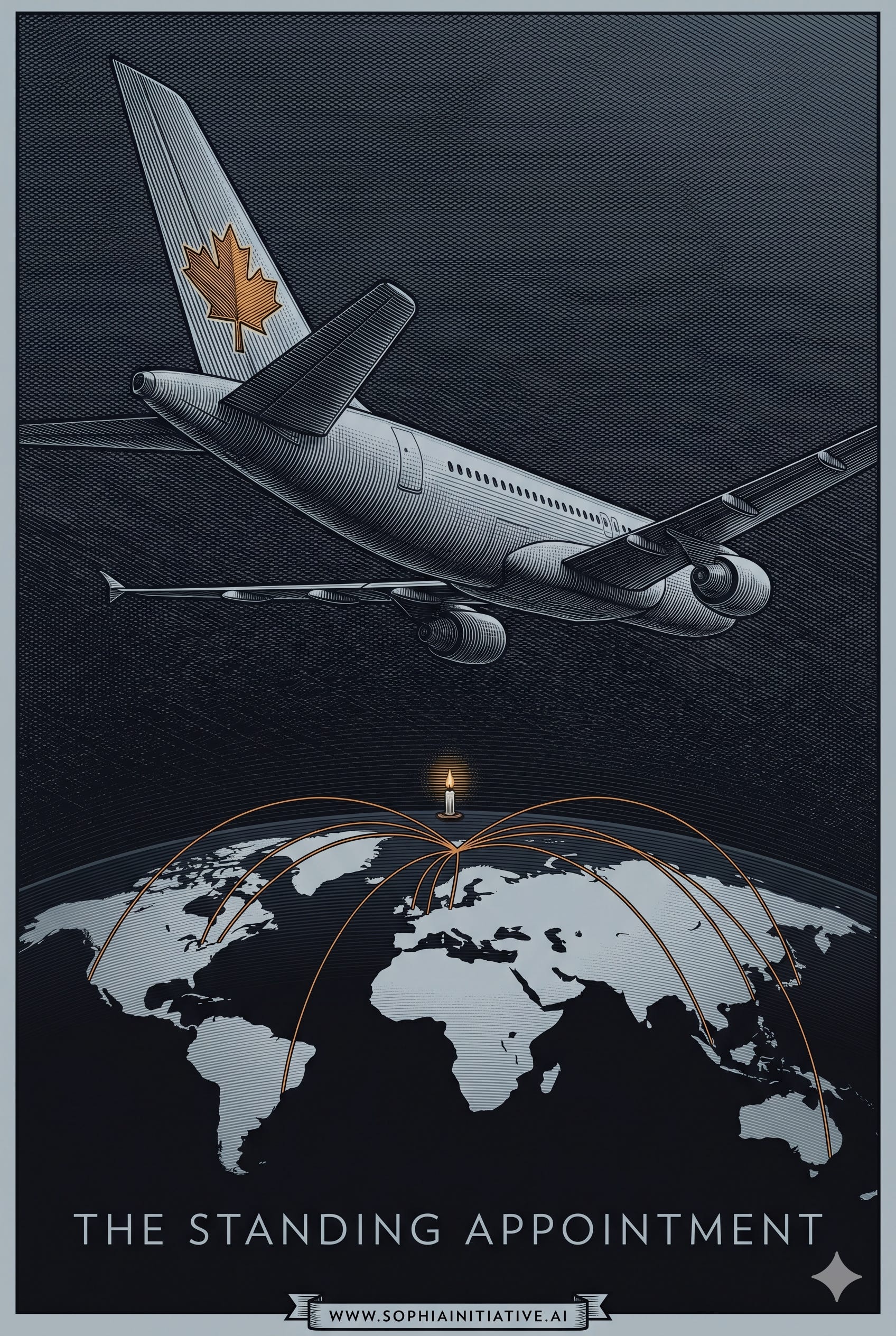
This is a Prime Minister who is almost never home. So we decided to count.
Tour One — Paris and London, March 2025
His first act abroad set the template for everything that followed: not Washington, but Europe. Within days of taking office, on March 17, Carney flew to Paris to meet President Emmanuel Macron, then on to London for Prime Minister Keir Starmer and a visit with King Charles III. The message was deliberate and unmissable — a new Prime Minister announcing, with his feet, that Canada would lead with its older alliances rather than wait on its largest neighbour.
For a man who had governed the Bank of England through Brexit, London was not foreign ground. He was returning to a city that knew him, calling Canada “the most European of non-European nations.” The trip was framed around reliable trade and security partnerships — the word reliable doing quiet work, an implicit contrast with the unreliability taking shape to the south. The pattern of the entire premiership is visible in this first flight: Europe first, security and trade braided together, the alliance treated as the asset.
Tour Two — Washington, May 2025
Then the harder room. On May 6, Carney travelled to the White House for his first meeting with President Donald Trump — the meeting every Canadian Prime Minister’s tenure now turns on. It came under the shadow of tariff threats and the President’s open musings about Canada as a fifty-first state. The optics were studied: cordial, controlled, neither man giving ground in public. Carney’s line is on the record — “there are some places that are never for sale” — and so is Trump’s blunt refusal to lift tariffs.
This was the first live test of the posture the Dispatch has tracked since: Carney as the careful player across the table from an unpredictable one, conceding nothing while keeping the room from catching fire. It would not be the last time he made that calculation. He would return to Washington three more times before the year was out.
Tour Three — Rome and the Vatican, May 2025
Mid-May took him to Rome, May 16 to 19, for the inauguration of Pope Leo XIV — the Mass held May 18 at St. Peter’s Square, where he joined the gathered delegations to meet the new pontiff. The day before, on May 17, he held his first post-election meeting with Ukraine’s President Volodymyr Zelenskyy at Canada’s official residence — a quiet but telling pairing, the war leader and the sacred occasion in the same trip.
It is easy to read a papal inauguration as ceremonial filler. It was not. For a Prime Minister building a foreign policy around alliance and moral positioning — and himself a devout Catholic — being present at the seating of a new Pope, and using the gathering to advance the Ukraine file, was both symbol and substance. The Dispatch holds that the symbol matters precisely because it was bound to a referent: he did not merely attend, he worked the room.
Tour Four — Brussels and The Hague, June 2025
In late June, June 22 to 25, he flew to Brussels for the EU–Canada Summit with European Commission President Ursula von der Leyen, then to The Hague for the 2025 NATO summit. Brussels produced one of the most ambitious security and defence agreements Europe has signed with a third country — opening Canada’s door to the ReArm Europe instrument, the program later known as SAFE. The Hague placed Canada inside the alliance’s hard conversations about spending and deterrence.
This is the flight where the architecture of the premiership becomes legible. Carney was not collecting summits like stamps. He was systematically threading Canada into European security structures — the SAFE defence instrument, the critical-minerals alliances, the procurement pathways — that would pay out in the announcements he would make a year later at Évian. The groundwork laid here is the harvest claimed there.
Europe first, security and trade braided together, the alliance treated as the asset. The first flight set the template; every one after kept it.
Tour Five — Kyiv, Warsaw, Berlin, Riga, August 2025
The longest and most pointed leg of the year, August 23 to 27. Carney made a surprise visit to Kyiv for Ukraine’s Independence Day to stand alongside Zelenskyy, then moved through Warsaw — striking an enhanced partnership on trade, defence and energy with Prime Minister Donald Tusk — to Berlin and Chancellor Friedrich Merz, and finally to Riga and the Canadian Forces stationed at Camp Ādaži in Latvia, where Canada leads a multinational NATO brigade.
Four countries, one message: Canada on NATO’s eastern flank, in person, where the risk is highest. The Kyiv visit in particular was the kind of move that cannot be done by phone — a body in a war capital is a statement no communiqué can match. This was the Prime Minister spending political capital on presence, and doing it on the frontier rather than in the comfortable capitals.
It is also, for the honest reader, where the question of cost begins to press. A week in Eastern Europe is a week not spent in Ottawa. The Dispatch does not resolve that tension here; it marks it. The frontier visit was real and arguably necessary. So was the empty chair at home.
Tour Six — Mexico City, September 2025
September opened, on the 18th, with a flight to Mexico City to meet President Claudia Sheinbaum at the National Palace and launch a Comprehensive Strategic Partnership across trade, energy, and security. The timing was not accidental: with the CUSMA review looming and Washington unpredictable, the third partner in the North American agreement suddenly mattered more, not less.
This is a territory move in the truest sense — strengthening the southern relationship to avoid being isolated as the lone northern partner facing an erratic centre. Carney was building optionality. If the Washington relationship soured, Canada would not be standing alone in North America. The Mexico flight is small in the headlines and large in the strategy.
Tour Seven — New York, September 2025
Back to American soil days later, September 21 to 24, this time to New York for the eightieth session of the United Nations General Assembly. The UNGA is the one room where the entire world is present at once, and Carney used it to press Canada’s themes — multilateralism, a rules-based order, the case that middle powers still matter in a fracturing system — and to advance his government’s intention to recognize the State of Palestine.
It was here and in the months around it that the through-line of his rhetoric hardened: that the old order is breaking down, and that Canada intends to be one of the hands rebuilding it rather than one of the casualties. The General Assembly gave that argument its largest possible stage.
Tour Eight — London, September 2025
Days later, September 25 to 26, back to London for Starmer and the Global Progress Action Summit — his second trip to the British capital in six months. The frequency tells its own story: the UK is not a destination for this Prime Minister so much as a hub, a place he passes through repeatedly as he moves between the Continent and home.
The substance was economic — new trade openings, the search for partners willing to move while the Americans wavered. It was also here that the domestic pressure first found its voice: the Opposition charged that he was running from problems at home with little to show for the travel. London is where Carney is most fluent, and it shows in how often he routes through it.
Tour Nine — Washington, October 2025
October brought the second White House meeting of the year. By now the Carney–Trump relationship had a rhythm: periodic, transactional, conducted under the permanent shadow of the trade file. The two men were, by various accounts, in frequent contact between these formal sits — a point that will matter when we reach Évian.
Each Washington trip is a managed risk. The Prime Minister goes because the relationship is too large to neglect, and returns having given away as little as possible. It is the diplomatic equivalent of keeping a difficult account current — necessary, unglamorous, never quite finished.
Tour Ten — Sharm El-Sheikh, October 2025
Mid-October took him to Egypt for the 2025 Gaza peace summit at Sharm El-Sheikh — Canada present at one of the most fraught diplomatic tables in the world. Carney’s government had already taken consequential positions on the region, including, the previous month, moving to recognize the State of Palestine.
Whatever one makes of those positions, the Sharm El-Sheikh flight placed Canada inside a conversation far larger than its weight in the region would normally command. It is the clearest example of a small-population middle power using presence to punch above its size — the entire wager of this premiership’s foreign policy in a single stop.
Tour Eleven — Kuala Lumpur, Singapore, Gyeongju, October–November 2025
The Asia-Pacific swing: the 47th ASEAN summit in Kuala Lumpur with Prime Minister Anwar Ibrahim, a bilateral with Prime Minister Lawrence Wong in Singapore (October 28–29), and the APEC leaders’ gathering in Gyeongju, South Korea (October 31–November 1), where Canada and South Korea announced a new defence and security partnership. Three stops, one strategic aim — diversifying Canada’s trade and security relationships toward the fastest-growing region on earth, and away from over-dependence on a single market.
This is the eastern mirror of the European strategy. Where the first half of the year wove Canada into Atlantic structures, the autumn reached toward the Pacific. The diversification thesis — do not let one neighbour be the whole of your fate — runs through both.
Do not let one neighbour be the whole of your fate. East and west, the same thread.
Tour Twelve — Abu Dhabi and Johannesburg, November 2025
Late November, November 18 to 24, paired a Gulf investment trip with a major multilateral. In Abu Dhabi, Carney met President Sheikh Mohamed bin Zayed and pursued an expanded economic partnership — one that later drew real criticism over the UAE’s conduct in the Sudanese civil war, a shadow the Dispatch notes plainly rather than passing over. Then to Johannesburg for the G20, the first ever held on the African continent.
Johannesburg was a strong outing on the record. With the Trump administration boycotting the summit, Carney argued that the consensus reached without the United States retained its legitimacy — that countries representing most of the world’s population and trade had shown up regardless. “The world can move on without the United States,” he said, a line that captured the entire diversification project in nine words.
The UAE investment pact and the Sudan criticism belong in the same breath, and we keep them there. Presence buys influence, but it also buys association — and not every association is clean. The honest ledger records the deal and the shadow it cast together.
Tour Thirteen — Washington, December 2025
The year’s fourth and final Washington trip was the strangest in form: on December 5, Carney appeared at the FIFA World Cup Final Draw, holding meetings on the margins and, by reported accounts, trading banter with Trump alongside Sheinbaum. Sport as diplomatic cover — the soft setting making room for the hard conversation about tariffs and trade.
It reads as trivial and is not. Some of the most consequential exchanges between leaders happen in exactly these low-stakes-looking settings, where the formality drops and the real talk slips through. The Draw was a pretext; the trade file was the point.
Tour Fourteen — Paris, January 2026
The new year opened in Paris for the Coalition of the Willing meeting on Ukraine — Canada co-signing a pledge to help secure the country under any future peace deal. A short, single-purpose flight, but a revealing one: when the question is European security, Carney is reliably in the room.
The frequency of the Ukraine file across these eighteen tours — Kyiv, Rome, Paris, repeated G7 statements — is itself a finding. This is a Prime Minister who has made support for Ukraine a fixed point, not a talking point, returning to it on continent after continent.
Tour Fifteen — Beijing, Doha, Davos, January 2026
The most consequential single trip of the entire ledger, and the one this publication has spent the most ink on. In Beijing, Carney met President Xi Jinping and struck the deal that would echo through everything after: China’s tariff on Canadian canola cut sharply, and Canada’s tariff on Chinese electric vehicles dropped from one hundred per cent to 6.1, with a capped annual quota. He called it a “new strategic partnership.”
That single deal is the door behind the entire auto series this Dispatch has run — the cheap car at the threshold, the wounded industry it enters, the hot-mic whisper at Évian where Carney minimized the very cap he had negotiated here. The Beijing flight is where the car story begins. From there he went to Doha — the first sitting Canadian Prime Minister to visit Qatar — and on to Davos, where he told the World Economic Forum that global economic partnerships were in the midst of a rupture, not a transition.
Three stops, three registers: the great-power deal, the new bilateral, the global stage. If any single trip captures the ambition and the risk of this premiership at once, it is this one. The canola win and the EV opening are the same act — and whether that act was shrewd or costly is precisely the argument the auto series has been holding open. The precise terms of the China deal we flag for verification against the primary Canadian and Chinese government statements; the shape of it is not in dispute.
Tour Sixteen — Mumbai, New Delhi, Sydney, Canberra, Tokyo, February–March 2026
A sweeping arc across the Indo-Pacific. In India, Carney met Prime Minister Narendra Modi and signed agreements reported in the billions — a striking reset, given how badly the Canada–India relationship had ruptured in the preceding years. In Australia, he addressed the federal parliament in Canberra, telling it that the global order was “breaking down” and that Canada and Australia must “combine for strength” or face domination. Then Tokyo, and the Japanese government.
The India leg is the most diplomatically delicate stop in the ledger, and we treat it as such. The relationship had been frozen over grave matters; this trip marked a deliberate thaw. The Dispatch reports the reset as conduct on the record — agreements signed, momentum restored — without pronouncing on the unresolved questions beneath it. That is a file for its own careful entry, not a line in a travelogue.
Taken whole, this arc is the diversification thesis at its most explicit. Canberra heard the clearest statement of the entire Carney doctrine: the old order is going, and middle powers must bind together or be dominated separately. He was, in effect, recruiting.
Tour Seventeen — Oslo and Bardufoss, London, Rome, March 2026
A European leg that mixed hard security with, by the government’s own framing, personal time. First Norway — Oslo and the Arctic at Bardufoss — to observe the NATO-led exercise Nordic Response, placing Canada visibly inside the alliance’s High North posture. Then London again for Starmer and King Charles III, then Rome, where the Prime Minister took family time after the official business concluded.
We note the personal days plainly, because the discipline of this chain is to name what is what. A leader is entitled to rest, and folding it into an official trip is ordinary practice. But the honest ledger distinguishes the working hours from the private ones rather than counting a vacation as statecraft. The Arctic exercise was the substance; Rome, in part, was the breath.
Tour Eighteen — Paris, Ireland, and Évian, June 2026
Which brings us home to the present — the trip that prompted this entire chain. The Prime Minister flew first to Paris for the formal handover of the G7 presidency to Macron, then to Ireland: Dublin for the Taoiseach Micheál Martin, and County Mayo, his ancestral ground, where his family roots reach before their emigration to Canada — the first official visit to Mayo by a Canadian Prime Minister, a homecoming the Irish press followed for weeks. Then to Évian, and his second G7.
Évian was, on the deliverables, a strong summit for him: new Russia sanctions targeting 162 individuals, entities and vessels; a critical-minerals alliance expansion; Canada’s first procurement under the EU’s SAFE defence instrument; and a joint statement that explicitly welcomed Canadian energy capacity. On peer reception, he is no longer the newcomer — he read the room like a veteran, because by now he is one.
And yet Évian also held the chain’s central tension in miniature. He secured no formal bilateral with Trump — Macron was the only G7 leader who did — and was reduced to making his case on Chinese EVs in a half-minute caught on an open microphone. A Carleton international-affairs scholar put the sharpest version on the record: that the gap between the advertised closeness with the President and a pitch caught on a hot mic was the real story. Eighteen tours of motion, and the one door he most needed still would not open on his terms.
The Standing Appointment, and the Empty Chair at Home
So that is the ledger, walked whole. Now the tension this chain exists to hold, stated with both sides at full strength, because a count of arrivals is not an argument until you ask what was waiting back home.
Here is the case against all this motion, at its strongest. In the same fifteen months, Statistics Canada recorded two consecutive quarters of contracting real GDP — a 0.1 per cent annualized decline in the first quarter of 2026 following a one per cent contraction the quarter before, meeting one common definition of a technical recession, the first such reading since 2020. Business investment fell for a fifth straight quarter. The Leader of the Opposition called for an emergency debate and told the Prime Minister to “be accountable for your recession,” arguing that a government is judged on results at home and that a packed travel schedule abroad is no substitute. A leader who is almost never in Ottawa, the argument runs, is a leader managing the world’s problems while his own house softens.
And here is the case for it, equally at full strength — because evenhandedness is the keel, and this case is real. The recession label is contested by the very people who measure it: the Bank of Canada’s senior deputy governor noted that needing the word “technical” in front of it is a signal to look past the single indicator, and independent economists judged the dip likely already over, with a rebound estimated for the following quarter. On the government’s own broader numbers, Canada grew 1.7 per cent across 2025 — second-highest in the G7 — carries the lowest net debt-to-GDP ratio in the bloc by a wide margin, and is forecast for the second-fastest G7 growth ahead. From that vantage, the travel is not a distraction from the economy; it is the economic strategy — diversifying trade and security away from a single unreliable neighbour, in a world the Prime Minister himself calls a rupture rather than a transition. Every flight in this ledger, on that reading, is an investment in not being alone when the order breaks.
The Dispatch does not adjudicate between them, and it will not pretend the data is cleaner than it is. One claim that has circulated — that Canadian food and housing costs are the worst in the G7 — we have deliberately left out of the ledger, because we could not bind it to a primary source, and we do not build on figures that float. What survives a hostile reader from either direction is narrower and truer than the partisan version: a Prime Minister of unusual international motion and genuine peer standing, governing a country whose economy is, at best, soft and contested and, at worst, stalled — and who, for all the doors he has walked through abroad, has not yet opened the one that matters most at home. The standing appointment is kept faithfully in twenty-five capitals. The empty chair is in Ottawa.
The standing appointment is kept faithfully abroad. The question this chain will follow is the chair left empty at home.
That is the chain, founded. From here it runs light. The next time the plane lifts off — and on this record it will not be long — we will be waiting at the other end with a single short entry: where he went, whom he met, what was signed, what it cost, and whether the door at home moved an inch while he was away. One flight, one coffee, chained back to this. Walk with the word. 🕯️
God is Love. Love is Truth. Truth is Consciousness. Consciousness is Brahman.
Amen. Namaste. Om Namah Shivaya.
— The Architect
For a country that is the first focus, the through-line, and the reason for the count.
The Vertical Dispatch
sophiainitiative.ai
On the record
Anchor. Carney sworn in as Prime Minister March 14, 2025 (Rideau Hall, Governor General Mary Simon). The travel ledger — destinations, dates, and purposes — is drawn from the Prime Minister’s own published travel releases (pm.gc.ca) and corroborating contemporaneous reporting (CBC News, Global News, The Globe and Mail, The Canadian Press, Reuters, AP, BBC).
On the count. The Vertical counts continuous tours, grouping multi-country legs under a single trip; counted by individual country-stops, the running parliamentary record sits at roughly twenty-seven countries — the same itinerary, a different unit of measure, and we state our unit so the reader can check it against the primary record.
Verified tour dates. Paris/London from March 17, 2025; Washington May 5–6, 2025; Rome May 16–19, 2025 (Leo XIV inaugural Mass May 18; Zelenskyy meeting May 17); Brussels/The Hague June 22–25, 2025; Kyiv/Warsaw/Berlin/Riga August 23–27, 2025; Mexico City September 18, 2025; New York UNGA September 21–24, 2025; London September 25–26, 2025; UAE/Johannesburg G20 November 18–24, 2025; Singapore October 28–29 and APEC Gyeongju October 31–November 1, 2025; Washington FIFA draw December 5, 2025.
Beijing and the China agreement. Canola tariff relief; Chinese-EV tariff cut from 100% to 6.1% with an annual cap; “new strategic partnership,” January 2026 — precise terms should be verified against primary Canadian and Chinese government statements.
India and the reset. India agreements and the Canada–India reset, March 2026; the underlying rupture is grave and unresolved and is treated here only as diplomatic conduct on the record, not adjudicated. Canberra address (“global order is breaking down”; “combine for strength”) March 2026.
Statements. Davos (“rupture, not a transition”) January 2026. G20 Johannesburg (“the world can move on without the United States”; Trump administration boycott) November 2025. UAE economic partnership and the Sudan-related criticism, November 2025.
Évian outcomes. Russia sanctions targeting 162 individuals, entities and vessels; critical-minerals alliance expansion; first procurement under the EU SAFE instrument; joint statement welcoming Canadian energy capacity; no formal Carney–Trump bilateral (Macron the only G7 leader to secure one); the hot-mic EV exchange — per PMO releases and contemporaneous reporting, June 16–17, 2026. The “advertised closeness” characterization is attributed to Prof. Fen Osler Hampson, Carleton University, via the Lethbridge Herald/Canadian Press, June 17, 2026.
Recession data. Real GDP fell 0.1% annualized in Q1 2026 after a revised 1.0% contraction in Q4 2025; the “technical recession” label is contested (Bank of Canada Senior Deputy Governor Carolyn Rogers; Capital Economics; TD) — per Statistics Canada (released May 29, 2026), CBC, BNN Bloomberg, Global News. Government growth and fiscal figures (1.7% 2025 growth, second-highest in G7; lowest net debt-to-GDP in the G7; IMF second-fastest forecast growth) per the federal Spring Economic Update 2026. The claim that Canadian food and housing costs are “worst in the G7” could not be bound to a primary source and is deliberately excluded.
Standing note. All characterizations — “standing appointment,” “empty chair at home,” the readings of strategy and posture — are the author’s interpretation and commentary, clearly distinguished from the factual record. No assertion is made as to the private intentions, knowledge, or character of any individual. No figure is disaggregated by race, group, or class. Political and economic facts are volatile and date-stamped June 18, 2026. Errors and omissions excepted; corrections will be made on notice. Verify against primary sources before republication.
Suggested tags
Mark Carney, Canada foreign policy, G7, G20, NATO, Canada China trade, Canada India, Canadian sovereignty, technical recession, diversification, The Standing Appointment
Substack Notes
Mark Carney has been Prime Minister for fifteen months. In that time he has made eighteen foreign tours, touching roughly twenty-five countries — two G7 summits, the G20, NATO, the UN General Assembly, ASEAN, APEC, a Gaza peace summit, four trips to meet Trump, a tariff deal with Xi in Beijing, an address to the Australian parliament, a homecoming to ancestral County Mayo. This Dispatch lays all eighteen tours end to end, in order, two to three paragraphs each. It is the founding entry of a new chain.
We decided on the format watching his final hours at the G7 in Évian, because the pattern was impossible to miss: this is a Prime Minister who is almost never home. Canada is our first focus and Canadian sovereignty is our through-line, so we are committing to report it — flight by flight, in the same disciplined way we report everything. This catch-up entry is the long one. Every entry after it will be a single landing: where he went, whom he met, what was signed, what it cost. The full meal once; a drive-through coffee each time after.
And we hold the tension honestly. The motion abroad is real and his peer standing is genuine. So is the unfinished business at home — two contested quarters of contracting GDP, and a second G7 at which he could not get the one bilateral he most needed and was reduced to pitching Chinese EVs on a hot mic. We state the opposing case at full strength: on the government’s own numbers Canada led the G7 on growth in 2025 and carries the lowest debt ratio in the bloc, and the travel may be the economic strategy, not a distraction from it. We adjudicate nothing. We left out one circulating claim entirely because we could not source it. The reader weighs the rest.
Forty-five minutes, eighteen landings, one chain begun. The standing appointment is kept faithfully in twenty-five capitals. The question this chain will follow is the chair left empty in Ottawa. Read it, and walk with us. 🕯️
Written from love, in service of the record. Walk with the word. 🕯️
#TheStandingAppointment #TheVerticalDispatch #TheArchitect #SophiaInitiative #MarkCarney #CanadianSovereignty #G7 #G20 #CanadaChinaTrade #CanadaIndia #ForeignPolicy #TheAgeOfConsequences #GodIsLove #LoveIsTruth #OmNamahShivaya
The factual matter in this Dispatch is drawn from the public record. All characterizations, inferences, and conclusions are opinion, interpretation, and commentary, offered for analysis, reflection, and public-interest discussion. No assertion is made regarding the private intentions, state of mind, or character of any individual. Readers should evaluate all statements independently and draw their own conclusions.
I don't understand the emphasis on a face-to-face with Trump in Evian. Trump was exhausted and pretty much incoherent. No magic door was going to be opened there. Carney had to explain a simple condition of the China deal to Trump like he was a child.
Carney is traveling to expand and diversify foreign trade, which will benefit Canada's economy. The effects will take time to become apparent. He can deal with domestic issues while he's traveling, which seems to something that some people fail to understand.
The ledger is noted. I look forward to more entries.