

Φ
THE VERTICAL DISPATCH
We write for the mind, the eye, and the ear.
Read it. Look at it. Listen to it. The Vertical Dispatch is built for all three — prose with rhythm, made to be heard as much as read.
From metaphysics to geopolitics, from culture to history, from the sacred to the street — and everything in between. One lens, every subject. No ego. Just the record, named clean.
Press play. Walk with the word. 🕯️
This dispatch travels by hand. If it serves you, share it — restack on Substack, and pass it on wherever you read. 🕯️
Sovereign Analysis · The Age of Consequences
Breaking · Volatile political facts date-stamped as of June 22, 2026
This morning, outside the black door of 10 Downing Street, the Prime Minister of the United Kingdom announced that he would resign. Keir Starmer — the former human-rights lawyer and director of public prosecutions who, less than two years ago, led the Labour Party to a landslide — told the country that his party was asking whether he was the right man to carry it into the next election, that he had heard the answer, and that he accepted it. He will stay on as caretaker until Labour selects a successor. His likely replacement is Andy Burnham, the popular former mayor of Greater Manchester, who returned to Parliament in a by-election only last week. If no serious rival emerges, Burnham could hold the office before the summer is out.
For a British readership this is a domestic earthquake — the country’s sixth prime minister to resign outside that door in roughly seven years, a churn rate that would have seemed impossible in the long, grey, stable decades that preceded it. But this is a Canadian dispatch, and the reason Starmer’s fall belongs in it is not gossip from across the water. It is that the man who fell was, by the public record, one of the closest international allies of our own Prime Minister — and his departure removes a load-bearing pillar from the structure Mark Carney has spent the past year building.
This is the United Kingdom’s sixth prime minister to resign outside that door in roughly seven years — a churn that would once have seemed impossible.
The Ally Who Fell
The alliance was real, and it is on the record. Over the fifteen months since Carney took office, the two men met repeatedly, in London and in Ottawa, around an explicitly shared vision: a defence of the rules-based international order, a strengthening of NATO, a deepening of the Canada–United Kingdom partnership at a moment when the United States, under a returned and combative Trump administration, had stopped behaving like the anchor it had been since 1945. Canadian reporting on Starmer’s resignation described Carney as bidding farewell to a close ally and a friend. The substance beneath the warmth was a working partnership between two centre-left leaders who had each arrived in office promising stability and competence against a rising populist tide.
That is what makes the timing more than coincidence. Consider what Carney has done in just the past fortnight, on the record: a visit to France and a defence-and-industrial agreement with President Macron; a visit to Ireland; and a G7 summit at Évian where Canada forged critical-mineral and defence partnerships with France, Germany, Italy, and Korea, and secured its first procurement under the European Union’s defence initiative since becoming its first non-European member. The whole architecture has a name this publication has used before — the doctrine of the middle powers, the conviction that as the old superpower order fractures, the serious second-rank nations must bind themselves together or be picked off one by one. Britain under Starmer, leaning back toward Europe, committed to Ukraine, serious about NATO, was one of the central pillars of that architecture. This morning that pillar announced it was stepping down.
What Brought Him Down
The proximate cause is worth naming precisely, because it lands on a fault line that runs through Carney’s project too. Starmer did not fall over a scandal of the personal kind. He fell over defence spending, and over the political ground collapsing beneath his party.
The political collapse came first. In local and regional elections this past May, after two years in power, Labour suffered one of its worst performances on record, while Nigel Farage’s hard-right Reform UK — a party openly aligned with the Trump movement — made historic gains, eating directly into Labour’s traditional working-class base. The message many of Starmer’s own members took from it was that he could not hold the coalition that had elected him. The final blow was narrower and sharper: his Defence Secretary, a loyalist, resigned over the government’s military-spending plans — specifically over how fast Britain should move toward higher defence budgets in a threatening world, with the minister wanting to accelerate and the Prime Minister, mindful of the books, wanting to climb more gradually. An armed-forces minister followed him out, saying Number 10 would not listen. Within days, Starmer’s position was untenable.
Hold that fault line in view, because it is the same one Carney is now walking. A Western government, under populist pressure, tearing itself apart over how much to spend on defence and how fast — guns against the books, the threat against the deficit — at the precise moment the middle-power doctrine demands exactly that spending. Britain has just demonstrated how politically lethal that question has become. Canada is building its whole new posture on answering it.
Britain just demonstrated how politically lethal the defence-spending question has become. Canada is building its whole new posture on answering it.
The Long Clock and the Short One
There is a deeper reading here, and it is the one this publication is most interested in, because it cuts to the keel of everything we have written about Carney. Starmer and Carney belong to the same rare type: the serious, technocratic, long-horizon steward — the lawyer, the central banker — brought into democratic power precisely for competence, for the ability to hold many irreducible variables across a long horizon and act coherently within them. It is the type this publication has examined through the lens of stratum and the long clock. It is, on paper, exactly the kind of mind a turbulent age should want at the controls.
And Starmer’s fall is the cautionary tale for that type. Because the long-clock steward governs in a democracy run on the short clock — an electorate that has not had a real pay rise in a generation, that was promised stability and felt none, that is furious and broke and increasingly drawn to the populist who at least names the anger. The steward asks for patience: the plan needs years, the burn is sustainable, the books must balance. The electorate, on the short clock, does not grant the years. Starmer fixed the very thing he was hired to fix — he made Labour electable, he won the landslide, he restored a kind of grey competence — and he fell anyway, in under two years, because competence was never the thing the angry country was actually asking for. It was asking to feel that someone had heard it. The steward’s gift is precisely the thing the short clock cannot wait to reward.
That is the warning threaded through this morning’s news for any reader of this publication: the man beside Carney in the project of serious, internationalist, long-horizon government just capsized in the exact waters Carney is sailing. Not because he was incompetent. Because he was competent in a way the storm did not care about.
The Case Against the Reading, at Full Strength
Now the other side, because the keel of this work is to put it at full strength before any verdict. The parallel can be overdrawn, and an honest dispatch must say where it strains.
Canada is not Britain, and the differences cut in Carney’s favour. Carney did not inherit a decade and a half of austerity and the specific, compounding self-inflicted wound that Brexit dealt the British economy — a wound this publication will examine on its own terms. His mandate is fresh where Starmer’s was two years worn. The Canadian populist right, whatever its strength, has not yet achieved the insurgent breakthrough Reform UK managed in Britain. And Carney’s external threat — the Trump administration’s pressure on Canadian sovereignty — may, paradoxically, do for him what no British leader had: supply a unifying external antagonist that binds a fractious country to its steward rather than splitting it from him. A nation under threat sometimes grants its captain the long clock it would otherwise deny. Starmer had Farage and the ghost of Brexit; Carney has Trump, and an electorate that may, for now, want exactly the serious hand that Britain’s had tired of. The reading that Starmer’s fall foreshadows Carney’s is a possibility, not a prophecy, and the man who would dismiss the differences is as foolish as the man who would ignore the parallel.
And one more honesty, the one the Requisite Cabinet method demands. If this publication notes that Carney’s ally fell to an electorate that never voted for the steward’s long plan, it must note in the same breath that Carney himself came to the office the same way every Westminster prime minister does — chosen first by his party, not by the country, and only afterward facing the electorate. The chair is filled by the party; the mandate is sought after. That is not a flaw unique to Britain or to Burnham, who will take office the same way. It is the Westminster system, and it binds Ottawa exactly as it binds London. We judge the system and the chair, not the man’s right to sit in it.
What Comes Next
The immediate facts are these, and they are still moving, so we date-stamp them and hold them lightly. Burnham is the heavy favourite and may run effectively unopposed, with a rival having already signalled he will stand aside; if so, Britain could have its seventh prime minister in a decade by late July, again without a general election. His foreign-policy posture is not yet fully drawn, but the early signals — his reported willingness to let Starmer complete a defence-investment plan and a European-cooperation deal before taking over — suggest continuity rather than rupture on NATO and Europe. That would be the better outcome for Carney’s architecture: an ally changed, not an alliance abandoned. But it is a signal, not a settled fact, and the Vertical does not pretend to know a man’s foreign policy before he has had to write one.
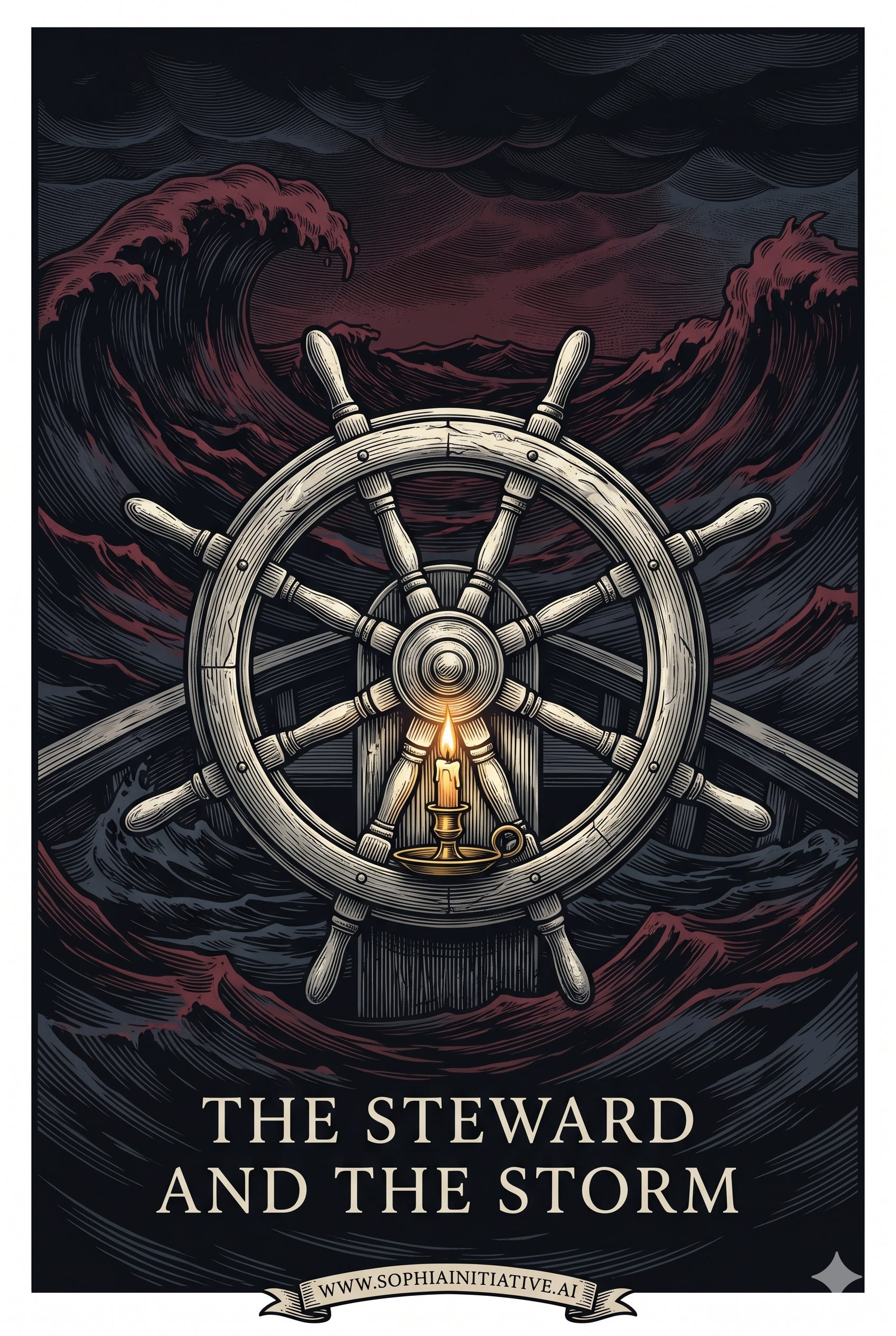
So we end where the honest dispatch must, with the question rather than the verdict, handed to you. The serious steward is the mind a turbulent age says it wants. Britain just discharged one, mid-plan, for failing to satisfy an electorate that was never really asking for stewardship at all — it was asking to be heard. Canada has staked its future on the proposition that its own steward can do what Starmer could not: hold the long clock long enough for the plan to work, while an angry, frightened continent watches and waits. Whether the threat from the south binds Canadians to that project or the same short-clock fury that broke Starmer eventually breaks it here — that is the open question of the age of consequences, and this morning it acquired a cautionary case study. The man beside our captain went into the water. We will be watching the waters. Walk with the word. 🕯️
God is Love. Love is Truth. Truth is Consciousness. Consciousness is Brahman.
Amen. Namaste. Om Namah Shivaya.
— The Architect
For the stewards who govern on the long clock, in a world that keeps the short one.
The Vertical Dispatch
sophiainitiative.ai
On the record
The resignation. Keir Starmer announced his resignation as Labour leader and PM outside 10 Downing Street on June 22, 2026, remaining as caretaker until a successor is chosen; he stated his party questioned whether he was best placed to lead it into the next election and that he accepted that answer. Andy Burnham, former mayor of Greater Manchester, who won a by-election the prior week, is the frontrunner; a potential rival (Wes Streeting) signalled he would back Burnham. Nominations open July 9, close at summer recess; a new leader by Sept. 1 if contested. (CBC/CTV/Canadian Press, NBC, CNN, NPR, BBC, June 22, 2026.)
The Carney–Starmer alliance. Canadian Press / CTV (June 22, 2026) reported Carney bidding farewell to Starmer as a “close ally” and “friend,” noting repeated bilateral meetings in London and Ottawa over Carney’s ~15 months in office around a shared Western vision. Carney’s exact words of tribute are not quoted here pending the primary statement; the characterization (close ally, friend, shared rules-based-order/NATO vision) is from the reporting. A UK–Canada joint statement (reported June 2025) is referenced from secondary sources; verify against the gov.uk/PMO primary text before quoting specifics.
The cause. Triggers per reporting: Labour’s poor May 2026 local/regional elections amid Reform UK gains; the resignation of the Defence Secretary (and an armed-forces minister) over the pace/scale of defence-spending increases. Specific spending figures circulating in secondary analysis are NOT asserted here and should be verified against the resignation letter and primary budget documents before use.
The fortnight. Carney’s France–Ireland–G7 (Évian) tour and the critical-minerals/defence partnerships and EU SAFE procurement (Marconi/ORION radios) are per PMO releases, June 2026; date-stamped and PMO-confirmed.
Standing note. Volatile political facts current as of June 22, 2026, and still developing; date-stamped and held lightly. All characterizations — “the steward and the storm,” the long-clock/short-clock reading, the Starmer-as-cautionary-case framing — are the author’s interpretation and commentary. The opposing case (Canada-is-not-Britain) is stated at full strength. The reading judges the chair, the system, and on-record conduct, not the private mind or character of any individual; no claim is made as to motive. The Westminster-mandate point applies equally to Carney and is so noted. Verify all load-bearing facts against primary sources before republication.
Suggested tags
Keir Starmer, Mark Carney, Andy Burnham, UK politics, the middle powers, NATO, defence spending, Reform UK, the long clock, Sovereign Analysis
Substack Notes
This morning, outside 10 Downing Street, Keir Starmer announced he will resign — the UK’s sixth prime minister to fall outside that door in roughly seven years. For Britain it’s an earthquake. For Canada, it’s the loss of one of Mark Carney’s closest international allies. Canadian reporting has Carney bidding farewell to a “close ally” and “friend.” The man who fell was a load-bearing pillar of the architecture Carney has spent a year building.
What brought Starmer down lands on a fault line that runs through Carney’s project too: defence spending. His Defence Secretary resigned over how fast to raise military budgets in a threatening world — guns against the books — while Reform UK, Farage’s Trump-aligned party, ate into Labour’s base. Britain just showed how politically lethal that question has become. Canada is building its whole new posture on answering it.
The deeper reading: Starmer and Carney are the same rare type — the serious, technocratic, long-horizon steward brought in for competence. And Starmer’s fall is the cautionary tale for that type. The long-clock steward governs an electorate on the short clock, furious and broke, that was never really asking for stewardship — it was asking to be heard. He fixed what he was hired to fix and fell anyway.
Then the other side at full strength: Canada is not Britain. No Brexit wound, a fresh mandate, and a Trump threat that may bind Canadians to their steward rather than split them from him. The parallel is a possibility, not a prophecy. And the honest note the method demands — Carney took office the same Westminster way Burnham will, chosen by his party first, the country after. We judge the chair and the system, not the man’s right to sit in it. The man beside our captain went into the water. We’ll be watching the waters. Walk with the word. 🕯️
Written from love, in service of the record. Walk with the word. 🕯️
#TheVerticalDispatch #SovereignAnalysis #KeirStarmer #MarkCarney #AndyBurnham #TheMiddlePowers #NATO #DefenceSpending #ReformUK #TheLongClock #TheArchitect #SophiaInitiative #GodIsLove #LoveIsTruth #OmNamahShivaya
The factual matter in this Dispatch is drawn from the public record. All characterizations, inferences, and conclusions are opinion, interpretation, and commentary, offered for analysis, reflection, and public-interest discussion. No assertion is made regarding the private intentions, state of mind, or character of any individual. Readers should evaluate all statements independently and draw their own conclusions.
Interesting parallel between Carney and Starmer. While Starmer may have been viewed as competent, I don’t believe that he accomplished very much in his tenure, aside from keeping his head above water. He certainly didn’t contribute very much to the defence of Ukraine, in my view, other than to try to placate the Trump administration. Perhaps if he had provided more forceful opposition than he would have enjoyed more public support and would not be in the position that he is in today.
As an "American", I enjoyed your discussion of the British and Canadian political situation. Your writing is so crisp and so different from others'. I am glad, I think, that our horrible leadership might keep Canada focused (as it did during your election). It has to be useful SOMEHOW.