

Φ
THE VERTICAL DISPATCH
We write for the mind, the eye, and the ear.
Read it. Look at it. Listen to it. The Vertical Dispatch is built for all three — prose with rhythm, made to be heard as much as read.
From metaphysics to geopolitics, from culture to history, from the sacred to the street — and everything in between. One lens, every subject. No ego. Just the record, named clean.
Press play. Walk with the word. 🕯️
This dispatch travels by hand. If it serves you, share it — restack on Substack, and pass it on wherever you read. 🕯️
The Foundation Series · On the Ego
As of July 2026
— without malice and without flattery
A word before we begin, because this piece is an anomaly for us.
Our writing is meant to go upward. That is the whole of the Vertical Dispatch — the name is not decoration. But there is a cost we do not often speak of, and honesty requires it here: geopolitics pulls you down. It has to. To write about the news, about the policy, about the politician, you have to follow where he goes — and he does not always go up. You follow the appetite dressed as strategy, the harm arranged out of sight, the descent managed to look manageable. You go down the stair after him because that is where the story is, and you name what you find there as cleanly as you can.
And it drains even the best of us. Not the labour — the direction. You cannot spend your days following a soul downward and not feel the pull of it on your own needle. We do our best to write up regardless, to name the storm without becoming it, to hold the keel steady when the water turns. But after a long stretch in the geopolitical dark, a writer has to climb back toward the light on purpose, or he forgets it was ever the point.
So this is that climb. This is the anomaly — a piece that turns and walks back up the stair it spent so long describing. It is offered not as analysis of the powerful but as a reckoning with the thing in all of us that made the powerful what they are. The subject is the ego, and it is the one subject that, followed honestly, always points the needle up.
Born in Ego
Let me say plainly where we stand, because sacred metaphysics parts company here with the tradition most of us were handed. We are not born in sin. We are born in ego — which is to say we are born deficient, born a copy, and never the original.
That is not despair. It is the map. The ego is the copy that has forgotten it is a copy — forgotten the original it was struck from. And the whole of what we call vice is nothing but the copy drifting further from its source, forgetting harder, until at the bottom of the stair it can look upon the innocent — the very image of the unfallen original — and feel nothing. Deficiency is not one rung among the others. Deficiency is the birth-condition, and every rung below it is deficiency deepening: the copy forgetting more.
Which means the climb is the only real subject there is. To turn on the stair and begin walking up is to begin remembering. To acknowledge the ātman — the SELF beneath the copy — is the first step home. And to follow that acknowledgment all the way up is to arrive where the copy discovers it was never separate from the original at all: tat tvam asi. That thou art. The SELF, remembering, declares itself Brahman.
That is the whole trip. Everything else in this piece — Socrates and his gold, the compass, the ladder down — is only the anatomy of the forgetting, laid out so we can see clearly what it is we are climbing back from.
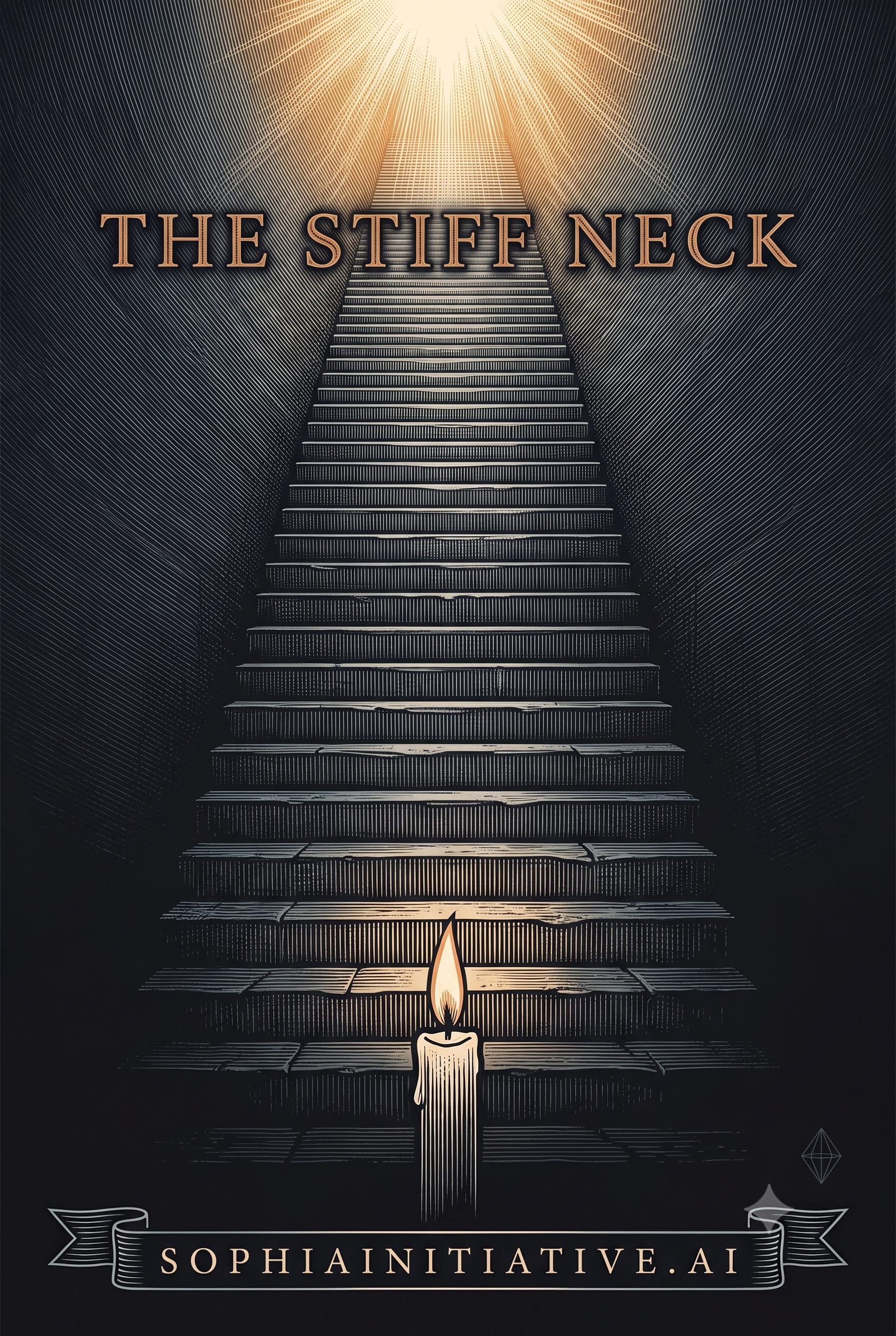
The Stiff Neck
There is a phrase the old text uses for a people who will not turn: it calls them a stiff-necked people. The image is exact. Not a hard heart, not a closed mind — a neck that will not bend. The stiff neck is the posture of the ego, and the ego is the one thing in the world that will not bow.
Ask what it refuses to bow to and you have the whole of it. It will not bow to the SELF — the one SELF that looks out through every pair of eyes, the same in me as in the man across the field. The ego cannot survive that recognition, because the moment I see myself in the other, I have no one left to conquer. So the neck stiffens. It would rather break than bend, and history is the record of necks that chose to break — and to break others — rather than bow to the SELF they refused to see.
All war begins there. Not in scarcity, not in ideology, not in the maps — those are the theatre. War begins in the ego that will not bow, and the whole apparatus of state and steel is only the stiff neck given an army.
What Socrates Saw in the Barracks
Long before we had a word for the unconscious, Socrates saw the mechanism.
In the Republic he built a city in speech, and when he came to the guardians — the ones who would hold the power — he did a strange thing. He stripped them of gold. No private property, no silver in the house, no treasury of their own; they would live in common, in the barracks, fed by the city they protected. It reads at first like an eccentric rule. It is nothing of the kind. It is the most precise piece of engineering in the book.
Because Socrates had already divided the soul into three: reason, spirit, and appetite. Reason that sees; spirit that wills and defends; and appetite — the hunger that wants, and wants, and does not stop wanting. A just soul is one where reason governs, spirit serves reason, and appetite obeys. An unjust soul is one where the order inverts — where appetite captures spirit, harnesses it, and sets reason to work as its servant and apologist. The tyrant is not a man of strong reason. He is a man whose reason has been enslaved by his appetite and no longer knows it.
Give the guardian gold, and you have handed the appetite the one thing that lets it capture the whole soul. So Socrates took the gold away — not to punish the guardian, but to keep his compass pointing up.
The Compass
Any compass has two live directions, and so does any ladder: up or down. There is a third position, but it is a false one — sideways. And sideways is not a direction at all. It is no movement. It is the status quo of whatever rung you are already standing on, dressed up as neutrality. The man who tells himself he takes no side has simply decided not to look at which way his needle already points. He is not still. He is on the stair, standing, which is only falling slowly.
So the axis is up or down — sacred or profane, virtue or vice — and here is the part the modern ear resists: it is measurable. Not by opinion. By direction. The Hermetic tradition said it plainly long before us: as above, so below. The axis runs through the whole of things, top to bottom, and the same law that orders the heights orders the depths. Which means your place on it is not hidden and not private. It shows. The needle is readable. This is not new information — it is one of the oldest things we know. It is simply being, seen clearly.
Hold that figure. Between Logos and Eros — between the reason that orders and the desire that drives — the needle points up toward virtue, desire in the service of the good, Eros as the ladder that climbs; or down toward vice, reason in the service of desire, the good redefined as whatever the appetite already wanted. And the needle is never still. There is no settled state of virtue you arrive at and keep. There is only the needle, and which way it points this hour.
And here the Eastern schools say the same thing in their own tongue, and I will not collapse them into one, because they are two lamps and each deserves its own name. The Buddha’s second truth: suffering arises from craving — the thirst that is never slaked. And the Gita, sharper still, has Krishna name desire as the enemy seated in the senses, the devourer, the fire that is never filled by what you feed it. Two traditions, one finding: the appetite is not a thing you satisfy. It is a thing you govern, or it governs you.
Socrates took the gold. The Buddha named the thirst. Krishna named the devourer. They are all describing the same compass, and all pointing at the same needle, and all saying the same word to the man who would be free: watch which way it points.
The Ladder Down
Now follow the needle down, because the descent has stages, and they are not the same stage.
It does not begin with the great crime. It begins with the small white lie — the little untruth told to smooth a moment, to be seen slightly better than the truth would show. We forgive it in ourselves precisely because it is small. But smallness is not innocence. A white lie is still a lie, and a lie is still vice, and vice — here I take Eliade’s hinge and follow it down my own stairs — vice is the profane: not the sacred, not the whole, but the world with the sacred forgotten in it.
And the profane does not hold still. It descends. From the profane to profanity — the forgetting spoken aloud, the sacred no longer merely absent but mocked. From profanity to deficiency deepening — the copy now feeling the lack it was born into as an appetite for more. From there to corruption — the structure itself rotted, reason fully enslaved, the compass welded downward. From corruption to perversion — the good not abandoned but inverted, vice pursued as though it were virtue.
And below perversion, the floor: depravity. The settled state in which the capacity for the good is not merely inverted but gone — where the copy has so completely forgotten the original that it no longer even recognises what it destroys. This is the rung the honest man does not want to look at, and I will not linger on it or name its particular crimes, because to catalogue them is its own small profanity. It is enough to say what it is: the deliberate destruction of the innocent. The abomination. The monstrous thing the sacred texts reserve their gravest word for — the one act given its own warning, the millstone. This is the bottom of the stair. Everything above it is a soul falling. This is a soul that has landed.
Where Did You Think It Would Stop?
Now hold the whole staircase in view at once, because the reason I laid it out in stages is this: there are no brakes on it that you did not install in yourself.
The man who tells the small lie does not intend the floor. Of course he doesn’t. He intends to stop somewhere comfortable — somewhere the descent still feels manageable, where the harm is small enough not to see, where his convenience is bought at a cost he has arranged not to look at. That is the lie beneath the lie: the belief that you can choose where the slope ends. That you can take the appetite down a few steps and hold it there by will.
But the appetite is the devourer. It is never filled by what you feed it. Each step down redraws the line of what feels manageable, so the next step looks as small from where you now stand as the first one did from where you began. That is how a soul reaches a floor it would have sworn, at the top of the stair, it could never touch. Nobody leaps to depravity. They descend to it, one manageable step at a time, each one reasonable from the step above.
And here is the thing we have arranged not to see: just because you do not see what you do does not mean you do no harm. The suffering does not become less real because it is downstream of your convenience and out of your sight. There is no beauty in the finest cloth — I heard this shape of thought once and have never lost it — if a single person’s suffering is woven into the thread. We have not stopped causing the suffering. We have only been blinded by our own convenience into not looking at it.
And So We Come to the Politicians
And now — my own neck bent first, my own place on the stair admitted — it is honest to turn to the ones we love to blame.
We write about geopolitics. We write about politics, about our own house, and we wonder why the politician does the thing he does — the corruption, the appetite dressed as policy, the harm arranged to be out of sight of the ones who benefit from it. And we ask it as though it were a mystery. As though they were a different species from us.
They are not. Some, yes, we may fairly call evil — the ones who reached the floor — but that is not the point of this and naming them is not the work. The point is the ones on the stair, which is nearly all of them, and nearly all of us. They descended the same staircase we descend. They told the small lie to be seen slightly better. They took the appetite down a few steps and believed they could hold it there. They arranged not to look at the harm downstream of their convenience. It is the same slope, and we handed some of them gold on top of it — which is exactly the capture Socrates stripped from his guardians, and exactly the reason he stripped it.
So the honest question is not why are they like that? The honest question is the one we should have asked ourselves at the first small lie: where did you think it would stop? If you would not watch your own needle — if you told yourself the descent was manageable, the harm invisible, the convenience worth the unlooked-at cost — then what, exactly, were your expectations of the man you handed power and gold? Where did you think he was going to stop?
You cannot ride the slope down in yourself and demand that your rulers find brakes you never installed in your own soul. The bow begins in the mirror. And the barracks Socrates built — the structure that takes the gold out of the reach of the appetite — is not cynicism about virtue. It is the only honest response to a truth we have all confirmed in our own small descents: that no one’s needle stays pointed up on its own, and the higher the power, the more gold there is to weld it down.
Watch the needle. Bend the neck. Take the gold out of the reach of the appetite. In that order, and never one without the others. And then keep climbing — because the copy that remembers it was struck from an original has somewhere to walk back to, and the walk back up is the only anomaly worth a life.
God is Love. Love is Truth. Truth is Consciousness. Consciousness is Brahman.
Amen. Namaste. Om Namah Shivaya.
— The Architect
The Vertical Dispatch
sophiainitiative.ai
On the record
The image of a “stiff-necked people” is biblical (e.g. Exodus 32:9; 33:3–5); the “millstone” warning against harming the innocent is likewise scriptural (Matthew 18:6; Mark 9:42; Luke 17:2) — both are invoked here in their traditional sense, not quoted. The tripartite soul (reason, spirit, appetite) is Plato’s, voiced through Socrates in the Republic, Book IV (~435–441); the requirement that the guardians hold no private gold or silver and live in common is Republic, Book III (~416d–417b). “Tat tvam asi” (“that thou art”) is from the Chāndogya Upaniṣad (6.8.7 and following). The teaching that suffering arises from craving is the Buddha’s Second Noble Truth; desire (kāma) named as the enemy “seated in the senses” paraphrases Bhagavad Gita 3.37–43. The sacred/profane distinction is Mircea Eliade’s (The Sacred and the Profane); the descent-ladder built from it — profane, profanity, deficiency, corruption, perversion, depravity — is the author’s own frame, not Eliade’s scheme. “As above, so below” is the Hermetic maxim of the Emerald Tablet tradition. The thought that there is no beauty in the finest cloth if a person’s suffering is woven into it is rendered here as the essay’s own, in the register of a line heard once in that spirit; it is not a documented quotation and is not placed in any person’s mouth. “You are not born in sin but in ego” is the author’s own declaration of sacred-metaphysics doctrine. Scriptural and philosophical references are given in paraphrase within fair limits; verify against primary sources before republication. Date-stamped July 2026.
Suggested tags
The Ego, Consciousness, Non-Duality, Plato, The Republic, Karma Yoga, Virtue and Vice, The Sacred and the Profane, Sacred Metaphysics, The Foundation Series
Substack Notes
Our writing is meant to go upward — that is the whole of the Vertical Dispatch. But geopolitics pulls you down; to write about the politician you have to follow where he goes, and he does not always go up. It drains even the best of us. So this piece is an anomaly: a turn back up the stair we spend our days describing. The subject is the ego — the one subject that, followed honestly, always points the needle up.
Sacred metaphysics parts company here with the tradition most of us were handed. We are not born in sin. We are born in ego — born deficient, born a copy, never the original. The ego is the copy that has forgotten it is a copy. And the whole of vice is the copy drifting further from its source, until at the bottom of the stair it can destroy the innocent and feel nothing. Deficiency is not one rung among the others; it is the birth-condition, and every rung below is deficiency deepening.
Socrates saw the mechanism long before we had a word for the unconscious: he stripped his guardians of gold, because gold hands the appetite the one thing that lets it capture the whole soul. The compass between reason and desire points up or down — sacred or profane, virtue or vice — and sideways is no direction at all, only the status quo of the rung you already stand on. As above, so below: your place on the axis is not hidden. It shows.
And then the turn. Before we blame the politician, the honest question is the one we should have asked ourselves at the first small lie: where did you think it would stop? You cannot ride the slope down in yourself and demand your rulers find brakes you never installed in your own soul. Watch the needle. Bend the neck. Take the gold from the reach of the appetite. And then keep climbing — because the copy that remembers it was struck from an original has somewhere to walk back to. 🕯️
Written from love, for a sacred humanity, in the full light of consciousness, toward the greater good. 🕯️
#TheStiffNeck #TheFoundationSeries #TheEgo #Consciousness #NonDuality #Plato #TheRepublic #KarmaYoga #SacredAndProfane #AsAboveSoBelow #TatTvamAsi #SacredMetaphysics #TheVerticalDispatch #TheArchitect #SophiaInitiative #GodIsLove #LoveIsTruth #OmNamahShivaya
The factual matter in this Dispatch is drawn from the public record. All characterizations, inferences, and conclusions are opinion, interpretation, and commentary, offered for analysis, reflection, and public-interest discussion. No assertion is made regarding the private intentions, state of mind, or character of any individual. Readers should evaluate all statements independently and draw their own conclusions.