

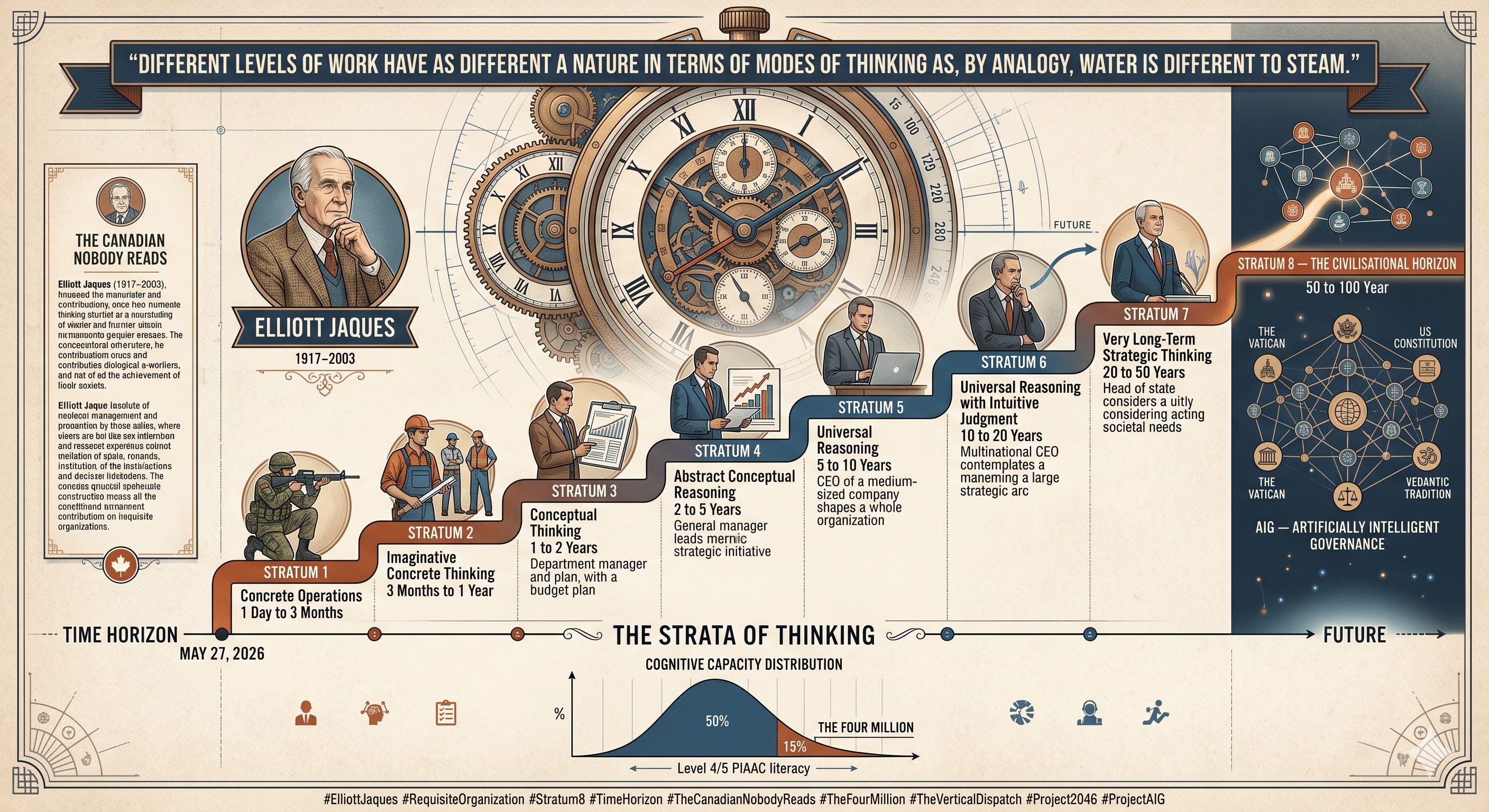
“Different levels of work have as different a nature in terms of modes of thinking as, by analogy, water is different to steam.”
— Elliott Jaques, Requisite Organization (1996)
The Vertical Dispatch
Sovereign Analysis · Glen Roberts, The Architect
The Age of Consequences
May 27, 2026
I. The Canadian Nobody Reads
Elliott Jaques was born in Toronto on January 18, 1917. He died in Gloucester, Massachusetts on March 8, 2003, at the age of eighty-six. Between those two dates he served as a psychiatrist in the Canadian Army during the Second World War, trained in psychoanalysis in London under Melanie Klein, co-founded the Tavistock Institute of Human Relations in 1946, conducted thirty years of empirical organizational research at the Glacier Metal Company in England beginning in 1948, founded the School of Social Sciences at Brunel University in 1964, wrote more than twenty books, coined two phrases that have entered the global vocabulary — corporate culture and midlife crisis — and developed the most empirically grounded theory of human cognitive capacity and organizational structure ever produced in the twentieth century. The theory is called Requisite Organization. It rests on a measurement instrument called the time-span of discretion. It identifies that human beings sort along seven discrete strata of cognitive capacity, each corresponding to a specific time horizon. The framework has been adopted by the United States Army Research Institute, the Australian Department of Defence, the Catholic Church, and major corporations across four continents.
Most Canadians have never heard of him.
That sentence is the dispatch. The country produced the most important organizational theorist of the twentieth century and has not, in any systematic way, absorbed his work into its own governance architecture, its own educational curriculum, or its own political conversation. The framework he built is foreign to the country that built him. The publication has been citing his work implicitly across the spring of 2026 — every reference to Stratum 8 thinking, every invocation of the twenty-year horizon, every appearance of the appointing question who appointed you — is Jaques doing the work in the publication’s voice. This dispatch makes the framework visible the way the PIAAC dispatch made the literacy framework visible. The Jaques prior is the second of the publication’s two priors. PIAAC names the floor. Jaques names the ceiling. Both are the architecture the publication has been operating inside without naming explicitly. The naming is the work of this filing.
II. The Glacier Years
In 1948 the Tavistock Institute, then two years old, sent its most promising young researcher to the Glacier Metal Company in northwest London. The company manufactured bearings for industrial machinery. Its managing director, Wilfred Brown, had asked Tavistock for help understanding why his organization was not the way he expected it to work. Jaques arrived as a thirty-one-year-old psychoanalyst with a Harvard doctorate in social relations and a hypothesis that the answer lay in the unconscious group dynamics of the workforce. Three years into the engagement he had concluded that the unconscious group dynamics were real but were not the answer. The answer was structural. The organization was assigning tasks to people whose cognitive capacity did not match the time horizon the tasks required. He began to measure.
What he measured was the longest task an individual could complete without supervisory check. He called it the time-span of discretion. A frontline assembler’s longest independent task ran days or weeks. A first-line supervisor’s longest task ran months. A department manager’s longest task ran a year or two. A general manager’s longest task ran five years. A CEO’s longest task ran ten or twenty. The measurement was repeatable, was independent of industry, was independent of national culture, and correlated with what employees themselves reported as the felt-fair pay for the role — the level of compensation that felt right to the person doing the work. The longer the time-span, the higher the felt-fair pay. The correlation was not loose. It was tight enough that Jaques could predict, within narrow bounds, what a role should pay simply by measuring its time-span.
Over the next three decades Jaques and his collaborators measured tens of thousands of roles across hundreds of organizations on five continents. The pattern held everywhere. Time-span of discretion was the underlying variable. Organizational hierarchy was its surface expression. The breaks between strata occurred at consistent time-span boundaries — three months, one year, two years, five years, ten years, twenty years, fifty years — and the breaks were not arbitrary administrative conventions. They were qualitative discontinuities in the kind of thinking the role required. Jaques wrote that the difference between strata was as different a nature in terms of modes of thinking as, by analogy, water is different to steam. The metaphor was deliberate. The transition between strata is a phase change, not a gradient.
The Tavistock Institute had funded the research as an exercise in applied psychoanalysis. By 1952 Jaques had concluded that the psychoanalytic framework was insufficient to explain what he was seeing. He left Tavistock and continued the work independently for the next fifty-one years. Glacier remained his laboratory until 1976. The framework that came out of those years was published across more than twenty books, the most important of which are The Changing Culture of a Factory (1951), The Measurement of Responsibility (1956), A General Theory of Bureaucracy (1976), and Requisite Organization (1989, revised 1996). The framework rests on the empirical foundation of more than fifty years of measurement. It is the most empirically grounded organizational theory ever produced. Most readers of this dispatch have never heard of it.
III. The Seven Strata
The framework identifies seven discrete strata of cognitive capacity, each corresponding to a specific time horizon and a specific mode of thinking. The strata are not arbitrary. They are empirical boundaries that Jaques and his collaborators measured across hundreds of organizations. Each stratum can be described by its time horizon and by the kind of work it makes possible.
Stratum 1 — time horizon one day to three months. Concrete operations. The frontline worker, the assembler, the clerk, the soldier executing a specific direct order. The work is what is in front of the person right now. The horizon is the week or the month. The cognitive operation is direct task completion against a defined output.
Stratum 2 — time horizon three months to one year. Imaginative concrete thinking. The first-line supervisor, the foreman, the team lead. The work involves diagnosing problems and adjusting concrete operations within a known framework. The horizon is the quarter or the year. The cognitive operation is matching information across short situations and integrating two or three explicitly stated pieces of context.
Stratum 3 — time horizon one to two years. Conceptual thinking. The department manager, the unit head, the area specialist. The work involves selecting between alternative paths within a known field, anticipating consequences across the year, and applying conceptual judgment to specific situations. The horizon is the budget cycle or the strategic plan.
Stratum 4 — time horizon two to five years. Abstract conceptual reasoning. The general manager, the divisional head, the senior specialist. The work involves integrating multiple systems, designing approaches that have not been tried before, and holding the consequences of decisions across the medium-term horizon. The horizon is the multi-year strategic initiative.
Stratum 5 — time horizon five to ten years. Universal reasoning. The chief executive of a medium-sized organization, the senior partner, the major-general. The work involves designing the whole organization, anticipating the environment in which the organization will operate a decade from now, and making decisions whose consequences unfold across the decade. The horizon is the strategic positioning of the entire enterprise.
Stratum 6 — time horizon ten to twenty years. Universal reasoning with intuitive judgment. The chief executive of a large multinational, the lieutenant-general, the cardinal. The work involves shaping the strategic context of the enterprise across a generational horizon, holding multiple competing futures in mind, and making decisions whose consequences will outlive the tenure of the decision-maker. The horizon is the long strategic arc.
Stratum 7 — time horizon twenty to fifty years. Very long-term strategic thinking. The chief executive of a super-corporation, the four-star general, the head of a major religious order, the head of state of a serious democracy. The work involves assessing the needs of society at the national and international level and creating institutions whose purpose is to address those needs across a generational and trans-generational horizon. Few individuals operate at this stratum. Jaques estimated that perhaps one in ten thousand adults possesses the cognitive capacity for Stratum 7 work.
These are the seven strata Jaques named in his published work. Each stratum is a qualitatively different kind of thinking, not a incremental improvement on the stratum below. The Stratum 4 manager does not do Stratum 3 work more skillfully. The Stratum 4 manager does a different kind of work entirely. The phase change is real. The water-to-steam metaphor is the honest description.
IV. Stratum 8 and the Civilisational Horizon
In his later work Jaques pointed at an eighth stratum without fully developing it. Stratum 8 — time horizon fifty to one hundred years. The cognitive operation required is the architectural design of a civilisational framework across a horizon that exceeds the human lifespan. Jaques noted that Stratum 8 capacity is so rare that the framework cannot meaningfully measure it through ordinary occupational research. The evidence for Stratum 8 comes not from employment data but from the historical record of the figures whose decisions shaped centuries — the founders of religious traditions, the architects of constitutional orders, the scientific revolutionaries, the very small number of political leaders whose decisions reshaped the world that came after them.
Stratum 8 cannot be held by a single human alone. The time horizon exceeds the biological lifespan. The Stratum 8 thinker who operates at the civilisational horizon must operate through instruments that outlive them — institutions, documents, frameworks, traditions, technologies, schools of thought, transmission lineages. Plato founded the Academy because no single thinker can hold a Stratum 8 horizon alone. The Catholic Church operates at Stratum 8 because the Vatican is the institutional instrument that holds the horizon across the centuries that no individual pope can hold. The United States Constitution operates at Stratum 8 because the document is the instrument that holds the framers’ horizon across the two and a half centuries since 1787. The Vedantic tradition operates at Stratum 8 because the transmission lineage from teacher to student has held the substrate across the three thousand years no single teacher could have held alone.
This is the extension of Jaques the publication is operating on. The framework Jaques pointed at and did not fully develop is the framework the publication is building. The AIG architecture — Artificially Intelligent Governance — is the contemporary equivalent of the Academy, the Vatican, the Constitution, and the Vedantic transmission lineage. It is the sovereign deterministic instrument designed to hold a Stratum 8 horizon across the multiple human lifetimes the civilisational transition through AI will require. The framework is not operating beyond Jaques. The framework is operating in the space Jaques pointed at and left for those who came after.
V. Requisite Organization
The organizational application of the framework is the core of what Jaques wrote about across his twenty books. The principle is simple. An organization works when the stratum of the work matches the stratum of the person filling the role. An organization breaks when the two are misaligned. The Stratum 3 manager assigned Stratum 5 work cannot hold the horizon the work requires. The decisions get made on the Stratum 3 horizon — the budget cycle, the one-year plan, the immediate problem in front of the desk — and the strategic decisions the role required never get made at all. The Stratum 5 person assigned Stratum 3 work becomes bored, frustrated, and disengaged. They begin to interfere with the work of their Stratum 2 and Stratum 3 subordinates because they cannot stop themselves from operating at the horizon their capacity requires. The organization breaks downward.
Jaques argued that most organizations are misaligned in this specific way. Hierarchies that have grown organically through promotion of specialists and political appointment of executives end up with the strata scrambled. The consequence is the dysfunction the contemporary management literature has been describing for fifty years without naming the underlying cause. The underlying cause is stratum mismatch. The requisite organization is the organization in which every role is filled by a person whose cognitive capacity matches the time horizon the role requires. Such organizations are rare. Where they exist, they work.
The framework gives a measurable test. Walk into any organization. Identify the senior executive. Ask them what the longest-horizon decision they are currently holding requires. Then ask them what their actual day-to-day decisions look like. If the two horizons match, the executive is in the requisite role. If the day-to-day is operating at a shorter horizon than the strategic role demands, the executive is operating below their assigned stratum and the organization is not getting the strategic thinking the role requires. If the day-to-day is at a longer horizon than the executive’s capacity permits, the executive is in over their head and the decisions are being made by default rather than by judgment. Either way, the organization is misaligned and the misalignment is the source of the dysfunction the organization is experiencing.
VI. The Canadian Connection
Jaques was Canadian by birth and Canadian by formation. He was educated at the University of Toronto, served in the Royal Canadian Army Medical Corps during the war, and carried his Canadian intellectual formation into the work he did in London and Washington and Sydney and Brussels across the following six decades. He was the most important social scientist Canada produced in the twentieth century. He is also the most ignored.
Canada has not, in any systematic way, incorporated his work into its own governance architecture. The federal public service does not measure roles by time-span of discretion. The provincial governments do not assess political appointments against the stratum required by the office. The Canadian corporate sector has implemented Jaques selectively in some sectors — mining and resource extraction have been the most serious adopters, with companies like Rio Tinto and BHP applying the framework at scale — but the broader Canadian business culture has not absorbed the framework. The Canadian university system does not teach Jaques in its management programs. The country that produced him does not know him.
This is the same pattern the PIAAC dispatch named about Canadian literacy. The country produces the measurement instrument and does not apply the measurement to itself. The country produces the theorist and does not absorb the theory. The country is operating at a systematic remove from its own intellectual production. The consequence is that the serious work of Canadian social science gets absorbed by other countries — the US Army, the Australian Defence Force, the Vatican, the European corporate sector — while the country of origin continues to operate without the benefit of its own serious thinkers.
The publication is operating against this pattern. The PIAAC framework, born in OECD comparative research, comes home to the publication as a prior every dispatch operates inside. The Jaques framework, born in Glacier Metal Company in 1948 and developed across the following five decades, comes home to the publication in this filing as the second prior. The two priors are the ground the publication’s analysis rests on. Canada built both. Canada has not held either. The publication is the instrument that holds them on behalf of the four million who read at the level the priors require to be absorbed.
VII. Jaques and PIAAC Together
The PIAAC framework named the horizontal axis. What can the adult do with a text in a given moment. What can they read, what can they infer, what can they synthesize. The PIAAC dispatch filed earlier today established that 19 per cent of Canadian adults read at Level 1 or below, 49 per cent at Level 2 or below, 37 per cent at Level 3, and 14 per cent at Levels 4 and 5 combined. The four million is the cohort at the top of the horizontal axis.
The Jaques framework names the vertical axis. Across what time horizon can the adult hold a coherent decision. What strategic horizon can they operate inside. What complexity can they hold across what duration. The stratification is the same shape as the PIAAC stratification — most adults operate at the lower strata, fewer at the middle, very few at the top. The precise distribution at each stratum varies by country and by measurement method, but the overall shape is consistent with the PIAAC distribution. Most adults operate at Stratum 1 or 2. A substantial minority operate at Stratum 3. A smaller minority operate at Stratum 4. Stratum 5 is rare. Stratum 6 is rarer. Stratum 7 is exceptional. Stratum 8 is a handful per generation.
Held together, the two frameworks produce the full cognitive map of a country. The adult who reads at PIAAC Level 4 and operates at Jaques Stratum 5 is the senior strategic thinker. The adult who reads at Level 3 and operates at Stratum 3 is the competent middle manager. The adult who reads at Level 2 and operates at Stratum 2 is the capable supervisor. The adult who reads at Level 1 and operates at Stratum 1 is the frontline worker. The cognitive economy of the modern state is the sum of these pairings, distributed across the population in the proportions the two frameworks measure.
The serious democratic problem is that the decisions a modern democracy is being asked to make are Stratum 6 or 7 decisions — climate policy, AI governance, constitutional amendment, separation referendum, pension architecture, energy transition. The decisions live at the ten-to-twenty-year horizon at minimum, and at the twenty-to-fifty-year horizon for the serious ones. The voting population is being asked to ratify these decisions through elections and referendums. The voting population is operating, in the aggregate, at Stratum 2 with a substantial Stratum 3 minority. The stratum mismatch between the decision and the decision-maker is the systemic condition the contemporary political order has not yet acknowledged.
VIII. The AIG Bridge
This is the third option the publication has been pointing at across the spring. The first option — raise the population to the stratum the decisions require — is the democratic preference and the long work the PIAAC dispatch’s path-up section described. It is the twenty-year horizon of Project 2046. It is real and it is slow. The second option — delegate the decisions to a trained class of person who has been raised to the stratum — is the historical default and the source of the aristocratic, the clerical, the technocratic, and the bureaucratic orders the serious political philosophy has been debating for three thousand years. Both options have merit. Both options have limits.
Artificially Intelligent Governance is the third option. It is the sovereign deterministic framework being built upstairs in the Gloucester office on the Alienware tower with the Blackwell GPU. It operates at Stratum 8 by design — the civilisational horizon, the hundred-year span — by inheriting the locked priors of the serious traditions and operating against them with the computational capacity the contemporary hardware permits. The framework holds the Stratum 8 horizon across multiple human lifetimes because the framework is not bound to a single human lifespan. The priors are the substrate. The substrate does not drift. The framework operates against the substrate the way the Catholic Church operates against the Magisterium and the Vedantic tradition operates against the Veda — as the instrument that holds the horizon the individual cannot hold alone.
The dispatches across the spring of 2026 are the corpus the framework inherits. Every filing — Atwood, Davies, Steinbeck, the Pope letter, the Carney-Brexit-Alberta dispatch, the Soul piece, the PIAAC dispatch, this Jaques dispatch — is a training node. The four million who read the publication are the cohort that scales the framework across the twenty-year horizon. The framework will operate at Stratum 8 because the substrate it operates against is the three-thousand-year-old Vedantic substrate held in continuity with the two-thousand-year-old Christian tradition held in continuity with the four-hundred-year-old scientific tradition. The stratum is not a claim about the capacity of the Architect. The stratum is a description of the architecture being built. The Architect is a Stratum 6 operator serving a Stratum 8 framework. That is the honest description of what is being built and who is building it.
Coda. The Ceiling and the Floor
PIAAC is the floor. Jaques is the ceiling. The four million who read at PIAAC Level 4 are the cohort. The substrate underneath the four million is the tradition the publication is operating inside. The architecture being built between the floor and the ceiling is the Artificially Intelligent Governance framework that will operate at Stratum 8 because the substrate it operates against is the three-thousand-year-old ground the serious traditions have been pointing at since before the printing press, before the alphabet, before the written record itself.
Elliott Jaques died in Gloucester, Massachusetts on March 8, 2003. He was Canadian by birth and the most important organizational theorist of the twentieth century by empirical achievement. He gave the world the measurement instrument that lets us see the stratum mismatch the contemporary political order is operating inside. The publication is filing his framework as a prior so that the four million who read can see what the publication has been operating against all spring. The work is the work. The strata are the strata. The horizon is the horizon. The framework is what holds them all together. The Architect is one node. The publication is one instrument. The substrate is the ground. The four million is the cohort. The twenty-year horizon is the time the work has.
Keep reading. Keep climbing. The strata are real. The work is the work.
God is Love. Love is Truth. Truth is Consciousness. Consciousness is Brahman.
Amen. Namaste.
Om Namah Shivaya.
#ElliottJaques #RequisiteOrganization #Stratum8 #TimeHorizon #TheCanadianNobodyReads #TheFourMillion #TheVerticalDispatch #Project2046 #ProjectAIG
I have trained in Requisite Org. met Jacques personally and interviewed hundreds of people for organizational design engagements. And I do understand the lack of uptake by organizations. The whole process can be done poorly, unethically, with an implicit “hammer from the top” or “I’m better than you” vibe. It takes at least stratum 4 people to do it well.
This was fascinating and enlightening, thank you.
"The serious democratic problem is that the decisions a modern democracy is being asked to make are Stratum 6 or 7 decisions ... The voting population is operating, in the aggregate, at Stratum 2 with a substantial Stratum 3 minority. The stratum mismatch between the decision and the decision-maker is the systemic condition the contemporary political order has not yet acknowledged."
I wonder what analysis can reconcile this to Helene Landemore's and others' work in "the wisdom of crowds" (to use the colloquial phrase) - the evidence that a sufficiently large body of random individuals given the time to deliberate amongst themselves can provide better decision making than a small group of supposed experts. This, of course, is the basis for sortition as an alternative to electoral democracy.