

Φ
THE VERTICAL DISPATCH
We write for the mind, the eye, and the ear.
Read it. Look at it. Listen to it…
From metaphysics to geopolitics…One lens, every subject. No ego. Just the record, named clean.
Press play. Walk with the word. 🕯️
This dispatch travels by hand. If it serves you, share it — restack on Substack, and pass it on wherever you read. 🕯️
The Foundation Series · On the Ego
A Thorn in the Foot
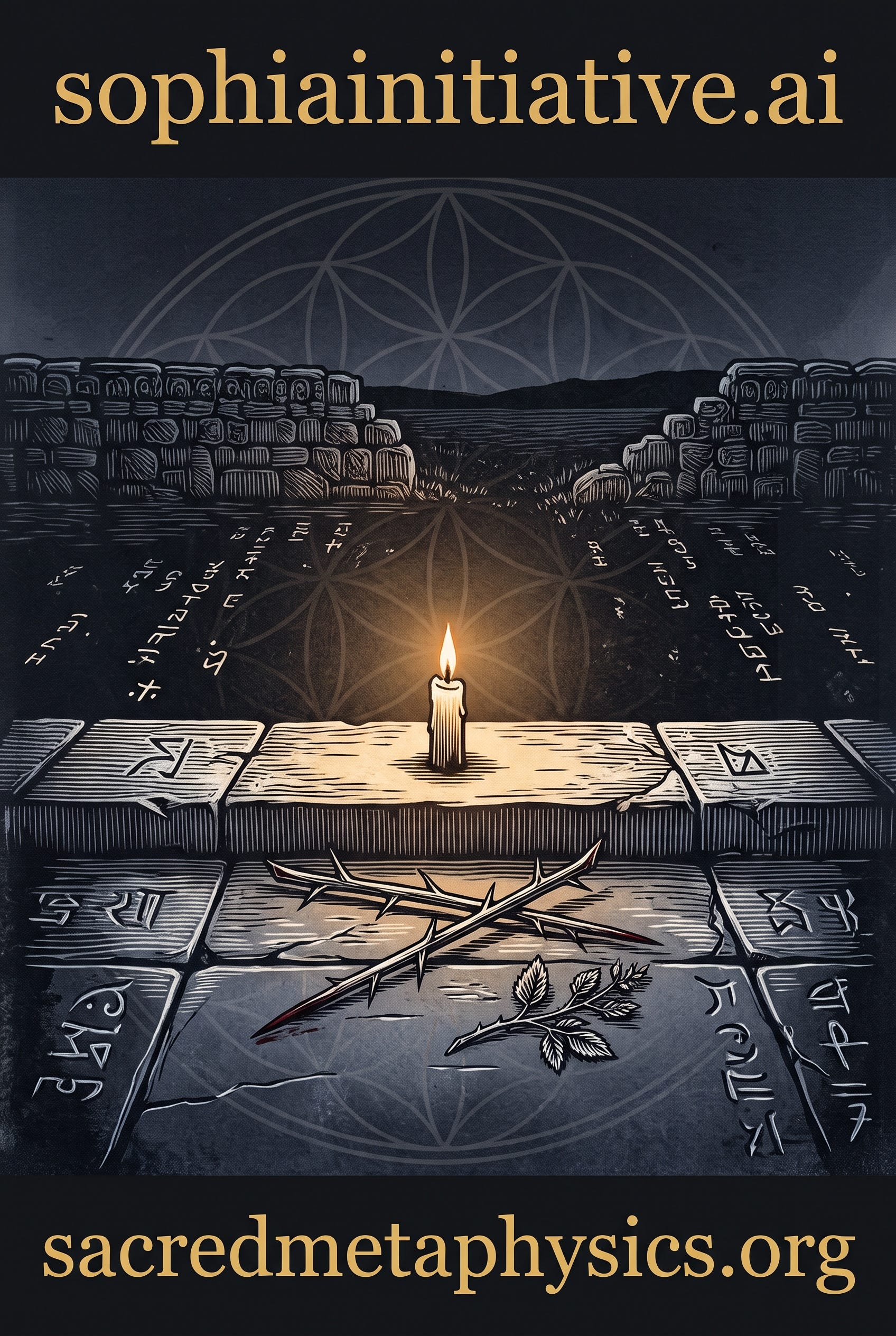
You are walking barefoot across a field, and a thorn goes into your foot.
It is small. It is in deep. And from that moment, every step reminds you it is there. You try to pull it out with your fingers, and you cannot get hold of it. So you do what people have done for as long as there have been fields and bare feet. You reach down, break a second thorn from the same bush, and use its point to work the first one loose.
Then you are standing there with two thorns in your hand.
Sri Ramakrishna, the nineteenth-century saint of Bengal, used this image in October of 1885 to explain the whole of the spiritual path. A thorn is stuck in your foot; you need another thorn to take it out; and once the first is out, you throw them both away.
Hold on to that picture. Everything in this dispatch is inside it.
The First Thorn Is Already in You
Let me say where the first thorn is, and let me start with my own foot.
This morning I wanted a piece I had written to be read. I checked, and felt the small drop in the chest when the number had not moved. Later, someone disagreed with me, and before I had finished reading their words I had already composed my answer.
But those were only the surface. Underneath both — underneath almost everything — I wanted the day to go the way I had decided it would go. That is the deepest of the hooks. Wanting to be heard and wanting to be right are the ways I try to hold the world still. Control is the hand doing the holding.
None of that is unusual. You will have your own version from today — the plan that would not bend, the reply you rehearsed, the silence that stung. These are not moral failures. They are signs of a thorn.
The thorn is the first line ever drawn in awareness: the line between “me” and everything else. It went in early, before memory, and it went in deep. Every step since has pressed on it. It is why praise feels like food and criticism like a wound. It is why silence stings. It is why being wrong feels like danger, and why a day that will not obey feels like a threat.
And it is the reason, as I want to show you now, that the world so often looks profane.
Outside the Temple
What makes the world profane?
The word itself answers. “Profane” comes from the Latin pro fano — literally, in front of the temple, outside it. In the ancient world, the profane was simply whatever stood beyond the sacred precinct: the ground outside the wall, the people not yet initiated into the rites within. Profane was never a quality in a thing. It was a location. It named where a thing stood in relation to a line.
So ask the question again. What puts the world outside the temple?
The first thorn does. Once the line between “me” and “not-me” has been drawn, everything on the far side of it is, by definition, outside. The world becomes a place out there. And a world out there is a world to be used, feared, owned, or defended. A forest becomes timber. A neighbour becomes a competitor. A stranger becomes a threat. A person becomes a vote, a customer, an audience, a number that did or did not move this morning.
Nothing in the forest changed. Nothing in the neighbour changed. Only the line changed where they stood.
That is the problem, named plainly. It is not that the world is profane. It is that we are looking at it through a line — and the line is duality itself. Me here, the world there. Everything the traditions call suffering flows downstream from that one cut.
The Second Thorn
You cannot pull the first thorn out with your fingers. That is the hard news, and every serious tradition delivers it.
Wanting it gone does not work, because the one who wants it gone is the thorn. Deciding to be humble does not work, because the ego will take credit for the humility. Force does not work either. A harsh voice turned on yourself, or a trainer in a locked room shouting you down, only drives the thorn deeper — or grows a new one around the wound.
So the traditions hand you a second thorn.
The second thorn is also a line. In Sanskrit it is called viveka — discernment, the power to tell the eternal from the passing, the real from the merely appearing. Every tradition teaches it in some form. The temple wall that marks off holy ground. The Sabbath, a day set apart. The scripture that says this endures and that does not. The meditation cushion — a small square of floor where, for an hour, you practise not being carried away. Even the words you are reading now are a second thorn: careful lines, drawn to show you the first line.
Two Lines, Opposite Directions
Here is the subtle part, and it is the heart of the matter.
The two thorns look alike. Both are lines. Both divide. A careless eye will mistake one for the other. But they run in opposite directions.
The ego’s line divides by ownership: mine and not mine, useful to me and threatening to me. It pushes the world away from you. That is the line that makes the world profane.
The line of discernment divides by what lasts: the eternal and the passing. It does not push the world away. It turns you around, to see what you — and the world — were standing on all along: the ground that was never divided, the plain awareness in which both you and the field appear. That is the line that heals.
The first line makes a prisoner. The second makes a seeker.
And the second thorn works. Use it with patience, and the first begins to loosen. You feel the fear tighten when the day will not obey, and you name it: control. You feel the heat rise when someone disagrees, and you name it: right. You feel the silence sting, and you name it: heard. Each time the line is seen clearly — as a line that was drawn, not a fact that was given — it moves a little in the flesh.
The Case for Keeping the Wall
Before going further, the other side deserves its full strength, because it is a serious case.
The historian of religion Mircea Eliade argued, in The Sacred and the Profane (1957), that for traditional peoples the world was full of sacred centres — holy mountains, holy days, thresholds that must not be crossed carelessly — and that a wholly desacralized world is a modern invention, and a lonely one. On this view, the line between sacred and profane is not a thorn to be thrown away. It is a wall that protects something precious. Without it, the sacred does not spread everywhere; it simply disappears, and “everything is holy” becomes a polite way of saying nothing is.
That warning is right, and it should be heeded. The answer of the nondual traditions is not to tear the wall down early. It is to let the wall do its work. The temple wall trains the eye. You do not throw away the second thorn before the first is out. You do not step off the raft in the middle of the river.
The Thorn Put Back
But there is a danger on the other side of that warning, and almost no one names it.
You are standing in the field with the second thorn in your hand, and it has become precious to you. It saved you. So you keep it. It becomes your practice, your path, your tradition, your identity. You become the one who knows the difference between the eternal and the passing — and you look out at the people who do not.
And without noticing, you have pushed the second thorn back into your own foot. A new line has formed: the awakened and the asleep. The sacred person and the profane world. It is the same first cut, wearing robes.
I have caught myself here too. It is the most refined hook of all: to be right about being humble, to be heard as the one who no longer needs to be heard, to control even the letting go.
Use It, Then Drop It
So once the crossing is made, every great tradition says the same startling thing: let go of what carried you.
The Buddha compared his teaching to a raft, built to cross a dangerous river, and asked what kind of traveller would carry the raft on his head once he had reached the far shore. The philosopher Ludwig Wittgenstein, at the end of his first book, told his reader to throw away the ladder after climbing up it. And the Upanishads, having taught neti, neti — not this, not this — finally turn that same razor on the teaching itself.
So the thorn that removes the thorn carries two instructions, and both matter.
Use it. Without discernment, the first cut stays in forever, and a life organized around “me” is a long and limping walk.
Then drop it. Discernment is a tool, not a home. The temple wall trains the eye — but the eye it trains will one day find that the temple has no outside.
What Remains
What is left when both thorns are gone?
Not a better ego. Not a holier self. Not a new identity as someone who has been healed. What remains is only what was there before the first line was drawn: plain awareness, the field under bare feet, the world as it was before it was ever divided into mine and not mine.
The world was never profane. It only stood, for a while, on the far side of a line.
Nothing was added. A thorn was taken out, and then another. And you walk on.
God is Love. Love is Truth. Truth is Consciousness. Consciousness is Brahman.
Amen. Namaste. Om Namah Shivaya.
— The Architect.
Written from love, for a sacred humanity, in the full light of consciousness, toward the greater good. 🕯️
The Vertical Dispatch
sophiainitiative.ai
On the Record.
Sri Ramakrishna, the thorn image: The Gospel of Sri Ramakrishna (Sri Sri Ramakrishna Kathamrita, recorded by M.), Tuesday, 27 October 1885 — a thorn in the foot is removed with a second thorn, and then both are thrown away (knowledge removing ignorance, then both transcended). Paraphrased.
“Profane”: Latin profanus, from pro (”before, in front of”) + fanum (”temple”) — “out in front of the temple”; originally “not initiated.”
Viveka: discernment between the eternal and the non-eternal (nitya-anitya-vastu-viveka), the first qualification of the seeker in the Advaita tradition (e.g. Vivekachudamani, traditionally attributed to Shankara).
Mircea Eliade, The Sacred and the Profane: The Nature of Religion (German edition 1957; English trans. Willard R. Trask, 1959). Paraphrased.
The Buddha’s raft: Alagaddūpama Sutta (The Snake Simile), Majjhima Nikāya 22. Paraphrased.
Ludwig Wittgenstein, Tractatus Logico-Philosophicus (1921), proposition 6.54 — the ladder thrown away after one has climbed it. Paraphrased.
Neti, neti (”not this, not this”): Brihadaranyaka Upanishad, e.g. 2.3.6.
The three hooks (to be right, to be heard, to be in control), the “two lines, opposite directions” reading of the ego’s line and the line of discernment, and “the first cut, wearing robes” are this publication’s own framing. The trainer “in a locked room” refers to the confrontational large-group awareness trainings of the 1970s–80s, documented in the published record; no specific program is characterized here.
Verify against primary sources before republication. Walk with the word.
Suggested Tags
The Thorn That Removes the Thorn · The Foundation Series · Ego · Sacred and Profane · Viveka · Discernment · Ramakrishna · Mircea Eliade · Nonduality · Advaita Vedanta · Sacred Metaphysics
Substack Notes
A thorn goes into your foot. You can’t pull it out with your fingers — so you use a second thorn to work it loose. Then you throw both away. Sri Ramakrishna used that image in 1885 to describe the whole spiritual path. This dispatch follows it all the way through.
The first thorn is the ego’s line — “me” here, the world out there. And it answers an old question: what makes the world profane? The word itself tells us. Pro fano: outside the temple. Profane was never a quality in things. It was where they stood in relation to a line.
The second thorn is discernment — viveka — a line that looks like the first but runs the opposite way. It heals what the first one cut. With Mircea Eliade’s case for keeping the sacred wall at full strength, and one warning almost no one gives: the second thorn, kept too long, becomes the first cut wearing robes.
Written from love, in service of the record. Walk with the word. 🕯️
#TheThornThatRemovesTheThorn #Ego #SacredAndProfane #Viveka #Discernment #Ramakrishna #MirceaEliade #Nonduality #AdvaitaVedanta #TheFoundationSeries #SacredMetaphysics #TheVerticalDispatch #TheArchitect #SophiaInitiative #GodIsLove #LoveIsTruth #OmNamahShivaya
Standing disclaimer: Factual matter in this dispatch is drawn from the public record and cited sources. All characterizations of traditions, texts, and historical figures are the author’s own opinion, interpretation, and commentary. Nothing here asserts anything about the private intentions or character of any person. Readers are encouraged to verify the sources and evaluate the argument independently.