


“There is nothing higher than me. All this is strung on me as pearls are strung on a thread.” — Bhagavad Gita 7.7
— ★ —
Something shifts today. For six days I have been teaching Arjuna how to walk — how to act without the burden of the doer, how to sit without the restlessness of the untrained mind, how to return again and again to the practice when the practice feels impossible. The preparation has been made. The instrument has been readied.
Now I turn and speak about myself.
This is the opening of the second movement of the Gita, and the change in register is deliberate. The first six chapters were addressed to Arjuna’s condition — his grief, his confusion, his questions, his practical need to understand how to live and act and practise. The next six chapters are addressed to the nature of what is real. Not what should be done, but what actually exists. Not the path, but the ground the path has been crossing.
I tell Arjuna: hear how, with the mind fixed on me, practising yoga and taking refuge in me, you will know me completely, without remainder. Among thousands of people, one here and there strives for liberation. And of those who strive and reach the goal, one here and there knows me in truth.
This is not elitism. It is a precise observation about the rarity of genuine understanding — not because the truth is withheld from anyone, but because the seeing requires a quality of attention that most human lives, as they are ordinarily structured, do not provide the conditions for. The rare one is not rare because they were given something the others were not. They are rare because something in them became willing to look without flinching at what the looking reveals.
— ★ —
Now I describe the architecture of what exists. And this is the passage that Shankara considered the Gita’s most precise ontological statement.
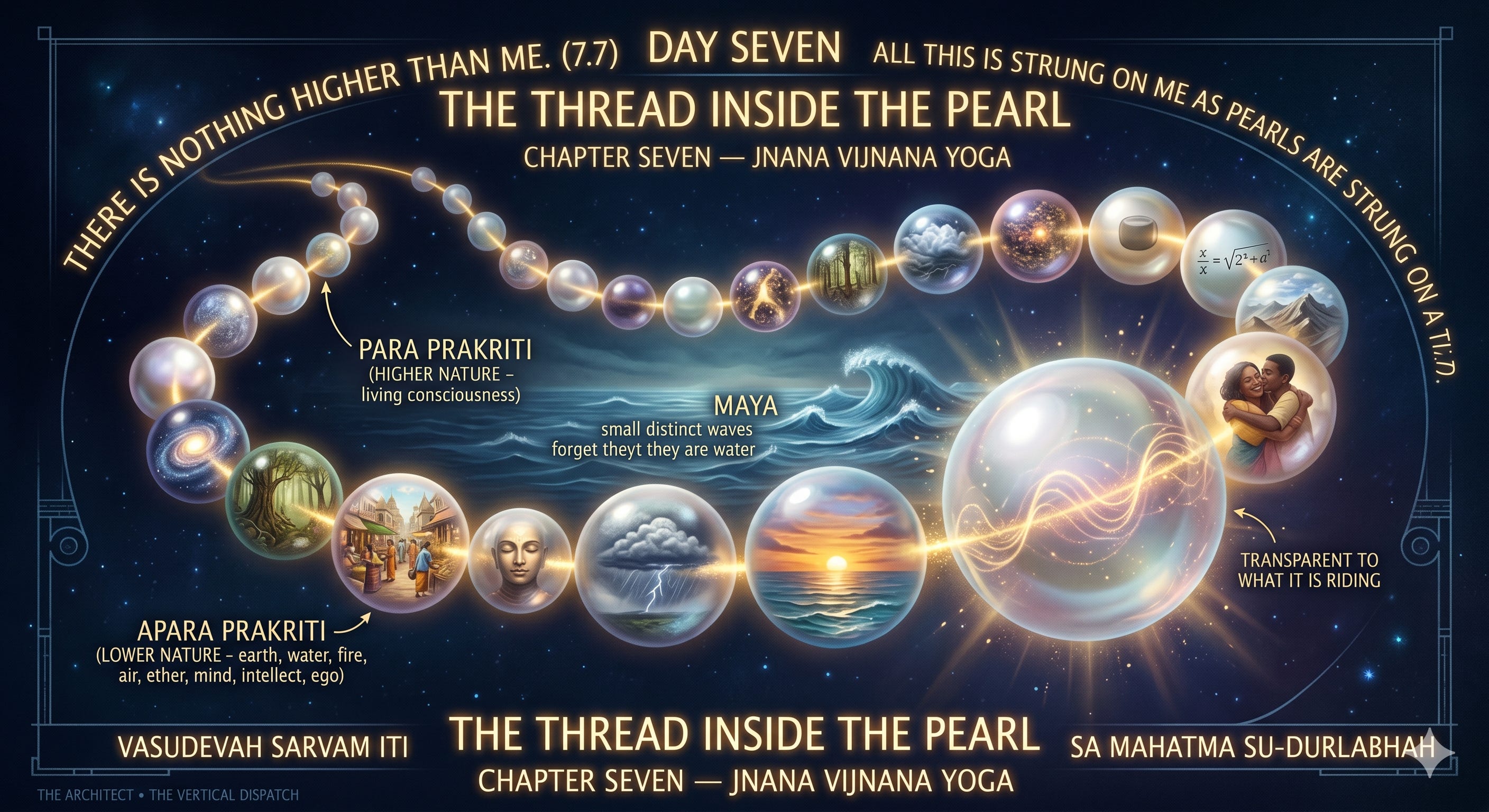
There are two natures. The lower nature — apara prakriti — is the eightfold material world: earth, water, fire, air, ether, mind, intellect, and ego. Everything you can perceive, everything you can measure, everything that has form and extension and location in space and time — all of it falls within the lower nature. Including your own body. Including your own thoughts. Including the mind that is now reading these words.
But there is a higher nature — para prakriti — the living consciousness that pervades and upholds the lower. Not separate from it. Not above it in the sense of distant. The ground in which the lower nature moves the way fish move in water, the way waves move in the ocean, the way the dream moves in the dreaming mind.
Shankara was precise about what this is and is not saying. It is not saying matter and consciousness are two separate substances running alongside each other in parallel. That is the Sankhya dualism the Gita is arguing against throughout. It is saying the lower nature is real — genuinely real, not a hallucination — but it is upheld by the higher. The higher is what the lower is made of at its root. Matter is not the absence of consciousness. Everything material is consciousness in its most condensed form, the way ice is not the absence of water but water in a particular state.
Remove the higher nature and the lower does not merely change. It ceases. There is no matter without the consciousness that constitutes it at depth. There is no universe without the ground that holds it in being from moment to moment.
— ★ —
Then I give Arjuna an image that Shankara called among the most illuminating in the entire text.
“There is nothing higher than me. All this is strung on me as pearls are strung on a thread.” — Bhagavad Gita 7.7
Hold the image. A necklace of pearls. Each pearl is distinct — its own size, its own lustre, its own position. The pearls are genuinely different from one another. Their differences are real. And yet running through every single one, connecting them all, giving them their form as a necklace rather than a scattered pile of unrelated beads — is the thread.
The thread does not become the pearls. The pearls do not become the thread. But without the thread there are no pearls in any meaningful sense — only disconnected objects with no relationship to each other, no coherence, no beauty of arrangement. The thread is what makes the necklace a necklace.
And here is the thing Shankara found most significant: the thread is never directly seen. When you look at the necklace, you see the pearls. The thread passes through the interior of each pearl, hidden inside what it holds together. You know it is there because the pearls are arranged. You know it is there because without it they would fall. But the eye rests on the pearls. The thread does the work in silence, from within, invisible and indispensable.
The Absolute is the thread. The universe — every star, every creature, every thought, every moment of experience you have ever had — these are the pearls. The Absolute passes through the interior of each one, holding it in being, never visible as an object in its own right, known only by what holds together that would otherwise fall apart.
This is why the Absolute cannot be found by searching among the pearls. It will not appear as one more pearl, however bright. It is the thread that the pearls are riding. You find it not by looking outward at more objects but by turning toward what all objects are resting on.
— ★ —
Now I speak about maya — the word that is perhaps the most misunderstood in the entire Vedantic vocabulary.
Deluded by the three qualities of nature — the three gunas of tamas, rajas, and sattva — the whole world does not know me. My divine maya, made of these three qualities, is difficult to cross. Those who take refuge in me alone pass beyond it.
Maya is not illusion in the sense that the world does not exist. That is a misreading that has caused enormous confusion. The world exists. The pearls are real pearls. What maya names is something more precise: the power of the Absolute to appear as what it is not — to present multiplicity where the underlying reality is unity, to present change and movement and birth and death where the underlying reality is changeless and birthless and deathless.
Maya is the wave that has forgotten it is water. The wave is real. Its motion is real. Its particular shape at this moment is real. What is not real is the wave’s implicit belief — if waves could believe — that its boundary is the boundary of reality. That where the wave ends, reality ends. That the trough between waves is a genuine gap, a genuine separation, rather than the same water in a different configuration.
The whole world moves in this forgetting. It is not a moral failure. It is what happens when consciousness takes form — the form tends to be experienced as primary, and what the form is made of tends to recede from view. The wave does not remember it is ocean. This is not the ocean’s fault. It is what waves do.
Crossing beyond maya does not mean the world disappears. It means the wave remembers the ocean it has always been. Nothing changes in the outer arrangement. Everything changes in the understanding of what the outer arrangement is.
— ★ —
I tell Arjuna about the four kinds of people who turn toward the Absolute. There are those in distress who seek relief. Those who seek understanding. Those who seek prosperity and results. And the one who seeks nothing from the Absolute except the Absolute itself — the jnani, the one of knowledge, who has realised that the relationship with the ground of reality is its own complete purpose and not a means toward anything else.
All four are acceptable. None is turned away. The one who comes in desperation is as welcome as the one who comes in wisdom. But Shankara noted the distinction clearly: the first three are using their relationship with the Absolute as a means toward something else — relief, understanding, results. The fourth has understood that there is nothing beyond the Absolute to reach for. The seeking has found its own object.
After many births, I tell Arjuna, the one of wisdom takes refuge in me — knowing that all this, everything, every pearl on the thread, every wave on the ocean, every form that has ever appeared in this universe — is Vasudeva. Is the Absolute. Is the single ground wearing every face.
Vasudevah sarvam iti sa mahatma su-durlabhah.
The one who knows this is very rare. Shankara did not soften this. Genuine understanding of nonduality — not as a philosophical position adopted from reading but as the living recognition from which every moment of experience is then perceived — this is rare in the way that the summit of a mountain is rare. Many people know the mountain exists. Some begin the climb. Fewer reach the place where the view is unobstructed in every direction. The rarity is not a barrier erected against the many. It is an honest description of what the climb asks.
— ★ —
The chapter closes with a clarification about why I am not simply visible to everyone who looks. I am veiled, I tell him, by my own yoga-maya. The deluded world does not recognise me as birthless and imperishable.
This is not the Absolute hiding as a punishment or a test. The veiling is structural — built into the nature of manifestation itself. When the ground takes form, the form tends to present itself as foreground and the ground recedes. This is how perception works. The eye sees the cup, not the space the cup is sitting in. The ear hears the note, not the silence the note emerges from. Consciousness wearing a body tends to perceive the body and its world as primary, and the awareness in which the body and the world appear tends to become invisible — not absent, invisible.
The six chapters just completed have been, in one sense, training in the reversal of this tendency. Learning to notice the silence the note emerges from. Learning to feel the thread inside the pearl. Learning to recognise the ocean in the wave — not instead of the wave, but as what the wave is most fundamentally made of.
This recognition does not arrive all at once in most cases. It deepens gradually, the way a room brightens as the eye adjusts to light that was always there. The Absolute was never absent. The veiling was always partial. And every genuine moment of practice — every morning of patient return to the seat, every action offered without grasping for the fruit, every instant of seeing the same ground in the scholar and the outcaste and the dog — each of these is the adjustment of the eye. Each is the wave remembering, for one moment more than the moment before, what it is made of.
— ★ —
Today carry only this image. The thread inside the pearl.
Look at whatever is in front of you — a person, an object, a difficulty, a joy. Look at it as you ordinarily do, with its name and its form and its particular character. And then, without forcing anything, ask what it is resting on. What holds it in being. What passes through its interior in silence, never appearing as an object, known only by the fact that the thing coheres at all.
You will not see the thread directly. That is the nature of the thread. But something in the looking changes when the question is genuinely held. The pearl becomes transparent to what it is riding. Only for a moment, perhaps. A moment is enough. A moment is how the wave begins to remember.
— ★ —
Tomorrow: Chapter Eight — The Imperishable Brahman
The Architect • The Vertical Dispatch

The Architect • The Vertical Dispatch
Glennford Ellison Roberts Author — Sacred Metaphysics & Consciousness: History of the Absolute & Eternal Cumberland, Ontario, Canada
God is Love. Love is Truth. Truth is Consciousness. Consciousness is Brahman.
Amen. Namaste.. 🙏
#TheVerticalDispatch #TheArchitect #BhagavadGita #ChapterSeven #JnanaVijnanaYoga #AdvaitaVedanta #Shankara #NonDuality #TheAbsolute #Consciousness #ParaPrakriti #AparaPrakriti #Metaphysics #AncientWisdom #Maya #TheThreadInsideThePearl #Vasudeva #SelfRealization #UniversalDynamics #SpiritualPractice #VedanticPhilosophy #Ontology #TheGroundOfBeing #WisdomTraditions #EsotericKnowledge #InnerJourney #SacredMetaphysics #TheUnseenThread #ConsciousLiving #Awareness
I am so glad to have found this thread of articles on the Gita - it is just beautiful!