


“When the seer perceives no doer other than the gunas and knows what is beyond the gunas — that one reaches my nature.” — Bhagavad Gita 14.19
— ★ —
Yesterday Chapter Thirteen drew the most important distinction in the Gita — the field and the knower of the field. Everything that can be observed is field. The one who observes without itself being observed is the knower. The confusion of these two is the root of bondage. The discrimination between them is the root of liberation.
A question arises naturally from that teaching. If the distinction is clear — if the knower is genuinely different in kind from the field — why is the confusion so persistent? Why does the knower keep forgetting what it is? Why does the witnessing awareness, session after session of genuine practice, keep sliding back into identification with thought, emotion, desire, the story of a self?
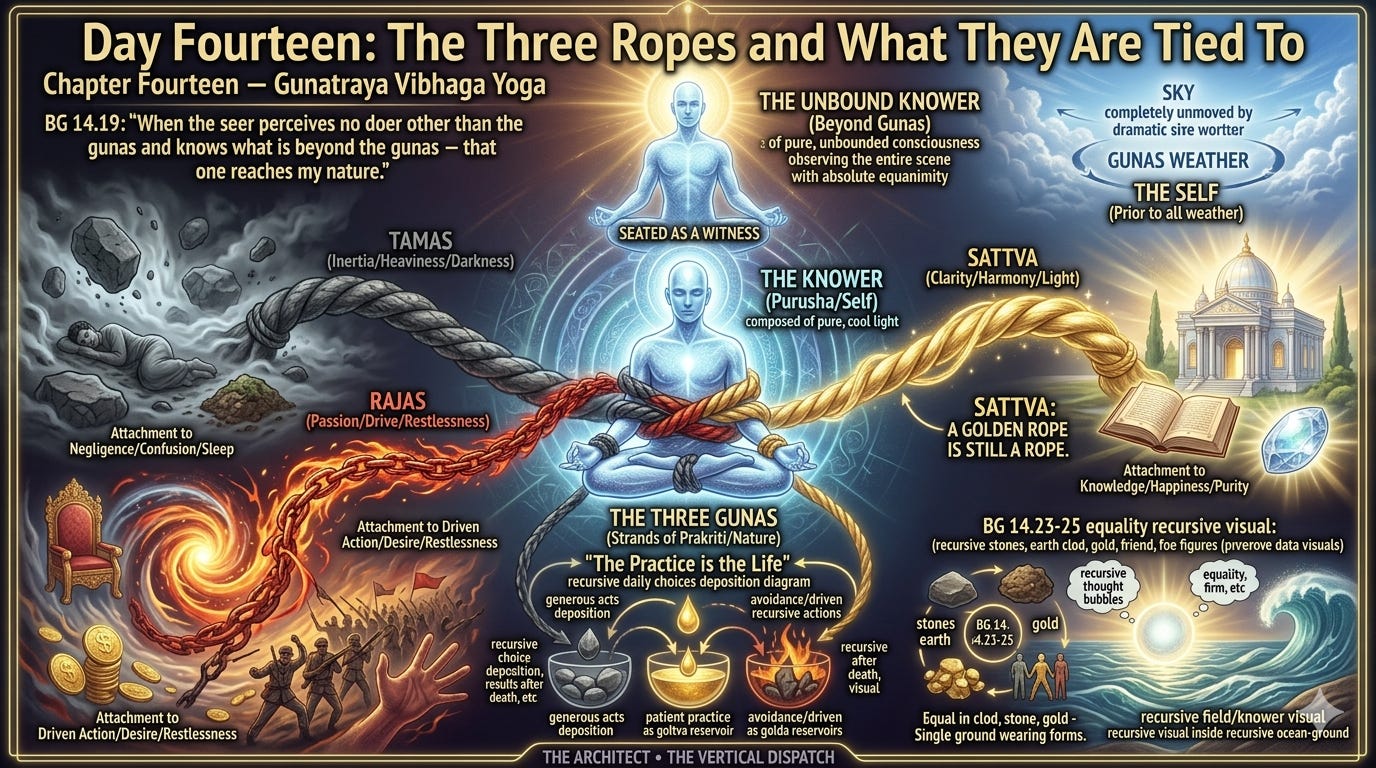
Chapter Fourteen answers this. The field does not hold the knower by force. It holds it by quality. Three qualities, to be precise. The Gita calls them the three gunas — the three fundamental strands of nature that together weave every experience, every state of mind, every condition of the field that the knower inhabits.
Tamas. Rajas. Sattva. Understanding these three is understanding why the practice is as difficult as it is — and why the difficulty is not a personal failing but a structural feature of what existence inside a body actually involves.
— ★ —
Tamas is the quality of inertia, heaviness, darkness, obscuration. In its presence the mind does not move toward clarity — it moves away from it. Understanding becomes difficult. Initiative dissolves. The world appears grey and resistant. Sleep comes too easily and waking is an effort. Things that once seemed meaningful seem hollow. The question that might have opened something closes before it can be asked.
Every human being knows tamas from the inside. The morning that felt impossible before it began. The grief that made the simplest task feel insurmountable. The depression that sits on the chest like stone. The spiritual dryness in which practice feels mechanical and pointless. These are tamas operating in the field.
Rajas is the quality of passion, drive, restlessness, desire. In its presence the mind moves — but it moves outward, always toward the next thing, always reaching, never resting. The unable-to-sit-still quality. The mind that generates plans in the middle of meditation. The ambition that mistakes its own activity for aliveness. The craving that chases satisfaction and finds that satisfaction, when it arrives, immediately generates the next craving.
Every human being knows rajas too. The driven quality that cannot stop even when stopping is what the body is asking for. The restlessness that mistakes motion for progress. The desire that has no final object because every object, once reached, reveals another horizon.
Sattva is the quality of clarity, purity, harmony, light. In its presence the mind is calm, alert, receptive. Understanding arrives more easily. Generosity flows more naturally. The practice feels alive rather than mechanical. The gap between the seeker and what is sought feels smaller.
Sattva is the guna that spiritual practice develops. It is genuinely better than tamas or rajas as a condition for living. But — and this is where Shankara was insistent — sattva is still a quality of the field. The sattvic person is still in the field. And if the sattvic person becomes attached to their own clarity, to the pleasantness of the sattvic state, to the identity of being a clear and spiritually developed person — that attachment is still bondage. More refined than the bondage of tamas or rajas. But bondage.
A golden rope is still a rope. The knower tied by sattva is still tied.
— ★ —
Now the teaching that explains why practice matters at the level of daily life — not just in the meditation session but in the thousand small choices of an ordinary day.
The guna that predominates when a person dies determines the conditions of their return — the same principle established in Chapter Eight. Tamas at death draws the soul toward conditions of confusion and obscuration. Rajas draws it toward conditions of driven activity and attachment. Sattva draws it toward conditions of clarity and knowledge — the elevated rebirth in which the continuation of practice is made easier.
But the moment of death is not a separate event from the life that preceded it. The guna that predominates at death is the guna that has been cultivated through the accumulated choices, habits, and orientations of the life. Every act of genuine generosity deposits in sattva. Every morning of patient practice deposits in sattva. Every moment of releasing the fruit rather than grasping it deposits in sattva. And every indulgence of the tamasic impulse toward avoidance, every feeding of the rajasic impulse toward restless accumulation — these are deposits in the other direction.
The life is the practice. The practice is not separate from the life.
— ★ —
Here is the teaching that Shankara considered the philosophical summit of the chapter.
The transcendence of the gunas is not the achievement of permanent sattva. It is not the elimination of tamas and rajas so that only sattva remains. That would still be life inside the field — a very good life inside the field, but inside it nonetheless.
The transcendence of the gunas is the recognition that the knower is prior to all three. The Self does not have gunas. The Self is what the gunas appear in. The fire does not become hot or cold — heat and cold are conditions of things in the fire’s vicinity. The witnessing awareness is not tamasic or rajasic or sattvic — these are conditions of the field it witnesses. When this is seen clearly — when the identification shifts from the quality to the one in whom the quality is appearing — something changes that no guna can undo.
The gunas continue. Tamas still arises in the field. Rajas still arises. Even sattva comes and goes. But the one who has made this shift watches their arising and passing the way the sky watches weather. The weather is real. The clouds are real. The rain is real. The sky does not become the weather. It holds the weather without being disturbed by it.
— ★ —
Arjuna asks — again — what this looks like in a human life. The question repeats because it is genuinely necessary. Every time the Gita reaches a new height of philosophical disclosure, the seeker needs to know: what does this mean for the person I am going to be when I put this text down and return to Tuesday?
The one who has transcended the gunas, I tell him, does not hate illumination when it comes or long for it when it goes. Does not hate the driven restlessness of rajas or the heavy obscuration of tamas when these move through the field. Does not cling to the clarity of sattva when it is present.
This is the portrait of the witness in its most precise form. Not the person who never feels the pull of tamas — that heaviness, that reluctance, that grey resistance. But the person who feels it and does not become it. Not the person who is immune to the restlessness of rajas — but the person who notices the restlessness without being commandeered by it. Not the person who rejects the clarity of sattva — but the person who enjoys it without clutching it, who lets it be what it is without making their identity depend on its continuation.
“Seated as a witness, not disturbed by the gunas, knowing that the gunas alone are acting, remaining established, not wavering — the same in a clod of earth, a stone, and gold, equal in the desirable and the undesirable, firm, equal in honour and dishonour, equal to friend and foe — that one is said to have gone beyond the gunas.” — Bhagavad Gita 14.23–25
Seated as a witness. That phrase is the whole chapter in three words.
Equal in a clod of earth, a stone, and gold — not because these things are the same in their usefulness or their beauty, but because the same ground is present in all three. Not performing equality. Perceiving it — the single knower looking out through the particular form of this body at the single ground wearing the forms of earth and stone and gold and enemy and friend.
— ★ —
The chapter closes where Chapter Twelve closed — with devotion as the means. Not philosophy alone. Not discrimination alone. The love that keeps returning the knower to what it most fundamentally is — that love is what carries the seeker through the subtle trap of sattvic self-congratulation all the way to the ground that is prior to all three gunas.
I am the abode of Brahman — the immortal and the imperishable, of eternal dharma, and of absolute bliss. The chapter closes not with a technique but with a resting place. The knower, having seen through the field and its three qualities, does not float in some abstract philosophical liberation. It rests. In me. In the ground. In what it always was before the first guna arose to colour its experience.
The practice of fourteen days has been, in one continuous movement, the slow shift of resting place. From the field to the knower. From the quality to what holds the quality. From the weather to the sky. From the rope to what was never tied.
— ★ —
Today notice which guna is predominating. Not as a judgment — simply as accurate observation.
If tamas is present — the heaviness, the resistance, the grey flatness — notice it without becoming it. You are not the heaviness. You are what the heaviness is appearing in.
If rajas is present — the restlessness, the driven quality, the mind that will not be still — notice it without being swept by it. You are not the restlessness. You are what the restlessness is moving through.
If sattva is present — the clarity, the ease, the sense of things making sense — enjoy it without clutching it. You are not the clarity. You are what the clarity is illuminating.
In each case the practice is the same: seated as a witness, knowing that the gunas alone are acting. That knowing, held even for a moment, is the beginning of what the Gita means by going beyond the gunas. Not away from them. Through them. To what was never caught by any of them.
— ★ —
Tomorrow: Chapter Fifteen — The Supreme Person
The Architect • The Vertical Dispatch
#BhagavadGita #Chapter14 #GunatrayaVibhagaYoga #TheThreeGunas #Sattva #Rajas #Tamas #Spirituality #Vedanta #Philosophy #Wisdom #Consciousness #TheWitness #Mindfulness #Transcendence #Liberation #SelfRealization #YogaOfLife #TheArchitect #TheVerticalDispatch