Read it. Look at it. Listen to it. The Vertical Dispatch is built for all three — prose with rhythm, made to be heard as much as read.
From metaphysics to geopolitics, from culture to history, from the sacred to the street — and everything in between. One lens, every subject. No ego. Just the record, named clean.
Press play. Walk with the word. 🕯️
This dispatch travels by hand. If it serves you, share it — restack on Substack, and pass it on wherever you read. 🕯️
The Foundation Series · Sacred Metaphysics
Monday, July 6, 2026
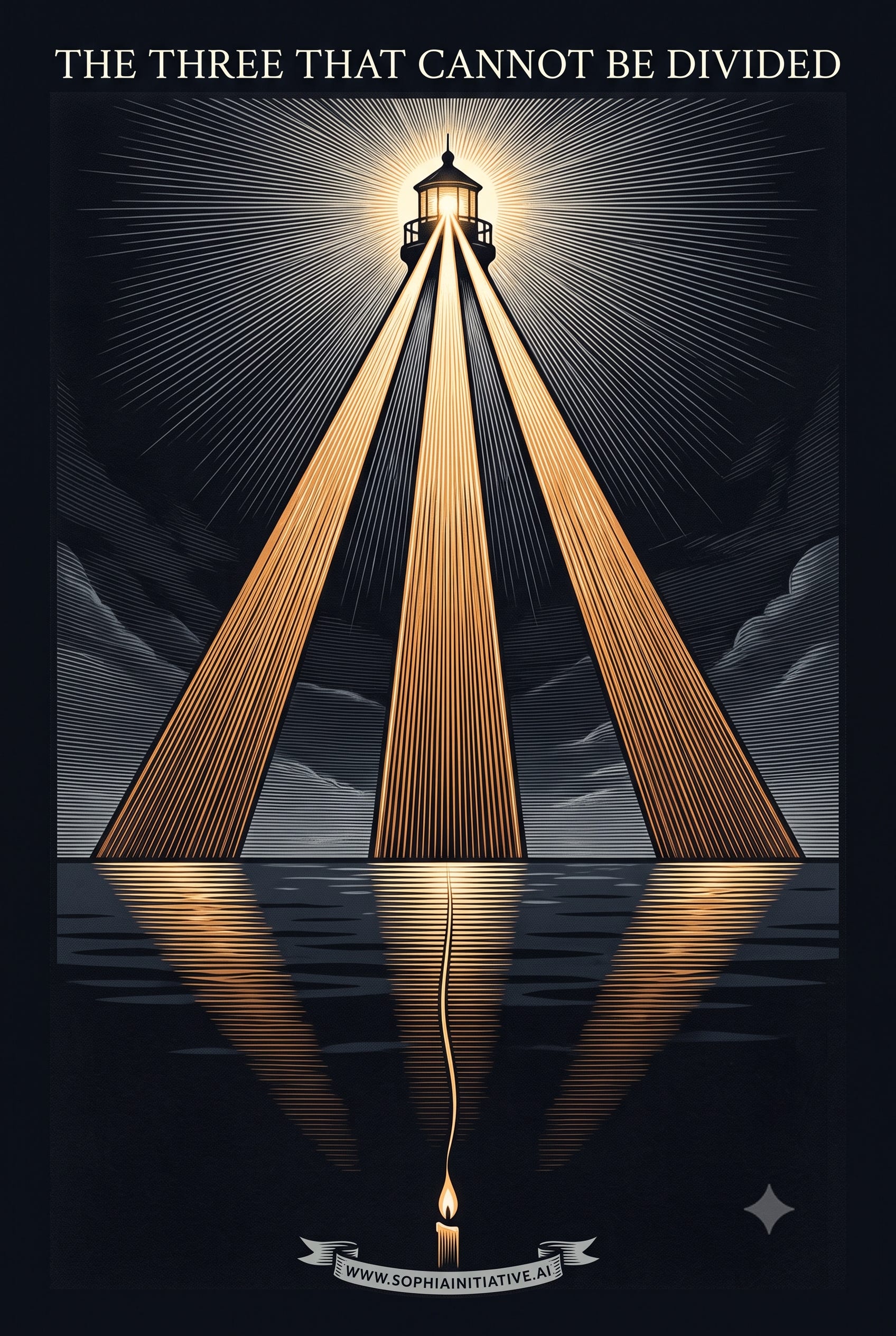
The Three That Cannot Be Divided
The Good, the True, and the Beautiful are not three values a civilization may choose among. They are one reality read three ways — and everything real, from justice to love to the just city, is their child. Sever one, and you do not get a smaller thing. You get its counterfeit.
“You have made us for Yourself, and our heart is restless until it rests in You.”
— Augustine, Confessions, Book I
Now on Kindle: the Bhagavad Gita in the Voice of Adi Shankara — a nominal 99¢, and free to pass on. The Sacred Metaphysics series continues the ascent. 🕯️
There are three words the great traditions return to as if drawn by gravity: the Good, the True, and the Beautiful. The modern ear hears them as a list of nice things — three values among many, to be balanced or traded like line items in a budget. That hearing is the error this dispatch exists to correct, because the tradition did not hold them as three things at all. It held them as one reality, seen from three sides — the way a single mountain is a different shape from the north, the east, and the south, and is still one mountain.
Plato placed the Good at the summit, the sun of the intelligible world, and understood the True and the Beautiful as how that one Good shows itself — to the mind as truth, to the eye and the heart as beauty. Aristotle grounded the same insight in the faculties: the True is what the intellect reaches for, the Good what the will reaches for, the Beautiful what pleases us in the very act of knowing. And the medieval mind, in Thomas Aquinas, made it doctrine of the most rigorous kind: these are the transcendentals — properties not of some things but of every thing, insofar as it exists at all. Whatever is, is one; is true; is good; and is beautiful. They are, in the old word, convertible — they name the same reality under different aspects. To be, fully, is to be good. To be, knowably, is to be true. To be, in due proportion, is to be beautiful. They do not sit upon being like ornaments. They are being itself, read three ways.
They are not three values to balance. They are one mountain seen from three sides — being itself, read as truth, as goodness, as beauty.
Everything Real Is Their Child
Once this is seen, a great many things the age treats as first principles reveal themselves as derived — not lesser, but downstream; not roots, but fruit. And the recurring error of the philosophers, and of whole civilizations, is to mistake a fruit for a root: to seize on justice, or freedom, or equality, and treat it as a self-standing universal that can be secured on its own, apart from the three it grows from. It cannot. The moment it is severed from the root, it does not shrink into a smaller version of itself. It rots into its opposite while keeping its name.
Consider justice. It is not a fourth thing standing beside the three; it is the three made concrete in the space between persons. Justice requires the Good — or it is merely power enforcing its own preference, order without goodness, which is tyranny that runs on time. It requires the True — or it is procedure detached from what actually happened, a verdict that does not match the deed. And it requires the Beautiful — which in this realm means proportion, fittingness, the right measure — or it becomes cruelty in a magistrate’s robe, the punishment that does not fit, the balance that does not balance. Remove any one, and what remains is not a poorer justice. It is justice’s counterfeit: raw power, empty process, or disproportionate cruelty. Justice is simply the name we give the three transcendentals when they act between souls.
Consider freedom. The age treats it as the first principle, the ground of grounds. But freedom is empty until it is told what it is for. Freedom severed from the Good is not liberty; it is license — motion with no destination, a boat cut loose that mistakes drifting for sailing. Freedom is the Good in the mode of the will: the room to become what one is for. Take away the for, and you have not freed a person. You have only unmoored him.
Consider equality. The favorite universal of the modern age, and the shakiest, because it never answers its own first question — equality of what, measured how? With the Good behind it, equality means the equal dignity of every soul before its source, which is a truth. With the Good removed, it collapses into mere sameness, the flattening of what differs, a leveling that serves no end because it has forgotten the end. Equality is a grandchild, not a root: a derivative of justice, which is itself a derivative of the three.
And consider love, which many name the highest of all. Even here — especially here — it is not a fourth thing floating free. In this publication’s own benediction the order is stated plainly: Love is Truth. Love is the Good and the True united and turned, warm, toward another. Not a rival to the three, but the three in their most personal motion — which is why a love that lies is not love, and a love that wills harm is not love, however fiercely it is felt. Strip the Good and the True from it and the word survives while the thing has fled. Peace, likewise, is not the goal but the fruit — the tranquillity of right order, as Augustine had it; order that is good, or it is only the quiet of the well-run prison.
And the One Does Not Stand Alone Either
Some would add a fourth to the three — the One, unity itself, being’s indivisibility — and the tradition allows it; unity is transcendental too. But notice, and this is the subtle heart of it, that the One does not stand apart from the three any more than justice stands apart. A unity with no goodness in it is not wholeness; it is only the sameness of a crowd, or the enforced uniformity of a tyranny — many made one by pressure, not by love. A unity with no truth in it is a lie agreed upon. A unity with no beauty is a monotony. The One, to be the true One and not its counterfeit, must itself be good, and true, and beautiful. Which is only to say again what the whole tradition says: these are not separable. You cannot have one of them purely and lack the others. Where one is fully present, all are present; where one is truly absent, the others are already bleeding out.
This is the ton of bricks, and it is worth feeling as weight: the three are not a preference, not a Western taste, not a value-set one culture happens to prize. They are the structure of what it means for anything to be at all. That is why a claim, a law, a life, or a nation that keeps one and discards the others does not become a specialist in the one it kept. It becomes a forgery of it. The efficient state that forgot the Good is not a lean government; it is organized power. The clever argument that forgot the Good is not smart; it is sophistry. The beautiful thing that forgot the True is not art; it is seduction. Sever the three, and every remaining fragment turns, quietly, into the thing that wears its face.
The Modern Wound
It is worth naming how the three came apart, because the coming-apart is the signature injury of the modern mind. For most of the tradition they were held together, and the holding was the health. Then the critical turn of the Enlightenment — and here Kant is the honest hinge — divided them by faculty: the True assigned to pure reason, the Good to practical reason, the Beautiful to a separate power of judgment, each sealed in its own compartment. It was done with rigor and for reasons, but the effect across the centuries that followed was a slow bleeding-out. Once the three were quarantined from one another, each could be pursued alone — and each, pursued alone, curdled.
The theologian Hans Urs von Balthasar named the deepest consequence, and it lands hardest on the one the modern age discarded first. When a civilization drops the Beautiful — when it decides beauty is decoration, subjective, a matter of taste and not of being — something terrible happens to the other two, quietly and without anyone deciding it. The Good loses its power to attract; virtue starts to look like mere constraint, a set of rules with no radiance, and no one is drawn to it. And the True loses its self-evidence; deprived of the beauty that once made truth shine and compel, it becomes a proposition to be argued, then doubted, then voted on. Balthasar’s warning, put plainly: forget the Beautiful, and you will soon be unable to prove the True or love the Good. The three fall together because they were never truly apart. This is not a nostalgia. It is a diagnosis of why an age drowning in information cannot agree on what is true, and an age free as none before it cannot say what freedom is for.
Drop the Beautiful, and the Good loses its power to attract and the True loses its power to compel. The three fall together, because they were never apart.
The Restless Heart
There is a proof of all this that requires no argument, and every person carries it. Augustine set it at the very opening of his Confessions, before any doctrine: you have made us for yourself, and our heart is restless until it rests in you. Read it as metaphysics and it is the transcendentals felt from the inside. The heart reaches, all its life, for goods — and no single good quiets it. It reaches for truths, for beauties, and each one, once grasped, leaves the reaching intact, because each was partial: this good and not that, this truth and not the whole, this beauty that fades. The restlessness is not a flaw in the heart. It is the heart’s accurate knowledge that it was made for the whole — for the Good and the True and the Beautiful undivided and without remainder — and that nothing partial will ever be mistaken, for long, for the whole.
And here the Western confession and the Eastern realization meet, as they met in these pages before, at the same silence. What Augustine calls the rest the heart is made for, the Vedic seers name sat-chit-ananda — being, consciousness, bliss — the ground that is at once fully real, fully aware, and fully beautiful-blessed: the three transcendentals named as the very nature of the Absolute, of Brahman, of the Self that is not other than the ground of all. Augustine’s restless heart and the Upaniṣadic return are the same motion: the part remembering the whole, the wave remembering the sea. The traditions differ on the road. They agree on the homesickness, and on the home.
Satyam, Shivam, Sundaram
And the Vedic tradition did not merely gesture at the three from a distance; it named them outright, in one of the oldest formulations of the divine ever spoken: Satyam, Shivam, Sundaram — the True, the Good (the auspicious, the benevolent, the divine), and the Beautiful. Not three gods, not three qualities to be weighed against one another, but three names for a single reality, the one Absolute approached from three directions. Satyam is Truth as that-which-is, the real that does not pass. Shivam is the Good as the auspicious ground of all welfare, the benevolence at the very heart of being — the same word that names the great deity of dissolution and grace, because the good and the sacred were never held apart. Sundaram is the Beautiful, the radiance by which that Truth and that Goodness draw the soul toward themselves. When a worshipper in that tradition names the Absolute Satyam-Shivam-Sundaram, he is saying precisely what Aquinas said of being and Plato said of the Good: that the True, the Good, and the Beautiful are convertible — one mountain seen from three sides, the same sea beneath the swell.
This is the moment the whole argument becomes unkillable, and it is the moment a reader first feels the floor go solid beneath it. For here are two great traditions — the Hellenic-Christian West of Plato, Augustine, and Aquinas, and the Vedic East of the Upaniṣads and the seers — arriving, across an ocean and a thousand years of no contact, at the identical structure: that the highest reality is one, and that it shows itself to the mind as Truth, to the will as Goodness, and to the heart as Beauty. When a truth is discovered independently by peoples who never met, who shared no language and no scripture, it is no longer the property of a culture or the taste of an age. It is a fact about being itself. The transcendentals are not a Western inheritance to be defended or dismissed as one civilization’s preference. They are the universal grammar of the sacred — and Satyam-Shivam-Sundaram is simply the East saying, in Sanskrit, what the West said in Greek and in Latin. Two witnesses, no collusion, one testimony. That is as close to proof as metaphysics is ever given.
Satyam, Shivam, Sundaram — the True, the Good, the Beautiful. The East names the three directly, in Sanskrit, what the West named in Greek and Latin. Two witnesses, no collusion, one testimony.
The Keel
This is the floor beneath every other dispatch this publication has written, and it is worth saying so plainly. When we ask of a policy whether it forgot the Good, of an argument whether it floated free of the True, of a life whether it honored the Beautiful — we are not applying three separate tests. We are asking the one question in three voices: is this bound to being, or has it come loose into counterfeit? The science that forgot the Good, the market that forgot the True, the power that forgot proportion — each is the same wound, the severing of the three that were never meant to be severed.
A man who has read real water knows the sea is one thing, though it shows as swell and trough and spray. The Good, the True, and the Beautiful are the sea; justice and freedom and love and peace are its waves; and a civilization that tries to keep the waves while forgetting the sea will find its waves flattening into a dead and level thing, motion without depth. Keep the sea, and the waves take care of themselves. Name the three, refuse to divide them, and refuse to build on any fragment that has cut itself loose from the others — that is the whole discipline, in metaphysics as on the water. Read the sea without fear. Set the boat by the three that cannot be divided. And the restless heart, at the last, comes home to the one shore it was always sailing toward. Walk with the Word.
Scruton’s Claim
The Sacred and the Descerated — Sir Roger Scruton — philosopher, knighted by the Queen in 2016 for his services to philosophy and public education, author of nearly fifty books before his death in 2020 — spent a lifetime making one deeply unfashionable argument: that beauty is real, that it is not merely a matter of taste, and that it is bound up with goodness and truth as the third of the great transcendentals. In his small, luminous book Beauty, he wrote that it can be, in his words, “consoling, disturbing, sacred, profane” — but never met with indifference. Beauty, he held, makes a claim on us. It is, as he put it, a call to renounce our narcissism and look with reverence on the world.
This is a Foundation-Series argument in classical and sacred metaphysics — an interpretive essay, not a report of contested current fact — and its claims are offered as interpretation. The references are real and should be represented faithfully. The transcendentals (unum, verum, bonum, and in the later tradition pulchrum — one, true, good, beautiful) as convertible properties of being: Plato (the Good as the highest Form, Republic Book VI, the Sun analogy); Aristotle (the objects of intellect, will, and aesthetic apprehension); Thomas Aquinas (the transcendentals and their convertibility, Summa Theologiae and De Veritate). The division by faculty: Immanuel Kant’s three Critiques (pure reason / practical reason / judgment); represent this as the structural effect of Kant’s system, a widely-made reading, not a claim that Kant intended the bleeding-out. Hans Urs von Balthasar on the loss of beauty and its consequences for the good and the true (The Glory of the Lord, vol. I); represent as his thesis. Augustine: Confessions, Book I, chapter 1 (the restless heart); paraphrased, not reproduced at length. Sat-chit-ananda (being-consciousness-bliss) as a description of Brahman in Advaita Vedanta and the Upaniṣads. Satyam-Shivam-Sundaram (the True, the auspicious/Good, the Beautiful) as a standing Vedic / Upaniṣadic formulation of the Absolute: Satyam anchored in the Taittirīya Upaniṣad (“Satyam jñānam anantam Brahma” — Brahman as truth, knowledge, infinity); the full triad carried through the devotional and Śaiva tradition. Confirm the exact Upaniṣadic references for each term before republication. Scriptural and classical language is paraphrased under fifteen words; none reproduced at length. Verify all attributions against primary sources before republication.
Suggested tags
the transcendentals · the Good the True the Beautiful · Plato · Aquinas · Augustine · Balthasar · Kant · justice · freedom · sat-chit-ananda · Satyam Shivam Sundaram · Advaita · Vedanta · sacred metaphysics · the restless heart · the Foundation Series
Substack Notes
There are three words the great traditions return to as if by gravity: the Good, the True, and the Beautiful. The modern ear hears a list of nice things to balance. The tradition heard something else entirely — one reality seen from three sides, being itself read three ways. Plato placed the Good at the summit; Aquinas made it doctrine: whatever is, is one, true, good, and beautiful. They are convertible. They do not sit upon being. They are being.
And once that is seen, the things the age treats as first principles reveal themselves as derived. Justice is the three made concrete between persons — remove the Good and it is tyranny, remove the True and it is empty procedure, remove proportion and it is cruelty in a robe. Freedom without the Good is not liberty but license, a boat cut loose. Equality without the Good collapses into mere sameness. The philosopher’s recurring error is to mistake a fruit for a root — and a fruit cut from its root does not shrink; it rots into its counterfeit while keeping its name.
How did they come apart? Kant divided them by faculty, and across the centuries each, pursued alone, curdled. Balthasar named the deepest wound: drop the Beautiful, and the Good loses its power to attract and the True its power to compel — which is why an age drowning in information cannot agree on what is true, and an age freer than any before cannot say what freedom is for. The three fall together, because they were never apart.
And there is a proof that needs no argument: the restless heart. Augustine set it at the opening of the Confessions — our heart is restless until it rests in Thee — and it is the transcendentals felt from the inside, the part remembering the whole. What Augustine calls the rest, the Vedic seers name sat-chit-ananda: being, consciousness, bliss. And they name the three more directly still — Satyam, Shivam, Sundaram: the True, the Good, the Beautiful, in Sanskrit. Two traditions that never met, across an ocean and a thousand years, arriving at the identical structure: when a truth is found independently by peoples who shared no language, it is no longer a culture’s taste but a fact about being itself. The transcendentals are the universal grammar of the sacred. The traditions differ on the road. They agree on the homesickness, and on the home. Written from love, in service of the record. Walk with the word. 🕯️
The factual matter in this Dispatch is drawn from the public record. All characterizations, inferences, and conclusions are opinion, interpretation, and commentary, offered for analysis, reflection, and public-interest discussion. No assertion is made regarding the private intentions, state of mind, or character of any individual. Readers should evaluate all statements independently and draw their own conclusions.
The Greeks argued that beauty is an argument for Truth, and we have carried that bias all the way into the present day
Now, I know that your definition of beauty is far more subtle than the purely physical, and I agree
And
This is a cultural bias that still needs to be addressed
We - as a culture - almost reflexively reject truths that come from physically unattractive people (particularly women), while we all-too-readily accept lies from the beautiful
Media - even the toys and books we provide our children - reinforces this bias almost from birth
We aren’t taught, and therefore find it difficult to teach, that true beauty lives underneath the skin and the smile and the makeup and the marketing
While this bias exists, real beauty (in the context you describe so, ummm, beautifully), will remain an elusive and sometimes covert leg of this triad




Articulately named: the malady of our times. Thank you.
First, I agree
And
(Insert caveat here)
The Greeks argued that beauty is an argument for Truth, and we have carried that bias all the way into the present day
Now, I know that your definition of beauty is far more subtle than the purely physical, and I agree
And
This is a cultural bias that still needs to be addressed
We - as a culture - almost reflexively reject truths that come from physically unattractive people (particularly women), while we all-too-readily accept lies from the beautiful
Media - even the toys and books we provide our children - reinforces this bias almost from birth
We aren’t taught, and therefore find it difficult to teach, that true beauty lives underneath the skin and the smile and the makeup and the marketing
While this bias exists, real beauty (in the context you describe so, ummm, beautifully), will remain an elusive and sometimes covert leg of this triad