


Sovereignty · Governance · Consequence
“It’s both the engine of Canada’s economy and incredibly precarious, and if you sneeze at it, it might all go away. These things are not compatible.” — Andrew Leach, energy economist, University of Alberta
In March 2026, the Canadian Climate Institute published a number, and the number was nine cents. After examining project-by-project compliance data for twenty-nine oil sands facilities under Alberta’s industrial carbon pricing system, the Institute found that the average producer pays, in out-of-pocket carbon costs net of royalty and tax deductions, about nine cents per barrel of oil. If the policy is strengthened to the credit price of one hundred and thirty dollars a tonne that Alberta and Ottawa themselves agreed to pursue, that figure rises — to roughly fifty cents a barrel by 2030. The Institute had a name for fifty cents. It called it the price of a Timbit.
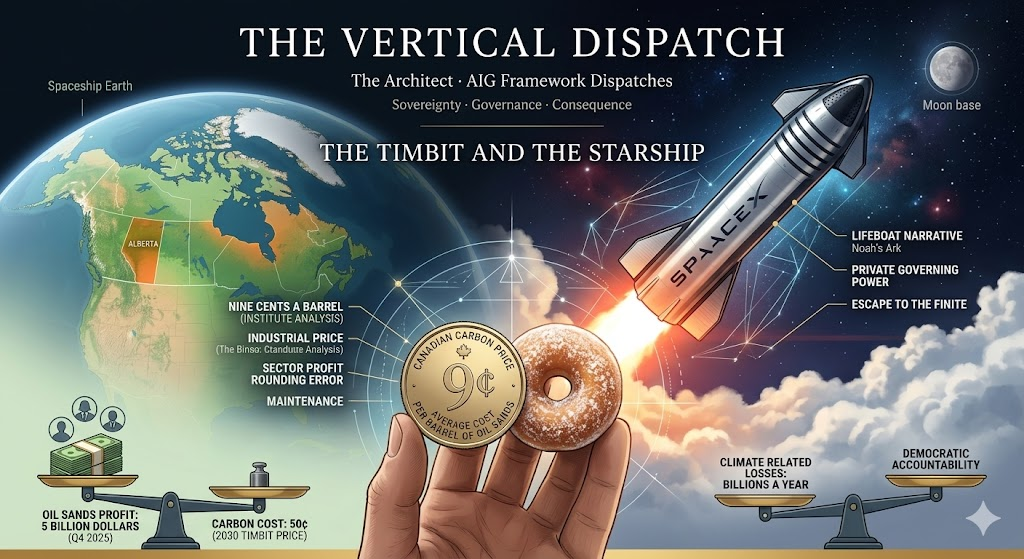
Hold that number still, because almost everything in Canadian politics that touches carbon is, on examination, an argument about it. The consumer carbon tax that dominated three elections — scrapped. What remains is the industrial price, and the industrial price, for the sector that generates the most heat in the debate, costs a Timbit a barrel. This dispatch is about why a civilisation would tear at its own seams over the price of a Timbit, about what the tearing conceals, and about a deeper contradiction the carbon fight is only the surface of.
One honesty marker before the elenchus begins, because the dispatch holds itself to the standard it holds power to. The Timbit is an average, and an average has a spread. The same Institute analysis found the hardest-hit facility, Strathcona’s Tucker Thermal, facing nearly four dollars a barrel by 2030, while at the other end Canadian Natural’s Peace River project would actually earn credits worth about two dollars and twenty-three cents a barrel by outperforming its benchmark. That spread is not a flaw in the argument. It is the argument: the policy is built so the efficient profit and the wasteful pay, and the average across the sector still lands at pocket change.
AIG INTEGRATION — THE NUMBER THAT AUDITS THE NARRATIVE
The elenchus does not argue with a narrative. It measures it. When a political story and a verified number point in opposite directions, Artificially Intelligent Governance follows the number and then asks the only question that matters: who benefits from the gap between the two? This dispatch does not assert that carbon pricing is good or that the oil sands are bad. It establishes one measured fact — the cost is a Timbit — and then audits every actor whose story requires that fact to be hidden. No quarter for a narrative that cannot survive its own arithmetic.
I. THE LEDGER OF THE ABSURD
Permit the dispatch one section of plain comedy, because the figures, set side by side, are genuinely funny — the way a man searching his whole house for the loose change he is owed, while a cheque for a fortune lies uncashed on the table, is funny. The humour here is not invented. It is the verified arithmetic, read aloud at the right speed.
Item one. The carbon cost the nation fights over: nine cents a barrel today, fifty cents by 2030. Item two. The 2025 financial performance of Canadian Natural Resources, one of the largest oil sands producers, drawn from the company’s own filing: in the fourth quarter of 2025 alone, net income of five point three billion dollars. Not revenue — profit. In ninety days. Item three. Across the full year, Canadian Natural directed approximately nine billion dollars to shareholders and balance sheet — four point nine billion in dividends, one point four billion in share buybacks, two point seven billion in debt reduction. Item four, the detail that writes its own punchline: 2026 marks the company’s twenty-sixth consecutive year of raising its dividend.
Now place the items on one table. A single oil sands company earns, in one three-month stretch, more than five billion dollars in pure profit — and the national emergency, the issue that fuels separatist sentiment and strains the federation, is whether that company and its peers should pay nine cents a barrel or fifty. The entire firestorm fits inside the rounding error of one quarterly earnings statement. If the carbon cost were a coin down the back of the sofa, the executives would not bend to pick it up. They are, however, prepared to fund a national argument about whether they should have to.
This is the comedy, and it is the whole comedy: a nation on its knees searching the floor for a Timbit’s worth of loose change, while the cheque on the table clears for five billion dollars. The laugh is real. So is the bill.
II. WHY THE FUSS — THE ANATOMY OF MANUFACTURED HEAT
If the cost is negligible, the heat comes from somewhere other than the cost. The dispatch names three sources, with the legal standard intact — these are documented patterns of advocacy, not findings of bad faith against any individual.
The first is the political weaponization of the word tax. A national brand was built on the phrase axe the tax, and the phrase outlived the thing it named: the consumer carbon tax has been scrapped, and the industrial price that remains costs the oil sands a Timbit — yet the slogan rolls on, because a slogan, once bonded to an identity, no longer needs a referent. It has stopped being about a tax. It is about belonging to the group that opposes the tax.
The second is opacity sold as policy. Canada’s industrial carbon pricing applies only to emissions above a facility’s benchmark, with free allocations, output-based credits, and tradable compliance. This is genuinely good design — it is precisely what holds the cost to a Timbit while preserving the incentive to cut emissions. But the same complexity that protects competitiveness also makes the system almost impossible for a citizen to see plainly, and an unseeable policy is a perfect political canvas: one side paints it as ruinous, the other as transformative, and the citizen, unable to check either, is left to pick a tribe.
The third, and the real one, is the threat not of a carbon price that fails but of a carbon price that works. The dispatch is scrupulous here. Analysts including the Pembina Institute hold that an effective price near one hundred and thirty dollars a tonne is the level that would actually move investment into emissions reduction. That is a contested forecast, not a settled fact, and the dispatch presents it as the claim of one side. But if it is even approximately right, it reframes the fight: the current system is too weak to do its job, the cost of making it strong enough is a Timbit, and the political war is being waged precisely to ensure the strengthening never arrives. The fuss is not about the fifty cents. It is about making sure the fifty cents never begins to bite.
III. IN FAIRNESS — THE CASE THE OTHER SIDE WOULD MAKE
No quarter does not mean no fairness. The dispatch owes the strongest version of the opposing case, and there is one. The oil sands are a genuine engineering achievement — an industry that turned bitumen, long considered unrecoverable, into competitively priced crude, sustaining hundreds of thousands of livelihoods and a substantial share of national export revenue. A government is right to be careful with such a thing. The competitiveness worry is not absurd on its face: capital is mobile, energy investment crosses borders, and a prudent policymaker watches the margin.
But the strongest opposing case is also where the elenchus closes its grip, and it does so using not a climate activist but an energy economist — Andrew Leach of the University of Alberta, who put the contradiction with a precision the dispatch will not improve upon. The industry, he observed, cannot be described as both the engine of the Canadian economy and so fragile that the lightest touch destroys it. The two claims cannot both be true. A sector that clears five billion dollars of profit in a quarter is not fragile. A sector that is genuinely the nation’s engine is not threatened by a Timbit. The opposing case, pressed, must surrender one of its halves — and whichever half it keeps, the case for the firestorm collapses.
Either the oil sands are strong — in which case a Timbit cannot hurt them — or they are fragile, in which case they are not the unshakeable engine their defenders proclaim. The narrative needs both at once. Reality permits only one. That is the elenchus, and it was an Alberta economist who sprang it.
IV. THE STARSHIP NAMED EARTH
Raise the altitude now, because the carbon fight is the surface of something older. The image of the planet as a vessel is not new, and its lineage matters, because the dispatch credits what it borrows. The earliest versions reach back to the nineteenth century, but two twentieth-century figures gave it the form we use. Buckminster Fuller, in his 1969 Operating Manual for Spaceship Earth, drew the picture: a single craft carrying a single crew through infinity, with no instruction book and no second vessel. And the economist Kenneth Boulding, three years earlier, did the harder thing — he made it an economic argument. Boulding contrasted what he called the cowboy economy, the economy of the open frontier and apparently illimitable resources, with the coming spaceman economy, in which the Earth is a closed ship with no unlimited reservoir for extraction and no unlimited reservoir for pollution. That distinction, drawn in 1966 by an economist, is this dispatch’s entire thesis stated sixty years early. The cowboy thought the plains were endless. The astronaut knows the hull is finite.
Hold that image — one vessel, one crew, one finite hull — because the next section is about a man who has looked at the same ship and drawn the opposite conclusion.
V. THE BACKUP PLANET AND THE UNELECTED HAND
There is a second response to the knowledge that the hull is finite, and it is not to maintain the ship. It is to build a lifeboat. The clearest living exponent of that response is Elon Musk, and this section examines his stated project — his own public words, on the record — not his character, which is not the dispatch’s business and which the elenchus has no instrument to measure.
Musk has said, repeatedly and publicly, that the purpose of his Mars programme is to establish a self-sustaining civilisation on another planet as a backup for humanity — so that, in his words, Mars could come to the rescue of Earth if something goes wrong. He has called the vessels modern Noah’s Arks. He has framed the enterprise as the maintenance of the light of consciousness, a duty to carry humanity forward in case of catastrophe on Earth. Take him entirely at his word. The contradiction the dispatch wishes to name does not require disbelieving a syllable of it.
Here is the contradiction. The same civilisation that finds a Timbit a barrel too dear to maintain the planet it already has, is being sold — and is funding, through public contracts and public subsidy — the construction of a lifeboat to a planet with no breathable air, no liquid water at the surface, no magnetic field, and a mean temperature far below the cruelest night on Earth. The repair of the working ship is dismissed as ruinous. The construction of the escape vessel is celebrated as visionary. This is not an economic judgement. No economic judgement could survive the comparison. It is a confession — a confession that a certain kind of mind would rather build the heroic lifeboat than perform the dull, unglamorous, inexpensive maintenance, because the maintenance earns no monument and the lifeboat does.
An ark is not a plan for the crew. It is a plan for the remnant. Noah’s vessel was never meant to carry everyone — that is the entire point of the story — and a backup planet, reachable only by those who build and own the ships, quietly answers the question the carbon fight keeps refusing to ask aloud: when the hull fails, whose survival was ever being budgeted for?
And this is where the dispatch states its actual indictment, plainly, so it is not mistaken for an attack on one man. The danger is not Elon Musk’s personality. The dispatch makes no claim about his inner life; it cannot, and it will not pretend otherwise. The danger is structural, and it would be the danger whatever the man’s character. It is this: wealth concentrated to the scale of the contemporary billionaire ceases to be merely wealth and becomes private governing power — the capacity of a single unelected individual to direct outcomes that belong, by right, to the public. Orbital infrastructure. A communications network that bears on the conduct of wars. The agenda of space itself, set by one balance sheet. No electorate voted for this allocation of power. No parliament granted it. It accumulated, quietly, in the space where a democracy was not looking. The money, at that altitude, is almost beside the point. The power is the point — the power to shape the common future without ever once asking the commons.
A billionaire at this scale is not a rich citizen. He is an unelected branch of government that no one designed, no one ratified, and no one can vote out. The objection is not envy. The objection is that a democracy has, without ever deciding to, grown a region of itself in which the public has no say — and a planet’s maintenance cannot be entrusted to a power the planet never chose.
AIG INTEGRATION — STRATUM, THE SHORT HORIZON, AND THE POWER NO ONE ELECTED
Two readings close this section. The carbon fight is checkers: axe the tax is a single move — remove the cost, win the square, take the applause this quarter — blind to the Go board on which emissions, insured losses, and the habitability of the next century are one connected position. In the Jaques frame the defect is precise: a governing mind at a low stratum genuinely cannot hold the multi-decade time-span on which a carbon budget is denominated, so the threat is not weighed, it is simply not seen. But the deeper AIG point is about the agent, not the horizon. Artificially Intelligent Governance exists to ensure that power over public goods is held by structures that can be audited and recalled. Private power at billionaire scale fails that test by construction — it answers to no electorate, submits to no elenchus, and cannot be questioned by those it governs. The Timbit measures whether a civilisation can take a small step in time. The unelected hand measures whether it still controls who takes the steps at all.
VI. THE VERDICT — THE TEST OF THE SMALLEST STEP
Set the findings in one line. The cost is a Timbit. The profit is five billion dollars a quarter. The disasters are billions a year and climbing. The political firestorm is real, exhausting, and aimed with precision at the gap between what the cost is and what the citizen has been told it is. And above it all sits the deeper contradiction: a civilisation declining the cheap maintenance of the ship it has, while financing a lifeboat for a remnant to a planet that cannot sustain a single unprotected human breath.
The dispatch returns the question to the reader, because the elenchus always does. The next time the word tax is deployed to set the federation against itself, hold up the Timbit and ask the one wielding it to define the cost — the real number, the nine cents, the fifty — and to define who profits from keeping that number out of the conversation. And the next time the lifeboat to Mars is sold as humanity’s hope, ask the harder question: a lifeboat for whom, built by whom, owned by whom, and answerable to whom? A fifty-cent carbon cost is not a threat to the oil sands. It is a test — of whether this civilisation is still capable of the smallest step to maintain the only vessel it will ever truly have, and of whether it still owns the hands that would take the step. The fire suppression system costs pocket change. The dispatch has read the instruments aloud. The decision was always ours — and the first task of citizenship is to make sure it stays ours.
No quarter for a narrative that cannot survive its own arithmetic. The number is nine cents. The hull is finite. There is no second ship for the crew — only, perhaps, a lifeboat for the few. The Timbit does not stop being a Timbit because a civilisation agreed to shout about it instead of paying it.
NOTE ON STANDARD
This dispatch distinguishes documented fact from interpretation. Carbon cost figures — nine cents per barrel today, under fifty cents by 2030 at a $130/tonne credit price — are from the Canadian Climate Institute’s March 2026 analysis of 29 oil sands facilities; the Institute notes its model does not account for changes in production levels or emissions benchmarks, and that limitation is acknowledged here. Financial figures for Canadian Natural Resources, including Q4 2025 net income of CA$5.3 billion and approximately CA$9.0 billion directed to shareholders and balance sheet in 2025, are from the company’s own published results. Statements attributed to Elon Musk regarding Mars as a backup for humanity, the “Noah’s Ark” framing, and the “light of consciousness” are drawn from his own public remarks and posts. The dispatch makes no claim regarding any individual’s psychology, motives, or inner life; its argument concerning concentrated wealth is structural and applies to the position, not the person. Forecasts regarding the carbon price required to drive investment, and projections of climate-related losses, are identified as published estimates, not settled facts. No allegation of unlawful conduct is made against any company or person named.
God is Love. Love is Truth. Truth is Consciousness. Consciousness is Brahman.
Amen. Namaste.
DISPATCH HASHTAGS
#TheTimbitAndTheStarship #TheVerticalDispatch #TheArchitect #AIG #ArtificiallyIntelligentGovernance #TheElenchus #NoQuarter #CarbonPricing #IndustrialCarbonPrice #AxeTheTax #ClimatePolicy #OilSands #Alberta #CanadianClimateInstitute #SpaceshipEarth #BuckminsterFuller #KennethBoulding #CowboyEconomy #SpacemanEconomy #BillionairePower #ConcentratedWealth #DemocraticAccountability #StratifiedSystems #GoVsCheckers #CivilisationalAnalysis #SubstackCanada