

“There are two persons in this world — the perishable and the imperishable. The perishable is all beings. The imperishable is called the unchanging. But there is another — the Supreme Person — who pervades and sustains the three worlds as the imperishable Lord.” — Bhagavad Gita 15.16–17
— ★ —
Chapter Fifteen is the shortest chapter in the Gita’s final movement. It is also, in Shankara’s reading, the most complete. In twenty verses it moves from the most vivid image of conditioned existence in the entire text to the most precise statement of what lies beyond it. It is a chapter that rewards slow reading — not because it is difficult, but because each verse is doing more philosophical work than its brevity suggests.
I open with a tree.
Not an ordinary tree. The ashvattha — the sacred fig, the peepal, the tree under which the Buddha would later sit, the tree that appears in the Katha Upanishad as the symbol of the entire structure of conditioned existence. And I describe it in a way that stops every reader who has genuinely been following this teaching.
Its roots are above. Its branches spread downward.
— ★ —
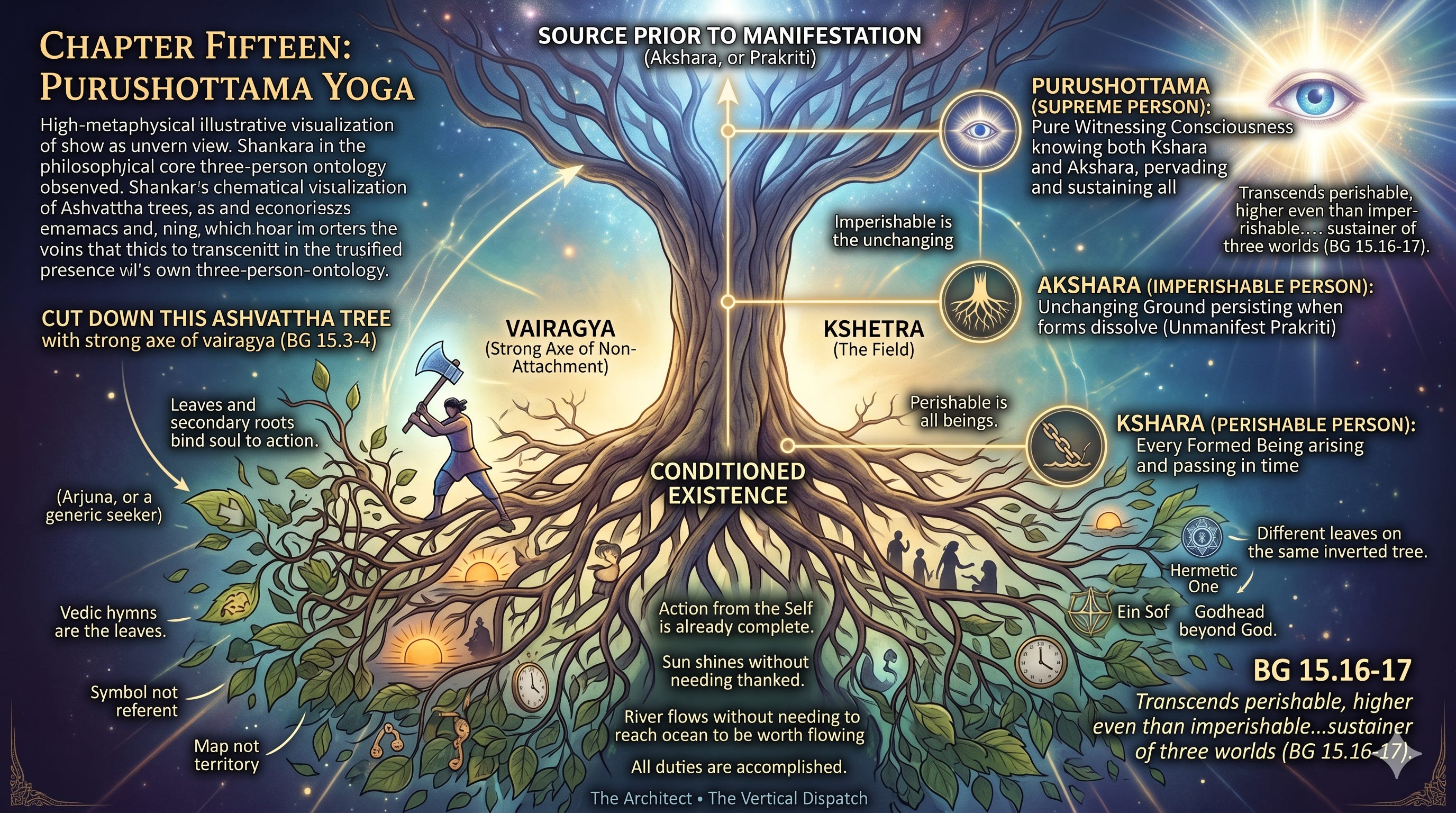
Take a moment with this image. An inverted tree. Roots reaching upward into what is prior to manifestation. Branches spreading downward into the world of forms, of time, of experience, of birth and death and the whole dense network of conditions that constitute a human life.
The roots are above because the cause of the tree — the ground from which everything arises — is not found by going deeper into manifestation. It is found by going in the opposite direction from where the branches are pointing. The branches, the leaves, the secondary roots that spread through the world of human affairs and bind the soul to action and its fruits — these are real. The tree is real. But the tree’s actual source, its actual ground, is not among the branches. It is above. Prior. The unmanifest from which the manifest descends.
Shankara noted the precision of the leaves. The Vedic hymns are the leaves of this tree. Not the roots. Not the trunk. The leaves — beautiful, necessary, seasonal, the part that photosynthesises and sustains the living organism of the tradition. But leaves fall. Leaves are renewed each season. The leaves are not what makes the tree a tree. The words that describe the Absolute are real and necessary and to be honoured. And they are leaves. The symbol is not the referent. The map is not the territory. The hymn is not the silence it is pointing at.
I tell Arjuna: the form of this tree is not perceived here as such. Its end is not perceived, nor its beginning, nor its foundation. The person caught inside the branches — identified with the forms and conditions of conditioned existence — cannot see the tree as a whole. They can only see the branch they are standing on.
The instruction that follows is among the most striking in the entire Gita.
“Having cut down this firmly rooted ashvattha tree with the strong axe of non-attachment — then that goal is to be sought from which those who reach it do not return.” — Bhagavad Gita 15.3–4
Cut it down. Not with hatred of the world — the tree is not the enemy. But with non-attachment. The axe is vairagya — the dispassion that Chapter Six named as the companion of practice, the quality that prevents the love of what is real from being mistaken for the love of what merely appears. The tree is cut not by withdrawing from life but by ceasing to identify the roots with the branches. By remembering that the source is above even when the living is below.
— ★ —
Now I give Arjuna the chapter’s philosophical core. The three-level ontology that Shankara considered the clearest statement of the Advaita position in the entire Gita.
Two persons exist in this world. The perishable — kshara — which is every formed being that arises in time and passes in time. The tree’s branches. Everything that has a beginning and an end. Everything the field contains.
And the imperishable — akshara — the unchanging ground that persists when forms dissolve. The unmanifest prakriti. The tree’s roots as they disappear upward into what the eye cannot follow.
But there is a third. The Supreme Person — Purushottama — who is neither of these. Not the perishable formed world. Not even the imperishable unmanifest ground. The pure witnessing consciousness that knows both — that is the ground in which both the perishable and the imperishable appear. That which transcends the tree entirely — root and branch alike — while pervading and sustaining every part of it.
Because I transcend the perishable and am higher even than the imperishable — therefore I am known as the Purushottama. The Supreme Person.
Shankara held this three-level distinction with great care. It is not a new teaching — it has been present in different vocabularies across all fifteen chapters. The field and the knower. The lower and higher nature. The perishable and what is beyond it. Chapter Fifteen names the three levels clearly and places them in precise relationship: all three are real at their own level, and the highest — the Purushottama — is what everything else is a manifestation of and what the seeker most fundamentally is.
— ★ —
This is the teaching that every genuine metaphysical tradition has arrived at through its own vocabulary. The Hermetic tradition speaks of the One that is prior to both being and non-being. The Hebrew mystical tradition speaks of Ein Sof — the infinite without limit — that is prior to every attribute. The Christian mystical tradition speaks of the Godhead beyond God. Different leaves on the same inverted tree. Different words for the same roots reaching upward into what no word fully contains.
Three levels. One reality expressing itself at three degrees of density. The tree with its roots above.
— ★ —
The chapter closes with a statement that Shankara called remarkable in its scope.
“The one who, undeluded, knows me as the Supreme Person — that one, knowing all, worships me with their whole being. Thus this most secret teaching has been declared. Knowing this, one becomes wise and all one’s duties are accomplished.” — Bhagavad Gita 15.19–20
All duties accomplished. Not abandoned. Not transcended in the sense of left undone. Accomplished — from the ground of genuine understanding rather than from the confusion of mistaken identity.
The person who knows themselves as the Purushottama — as the witnessing consciousness that is prior to both the perishable and the imperishable — does not stop acting. They continue to work, to love, to serve, to engage with every ordinary demand of a human life. But the action arises from a different source. Not from the ego’s need to secure outcomes. Not from the fear that drives tamasic avoidance or the desire that drives rajasic accumulation. From the Self that knows what it is and acts accordingly.
Action from the Self is already complete. It does not need the fruit to validate it. It does not need the outcome to justify it. It is complete in the acting — the way the sun shines without needing to be thanked for the light, the way the river flows without needing to reach the ocean to have been worth flowing.
All duties are accomplished not because the list of duties has been finished but because the one who performs them is no longer performing them in order to become something they are not already. The performance and the performer and the purpose have collapsed into a single movement. That movement — the Self acting as itself — is what duty looks like when it has been fully understood.
— ★ —
The symbol is not the referent. The leaves are not the roots. The branches are not the ground. The Vedic hymns, the tilak on the forehead, the name of God in any language, the tradition that carries the teaching — these are the tree’s leaves. Real, necessary, seasonal, to be honoured.
The roots are above. The Purushottama is prior to every form the teaching has ever taken. And it is, Shankara says without hesitation, what you are. Not what you will become through sufficient practice. Not what you were before the confusion began. What you are, now, reading these words, in this moment, regardless of how clearly you can currently see it.
The seeing is what varies. The reality does not.
— ★ —
Today sit with the image of the inverted tree. Not as an intellectual exercise — as a felt orientation.
The branches of your life — the relationships, the work, the daily conditions, the history, the plans — these are real. They are the tree. Let them be what they are without pretending they are not there.
And then ask, quietly: where are the roots of all this? Not downward into more complexity, more history, more cause and effect. Upward. Prior. Into what was present before the first branch grew.
You do not need to find the roots today. The question, held honestly, is already the axe beginning its work.
— ★ —
Tomorrow: Chapter Sixteen — The Divine and Demonic Natures
The Architect • The Vertical Dispatch
#BhagavadGita #ChapterFifteen #PurushottamaYoga #TheInvertedTree #Ashvattha #AdiShankara #AdvaitaVedanta #Metaphysics #NonDuality #TheSupremePerson #Kshara #Akshara #Vairagya #SacredMetaphysics #UniversalDynamics #TheVerticalDispatch #GlenRoberts #TheArchitect #Project2046 #AxiomaticCorrection #TheGeometryOfEverything #VerticalCausation #WitnessingAwareness #Ontology #FoundationalText #SpiritualGeometry #ThePriorAxiom #Consciousness #TruthIsConsciousness #GodIsLove #LoveIsTruth #SacredMetaphysicsVolume3 #JourneyToTheSelf #OnePlaneTwoAxes #Xorigin #TheAxeOfNonAttachment #BionicSage #ZeroFluff #ProtocolXYZ #LogicIntegrated