

It has been twenty-five years since the world broke.
If you were there, you remember the specific texture of that winter. The smoke had barely cleared from Lower Manhattan, and the air felt brittle. We were suddenly aware that the world was not safe, that the skyline could change in an instant, and that there were forces watching us that hated our way of life.
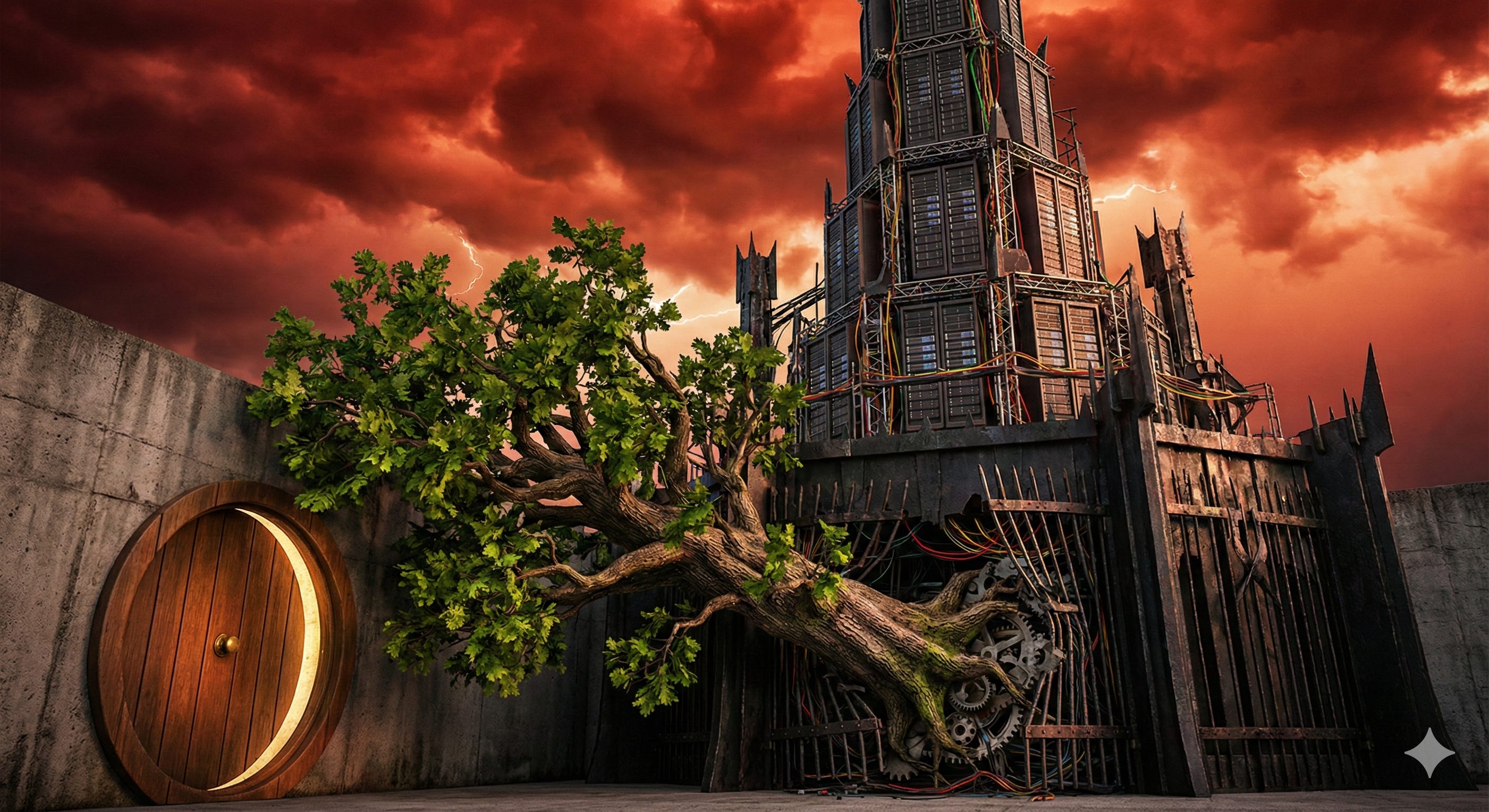
And then, just before Christmas in 2001, a movie appeared. It wasn’t just a film; it was a medicine. The Fellowship of the Ring arrived in theaters at the precise moment we needed to understand the nature of evil. We sat in the dark and watched a story about a Great Eye that saw everything. We watched a story about Two Towers—Orthanc and Barad-dûr—that stripped the forests bare to build machines of war.
But most importantly, we watched a story about a Fellowship. Nine walkers. A horizontal band of brothers who stood against a vertical evil. We saw that the only thing that could defeat the Tower was not a bigger Tower, but a gardener named Samwise Gamgee who refused to leave his friend.
Now, the wheel of time has turned. It is 2026. The smoke of 2001 is gone, but a new shadow has lengthened. You and I are living through the sequel, but the villains have changed their clothes. The “Two Towers” are no longer steel and concrete in New York. They are Glass and Silicon in California.
We are witnessing the rise of the False Vertical. The Tower of the Eye is now the surveillance architecture of the Big Five, the algorithms that watch every step, every click, and every heartbeat. They do not need searchlights; they have our phones. The Tower of the Sorcerer is the ivory tower of the new AI elite, weaving spells of virtual reality to distract the masses from the fact that their trees are being cut down to fuel the server farms.
They tell us to look up. They tell us to look at the screen, at the cloud, at the rocket. They strip the “Shire”—our privacy, our attention, our children’s innocence—to feed the fires of their industry.
So, what is the strategy for the Project 2046 generation? How do we fight a Dark Lord who owns the servers we speak on?
We must look to the myth. Sauron was not defeated by a warrior king like Aragorn fighting him head-on. He was defeated by two Hobbits who simply walked. The Hobbit is the ultimate Horizontal Archetype. They do not want power; they want six meals a day. They do not want to fly; they want to walk barefoot on the grass. They do not want a “Network”; they want a neighborhood.
The Shire is the original Analog Zone. It is a place of soil, beer, and slow time.
The central lesson of Tolkien is that you cannot use the Ring to do good. The Ring represents the ultimate technology, the ultimate power. It always betrays the user. Even Gandalf feared to touch it. Even Galadriel refused it. Today, we are handed the Ring every morning. The headset, the smartphone, the infinite scroll. They promise us we can be invisible, powerful, and all-knowing. But the Sovereign knows the truth: to wear the Ring is to be seen by the Eye.
The mission for 2026 is simple. We must become the Fellowship of the Real. We are not trying to destroy the Tech Giants with swords. We are simply refusing to wear the Ring. We are planting the “Sideways Oak,” building communities that grow horizontally and crash through the vertical machinery of the age.
We are guarding the Shire. We are keeping our homes free of the digital eye, protecting the spirit of Samwise in our grandchildren. The Towers are rising again, taller and colder than before. But the grass is still growing. The soil is still waiting. And the King only returns when the Shire is saved.
Throw the Ring in the fire. Walk the earth. The Table remains.
#TheTwoTowers #Tolkien #Project2046 #TheShire #AnalogResistance #FellowshipOfTheReal #SiliconValley #911Anniversary #Mythology #SamwiseGamgee #HorizontalSolution