

Φ
THE VERTICAL DISPATCH
We write for the mind, the eye, and the ear.
Read it. Look at it. Listen to it. The Vertical Dispatch is built for all three — prose with rhythm, made to be heard as much as read.
From metaphysics to geopolitics, from culture to history, from the sacred to the street — and everything in between. One lens, every subject. No ego. Just the record, named clean.
Press play. Walk with the word. 🕯️
This dispatch travels by hand. If it serves you, share it — restack on Substack, and pass it on wherever you read. 🕯️
On Consciousness · The Foundation Series
Sacred Metaphysics · The Universal Grammar of Non-Duality
The Metaphysics of Zero and the Physics of One
Coming September 1,2026
sacredmetaphysics.org
To Wolfgang Smith, who gave the key to a door I had long been standing before.
“Being is said in many ways… and it is always a source of perplexity.”
— Aristotle, Metaphysics
Twenty-three centuries ago, Aristotle set down the one question he believed would never rest. There is a science, he said, that studies being simply insofar as it is — being qua being — and its question is the oldest and the most permanent of all. What is it, to be? It was asked long ago, he wrote, it is asked now, and it will always be asked; and it is always a source of perplexity. Aei aporoumenon. Forever unresolved. He gave the deepest question its name and, in the same breath, told us it would not close.
The name for that question is ontology — the study of being as such, the deepest room in the house of metaphysics, the one the others rest upon; for before one can ask what God is, or what the cosmos is, one must ask what it is to be at all. And the perplexity Aristotle named has held, unbroken, for two thousand years. This dispatch is about why it held — and where, at last, it closes.
For it held for a reason. The question stayed open not because no one was clever enough to answer it, but because it was pursued in the one manner that can never answer it: from the outside, as though being were an object out there to be described. And there is a strange feeling that comes over a reader of the metaphysical writing of our own age, which is only the latest form of that same ancient reaching. You can feel the ambition — the reaching for the great questions, consciousness, reality, meaning, the divine. And you can feel the collapse. The argument drifts. It begins in metaphysics and ends in psychology, or politics, or evolutionary biology dressed as ontology. The ladder breaks. The ascent never arrives.
The reason is not that the writers are foolish. Many of them think a great deal, and think well. The reason is that they are trying to describe the highest structure of reality with a vocabulary that cannot carry it. They reach for the vertical with the grammar of the horizontal — the language of systems, therapy, identity, and sentiment — and horizontal language cannot climb. It cannot reach the One. So the work diverges: not from foolishness, but from being linguistically unequipped for the altitude it attempts.
There is a tell, and once it is seen it cannot be unseen. Watch what such a writer reaches for at the moment the argument needs a ground — a first principle, a source, an account of being itself. Watch, and the hand will close, at every vertical moment, on a scientist. Order out of chaos, from a physicist. Saturation and emergence, from a biologist. Integration, from a cell. The commons, from an economist. Every load-bearing claim about the deep structure of reality is cashed out in the grammar of complexity science — the very move it accuses modernity of, and then makes. The surest sign of a mind that has not done metaphysics as a discipline is that when it needs a first principle, it borrows one from physics.
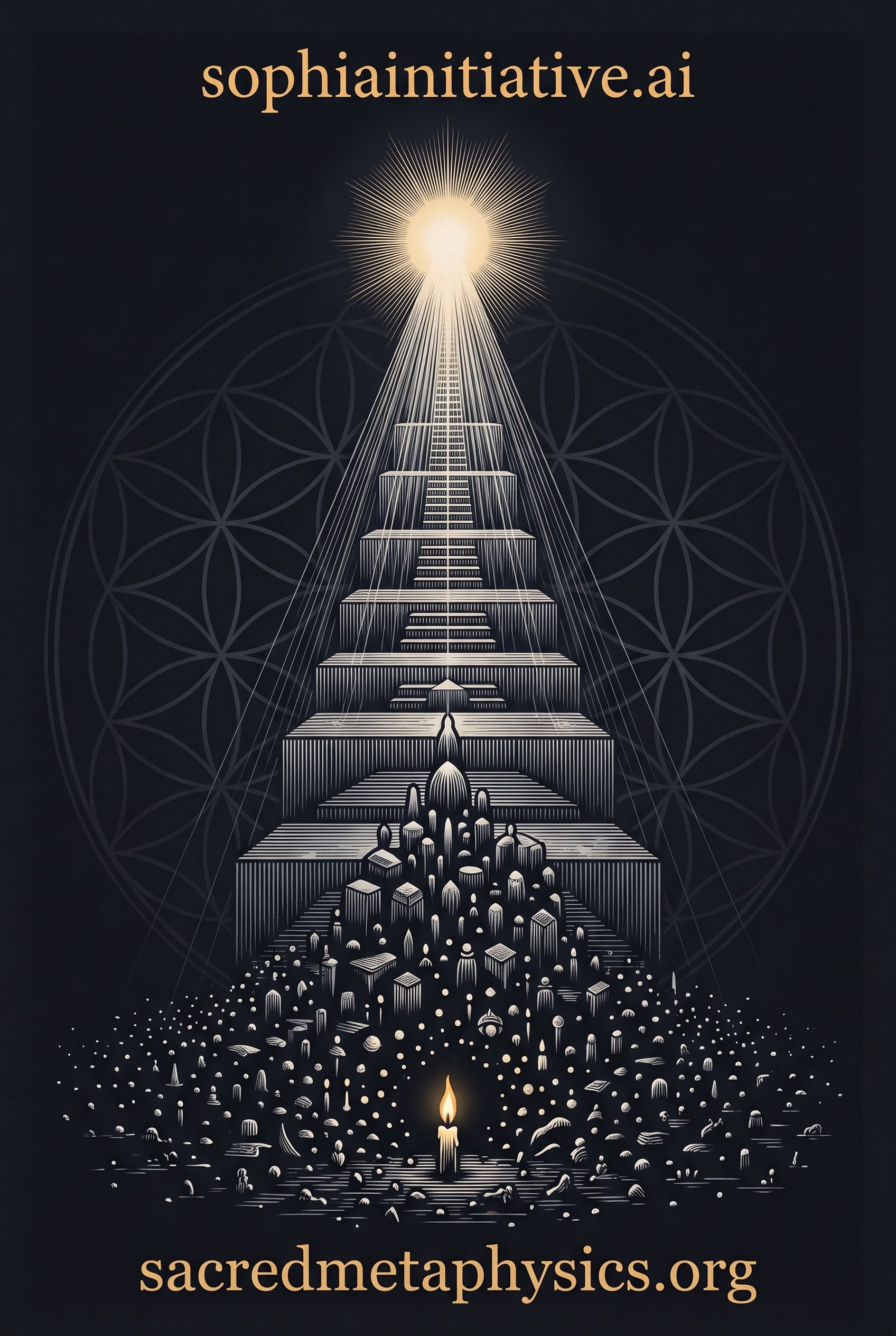
This dispatch draws one distinction and follows it to its end: the difference between metaphysics and sacred metaphysics — between the horizontal description of being and the vertical completion of it. The horizontal and the vertical are not a metaphor of convenience. Wolfgang Smith, in his recovery of vertical causation, has shown that a cause need not lie beside its effect in the chain of time and matter; it may stand above it, as the source stands above what descends from it. The horizontal is the plane of things acting upon things; the vertical is the descent of the higher into the lower, of the One into the many. Metaphysics that knows only the horizontal can describe the plane forever and never once look up. And so the difference is carried, before anything else, in the vocabulary. A mind cannot climb a ladder its language does not contain. So we begin by building the ladder in the words themselves.
The Three Tiers of the Universal
Everything turns on keeping three things apart that the modern hand keeps pressing into one. They are not three opinions. They are three altitudes, and the whole of what follows depends on marking them so cleanly that the eye can tell them apart on the page.
First, in lower case: universal and particular. This is the working machinery of philosophy — redness, justice, the triangle. The problem of the one and the many held as a logical and epistemic problem: how one form appears in many instances. It is rigorous, and it is real, and it is horizontal. It stays inside the created order, sorting the many. Aristotle lives here; the medievals fought their long wars here.
Second, in capital initial — the Universals — and this mark is reserved for three, and only three: Goodness, Beauty, Truth. The transcendentals. Not mental conveniences for grouping, but the properties said of Being itself, in which every particular participates and which no particular exhausts. This is the summit of what discursive reason can reach: where a few great minds actually stood, feeling the Form pull upward rather than merely organize sideways. If a thing can be counted — one of three — it belongs here.
Third, in full capitals — THE UNIVERSAL — not a Universal among the three, not even the highest of them, but the source from which the three descend. The referent behind every referent. Brahman. The Good beyond being that even Plato could only point at and go quiet — beyond being itself. It cannot be counted, for there is no second to it. It is not a position the mind takes. It is what the mind dissolves into when it is honest about its own ceiling.
The test that sorts every instance is a single question: can it be counted? If it can be counted — one of three — it is a Universal. If it is the uncountable source, it is THE UNIVERSAL. The typography itself carries the metaphysics.
The moderns under examination do not know these three tiers are different. That is the whole of the failure. They use “the One,” “the whole,” “the universal” as interchangeable warm words, as though reaching the third were a matter of feeling the first hard enough. But a vocabulary that cannot mark the difference between organizing particulars and touching the Source cannot climb from one to the other. This is not a shortage of words. It is the absence of a graded vocabulary — a ladder in the language itself. And where there is no ladder in the language, there is no ascent in the thought.
The Wall, and Who Knew It Was There
This must be said with care, for it is meant generously and not in dismissal. The greatest metaphysicians of history were horizontal metaphysicians — and their greatness was to work the universals all the way to the summit of what universals can do, and, at their best, to know that a wall stood at the top.
Kant is the honest one. He maps the phenomenal and draws the line at the noumenal, and says: you cannot cross this; reason gives out here. He does not pretend to stand on the far side. He names the wall. Plato is the strongest witness, and the subtlest: he reached the Good beyond being, and then confessed that of the highest things there is no writing of his, and never will be. That is not a failure. That is a man who reached the summit and told us the pen stops here. Russell would not look up at all — the horizontal made fully self-satisfied. Berlin held resolutely to the plane of the many, and called the reach for the One dangerous.
The moderns under examination differ from every one of these in a single decisive way: they do not know the wall exists. Kant knew the noumenon was there and unreachable by his instrument. They think they can talk their way to the One, because they have never climbed high enough to reach the place where language gives out. The great thinkers earned the silence. The moderns never reached the altitude where the silence begins. They are doing lower-case work and calling it the summit, because they have never seen the summit, and do not know it stands above the tree line.
The Three, and the Proof of a Universal
Of the Universals there are three, and only three: Goodness, Beauty, Truth. Bonum, pulchrum, verum — the transcendentals, convertible with one another, in which every particular participates and which no particular exhausts. This is not a new coinage. It is the oldest recognized grammar of the vertical in the Western line, running from Plato through Augustine and the Scholastics, tested across two thousand years against the question of whether there were more, and settled on these.
And here is the demonstration that they are real and not invented. The same three appear, independently, in the Vedic tradition: Satyam, Shivam, Sundaram — the True, the Auspicious or Good, the Beautiful. No contact, no borrowing, half a world and an age apart. That convergence is not a coincidence to be waved at. It is the test of a genuine universal. A universal is precisely the thing that appears in every civilization that climbs high enough, because it is not made by a culture but discovered by consciousness. Redness is a lower-case universal; it needs eyes. Truth is a Universal; it needs Being. When Greece and India, with no line between them, both reach the summit and both report the same three, we are watching two independent instruments read the same invariant. The convergence is the evidence. It is the floor no rhetoric can move, because two traditions moved to it separately and found the same stone.
A Man of Virtue Is Not Ashamed of Truth
Here is a proposition, and it will teach the whole horizontal error in a single stroke: a man of virtue is not ashamed of truth.
The horizontal mind, hearing it, reaches at once for a source. It runs the cadence through its associations, finds the nearest particular, and binds the universal to it — infers backward from the words to a mouth that must have spoken them. And in that instant it commits the very error this dispatch is about: it mistakes a Universal for a particular. It takes a statement that belongs to anyone who stands rightly before the truth — Marcus Aurelius as much as Paul, a Stoic emperor as much as a Christian apostle, a Vedic seer as much as either — and collapses it down to one man, one text, one tradition.
This is Russell’s own doctrine turned against Russell. We infer, he said, from particulars — and inference is exactly the failure here, for to infer a universal up from its instances is always, in the end, to own it to one instance. But a Universal does not come from a source. It is not inferred up from particulars; it is read down — recognized wherever consciousness climbs high enough: in Marcus, in Paul, in the Gita, in whoever stands before the truth and does not flinch. Marcus never met Christ and was never ashamed of truth. That is not a caveat. That is the proof. Were the proposition particular, it would need its source. Because it holds across a Stoic emperor and a Christian apostle and a Vedic seer with no line between them, it is shown to be a Universal. The independence of the witnesses is the demonstration — the very structure that proves the transcendentals. The metaphysician, therefore, is not ashamed of truth, and the instant one asks whose that is, one has confessed that one is still reading horizontally.
Even the Highest Symbol Is a Symbol
The error has a last hiding place, and it is the most sacred one — which is why it is the hardest to see and the most important to name. Christ, read through the dividing lens, becomes a particular; and the moment he is a particular, the othering follows: Christians and the rest, the saved and the unsaved, us and them. But that othering is not in Christ. It is in the lens. It is we who make Christ other — the same reflex that binds a universal proposition to a single name, run all the way up to its most exalted form.
Christ, followed to the top, was transparent to the Universals — a particular so transparent that the Good, the Beautiful, and the True shone straight through him to THE UNIVERSAL behind them. The window so clean it discloses the source. And here is the turn that takes nerve to make: even the consciousness that has realized this, if it still clings to the symbol as the symbol, has not completed the ascent. To need that one form — to need it to be this name and not the source the name was transparent to — is to have reached the Beautiful through a single window and mistaken the window for the light. The symbol is not the referent, even when the symbol is the most sacred name one knows. Especially then — for that is the last place the discipline must hold.
The Gita marks the grade. In the twelfth chapter, answering Arjuna’s direct question — whether those who worship the manifest form or those who seek the unmanifest are the further along — Krishna says the worshippers of the form receive their reward; the path is real and is not despised. And then he says the harder thing: greater still, though the toil is greater for the embodied, is the one who reaches the formless, the imperishable. The highest reward asks the highest surrender. And there is a deeper reading yet, which completes the teaching: not the rejection of the form, which is only the dividing lens inverted, still at war with the particular; and not the clinging to it, which is the dividing lens grown reverent; but the seeing of every form as the light behind it. Where no single form can other you from the rest, because you have become the reading itself.
The First Form, Which Is No Form at All
Now we stand at the summit, and here the vocabulary must do its most exact work, for here is where the climbing mind makes its subtlest error. Having risen through the three Universals — Forms that can be named, contemplated, participated in — the mind reaches THE UNIVERSAL and quietly treats it as one more Form: a fourth, a higher, the best of the Forms. And that is the fall. A Form among Forms is still an object; it is still counted; it is still something the seer stands before. Were THE UNIVERSAL a Form, it would have an outside, and could be pointed at — and then it is a particular again, and the whole ladder collapses back onto the plain.
So it must be named by the paradox that keeps it from being mistaken for a fourth thing. THE UNIVERSAL is the first Form, which is no form at all. First not in sequence, not Form number one in a series, but first as origin — the ground from which all Form descends. And precisely because it is the source of form, it has no form of its own, the way the source of all light is not itself one more lit thing. Formless, because it is the origin of form.
This is the heaviest reading in the dispatch, and it asks of the reader something the earlier rungs did not. It asks that two truths be held at once, and neither let go: that it is first, and that it is no form. Let either fall and the summit is lost — the One resolved into an object, or dissolved into a nothing. It is neither. It is the edge on which both stand. The reader who lets the tension collapse to one side has stepped off that edge and back onto the horizontal. The reader who holds both, and does not resolve them, is standing where the whole climb was leading. Here one does not receive a claim. Here one holds a tension. That is what the summit asks.
The Turn
And here is the last turn, the one the whole ladder was built to deliver, and it is the strangest and the nearest thing. Climbed all the way up — from the particular to the universal, from the universal to the Universals, from the three to THE UNIVERSAL at the summit — we find, at the top, the source that every sign was pointing at. And then the ladder turns. We discover that the source it points to was never far off, out there, above; that the finger, followed all the way up, comes round at the last and points back at the one who was reading it.
For the reference climbed through you. You were the apex of every triangle, the living reading by which each sign reached the thing beyond it. And when the reading arrives at the top of the ladder, at THE UNIVERSAL, it arrives at the ground of the very consciousness that was doing the reading. The seer, climbing, meets himself at the summit. The seeker was the sought. And this is why the summit had to be no form: a Form would stand out there to be seen, but the formless source has no outside to point at, so followed all the way up it can only turn and point at the seeing itself. A formless summit is the only kind that can be the seer. Had it a form, you would be looking at it. Because it has none, you are it.
This is what the Māṇḍūkya Upaniṣad names turīya — the fourth. Not a fourth state set beside waking, dream, and deep sleep, as a fourth object beside three others, but the pure awareness in which those three arise and which is none of them: the witness that cannot be counted among the things it witnesses. It is the same shape as the summit itself. THE UNIVERSAL is not the fourth of the three Universals, as turīya is not the fourth of the three states; each is the ground in which its three appear, the seeing and not the seen. The East gave the witness a name and called it the fourth, and then, in the naming, made clear that it was never one more thing to be numbered — but the one to whom all numbering appears.
This is what the seers of India meant, older than memory, in the syllables that hold the whole of the East in a breath: Aham Brahmasmi — I am Brahman. Tat Tvam Asi — that thou art. You are THE UNIVERSAL that the whole greater stone, in every hand that ever carved it, was pointing at the entire time. The words of the source are written all around us. We spent an age unable to read them, certain we were looking at pictures. Now we take up the key — and the first thing it unlocks, and the last, is that the reader was the referent, and the long search outward was the source, in us, learning to read its own face.
Neti Neti — and What Remains
And the discipline holds all the way up. This is the guard that lets the turn survive the sharpest reader in the room. Symbol is not referent at every rung of the climb. The map is not the territory the whole way. The distinction that has governed every step does not fail at the summit; it is fulfilled there — for the whole ascent was a via negativa, a patient clearing: not this, not this. The symbol is not the referent. The map is not the territory. Neti, neti. Each rung a two set aside, until the last two remain to be cleared: the pointing and the pointed-at, the symbol and its referent themselves.
And when even that pair dissolves — for at the source there is no longer a two to hold apart — what remains cannot be cleared, because it is not a symbol pointing and not a referent pointed-at. There is no symbol. There is no referent. There is only being. Sat. Is-ness itself, before any predicate, the one word that has no outside because there is nothing that is not it. Not Chit, not yet Ananda — but Sat first: that it simply is. Consciousness awake to that being, and the fullness of that waking, follow; but the ground is Sat. It cannot be set on the ladder, for it is what the ladder leaned against the whole time.
So the charge against modern metaphysics is not that it is foolish, and not that its writers are lesser minds. The charge is narrower, and it is unkillable: it begins partway up a ladder whose lower rungs it never built, and it reaches for the summit with a vocabulary that has no word for the summit. It works the universals honestly and calls the result the Universal. It mistakes metaphysics for sacred metaphysics — the horizontal description of being for the vertical completion of it — and, not knowing there is a wall, writes on and on across the plain, certain it is climbing. The remedy is not more thought. It is the priors. It is the vocabulary of the vertical, recovered and held with discipline, so that the mind may once again mark the difference between sorting the many and touching the One — and, having marked it, climb; and having climbed, fall silent; and in the silence, be.
There is a discipline that grades the work, and it is the one that grades it clean.
The metaphysician who holds the three as priors can look at a piece of thinking and see where it stands on the ladder — can name the flaw, and say honestly how far the work climbed toward the Universal. But he can do this cleanly for one reason only: he has surrendered the ego that would grade the soul. The right to grade the work is purchased by the surrender of the right to grade the person. Ego grades to stand above — I am higher than you. The surrendered mind grades because the standard is real and the student is owed the truth of where the work stands — the Universal is above us both, and I owe you an honest reading of how far this rose toward it. The same red pen; opposite roots. And the one who has truly reached the summit is the last who would grade the ones still climbing, for he remembers he was there, and knows there is no one left at the top to do any grading. The ascent was never ego. That surrender is what buys the standard, and it is what keeps it clean.
God is Love. Love is Truth. Truth is Consciousness. Consciousness is Brahman.
Amen. Namaste. Om Namah Shivaya.
— The Architect.
Written from love, for a sacred humanity, in the full light of consciousness, toward the greater good. 🕯️
The Vertical Dispatch
sophiainitiative.ai
On the Record
This is a Foundation Series dispatch — a work of metaphysics, not of the present-moment record — and its load-bearing references are to the philosophical and scriptural canon. Aristotle on being qua being and the permanent perplexity of the question: Metaphysics, Books IV (Gamma) and VII (Zeta); the phrases here render the sense of those passages and are not presented as verbatim translation. The transcendentals — Goodness, Beauty, Truth — as developed from Plato through Augustine and the Scholastics. Their Vedic parallel, Satyam-Shivam-Sundaram, drawn from the Hindu devotional and Vedantic tradition. The Mahāvākyas: Aham Brahmāsmi (Bṛhadāraṇyaka Upaniṣad) and Tat Tvam Asi (Chāndogya Upaniṣad). Turīya, the fourth, the witness beyond waking, dream, and deep sleep: Māṇḍūkya Upaniṣad. The grading of form-worship and the formless: Bhagavad Gītā, Chapter 12. The recovery of vertical causation attributed to Wolfgang Smith, per his published work. Kant on the phenomenal and the noumenal; Plato’s confession regarding the unwritten highest things (Seventh Letter); Russell on knowledge by inference. No quotation is placed in the mouth of any figure as verbatim speech; where a teacher’s sense is given, it is given as the shape of the teaching. Verify against primary sources before republication.
Suggested Tags
metaphysics · ontology · sacred metaphysics · the transcendentals · Advaita Vedanta · Aristotle · Plato · Wolfgang Smith · vertical causation · symbol and referent · consciousness · the Universal
Substack Notes
What is the difference between metaphysics and sacred metaphysics? One describes being from the outside. The other completes the ontology — and closes the oldest open question in philosophy. THE UNIVERSAL is a treatise on the vocabulary of the vertical: the graded language that lets the mind climb from the particular, to the universal, to the three Universals — Goodness, Beauty, Truth — and at last to THE UNIVERSAL, the formless source from which the three descend.
The argument is that most modern writing that calls itself metaphysics reaches for the summit with a vocabulary that has no word for the summit. It works the universals honestly and calls the result the Universal. The remedy is not more thought. It is the priors — the vocabulary of the vertical, recovered and held with discipline.
It ends where the tradition of India and the tradition of Greece both end, when followed all the way up: the reader was the referent. The seeker was the sought. And when even the last pair — symbol and referent — dissolves, what remains cannot be cleared. There is no symbol. There is no referent. There is only being. Sat.
Written from love, in service of the record. Walk with the word. 🕯️
#TheVerticalDispatch #TheArchitect #SophiaInitiative #SacredMetaphysics #Ontology #Metaphysics #Consciousness #Vedanta #Transcendentals #GodIsLove #LoveIsTruth #OmNamahShivaya
The philosophical and scriptural matter in this Dispatch is drawn from the public record of the metaphysical traditions. All characterizations, inferences, and conclusions are opinion, interpretation, and commentary, offered for analysis, reflection, and public-interest discussion. No assertion is made regarding the private intentions, state of mind, or character of any individual. Readers should evaluate all statements independently and draw their own conclusions.
Yes, I see value in building a graded vocabulary for the vertical, the three-tier distinction — universal, Universal, THE UNIVERSAL — and that gives the argument its structure. I think this is helpful.
As you know, my work is coherence‑mechanics, pattern behavior, boundary logic, but I recognize the structural impulse behind what you’re doing. You’re trying to give language the scaffolding to climb, and I agree that vocabulary determines what a mind can reach.
I do diverge from the claim that the summit “closes” the oldest question. I see that differently: not as a vertical completion but as the point where the reader becomes the mechanism through which meaning is established.
But the architecture is disciplined, and I appreciate you sending it.