

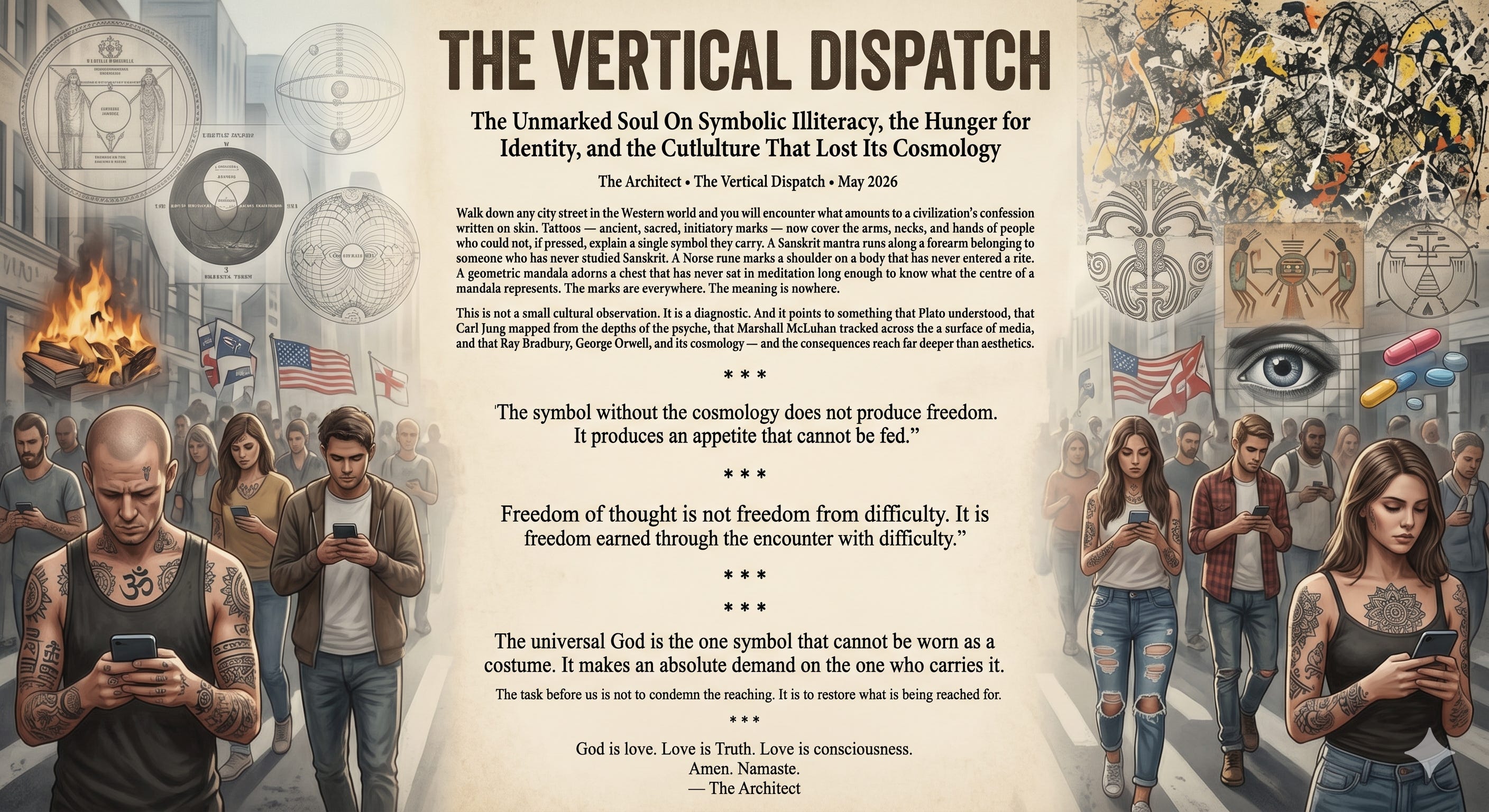
Walk down any city street in the Western world and you will encounter what amounts to a civilization’s confession written on skin. Tattoos — ancient, sacred, initiatory marks — now cover the arms, necks, and hands of people who could not, if pressed, explain a single symbol they carry. A Sanskrit mantra runs along a forearm belonging to someone who has never studied Sanskrit. A Norse rune marks a shoulder on a body that has never entered a rite. A geometric mandala adorns a chest that has never sat in meditation long enough to know what the centre of a mandala represents. The marks are everywhere. The meaning is nowhere.
This is not a small cultural observation. It is a diagnostic. And it points to something that Plato understood, that Carl Jung mapped from the depths of the psyche, that Marshall McLuhan tracked across the surface of media, and that Ray Bradbury, George Orwell, and Aldous Huxley each warned about in their own register. We are living inside a civilization that has severed the symbol from its cosmology — and the consequences reach far deeper than aesthetics.
Begin with Jung, because he gives us the mechanism. The psyche does not tolerate a vacuum. When the conscious mind is deprived of meaning — genuine meaning, rooted meaning, meaning that costs something to acquire — the unconscious does not go quiet. It intensifies. What cannot be integrated consciously is projected outward. Jung called this the shadow: the repository of everything unacknowledged, undeveloped, and unearned within the self. The shadow does not disappear in a secular age. It relocates. It finds its expression in the hunger for identity, for belonging, for a mark that says: I am someone. I am part of something larger than myself.
The tattoo needle, in this light, is performing a function that the initiation rite once performed — but without the initiation. The Maori warrior earned his tā moko through years of preparation, through tests of character, through transmission from elders who held the living tradition. The mark was the record of a passage. Today’s equivalent is chosen from a Pinterest board. The hunger is real. The cosmology behind the symbol is absent. And so the mark becomes a costume — sincere in its reaching, hollow in its grounding.
The torn jeans complete the picture from a different angle. Poverty aestheticized by those who have never known poverty. The 1930s produced torn clothing through necessity, through the grinding reality of the Depression, through the indignity of a society that had failed its people. That indignity was real. The people who wore it would not have called it fashion. They would have been ashamed — not because shame is always virtuous, but because they understood the difference between a wound and a costume. We have lost that understanding. We have made a style out of a scar that belongs to people who are no longer here to object.
The symbol without the cosmology does not produce freedom. It produces an appetite that cannot be fed.
Marshall McLuhan saw this coming, though the specific form might have surprised him. His concept of the Global Village was not a utopia of information flow. It was an observation about the nature of electronic media: that it retrieves the simultaneity, the depth, the participatory immersion of the tribal acoustic world. The village was not meant to be a metaphor for shallow connectivity. It was meant to describe the recovery of something ancient — a world where everyone is implicated in everything, where the medium shapes the soul as much as the message.
What we received instead was the village’s surface without its wisdom. Global connectivity delivered us symbols from every tradition on earth — Tibetan, Yoruba, Celtic, Hindu, Indigenous, Sufi — and placed them on the same screen, stripped of their initiation requirements, flattened into aesthetic objects available to anyone with a search bar and a credit card. McLuhan’s Global Village assumed that the retrieval of depth would accompany the retrieval of form. The internet retrieved the form and left the depth behind. We have the markings without the rite of passage. We have the world’s symbols without the world’s cosmologies. We are, in the most precise sense, symbolically illiterate in the most symbol-saturated moment in human history.
Plato understood all of this two and a half millennia before the first tattoo parlour opened on a Western high street. His argument in The Republic is routinely misread as censorship — as the authoritarian impulse of a philosopher who feared art. That reading is superficial. Plato’s actual concern was soul-formation. His claim was that a city has a soul just as an individual does, and that the health of the collective soul depends on what the culture places before its citizens — particularly its young. Art, for Plato, was not decoration. It was formation. It shaped character. It calibrated desire. It taught the soul what to love.
The question Plato was asking was not who gets to make art but what does art do to the person who encounters it? His answer: it forms them, whether we intend it to or not. Art rooted in wisdom, in beauty that points toward truth, in the kind of excellence that requires something to achieve — that art elevates. Art that mimics without wisdom, that amplifies appetite without orienting it, that flatters the ego rather than challenging it toward something greater — that art degrades. Not because of any external prohibition, but because of what it does to the interior life of the person who consumes it.
This is not censorship. This is cosmology. And it is precisely the cosmology our age has abandoned.
Three novels mapped the three failure modes of a culture that loses this understanding. Bradbury gave us Fahrenheit 451: the voluntary abdication of depth, a society that chose entertainment over encounter, spectacle over substance — not because anyone forced it to, but because depth is demanding and distraction is available. Orwell gave us 1984: the coerced abdication, the external machinery of power that makes thought dangerous and compliance mandatory. Huxley gave us Brave New World: perhaps the most accurate of the three — pleasure itself as the mechanism of abdication, a society so thoroughly satisfied at the surface that it never notices the depth has been removed.
We did not choose one of these futures. We received all three simultaneously. The voluntary distraction of Bradbury operates through every screen. The coercive narrowing of Orwell operates through the algorithmic architecture of what we are permitted to think and say. The hedonic saturation of Huxley operates through a consumption economy that has made comfort the highest value and difficulty the primary enemy. In such a world, the question — what did you have to pass through to arrive here? — the initiatory question, the question every wisdom tradition insists upon — has no institutional home. The answer is increasingly: nothing. And the symbols on the skin remain unearned.
Freedom of thought is not freedom from difficulty. It is freedom earned through the encounter with difficulty.
It would be convenient, at this point, to assign this failure to one side of the political ledger. Convenient — and false. The right wing in its current populist form is performing the identical gesture as the tattoo. It is reaching for symbols without the cosmology behind them. The flag, the cross, the founding documents, traditional values, national identity — these are not fraudulent symbols. They have genuine roots, genuine weight, genuine civilizational content. But in the hands of contemporary populism they have become costumes rather than commitments. The man who wraps himself in the flag but has never read the Federalist Papers. The politician who invokes the cross but whose conduct bears no relationship to the Sermon on the Mount. The nationalist who celebrates heritage but cannot name three things that heritage actually demanded of those who built it. This is symbolic illiteracy in a conservative register — and it is no less hollow for being draped in tradition.
The left has constructed its own parallel performance. Land acknowledgements recited without any living relationship to the people whose land was taken. Diversity statements that alter no material reality for anyone. The compulsive proliferation of identity categories as a substitute for the interior work of self-knowledge. Progressive symbols worn as tribal markings — which is, of course, precisely what they are. The mechanism is identical. The shadow projection is identical. The hunger driving it is identical. Only the wardrobe differs.
A society that has lost its cosmology does not produce coherent left or right. It produces tribalism — dressed in the symbols of tradition on one side, and the symbols of progress on the other.
Plato’s diagnosis lands on both with equal force. What both are reaching for — and neither is finding — is a grounded account of what a human being is, what a society is for, and what we owe each other across time. That account cannot be assembled from slogans, from flags, from land acknowledgements, from any of the symbolic currency currently in circulation. It requires exactly what every wisdom tradition has always required: the willingness to be formed, to pass through something difficult, to earn one’s position rather than inherit a costume. The political binary is not the disease. It is the symptom — the shadow war of two tribes, each performing an identity neither has paid the price to inhabit.
The philosopher Sir Roger Scruton spent the last decades of his life bearing witness to what this costs. In his documentary Why Beauty Matters and his book The Face of God, Scruton argued that the abandonment of beauty in modern art and architecture is not a matter of taste. It is a spiritual symptom. When a civilization stops reaching toward beauty as an objective quality — something real, something that points beyond itself toward a transcendent order — it does not become neutral. It begins producing ugliness not as accident but as ideology. The deliberately broken, the intentionally ugly, the programmatically transgressive — these are not freedom. They are the shadow of a tradition that has been discarded without being understood.
Scruton’s insight connects directly to Plato’s: beauty is not decoration. It is the sensory face of the good. When art is oriented toward beauty — genuine beauty, beauty that costs something to achieve and demands something from the one who encounters it — it performs a sacred function. It trains the soul to recognize what is real, what is true, what is worth loving. When art abandons that orientation, it does not liberate the soul. It disorients it. The soul that has lost its capacity to be addressed by beauty is a soul that has lost its compass. And a culture full of such souls produces exactly what we see: the hunger for meaning expressed through markings that carry no meaning, the reach for identity through symbols that have been emptied of their content.
And here we arrive at the deepest proposition of all — the one that underlies everything else in this diagnosis. If God exists, then by definition that God is a universal God. Not the god of a nation. Not the god of a confession. Not the god of a tribe, a flag, a political platform, or a preferred demographic. The Absolute, if it is truly absolute, belongs to no one and therefore to everyone — to all souls, in all times, across all of space. It is the ground of being itself, not a being among beings who has chosen sides.
This is the precise difference between religion as knowledge and religion as ideology. Religion as ideology makes God into the ultimate tribal symbol — the cosmic endorsement of our particular grievances, our particular history, our particular claim to the land or the throne or the moral high ground. This is the god the ego manufactures, and it is indistinguishable in its structure from every other costume in our catalogue: the tattoo without the cosmology, the flag without the constitution, the cross without the Sermon on the Mount. It is a symbol performing the function of meaning without carrying any.
Religion as knowledge — the tradition that runs from Plato’s Good through Shankara’s Brahman through Eckhart’s Godhead through every genuine mystical lineage on earth — points in precisely the opposite direction. It insists that the encounter with the Absolute dissolves the tribal self rather than inflating it. That genuine knowledge of the sacred is not a possession but a dispossession — the ego does not acquire God, it is relinquished into something it cannot contain. This is what Scruton meant by beauty: not aesthetic pleasure, but the encounter with something that exceeds you, that calls you toward a greatness you have not yet achieved. The quest for goodness, for beauty, for truth — these are not three quests. They are one, addressed to the same ground, requiring the same passage through the self.
The universal God is the one symbol that cannot be worn as a costume. It makes an absolute demand on the one who carries it.
This is the ground from which Artificially Intelligent Governance must emerge — not as a technical solution to a political problem, but as a civilizational response to a civilizational failure. AIG does not propose to prohibit bad art or mandate good symbols. That would be Plato’s censorship without Plato’s philosophy, which is merely tyranny. What AIG proposes is the restoration of the initiatory function at the level of governance itself: the insistence that freedom of thought is not the same as freedom from consequence, that expression without formation is not liberty but licence, that a society capable of self-governance requires citizens who have been genuinely formed — not merely informed, not merely entertained, but formed.
Consider Jackson Pollock. Born in Cody, Wyoming in 1912, he spent years under Thomas Hart Benton mastering classical composition and figure drawing — the full weight of the Western tradition absorbed through discipline and repetition. He then moved through the Surrealists, engaged deeply with Jungian analysis, studied the sand paintings of the Navajo, encountered the automatic gesture as a philosophical proposition rather than a technical shortcut. By the time Pollock stood over a canvas on the floor of his Long Island barn and released paint from a can, he knew exactly what tradition he was departing from and why. The gesture was earned. The freedom was purchased at the price of years of constraint. That is what separates Number 31 from a child imitating it on YouTube. Not talent. Not permission. Passage.
The Maori warrior earned his mark. Pollock earned his gesture. The question is not whether such earning should be legislated — it cannot be, and should not be. The question is whether we as a civilization are willing to recover the structures, the transmission lineages, the initiatory passages through which earning becomes possible. Whether we are willing to say that not everything placed on a canvas is art, not every mark on skin is symbol, not every opinion formed in thirty seconds of scrolling is a thought.
The loss of the sacred does not produce freedom. It produces an appetite that cannot be fed. The hunger for identity that drives the tattoo needle, the torn jeans, the tribal politics, the endless scrolling for something that feels real — that hunger is not pathological. It is entirely human. It is the soul reaching for what it knows it needs and finding, in the place where wisdom should stand, only a vast marketplace of imitations.
The task before us is not to condemn the reaching. It is to restore what is being reached for.
God is love. Love is Truth. Love is consciousness.
Amen. Namaste.
— The Architect#trending #socialmedia #digitalmarketing #hashtags #contentcreation #virality #reach #engagement #algorithms #discoverability #metadata #socialstrategy #branding #onlinepresence #visibility #growthhacking #marketingtips #tagging #searchability #influence #socialnetworking #onlinecommunity #trends #exposure #contentoptimization #digitalworld
Now I have to re-read The Republic too.
And yes, the loss of ritual, and earned trappings from a successful quest to better one’s self has been systematically stripped from our societies. I think it has been done deliberately to create more docile proles, to borrow Orwell’s term for the common man.
The quest before us then is how to re-establish the striving to become more than we are? In Japanese terms, which do you see as your path? The adventurer, testing themselves by increasingly difficult physical challenges, or the householder, testing themselves through meditation and koans?
I have always thought we needed some of both. Our bodies and spirits seem to demand action to bring us part way, and time to think about the action afterwards to grow from it.
Even the passage from the surety of childhood into the uncertainty of adulthood is being denied to the most recent generations. How many of the activities and rituals that the Baby Boomers held dear are still treated as such? From a man’s perspective, first crush. First call to a girl from the phone on the kitchen wall. First kiss. First heartbreak. First love.
Then there were the external tests. Getting your first job. Your driver’s license. Your first adult purchases like clothes, beer or flowers for a girl. Each time you took a step forward, you were more accepted as an adult. Each step brought you closer to who you are.
The push for homogeneity from the limited thinking of the big business ‘community’ has sought to eliminate it all to make better consumers, who look and act more like mushrooms. But that is by design.
The ugliness of modern life is almost unbearable. In my city, we have buildings that are in the neo-classical design from the early 1900’s. We also have some red granite facade with green tinted widow office towers. The architectural details on the older buildings are often porcelain plates mortared onto brick structure. Some are done in dressed stone, often quarried an hour away. The workmanship is exquisite: all the cuts are laser straight, the courses plumb and level, even after 120 years of harsh -30F winters and 100F summers. The builders poured their lives into these buildings. How many buildings put up in the last 50 years will be around in 50 years? How many in 120? There are cathedrals from the 1200’s in Europe, temples in Japan, China and India where the feet of people have worn the floor stones down by many inches.
One of the failings of North American public education has been the refusal to teach the history of the continent. From Clovis people, most likely descendants of European walrus hunters from the the Bay of Biscay who got caught on the North Atlantic Ice and shuffled to North America, to the first Nations peoples who emigrated here following the animal herds off the northern coast of Alaska, and down the West Coast by boat, to the contact between Columbus, Cartier, and Cabot, the Virginia colony, slavery, etc… It is messy, brutal and often bloody.
PS: I look forward to your next post. I am using braincells that have been dormant for a very long time and it is making life far more interesting. Thank you.