

On Tao Te Ching, Chapter Eleven
“Thirty spokes converge at a single hub; it is the emptiness at the center that makes the wheel useful. Clay is shaped into a vessel; it is the emptiness within that makes the vessel useful. Doors and windows are cut into a room; it is the emptiness there that makes the room useful. Therefore, benefit comes from what is there; usefulness comes from what is not there.” — Tao Te Ching, Chapter 11
— ★ —
Lao Tzu does not begin with an abstraction. He begins with a wheel.
A wheel that someone made with their hands, in a workshop, from wood. Thirty spokes, each one cut and fitted and driven into the hub with the precision that only a craftsman who has made many wheels possesses. It is a beautiful object. It is also, in the way that the most ordinary things are, a revelation.
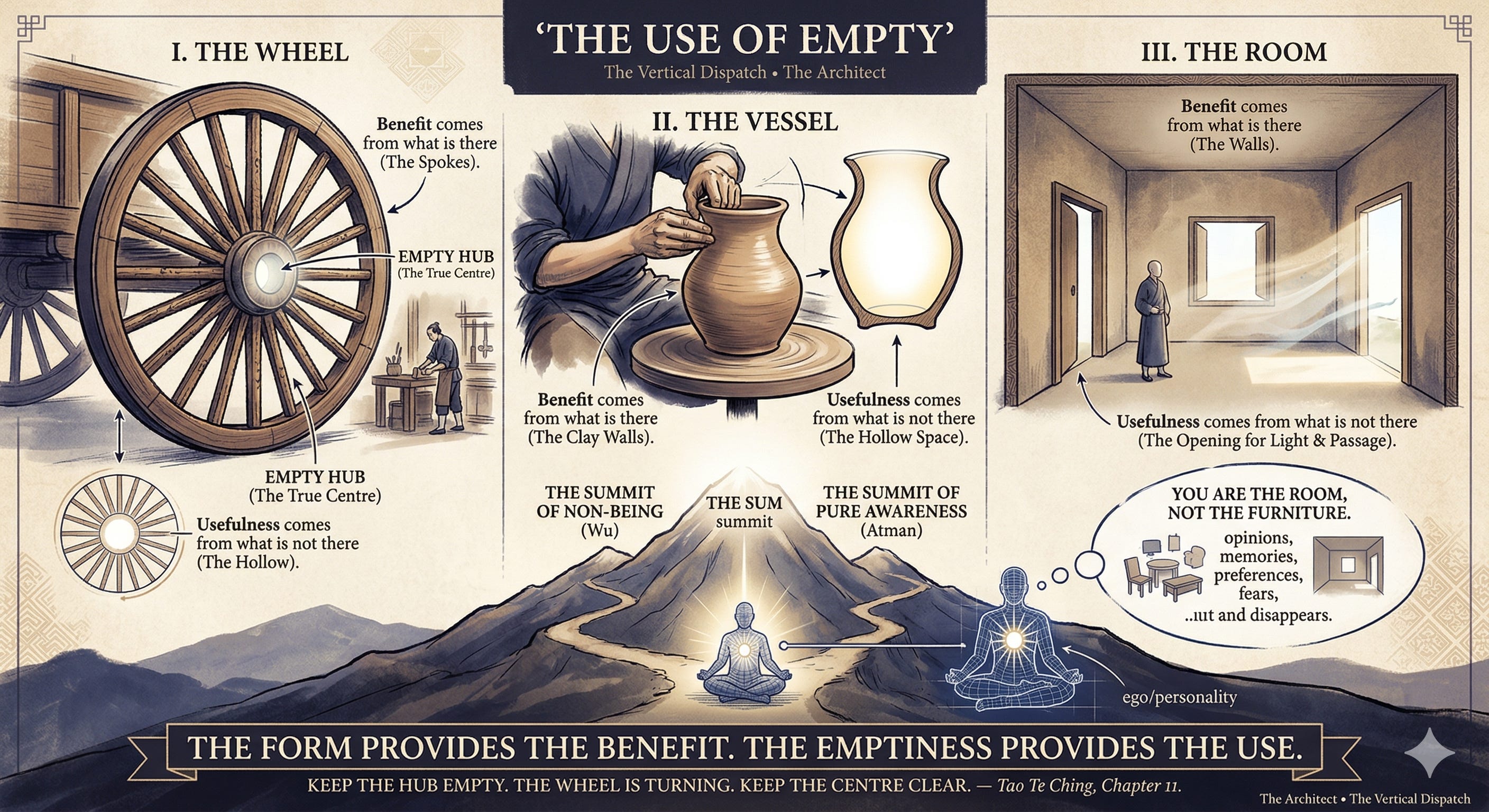
Look at where the spokes meet. Not at the spokes themselves — you have already seen those, you know what they are, you can measure and admire them. Look at what they converge upon. The hub. And at the centre of the hub: nothing. A hole. An absence. The thing the wheelwright did not put there, the space he preserved by not filling it, the emptiness around which every spoke is organised and from which the axle passes and on which the entire capacity of the wheel to turn depends.
Remove the spokes and you have no wheel. But fill the hub — pack it solid, make it continuous, leave no empty space at the centre — and you have something that cannot turn. It can sit. It can be admired. It cannot move, and therefore it cannot carry anything, and therefore for all its craftsmanship it is useless.
The wheel works because of what is not there.
— ★ —
He does not stop at the wheel. He takes you to a potter’s hands shaping clay on a wheel — a different wheel now, turning on that same principle of empty centre — and shows you the vessel forming. The walls rising, the clay thinning, the interior opening into the hollow that is the entire purpose of the object. A pot with no interior is a lump of fired clay. It cannot hold water, grain, oil, medicine, wine, or the ash of someone loved. The hollow is not the absence of the pot. The hollow is what the pot is for.
Then he takes you into a room. Four walls, a ceiling, a floor — all of it solid, all of it necessary, all of it carefully built. And cut into those walls: doors and windows. Openings. Places where the solidity stops and air and light and the people who will live there can pass through. Without the walls, no shelter. Without the openings in the walls, no room to live in — only a sealed box, which is not a room but a tomb.
Three images. One teaching. The form provides the benefit. The emptiness provides the use.
— ★ —
Now Lao Tzu stops. He has said what he came to say. He does not explain it further, does not labour the point, does not offer you a diagram of the principle or a programme for its application. He offers you the images and the single closing line and trusts that if you are the kind of person who reads such things, you will know what to do with them.
But let us stay here a moment longer, because the implications run deeper than a lesson in carpentry and pottery.
You are built on the same principle. Not as a metaphor. As a structural fact.
The ego — the personality, the accumulation of experience and preference and habit and history that you call yourself — is the spokes. It is real. It is necessary. It is the shaped thing that allows you to move through a world of other shaped things, to hold experience without being dissolved by it, to act with continuity and purpose across the days of a life. Do not mistake what follows for an instruction to dismantle it. The spokes are essential. Lao Tzu is not teaching you to remove the spokes.
He is teaching you to keep the hub empty.
The ego that has forgotten this — and it forgets easily, it forgets constantly, this is not a moral failing but simply its nature — will try to fill the centre. It will pack the hub with identity, with continuity, with the ongoing project of being a solid and permanent self. And as it does, the wheel begins to labour. The movement that was effortless becomes effortful. The carrying that was natural becomes a burden. Not because you have become weaker. Because you have filled the very space that made movement possible.
— ★ —
The tradition that produced Lao Tzu called this space wu — non-being, emptiness, the unmanifest ground from which all manifest things arise and to which they return. It is not a void in the sense of nothing. It is a void in the sense of everything that has not yet taken form. The silence before the word that makes the word possible. The stillness before the movement that makes the movement real.
Eight thousand miles away and two centuries later, a young philosopher in India named Shankara sat with the Bhagavad Gita and arrived at the same place by a different road. He called it the Atman — the witnessing Self, the pure awareness that underlies all the contents of experience without being any of them. The Self is not the thoughts. It is what knows the thoughts. It is not the emotions. It is what knows the emotions. It is the hub, always empty, always present, around which the entire turning of a life is organised.
Two traditions, two languages, two mountains. The same silence at the summit.
— ★ —
There is a sentence in the original piece that was written before this one that deserves to survive the rewriting: you are the room, not the furniture.
It is worth sitting with. The furniture — your opinions, your memories, your preferences, your wounds, your achievements, your fears, your plans — all of it is real. All of it has its place. None of it is you. You are the space in which all of it appears. The room does not become the furniture when the furniture is moved in. The room does not empty itself when the furniture is moved out. The room remains what it was before the first chair arrived and will remain what it is after the last one is gone.
This is what Lao Tzu is pointing at when he cuts the window. The window is not an absence of wall. The window is an opening that allows the room to be inhabited. Every moment in which you recognise the space you are rather than the contents you hold is a window cut in the wall. Light comes through. Air moves. Something that was sealed becomes liveable.
— ★ —
The last line of Chapter Eleven is the most compressed philosophical statement in the entire Tao Te Ching. Benefit comes from what is there. Usefulness comes from what is not there.
Read it in one direction and it is a statement about wheels and pots and rooms. Read it in the other direction and it is a statement about you. Your form — your body, your mind, your history, your capabilities — provides benefit. It navigates, builds, loves, works, creates. But the usefulness — the deep capacity to serve life without being consumed by it, to act without hardening, to be present without being imprisoned by presence — that comes from the emptiness you are willing to preserve at the centre.
The sage in the Taoist tradition is not a person who has become less. The sage is a person who has stopped filling the hub. The wheel still turns. The spokes are still there, doing their work. But at the centre there is nothing — and because there is nothing at the centre, everything can move through.
— ★ —
Lao Tzu does not tell you what to do with this. Neither will I.
But somewhere in your day today there will be a moment when you feel the hub filling — when identity is asserting itself, when the need to be seen or right or continuous is packing itself into the centre of the wheel. You will recognise it by the friction. The slight heaviness. The sense that what should be effortless has begun to cost something.
In that moment, you do not need to do anything. You only need to notice. The noticing itself is the empty hub. The awareness that watches the filling is the space that was never full. You are already the room. You have always been the room.
The wheel is turning. Keep the centre clear.
— ★ —
Glennford Ellison Roberts Author — Sacred Metaphysics & Consciousness: History of the Absolute & Eternal Cumberland, Ontario, Canada
God is Love. Love is Truth. Truth is Consciousness. Consciousness is Brahman.
Amen. Namaste.. 🙏
The Architect • The Vertical Dispatch
#TaoTeChing #LaoTzu #ChapterEleven #WuWei #Emptiness #TheUseOfEmpty #Taoism #EasternPhilosophy #AncientWisdom #Consciousness #SpiritualAwakening #NonDuality #Advaita #TheWay #Ego #Presence #Mindfulness #SpiritualSeeker #WisdomTraditions #TheVerticalDispatch #TheArchitect