


Φ
THE VERTICAL DISPATCH
We write for the mind, the eye, and the ear.
Read it. Look at it. Listen to it. The Vertical Dispatch is built for all three — prose with rhythm, made to be heard as much as read.
From metaphysics to geopolitics, from culture to history, from the sacred to the street — and everything in between. One lens, every subject. No ego. Just the record, named clean.
Press play. Walk with the word. 🕯️
This dispatch travels by hand. If it serves you, share it — restack on Substack, and pass it on wherever you read. 🕯️
The Price of Everything · A Vertical Dispatch Feature · Part Two of Seven
June 23, 2026
Yesterday we asked what a thing is worth. Today we ask what the measure is — and find it has no floor.
Say the word money and, for most of a certain generation and a good many since, a sound arrives before any thought does: a cash register, a coin drawer, the chime and clatter of a till, looped into a rhythm. Pink Floyd built a song on that sound more than fifty years ago, on one of the best-selling records ever pressed, and it has played on every radio and every streaming service in the decades since. It is, very likely, the first thing the culture hands you when you reach for the idea of money. A song about the thing everyone chases and no one can quite hold.
And here is what is strange about the most famous song ever written about money: it never once asks what money is. It does not have to. Neither do we. We move the stuff around all day, earn it and owe it and worry about it, and almost never stop on the simplest question of all — the one a child would ask and an economist would change the subject to avoid. What is it? Not where do I get more of it. What is the thing itself? This is the second part of a feature that began, yesterday, with the human being and the worth that has a body. Today we follow the thread up out of the field and the loom and into the bank, and we ask what the measure became once it came loose from the life it was built to serve.
The most famous song ever written about money never once asks what money is. Neither, most days, do we.
The Phrase That Dissolves
There is a phrase you have heard a thousand times, from finance ministers and central bankers and the financial pages, so worn with use that it passes the ear without resistance: the goal is to protect the value of money. It sounds unimpeachable. Who could be against protecting value? But hold the phrase still for a moment and look at it, the way we looked yesterday at the love of money, and watch it begin to come apart in your hand.
Protect the value of money — in terms of what? Value is never a property a thing has by itself; it is always a relation, a thing measured against another thing. A dollar is worth what it can be exchanged for. So to say the dollar’s value is protected, or eroded, you need a second thing to hold it against — and the moment you ask what that second thing is, the floor opens. The dollar is not protected against gold; we left that behind generations ago, and the value of our money is, in the Bank of Canada’s own words, not fixed to any other currency or to any precious metal. It is not protected against an hour of human labour, the measure Thoreau gave us yesterday. It is protected against a basket.
That is the technical truth, and it is worth saying plainly because almost no one does. The value of your money is measured against a basket of goods and services — the Consumer Price Index — described by the Bank itself as a fixed basket of goods and services purchased by consumers. Someone chooses what goes in the basket. Someone weights how much each item counts. Someone updates it as habits change. The basket is not a rock of fixed reality against which the dollar is honestly measured. It is a construct, assembled and revised by the same institutions doing the measuring. Which means that protect the value of money resolves, when you chase it all the way down, to protect the dollar’s exchange rate against a statistical artifact that a committee builds. The referent of the phrase is not a thing in the world. It is another symbol. We have, once again, mistaken the map for the territory — only this time the map is the only territory there is.
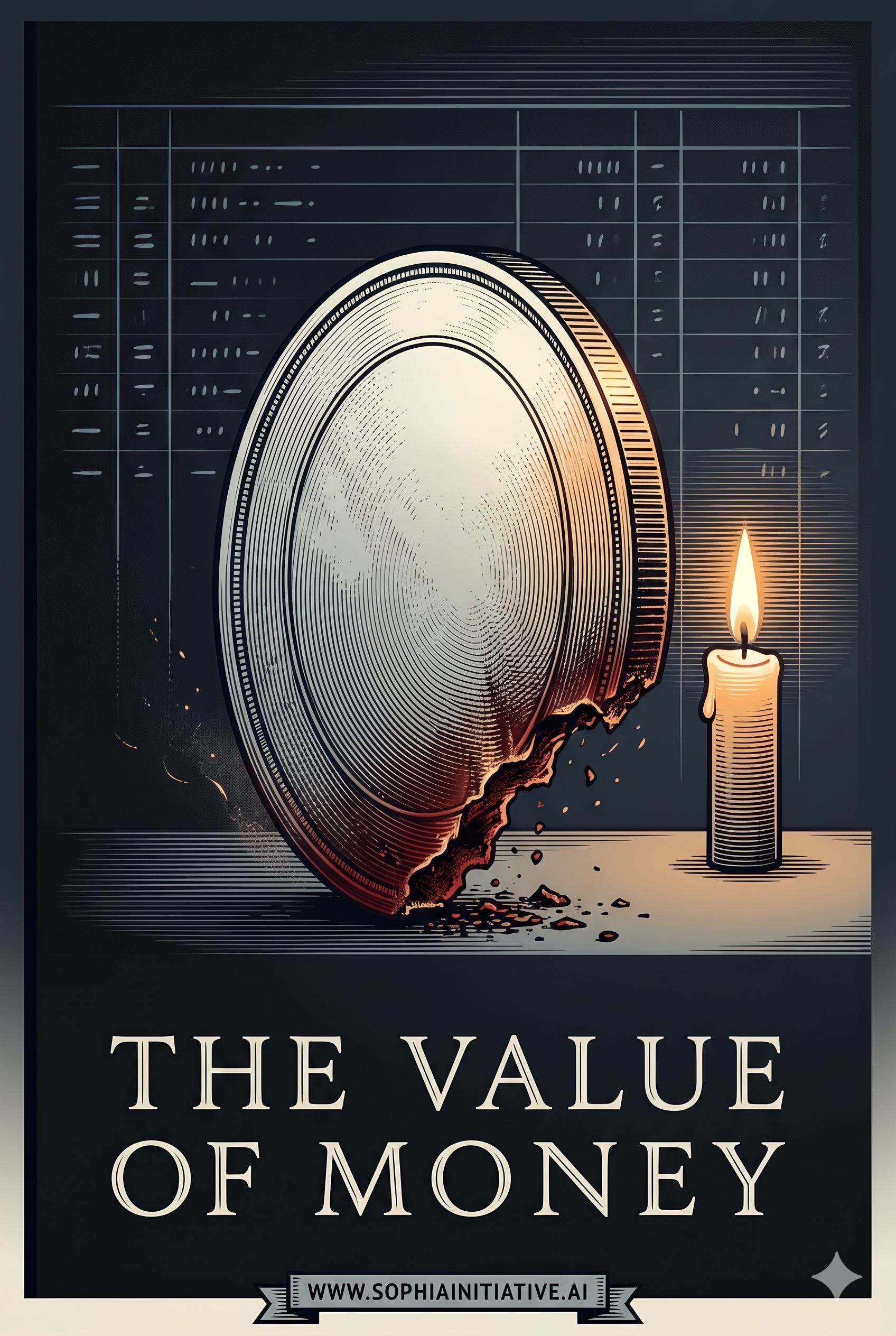
The value of your money is measured against a basket someone assembles and weights. The referent is not a rock. It is another symbol.
The Guardian and the Controlled Burn
Now the part that turns the whole phrase inside out, and again it is not a secret — it is published, openly, on the Bank of Canada’s own pages, for anyone who cares to read past the headline. The mandate is not, in fact, to protect the value of money. The mandate is to manage its decline at a chosen, steady rate.
The target, set jointly by the Bank of Canada and the federal government and renewed every five years, is two per cent inflation — the midpoint of a one-to-three-per-cent band, expressed as the year-over-year rise in that basket. Read what that means without flinching. The official, agreed, deliberate goal is for your money to lose value — just slowly, and predictably. The Bank says so itself, in plain words on its explainer pages: prices go up a little bit each year. They are not protecting the dollar’s worth. They are administering its erosion at a managed pace. Protect the value of money is the phrase on the door. Engineer a steady two-per-cent annual decline is the work being done inside. Those are not the same sentence. One is a guardian standing watch over a treasure. The other is a controlled burn, set on purpose, kept to a planned acreage. And a citizen who was told only the first has not been lied to, exactly — but has not been told the thing that matters most about the money in their pocket: that it is designed to be worth a little less every year, by agreement, on purpose.
And here is the fact that turns a national curiosity into something larger, because it is the same in almost every developed country on earth. The two-per-cent target is not a Canadian eccentricity. It is the settled consensus of the entire Western central-banking order. New Zealand pioneered the formal target; Canada adopted two per cent as its midpoint in 1991, the Bank of England in 1992, the European Central Bank defined price stability as “below, but close to, two per cent” in 1998, the United States Federal Reserve adopted the identical two per cent in 2012, and the Bank of Japan in 2013. By the Bank of England’s own count there were twenty-seven full inflation-targeting central banks by 2012. The measures differ slightly — Canada and Britain hold their dollar against a consumer-price basket, the Americans against a different index, the Europeans against a third — but the number is the same everywhere: two per cent, every year, by design. When institutions that do not answer to one another, on four continents, independently settle on the very same figure for the planned decline of their currencies, you are no longer looking at one country’s policy. You are looking at the architecture of the modern monetary world. “Price stability,” across that entire architecture, has come to mean prices that rise forever, on purpose, at a pace someone chose.
Where the Dollar Actually Comes From
If the value of money is stranger than we are told, its origin is stranger still — and here, for once, we do not have to rely on a dissident or a documentary, because the most orthodox institution imaginable has put it in writing. In 2014, the Bank of England published a paper in its Quarterly Bulletin titled, with no drama at all, “Money creation in the modern economy.” It is not a pamphlet from the fringe. It is the central bank, explaining itself.
And what it says overturns the picture nearly all of us carry. Most people believe banks are intermediaries — that they take in the deposits of savers and lend that existing money out to borrowers, passing a fixed pool of money from the thrifty to the needy. The Bank of England states, flatly, that this is a misconception. The reality is the reverse. The great majority of money in a modern economy is created by commercial banks, in the act of making loans. When a bank grants you a loan, it does not hand you someone else’s deposited savings. It writes a new deposit into your account — money that did not exist the moment before. The loan creates the deposit. New money is brought into being, by a keystroke, in the act of lending. Most of the money in circulation, the Bank says, is created this way — not printed by the central bank, but conjured by commercial banks when they lend.
Sit with that, because it is the floor under everything. The money in your account is, for the most part, not a stock of value someone saved and stored. It is a debt — someone’s promise to repay, recorded as your asset. Money, in the modern economy, is very largely created as debt, and extinguished when the debt is repaid. This is not a conspiracy theory. It is the considered, published position of the Bank of England, confirming what a long line of monetary economists had argued and been dismissed for arguing. The thing in your wallet and your account is a promise, born of lending, whose quantity is governed by how much borrowing the system encourages — and whose value is then managed, downward, at two per cent a year, against a basket a committee assembles.
The loan creates the deposit. Money is very largely born as debt — not the Bank’s pamphleteer saying so, but the Bank of England itself.
The Culture’s Dream-Life
A truth this large and this hidden does not stay only in the journals. It leaks into the culture as anxiety, and the culture does with anxiety what it always does — it makes stories. Two of them are worth naming, because they show the two ways a real fear gets handled: honestly, and dangerously.
The honest way is fiction that knows it is fiction. The 2009 thriller The International, with Clive Owen, built its plot on a bank that sought not profit but control of debt — because, the film argued, to own the debt of nations is to own the nations. It is a screenwriter’s drama, and it never pretends otherwise. But it crystallized a real intuition into a shape an audience could feel: that the deepest power is not the having of money but the holding of others’ obligations. Fiction earning its keep — naming a fear the spreadsheet cannot, and signing it honestly as a story.
The dangerous way is the specimen, and it is worth dissecting precisely because it failed. More than a decade ago an internet film called Zeitgeist carried, among other claims, a version of the very truth the Bank of England would later confirm — that money is created as debt. But it wrapped that real insight in a tissue of conspiracy, fabrication, and unfalsifiable grand design, until the whole package collapsed under its own overreach and was discredited. And here is the cost of that failure, the reason it is a cautionary specimen and not a source: by binding a true thing to a false frame, it made the true thing harder to say. For years, to mention that money is created as debt was to be filed with the cranks, because a film had poisoned the well. This is the exact operation this publication has named before, in another register — a real fact fitted to a false frame until the fact itself becomes unspeakable in serious company. The lesson is not that the insight was wrong. The Bank of England vindicated the insight. The lesson is that a truth bound to a lie is dragged down with the lie — which is why we take our floor from the central bank’s own bulletin, and treat the film only as the wreck that marks the reef.
The Case for the Burn, at Full Strength
Now the other side, at full strength, because the keel of this work is to put the strongest version of the opposing case before any verdict — and the case for the system as it is, is serious, and the people who hold it are not fools or villains.
Start with the managed decline, the two-per-cent burn, which sounds sinister until you ask what the alternatives actually are. Why would anyone want money to lose value on purpose? Because the opposite — money that gains value, prices that fall year over year — is the genuine economic nightmare, and it has a name: deflation. When money is worth more tomorrow than today, people stop spending and stop investing, because waiting is rewarded; the economy seizes; debts grow heavier in real terms as the money to repay them gets dearer; and the seizure feeds itself in a downward spiral that has, historically, meant mass unemployment and ruin. The Bank of Canada says exactly this, in its own defence: that setting the target near zero would court deflation, and that a small, steady, predictable rise lets the economy work — lets wages adjust without employers having to cut them outright, lets prices move, and keeps a margin of daylight above zero so the Bank has room to cut rates in a crisis. The two-per-cent burn, on this account, is not a theft. It is the grease that keeps the machine from seizing, and the lesser of the available devils. And the strength of this defence is precisely that it is not one bank’s rationalization but the unanimous reasoning of the whole order: every major central bank that adopted the two per cent gives the same account, that a small positive target is the shortest safe distance from the deflationary cliff. When the entire profession agrees on the why, the honest reader must take the why seriously.
And the creation of money as debt, unsettling as it sounds, has its own serious defence. A money supply that can expand as the economy grows — that is not chained to however much gold happens to sit in a vault — is what lets a society build the factory before the savings exist to pay for it, lets the young family buy the house and pay for it over the working life it will shelter, lets enterprise run ahead of accumulated wealth. Debt-created money is, on this view, not a trick but an engine: the mechanism by which a civilization borrows from its own future to build the thing that makes the future richer. Tie money rigidly to a metal and you get not honesty but strangulation — the recurring brutal contractions of the gold-standard era, when the money could not grow to meet the work that wanted doing. The system we have, for all its strangeness, was built by people trying to solve real catastrophes, and it solved many of them.
That case deserves to stand without a rushed rebuttal, because it is largely true. The managed decline has reasons. The debt-creation has reasons. The people who run the system are, in the main, serious stewards of a genuinely hard problem, and the alternatives they rejected were not utopias but disasters they had lived through or studied. To pretend otherwise would be to commit this feature’s own cardinal sin and let an indignation outrun its referent.
Deflation is the real nightmare. The two-per-cent burn is the grease that keeps the machine from seizing. The defence is real.
The Question Under the Phrase
So hold both, because holding both is the discipline. The system is strange and the system is defensible. Money is created as debt, and that is an engine as much as a chain. Its value is managed downward by design, and that managed decline may genuinely be the lesser devil. None of the strangeness, by itself, is a scandal. A reader who finishes this thinking the banks are simply robbing them has missed the argument as badly as one who finishes thinking the phrase protect the value of money was ever literally true.
But notice what the strongest defence quietly never claims. It never claims that protect the value of money is an accurate description of the thing. It claims the managed decline is wise, the debt-creation necessary — not that the phrase on the door matches the work inside. And that gap, between the reassuring phrase and the actual design, is the whole of what this dispatch asks you to see. Not that money is evil. Not that the system is a conspiracy. But that the language we are given about money is built to soothe rather than to inform — that protect the value names the opposite of the policy, that the basket is presented as a fixed measure when it is an assembled one, that the deepest fact about your money, that it is born as someone’s debt, is the one fact least often said out loud.
Which leaves one question, and it is the only one that finally matters, and we hand it to you rather than answer it. A system this strange and this consequential is going to be managed by someone. The money will be created, its decline administered, the basket assembled, whether you understand it or not. So the question is not whether to have such a system — we have one, and the alternatives have their own graves. The question is who the managers answer to. Whether the people who set the burn and assemble the basket and govern the lending are accountable, finally, to the citizen whose life is measured in that money — or only to themselves, and to the holders of the debt that money is made of. That is not a question about economics. It is a question about power, and about whether the measure serves the life or the life serves the measure. Tomorrow we will meet the thinkers who tried to answer it, and the catastrophes done in their names. For now, hold the question where the phrase used to be. Walk with the word. 🕯️
God is Love. Love is Truth. Truth is Consciousness. Consciousness is Brahman.
Amen. Namaste. Om Namah Shivaya.
— The Architect
For everyone who was handed the phrase and never told what it covered.
The Vertical Dispatch
sophiainitiative.ai
On the record
Pink Floyd. “Money” (1973), from The Dark Side of the Moon, one of the best-selling albums in history, opens on a looped cash-register/coin motif. The song is described here, not quoted; no lyrics are reproduced (copyright).
The basket / CPI. The Bank of Canada measures the inflation target against total CPI, defined on its own pages as “a fixed basket of goods and services purchased by consumers,” and states the value of the dollar is not fixed to any currency or precious metal (bankofcanada.ca). The composition and weighting of the CPI basket are set and periodically revised (Statistics Canada).
The 2% target. Canada’s inflation-control target is the 2% midpoint of a 1–3% range, set jointly by the Bank of Canada and the federal government, adopted 1991, renewed every five years (most recently to end-2026), expressed as the year-over-year change in total CPI. The Bank states openly that “prices go up a little bit each year,” that the target avoids deflation, and that a below-2% target would raise deflation risk (bankofcanada.ca, “Why we target 2% inflation” and “Understanding inflation targeting”).
The 2% as global consensus. The 2% target is shared across the major developed-economy central banks: New Zealand (pioneer), Bank of Canada (1991, CPI), Bank of England (1992, CPI), European Central Bank (price stability defined 1998 as “below, but close to, 2%,” HICP), U.S. Federal Reserve (Jan. 2012, PCE), Bank of Japan (Jan. 2013). The BoE’s Centre for Central Banking Studies counted 27 full inflation-targeters by 2012. Sources: ECB Governing Council statements (ecb.europa.eu); Federal Reserve Statement on Longer-Run Goals (federalreserve.gov); historical adoption dates per central-bank records and standard reference summaries. All cite the same deflation-avoidance rationale. Date-stamped June 2026; as of mid-2026 several of these banks were running ABOVE target amid the Middle East energy shock — verify current figures before republication.
Money creation. “Money creation in the modern economy,” Bank of England Quarterly Bulletin 2014 Q1 (McLeay, Radia, Thomas), states that the majority of money in the modern economy is created by commercial banks making loans; banks do not simply lend out savers’ deposits, and a loan creates a new deposit. Verified against the Bank of England’s published bulletin.
The films. The International (2009, dir. Tom Tykwer; Clive Owen) is cited as fiction. “Zeitgeist” (2007, online film) is referenced only as a cautionary specimen of a real insight (debt-money) bound to discredited conspiracy claims; it is NOT a source, and the debt-money insight here rests solely on the Bank of England bulletin above.
Standing note. All characterizations — “the controlled burn,” “the phrase that dissolves,” the reading of “protect the value of money” as the inverse of the policy — are the author’s interpretation and commentary, clearly distinguished from the sourced facts. The case for the system (deflation risk; debt-money as growth engine) is stated at full strength. Accountability is directed at structures and language, never at any individual. Economic facts are current as of June 2026; verify against primary sources before republication.
Suggested tags
money, inflation, the value of money, money creation, debt, central banking, Bank of England, Bank of Canada, CPI, The Price of Everything
Substack Notes
Say “money” and a cash register rings — Pink Floyd built the most famous song about it on that sound. And the most famous song about money never once asks what money is. Neither, most days, do we. Part Two of The Price of Everything follows the thread up out of the field and into the bank, and asks the child’s question the economist changes the subject to avoid: what is the thing itself?
“Protect the value of money” is a phrase that dissolves when you hold it still. Value against what? Not gold, not an hour of labour — against a basket of goods a committee assembles and weights. The referent is another symbol. And the mandate isn’t even to protect the value: it’s a 2% inflation target — the deliberate, published goal that your money lose a little value every year. Not a guardian over a treasure. A controlled burn, set on purpose. And it’s not just Canada: the same 2% is the settled consensus of nearly every major central bank — the U.S. Fed, the ECB, the Bank of England, the Bank of Japan — all on the identical number, by design. That’s not one country’s policy. It’s the architecture of the modern monetary world.
Where does the dollar come from? Not from the printing press, and not from savers’ deposits lent out. The Bank of England’s own 2014 paper says it plainly: most money is created by commercial banks in the act of lending. The loan creates the deposit. Money is very largely born as debt — the central bank itself saying so. We take our floor from the Bank’s bulletin, not from any film — and we name why the conspiracy version (Zeitgeist) poisoned the well by binding a real insight to a false frame.
Then the other side at full strength, because that’s the keel: deflation is the real nightmare, the 2% burn is the grease that keeps the machine from seizing, and debt-created money is an engine that lets a society build before it has saved. The system is strange AND defensible. The scandal isn’t that money exists or that it’s made of debt. It’s that the language is built to soothe rather than inform — and the only question that finally matters is who the managers answer to: the citizen, or themselves. Walk with the word. 🕯️
Written from love, in service of the record. Walk with the word. 🕯️
#ThePriceOfEverything #TheValueOfMoney #MoneyCreation #Inflation #CentralBanking #BankOfEngland #BankOfCanada #Debt #TheVerticalDispatch #TheArchitect #SophiaInitiative #GodIsLove #LoveIsTruth #OmNamahShivaya
The factual matter in this Dispatch is drawn from the public record. All characterizations, inferences, and conclusions are opinion, interpretation, and commentary, offered for analysis, reflection, and public-interest discussion. No assertion is made regarding the private intentions, state of mind, or character of any individual. Readers should evaluate all statements independently and draw their own conclusions.
Dougald Lamont has written extensively about the creation of money as well.
In the 70's, governments (Canada and other countries) has decided to not issue debts purchased by BoC (same with other central banks as it was since WWII) but to issue debts financed by private sector, under recommendation of Basel committee. So, since then, Canada has been carrying on real interest payments in the federal budget to private sector and no more to it's central bank.
Such a scheme had been in use after WWII to finance large infrastructure projects (such as TransCanada highway, ports, military infrastructure,...) at no cost since interest payments paid to BoC would come back as revenues for the fed govt since it owned 100% of BoC. So issuing debt purchased by BoC (instead of private sector financing) doesn't induce deficits on the fed budget (interest payments = dividends from BoC); on the contrary interest payments to private investors has to be added to the fed budget (and decreasing amount of $$$ available for social services, infrastructure development,...)
So, at this time, since Mark Carney wishes to invest heavily in national infrastructures, increase funding for the army, housing development,... , instead of issuing debt purchased by private sector, would it be advisable to have such debts financed by BoC while still maintaining inflation within acceptable boundaries?